Think of it as Yoga for the brain, we are going to stretch a bit.
The Forgotten Nuclear History of South Florida
Nike Hercules, the Cuban Missile Crisis, and the Nuclear Missiles Hidden in Our Backyard
Most people who think about South Florida and the Cuban Missile Crisis picture Soviet missiles in Cuba pointed toward the United States.
But there is another side of that story that is rarely discussed.
The United States had nuclear missiles in South Florida too.
Not strategic ICBMs buried in giant silos.
These were Nike Hercules surface-to-air missiles, positioned around Miami, Homestead, the Everglades and the Florida Keys. Some carried nuclear warheads. And although their primary mission was to destroy attacking aircraft, the Nike Hercules also possessed a surface-to-surface capability that could strike targets inside Cuba.
For nearly two decades, South Florida was not merely close to the Cold War.
South Florida was part of the nuclear battlefield.
October 1962 — Suddenly Florida Was the Front Line
Before the Cuban Missile Crisis, American air-defense planners concentrated primarily on an attack coming from the Soviet Union across the Arctic.
Then, on October 14, 1962, a U-2 reconnaissance aircraft photographed Soviet missile installations being constructed in Cuba.
The geography of American defense changed almost overnight.
Cuba was only about 160 miles from South Florida, and Soviet aircraft, missiles and potentially nuclear weapons were suddenly operating immediately south of the United States.
The National Park Service describes South Florida as the nation’s “Achilles heel” exposed by the Cuban Missile Crisis.
The United States responded rapidly.
In late October 1962, the Army’s 2nd Missile Battalion, 52nd Air Defense Artillery was ordered south from Fort Bliss, Texas. Batteries of Nike Hercules missiles were hurriedly deployed into South Florida while the confrontation with the Soviet Union was still unfolding.
Initially, some of the soldiers lived in tents and operated sophisticated missile equipment from muddy fields.
Eventually permanent installations were constructed.
Four Nike Hercules Bases
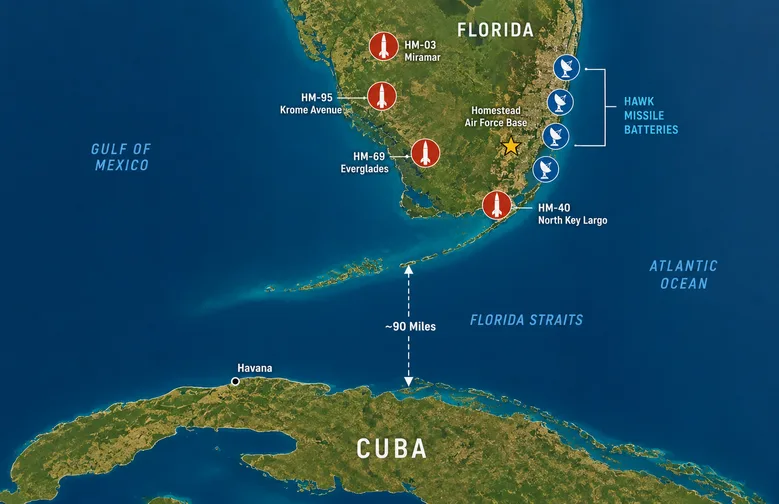
The Army ultimately operated four major Nike Hercules installations in South Florida.
They were located in or near: Miramar
The western Miami/Krome Avenue area
North Key Largo
Everglades National Park near Homestead
The National Park Service identifies these four installations and notes that the former Miramar site later became commercial development, while another became associated with what is now the Krome detention complex.
They formed part of a much larger defensive network.
The Nike Hercules batteries were integrated with eight Hawk missile batteries stretching from North Miami toward Key West, giving South Florida defenses the ability to engage aircraft at different altitudes.
Miami had effectively become surrounded by guided missiles.
And some of those missiles carried nuclear weapons.
The Missile
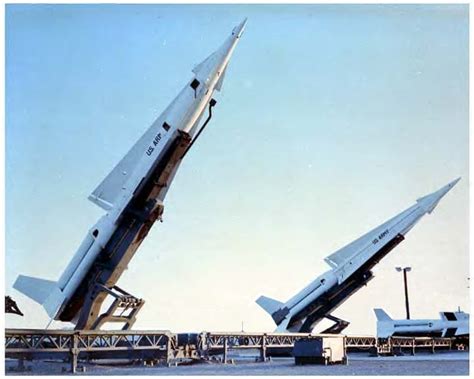
The MIM-14 Nike Hercules was enormous by modern air-defense standards.
It stood approximately: 41 feet tall weighed more than 10,000 pounds could reach speeds around Mach 3.6 and had a range exceeding 75 miles in its primary air-defense role.
It was guided by powerful ground-based radar and computers that simultaneously tracked the target and the missile.
But the most important characteristic was its warhead. The Hercules could carry either:
a conventional high-explosive fragmentation warhead or a nuclear warhead.
And these were not merely missiles that theoretically could carry nuclear weapons.
Nuclear-armed Hercules missiles were actually deployed.
Nuclear Weapons in the Everglades
Imagine driving toward the Everglades during the 1960s. Beyond the farms, mosquitoes, alligators and sawgrass stood an American nuclear missile installation.
At what became HM-69 inside Everglades National Park, Army crews kept 41-foot Nike Hercules missiles in a constant state of readiness.
The National Park Service states explicitly: Some of those missiles were fitted with nuclear warheads.
The largest warheads deployed there were rated at approximately 40 kilotons—roughly three times the explosive power of the Hiroshima bomb.
Today visitors can walk through portions of HM-69. The missile barns remain. The berms remain. The launch infrastructure remains. There is even an actual Nike Hercules missile preserved there. Its nuclear warhead, fortunately, is gone.
But during the Cold War, this quiet section of the Everglades was an operational nuclear weapons installation.
Why Put a Nuclear Bomb on an Anti-Aircraft Missile?
At first that sounds insane.
Why would anyone use a nuclear weapon to shoot down an airplane?
Because American planners weren’t expecting one airplane.
They feared formations of Soviet nuclear bombers penetrating American airspace together.
A conventional missile might destroy one aircraft.
A nuclear Hercules could explode in the middle of the formation.
The tremendous blast, thermal effects and radiation could potentially destroy several bombers simultaneously.
The Hercules was developed in part because the earlier Nike Ajax system was considered inadequate against a massive Soviet bomber attack. The Army therefore designed Hercules from the beginning around the possibility of carrying a nuclear warhead.
That made the Hercules one of the strangest weapons of the nuclear age:
a nuclear weapon designed primarily to destroy other nuclear weapons before they reached American cities.
But Hercules Had Another Trick
Here is the part of the South Florida story that is even less widely remembered.
Nike Hercules wasn’t limited strictly to shooting upward.
The system had a surface-to-surface capability.
In other words:
It could attack targets on the ground.
Instead of guiding the missile toward an airplane, the fire-control system could direct it toward coordinates on the Earth’s surface.
And because South Florida sits so close to Cuba, that capability had extraordinary implications.
The National Park Service states explicitly that although the South Florida Nike batteries were intended to protect the Miami metropolitan area:
a Nike Hercules based in South Florida was capable of striking a ground target on mainland Cuba.
Think about what that means.
A weapon usually remembered as an American defensive anti-aircraft missile could potentially become a short-range nuclear ground-strike weapon against Cuba.
The same missile.
The same warhead.
A different target.
South Florida Had a Nuclear Sword as Well as a Shield
That changes the way we should think about these installations.
They were unquestionably built primarily for defense.
Their principal job was protecting South Florida from Soviet or Cuban aircraft.
But technologically, the Hercules represented both a shield and a sword.
Point it toward the sky and it was an interceptor.
Give the guidance system ground coordinates and it could become a surface-to-surface weapon.
Put a W31 nuclear warhead on it and the implications were obvious.
During one of the most dangerous periods of the Cold War, the United States possessed nuclear-capable missiles in Florida that were within striking distance of Cuba.
And One South Florida Battery Had Already Fired a Nuclear Hercules
There is another remarkable connection.
When three batteries of the 2nd Missile Battalion were rushed from Fort Bliss toward Florida during the Cuban Missile Crisis, B Battery wasn’t initially with them.
B Battery was thousands of miles away.
Its soldiers were at Johnston Island in the Pacific, participating in Operation Dominic.
And what were they doing?
Testing Nike Hercules missiles with nuclear warheads.
On November 4, 1962, only days after the most dangerous phase of the Cuban Missile Crisis, a Nike Hercules was launched during a test known as TIGHTROPE.
A live W31 nuclear warhead aboard the missile detonated approximately 21 kilometers above Johnston Atoll.
It was a real Hercules.
A real nuclear warhead.
A real nuclear detonation.
B Battery subsequently returned and became part of the South Florida defense network, ultimately operating from North Key Largo as HM-40 until 1979.
So some of the soldiers manning Florida’s missiles hadn’t merely trained with nuclear-capable Hercules missiles.
They had participated in an actual nuclear Hercules test.
The Cold War Came to Key Largo
B Battery’s permanent installation was constructed in the tropical hardwood hammock of North Key Largo.
Imagine that combination:
Crocodiles.
Mangroves.
Tropical forest.
Tourists driving toward the Keys.
And a United States Army nuclear-capable missile battery.
The Key Largo installation remained operational until 1979. Much of the former military property eventually became part of the Crocodile Lake National Wildlife Refuge, and portions of the missile infrastructure were later removed as the land was restored.
Nature slowly reclaimed one of America’s nuclear battle stations.
The Russians Were Close
This was not an imaginary enemy thousands of miles away.
South Florida missile crews regularly tracked aircraft associated with Cuba.
According to the National Park Service, South Florida Nike crews saw Soviet- and Cuban-piloted MiGs on their radar screens.
The men operating those consoles sometimes had to make decisions while watching potential hostile aircraft approaching American airspace.
Behind them were missiles.
Some containing conventional explosives.
Some containing nuclear weapons.
A mistake could have had consequences almost impossible to comprehend.
Yet none of South Florida’s Nike Hercules missiles were fired in combat.
Nuclear Weapons Hidden in Plain Sight
One of the fascinating things about South Florida’s nuclear history is how ordinary the locations eventually became.
One former missile location became commercial development.
Another became government property.
The Key Largo facility largely disappeared back into nature.
And the Everglades installation became a historical site surrounded once again by wetlands and wildlife.
Today millions of people live around Miami without realizing that they may routinely drive only a few miles from locations where American soldiers once guarded nuclear weapons.
There are no giant ICBM silos.
No Strategic Air Command monuments.
No enormous warning signs announcing:
NUCLEAR WEAPONS WERE ONCE HERE.
Much of the infrastructure simply disappeared into modern South Florida.
HM-69 — The Survivor
One place escaped destruction.
Nike Missile Site HM-69 in Everglades National Park.
The Army Corps of Engineers completed the permanent installation after the Cuban Missile Crisis, and it remained active until 1979.
Its isolation helped preserve it.
Today HM-69 is considered one of the best-preserved Nike Hercules installations in the United States.
The missile barns remain.
The assembly buildings remain.
The protective berms remain.
The kennel for the military guard dogs remains.
And inside sits a restored Nike Hercules.
It looks almost like a museum prop.
It wasn’t.
It is a survivor from a period when South Florida stood on one of the most dangerous borders in the world.
Two Nuclear Arsenals Facing Each Other Across 160 Miles
The Cuban Missile Crisis is normally told from one direction.
The Soviet Union put nuclear missiles in Cuba capable of striking the United States.
That is absolutely true.
But from Cuba, the picture looked somewhat different.
American nuclear forces already surrounded the Soviet Union globally.
And immediately after the crisis, the United States established an increasingly sophisticated missile-defense system across South Florida.
Some of those missiles carried nuclear warheads.
And at least technically, Hercules missiles stationed there could attack targets inside Cuba.
So across approximately 160 miles of ocean sat two adversaries staring at each other.
Cuba—with Soviet weapons and aircraft.
Florida—with American aircraft, ships, Hawk missiles and nuclear-capable Nike Hercules missiles.
The Florida Straits had become one of the front lines of the nuclear Cold War.
We Remember the Missiles in Cuba
We rarely remember the missiles in Florida.
Perhaps that is because the Nike Hercules never had to be fired in anger.
The crews waited.
The radars turned.
Aircraft appeared on their screens.
The missiles remained ready.
And eventually the Cold War moved on.
By 1979, the final Florida Nike Hercules batteries were shut down. The Army notes that Florida and Alaska were among the last American Hercules deployments to remain operational.
The missiles disappeared.
The soldiers left.
South Florida grew over much of the landscape.
Shopping centers, highways, government facilities and wilderness replaced missile batteries.
And within a generation, much of the story was forgotten.
The Forgotten Nuclear History of South Florida
Today when someone says “Cuban Missile Crisis,” we instinctively look south toward Cuba.
Perhaps occasionally we should look around Florida too.
Because hidden underneath modern South Florida is the physical footprint of another nuclear arsenal.
There were radar stations.
Missile launchers.
Army compounds.
Guard dogs.
Soldiers working around the clock.
Forty-one-foot missiles capable of traveling several times the speed of sound.
And nuclear warheads powerful enough to destroy formations of enemy aircraft—or potentially targets across the Florida Straits.
For seventeen years after the Cuban Missile Crisis, men stood watch in the Everglades and the Florida Keys with nuclear weapons nearby.
They never had to use them.
And that may be the most important part of the story.
South Florida once stood at the edge of a nuclear battlefield.
The missiles were real.
The nuclear warheads were real.
Cuba was within reach.
And today, almost everyone drives past the remains without knowing they were ever there.
The Nuclear Map of South Florida
The Cold War missile network hiding underneath modern Miami, the Everglades and the Florida Keys
During the Cuban Missile Crisis, South Florida did not merely sit near the confrontation.
It became part of the battlefield.
The U.S. Army established a permanent Homestead–Miami Air Defense Area built around Nike Hercules batteries, supported by Hawk surface-to-air missiles, radar installations, Homestead Air Force Base and command-and-control facilities. The National Park Service records four Nike Hercules batteries and eight Hawk batteries stretching from North Miami toward Key West. (National Park Service)
Here are the four principal permanent Nike Hercules positions and the military geography around them:
The historic Nike coordinates above correspond to the launch areas. Exact control/radar sites were normally separated from the missile launch positions. The surviving historical-site coordinates match specialized Nike-site records, while the National Park Service independently confirms the overall four-battery South Florida network. (The Military Standard)
1. HM-03 — The Nuclear Missile Site in Suburban North Miami
Battery C — Carol City / Miramar
Approximate launch position:
25.9618° N, 80.3033° W
This was the northern anchor of the Nike Hercules ring.
The unit originally operated as HM-01 during the emergency deployment of 1962 and was later associated with the permanent HM-03 installation. The launch area sat near the Miami-Dade/Broward line in what became the Miramar area. (The Military Standard)
That geography is striking today.
What had been the edge of developed Miami in the early 1960s eventually became surrounded by South Florida suburbia.
So when people imagine nuclear missiles, they picture isolated silos in Montana or North Dakota.
South Florida’s were different.
One of Miami’s nuclear-capable missile batteries was sitting practically in the suburbs.
2. HM-95 — The Krome Avenue Battery
Battery D — western Miami-Dade
Approximate launch position:
25.7561° N, 80.4910° W
HM-95 stood west of Miami near Krome Avenue and the Tamiami Trail corridor. (The Military Standard)
The National Park Service identifies one of the four former South Florida Nike sites with the property that later became associated with the Krome detention complex. (National Park Service)
Think about the geography.
To the east:
Miami.
To the west:
The Everglades.
To the south:
Cuba.
And sitting between them was a battery of 41-foot Nike Hercules missiles.
3. HM-69 — The Everglades Nuclear Missile Base
Battery A — Everglades National Park
Approximate launch position:
25.3701° N, 80.6847° W
This is the site that survived.
HM-69 is extraordinary because you can still visit it.
The National Park Service describes it as one of the best-preserved Cold War missile installations in Florida. Three above-ground missile barns, support structures and a restored Nike Hercules remain. (National Park Service)
And there is an important Florida-specific reason the missiles were stored above ground:
You cannot conveniently dig a deep missile magazine in the Everglades.
The extraordinarily high water table forced the Army to use above-ground missile storage and launching facilities, unlike many Nike installations elsewhere in the United States. (National Park Service)
Some Hercules missiles assigned to South Florida were equipped with nuclear warheads.
The National Park Service gives yields up to approximately 40 kilotons—about three times the explosive yield of the Hiroshima weapon. (National Park Service)
That makes HM-69 perhaps the strangest piece of South Florida Cold War history:
An American nuclear missile installation in the middle of the Everglades.
4. HM-40 — The Key Largo Battery
Battery B — North Key Largo
Approximate launch position:
25.2616° N, 80.3136° W
This was arguably the most geographically interesting Nike site.
HM-40 sat in North Key Largo, considerably closer to Cuba than the Miami-area batteries. Its associated fire-control installation was nearby, and the site operated from 1965 until the South Florida defenses closed in 1979. (The Military Standard)
Much of the launch facility later disappeared as nature reclaimed the area. Historical documentation of the site describes the former missile installation becoming swallowed by subtropical forest. (Keys History)
But Battery B had another distinction.
These soldiers had direct experience with a real nuclear Nike Hercules launch.
Before joining the South Florida deployment, Battery B had participated in the Johnston Island nuclear testing program. A Nike Hercules carrying a live W31 warhead was fired and detonated during the TIGHTROPE test shortly after the Cuban Missile Crisis. (Wikipedia)
Then the battery eventually ended up in Key Largo.
The Second Missile Belt — HAWK
Nike Hercules was only part of the picture.
Behind and between the Hercules sites were eight Hawk missile batteries, according to the National Park Service, extending from North Miami toward Key West. (National Park Service)
The Hawk had a different job.
Nike Hercules
Longer-range, high-altitude defense.
MIM-23 Hawk
Lower- and medium-altitude defense against aircraft.
Unlike Hercules, Hawk was not a nuclear weapon system. It provided the conventional inner/lower-altitude layer of the defense network.
During the Cuban Missile Crisis, Hawk batteries appeared around the Keys as American forces rapidly fortified the region. Key West in particular became heavily militarized because Cuba was only about 90 miles away. (Truman Little White House)
So an attacking aircraft potentially faced overlapping layers:
Radar detection
↓
Nike Hercules
↓
HAWK
↓
fighter aircraft
↓
Homestead Air Force Base
This wasn’t a handful of missiles standing alone.
It was an integrated air-defense system.
Homestead Air Force Base — The Hub
At the center of the southern Florida military buildup stood Homestead Air Force Base.
During the post-crisis permanent deployment, the headquarters element of the Nike battalion moved to Homestead AFB, which became an important component of the Miami-Homestead defense network. (Wikipedia)
That helps explain the placement of the batteries.
They weren’t merely defending downtown Miami.
They were protecting:
Miami
Homestead AFB
military installations
South Florida infrastructure
and the southern approaches to the United States.
The system effectively created a missile shield around one of America’s most exposed regions.
And Then There Was Cuba
This is where the map becomes really interesting.
Nike Hercules is usually described as:
Surface-to-air missile.
That’s correct.
But it isn’t the whole story.
The Hercules fire-control system also had a surface-to-surface capability.
And the National Park Service makes a remarkable statement about the South Florida deployment:
A Nike Hercules based in South Florida was capable of striking a ground target on mainland Cuba.
That doesn’t mean the Florida batteries were deployed primarily as nuclear missiles aimed at Havana.
They weren’t.
Their principal mission was air defense.
But the capability existed.
That distinction is important.
The Map Changes Depending on Which Direction You Look
We normally visualize October 1962 this way:
CUBA
☢ Soviet nuclear missiles
⬆
⬆
⬆
FLORIDA
American cities under threat.
And that is historically correct.
But look at the military geography from Cuba.
The picture becomes:
SOUTH FLORIDA
HM-03 — Nike Hercules
HM-95 — Nike Hercules
HM-69 — Nike Hercules ☢
HM-40 — Nike Hercules
HAWK batteries
Homestead AFB
Key West military installations
⬇
⬇
⬇
CUBA
Now the confrontation looks very different.
A Nuclear Frontier Only 90 Miles Wide
At Key West, the Florida Straits are only about 90 miles wide.
That is astonishingly small in strategic terms.
A modern automobile trip from Miami to Naples is farther than that.
During the Cold War, those waters separated two hostile political systems backed by the world’s nuclear superpowers.
On one side:
🇺🇸 The United States
On the other:
🇨🇺 Castro’s Cuba
And behind Cuba:
🇷🇺 The Soviet Union
South Florida consequently became something unusual in American Cold War geography.
Most Americans imagined the Soviet threat coming: over the Arctic, across the Atlantic, or
over the Pacific. Miami had a potential enemy operating immediately offshore.
1962 — The Missile Network Appears Almost Overnight
When Soviet missile installations were discovered in Cuba in October 1962, South Florida had nothing resembling the permanent missile network that would later surround Miami.
Army units came south rapidly. Missiles traveled through ordinary Florida streets.
Temporary positions were established. Radar systems went up.
Soldiers lived under primitive conditions while the defenses were made operational.
The NPS describes Nike-Hercules and Hawk battalions being sent into South Florida almost immediately after the Soviet missiles were discovered. (National Park Service)
What began as an emergency measure became permanent.
The Cuban missiles left. The Florida missiles stayed.
1962 → 1979
For approximately the next seventeen years, South Florida remained defended by the missile system created out of the Cuban crisis.
The four major permanent Hercules positions formed an arc:
NORTH
HM-03 Carol City / Miramar
HM-95 Western Miami
HM-69 Everglades
HM-40 North Key Largo
SOUTH
CUBA The arrangement wasn’t accidental.
It created overlapping coverage of the Miami-Homestead region and the approaches from the south.
The Florida Nike batteries remained active until 1979, exceptionally late for the American Nike system. (Nike Historical Society)
What Happened to the Nuclear Missile Bases?
This may be the strangest part of the map.
HM-03 — Miramar / Carol City
Urban South Florida largely grew around the former military landscape.
HM-95 — Krome Avenue
The location became associated with the federal Krome detention facility.
HM-40 — Key Largo
Nature reclaimed much of the site.
HM-69 — Everglades
Preserved by the National Park Service.
The missile network did not simply disappear.
South Florida grew over it. Roads appeared. Subdivisions appeared. Shopping centers appeared. Government facilities appeared. Forests returned. Mosquitos guard all.
People moved into neighborhoods without any idea that nuclear-capable missiles once stood only a short distance away.
And HM-69 Is Still There
That makes HM-69 particularly valuable.
You don’t have to imagine this history.
You can actually stand where it happened.
The National Park Service still preserves the missile barns and an actual Nike Hercules at the former Alpha Battery site. (National Park Service)
Stand there today and you hear: birds, wind, insects, and the sounds of the Everglades.
Sixty years ago, soldiers standing on almost exactly the same ground were operating radar systems and maintaining missiles capable of carrying nuclear warheads.
The Forgotten Nuclear Map
Perhaps the most revealing way to understand the Cuban Missile Crisis is not by looking only at Cuba.
Zoom the map out slightly. You discover something much larger. Soviet missiles in Cuba.
American nuclear-capable missiles in Florida. HAWK batteries through the Keys.
Homestead Air Force Base. Key West military installations. American and Soviet aircraft.
Naval forces in the Florida Straits. And between everything:
90 miles of ocean.
For a brief period in October 1962, those 90 miles may have been some of the most dangerous real estate on Earth.
And for another seventeen years, nuclear-capable missiles remained hidden in the subtropical landscape of South Florida.
We remember the missiles in Cuba.
We forgot the missiles in Florida.
That is the forgotten nuclear map of South Florida.
For more information
https://en.wikipedia.org/wiki/Nike_Hercules
https://www.nps.gov/ever/learn/historyculture/hm69.htm
https://www.tripadvisor.com/Attraction_Review-g143024-d3927759-Reviews-HM69_Nike_Missile_Base-Everglades_National_Park_Florida.html
https://abandonedfl.com/nike-missile-site-hm-69/