Think of it as Yoga for the brain, we are going to stretch a bit.
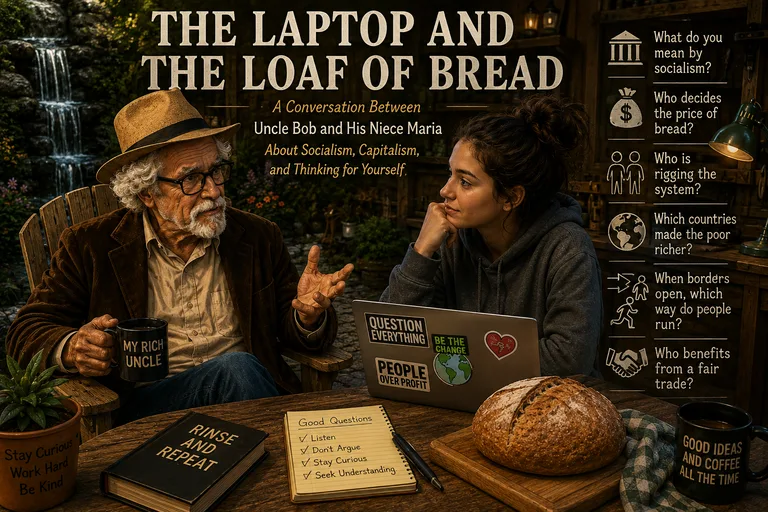
The Laptop and the Loaf of Bread
Maria showed up at Uncle Bob’s house late Saturday afternoon carrying a laptop under one arm and its power supply tangled around the other.
She was in her early twenties, in college, smart, opinionated, and—as Uncle Bob liked to remind her—dangerously confident around technology she didn’t understand.
MARIA: Uncle Bob, I need a favor.
UNCLE BOB: That sentence has cost me a lot of money over the years.
MARIA: My computer is acting weird.
UNCLE BOB: “Acting weird” is a very precise technical diagnosis.
MARIA: It freezes. Sometimes it won’t connect to Wi-Fi. And yesterday it told me I didn’t have enough disk space.
UNCLE BOB: How much disk space do you have left?
MARIA: I don’t know.
UNCLE BOB: Of course you don’t.
MARIA: That’s why I brought it to you.
Bob took the laptop from her and set it down on the kitchen table.
UNCLE BOB: Password?
MARIA: I’m not giving you my password.
UNCLE BOB: Then I’m fixing the outside of the computer.
MARIA: Fine. I’ll type it in.
She sat beside him while the machine booted.
Bob started checking the drive, startup programs, updates, and network settings. Maria pulled out her phone and began scrolling.
After a minute she shook her head.
MARIA: Look at this.
UNCLE BOB: That’s usually how trouble starts.
MARIA: They’re talking about how billionaires keep getting richer while normal people can’t afford houses anymore.
UNCLE BOB: That’s actually a reasonable thing to be concerned about.
MARIA: See? That’s why socialism is becoming popular.
Bob stopped typing for a moment.
He knew exactly where the conversation could go.
Maria knew his politics. Bob knew hers. They had both heard enough family arguments at Thanksgiving to recognize the warning signs.
So instead of immediately responding, Bob closed the settings window and turned toward her.
UNCLE BOB: Can I ask you something?
MARIA: Here we go.
UNCLE BOB: No. That’s exactly what I don’t want.
MARIA: What?
UNCLE BOB: I don’t want this turning into me trying to convince you to vote for Donald Trump or become a conservative.
MARIA: That’s what I figured you were about to do.
UNCLE BOB: I’m not.
You’ve mentioned socialism several times lately, and I realized something.
I’m not sure I actually know what you mean when you use the word.
So instead of telling you what socialism means, I want you to tell me.
MARIA: Okay.
UNCLE BOB: And let’s make a deal.
I’m going to ask questions.
You’re allowed to ask me questions.
If either one of us gets irritated, we stop talking politics for five minutes, make fun of your computer, get something to drink, and then come back to it.
I’m not trying to trap you.
I’m not trying to score points.
I’m interested in how you reached your conclusions.
And you can do exactly the same thing to me.
MARIA: You’re actually going to listen?
UNCLE BOB: That’s the experiment.
MARIA: All right. Go ahead.
Bob turned back toward the laptop.
UNCLE BOB: First question.
When you say socialism, what exactly do you mean?
Do you mean something like Denmark, where there are private companies and private property, but government taxes people more and pays for a larger social safety net?
Or do you mean actual socialism, where the government owns or controls major industries and the means of production?
Because those are two very different things.
MARIA: I’m mostly talking about healthcare, education, housing assistance, things like that.
UNCLE BOB: Okay. That’s important.
Because if socialism simply means government paying for certain things, America has been doing versions of that almost from the beginning.
We have public schools. Social Security. Medicare. Roads. Police. Fire departments. The military.
So maybe our disagreement isn’t capitalism versus socialism at all.
Maybe the real argument is: How large should the government’s role be, what should government provide, and how much taxation are we willing to accept to pay for it?
MARIA: That’s probably closer to what I mean.
UNCLE BOB: Good. Now we’re getting somewhere.
You also say sometimes that capitalism is rigged.
MARIA: It is.
UNCLE BOB: I actually think parts of it are rigged too.
But here’s my question:
Rigged by whom?
Corporations?
Politicians?
Banks?
Rich people?
Lobbyists?
Government regulators?
MARIA: Probably all of them to some extent.
UNCLE BOB: Okay. Then here’s the part I’m interested in.
If powerful people are capable of rigging capitalism, what prevents powerful people from rigging socialism?
If your solution is to give government considerably more control over the economy, aren’t you handing even more power to the same political system you just told me can be corrupted?
MARIA: Unless there are strong democratic controls.
UNCLE BOB: That’s a reasonable answer.
So maybe the real question becomes: What institutions keep concentrated power accountable?
Whether that power belongs to corporations or government.
MARIA: I can agree with that.
Bob clicked through several folders on her computer.
UNCLE BOB: By the way, you have 186 gigabytes of videos on here.
MARIA: Don’t delete those.
UNCLE BOB: I wasn’t going to.
Although I may use them later as evidence that capitalism isn’t the only system capable of wasting resources.
MARIA: Very funny.
UNCLE BOB: Here’s another question.
What’s a loaf of bread cost?
MARIA: I don’t know. Four dollars?
UNCLE BOB: Good enough. I’m not trying to embarrass you.
Now tell me the name of the person who decided bread should cost four dollars.
MARIA: There isn’t one person.
UNCLE BOB: Exactly.
Walmart didn’t call Publix, Publix didn’t call Costco, Costco didn’t call every farmer in Kansas, and everybody didn’t get together Wednesday morning and announce:
“Bread shall now be $4.12.”
Yet somehow millions of farmers, truck drivers, flour mills, bakeries, supermarkets, employees and customers constantly arrive at prices.
How?
MARIA: Supply and demand.
UNCLE BOB: Exactly.
And that’s one of the things I find fascinating about markets.
Nobody necessarily knows what the “correct” price of bread is.
The price emerges from millions of decisions.
Wheat prices.
Fuel.
Labor.
Transportation.
Weather.
Packaging.
Electricity.
Competition.
Consumer demand.
And if one store charges twelve dollars when everybody else charges four, what happens?
MARIA: People buy it somewhere else.
UNCLE BOB: Right.
Now let’s say bread suddenly goes from four dollars to six.
Why?
MARIA: Inflation?
UNCLE BOB: Maybe. But what does inflation mean?
Is the wheat more expensive?
Fuel?
Labor?
Money supply?
Interest rates?
A crop failure?
Supply-chain problems?
Government policy?
Some combination?
That’s the kind of thing I want us to think about before saying somebody should simply order the price back down.
MARIA: But companies can also raise prices just because they can.
UNCLE BOB: Absolutely.
And monopolies can destroy the competitive mechanism I’m talking about.
That’s where I think your argument gets stronger.
If five companies secretly become one cartel, that’s not really a competitive market anymore.
So then the question isn’t just government or capitalism.
It’s:
How do we preserve competition?
MARIA: Okay. That’s fair.
UNCLE BOB: Now here’s a harder question.
Can you give me an example of a country where the state substantially took ownership of the means of production and the poor became dramatically wealthier because of it?
I’m not asking sarcastically.
Give me the strongest example you can find.
MARIA: What about China?
UNCLE BOB: Good example to investigate.
China calls itself communist, but much of its enormous reduction in poverty happened after it allowed markets, private businesses, foreign investment and profit incentives back into the economy.
So what caused the improvement?
Socialism?
Markets?
A mixture?
That’s worth examining rather than just throwing labels around.
MARIA: What about Scandinavian countries?
UNCLE BOB: Also worth studying.
But they’re interesting because they’re mostly capitalist economies with extensive welfare states.
Private companies.
Private property.
Stock markets.
Entrepreneurs.
Billionaires.
Competitive markets.
Then government taxes that wealth and redistributes part of it through services.
That’s very different from the government owning everything.
MARIA: So you’re saying they’re not socialist?
UNCLE BOB: I’m saying the word socialism gets used to describe so many different systems that sometimes people argue for an hour without realizing they’re talking about completely different things.
MARIA: That’s probably true.
UNCLE BOB: Here’s another question.
When countries severely restrict people from leaving, which direction are people usually trying to go?
Into the country?
Or out?
MARIA: Usually out.
UNCLE BOB: That’s something I think we should pay attention to.
Historically, when governments had to build walls to keep their own citizens from leaving, that’s a pretty powerful signal that something wasn’t working.
And here’s another perspective question.
Would you rather be poor today or rich in 1900?
MARIA: Rich in 1900.
UNCLE BOB: Think carefully.
You’re rich.
Beautiful house.
Servants.
Maybe even a horse and carriage.
Then you get pneumonia.
MARIA: Okay…
UNCLE BOB: No antibiotics.
You need heart surgery.
Doesn’t exist.
You need an MRI.
Doesn’t exist.
Air conditioning?
Probably not.
Internet?
No.
Commercial airlines?
No.
Modern dentistry?
Barely recognizable.
Your child gets a bacterial infection that today requires twenty dollars’ worth of antibiotics.
In 1900, being rich might not save them.
So which life is actually wealthier?
MARIA: That’s different from income though.
UNCLE BOB: Exactly.
And that’s the point.
We should measure progress by more than money.
What can ordinary people actually obtain?
Food.
Medicine.
Transportation.
Information.
Education.
Entertainment.
Technology.
Life expectancy.
Those matter too.
MARIA: But poor people still struggle.
UNCLE BOB: Absolutely.
I’m not saying, “Everything is great, stop complaining.”
I’m saying we need perspective before deciding the entire system has failed.
Here’s another question.
Suppose you make candles.
I walk into your store.
You say one candle costs twenty dollars.
I look at it and decide it’s worth twenty dollars.
I give you the money.
You give me the candle.
You wanted the twenty dollars more than the candle.
I wanted the candle more than the twenty dollars.
We both walk away happier.
Who lost?
MARIA: Nobody necessarily.
UNCLE BOB: Right.
That’s the basic magic of voluntary exchange.
Trade isn’t necessarily one person winning and another person losing.
Both sides can gain.
Now obviously there are exceptions.
Fraud.
Coercion.
Monopoly.
Pollution.
Exploitation.
Information people deliberately hide.
Those need rules.
But the existence of bad trades doesn’t mean voluntary trade itself is bad.
MARIA: What about wages?
Companies have more power than individual workers.
UNCLE BOB: Sometimes they absolutely do.
So here’s the question I wrestle with:
Someone has to determine what your labor is worth.
Should it primarily be negotiated between you and the person who wants to hire you?
Should unions negotiate it collectively?
Should government establish a minimum?
Should government determine the entire wage?
And where do we draw the line?
MARIA: I’d definitely support minimum wages and unions.
UNCLE BOB: Good.
Then we’re not debating whether markets should exist.
We’re debating the rules around the market.
That’s a much more useful conversation.
Maria watched as Bob disabled several programs that were starting automatically with the computer.
MARIA: You know, you don’t sound nearly as conservative when you’re asking questions.
UNCLE BOB: That’s because I’m not trying to recruit you.
I’m trying to understand how you’re thinking.
And I’d rather you challenge me too.
Ask me why I believe capitalism works.
Ask me where capitalism fails.
Ask me about monopolies.
Ask me about healthcare.
Ask me why somebody working forty hours a week can still struggle to afford housing.
Those are legitimate questions.
MARIA: So what are you actually trying to convince me of?
Bob looked over at her.
UNCLE BOB: Nothing tonight.
That’s the point.
I want to know whether you arrived at your beliefs because somebody gave you a slogan…
…or because you’ve thought through the consequences.
And you should demand exactly the same thing from me.
If I say, “The free market will solve it,” ask me:
“How?”
If I say, “Government will screw it up,” ask:
“Why?”
If you tell me government should solve something, I’ll ask:
“How?”
If you tell me capitalism caused something, I’ll ask:
“How?”
Neither one of us gets to escape by using a label.
MARIA: That’s actually reasonable.
UNCLE BOB: That’s all I’m asking for.
Not conservative thinking.
Not liberal thinking.
Not socialist thinking.
Thinking.
And when you tell me something I disagree with, instead of immediately saying you’re wrong, I’d rather ask:
“When you say that, what exactly do you mean?”
Then I’ll listen to your answer.
Because I’d rather understand how you reached your conclusion than simply beat you in an argument.
Bob restarted the laptop.
A few seconds later it came back up noticeably faster.
MARIA: Wow. You fixed it.
UNCLE BOB: Mostly.
You had about thirty things starting automatically, your drive was almost full, and you haven’t installed updates in six months.
MARIA: So the system was broken.
Bob looked at her.
UNCLE BOB: No.
You weren’t maintaining it.
Maria stared at him for a second.
MARIA: You have been waiting this entire conversation to say that, haven’t you?
UNCLE BOB: Maybe.
MARIA: And you said you weren’t trying to convince me of anything.
UNCLE BOB: I’m fixing your computer.
Political philosophy is extra.
MARIA: I’m never bringing you another computer.
UNCLE BOB: You’ll be back.
MARIA: Probably.
She picked up the laptop.
Then stopped at the door.
MARIA: Uncle Bob?
UNCLE BOB: Yeah?
MARIA: I’m still a socialist.
UNCLE BOB: That’s fine.
Just make sure you know what kind.
Maria laughed.
MARIA: Goodnight, Uncle Bob.
UNCLE BOB: Goodnight, kid.
And back up your computer.
MARIA: I knew there was going to be another lecture.