Think of it as Yoga for the brain, we are going to stretch a bit.
The Monty Hall Paradox: Why Switching Doors Doubles Your Odds
Three doors, one car and a decision that fooled thousands of intelligent people—including mathematicians but it works every time, well almost-- YNOT!
This is more important to your success in life than you may think initially, it effects all your life choices. So read on…
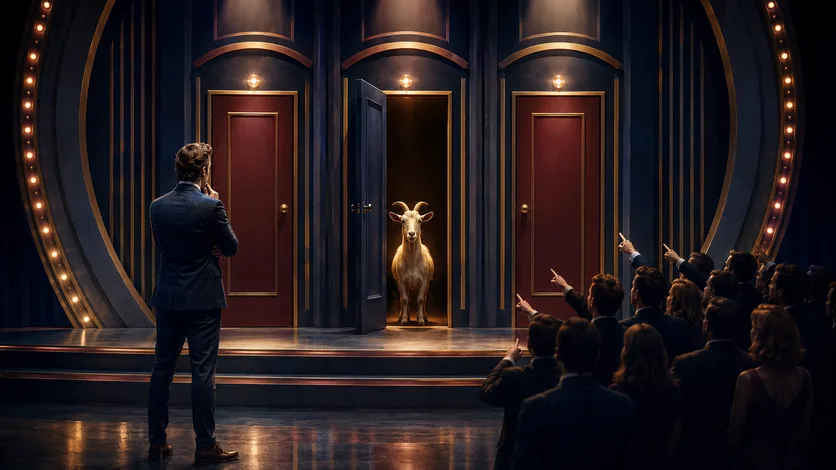
Imagine that you are standing on a television game-show stage facing three closed doors.
Behind one door is a new car. Behind the other two are goats.
You choose Door No. 1.
The host knows what is behind every door. Instead of immediately revealing your prize, he opens Door No. 3 and shows you a goat. Two unopened doors remain: the one you originally selected and Door No. 2.
Then he asks the question:
Would you like to stay with Door No. 1—or switch to Door No. 2?
Most people instinctively believe it no longer matters. Two doors remain, so the car must have a 50 percent chance of being behind either one.
That sounds perfectly reasonable.
It is also wrong.
Under the standard rules of the puzzle, switching gives you a two-thirds chance of winning the car. Staying with your original choice gives you only a one-third chance.
In other words, switching doubles your odds.
Why the Odds Are Not 50–50
When you initially select one of three doors, your chance of choosing the car is one in three.
That also means there is a two-in-three chance that the car is behind one of the two doors you did not select.
The host’s action does not make your original guess more accurate. Your door still carries the same one-third probability it had when you chose it.
The important detail is that the host is not opening a door randomly. He knows where the car is, must reveal a goat and must leave the car hidden.
Once he eliminates a losing door, the entire two-thirds probability assigned to the doors you did not choose effectively becomes concentrated on the only remaining unopened door.
The possible outcomes look like this:
What you chose first
Probability
Result if you switch
The car
1/3
You lose
Goat No. 1
1/3
You win
Goat No. 2
1/3
You win
Switching loses only when your first choice was correct. That happens one-third of the time.
Switching wins whenever your first choice was wrong. That happens two-thirds of the time.
If three doors still feel confusing, imagine the same game with 100 doors.
One door hides a car. The other 99 hide goats.
You select Door No. 17. Your chance of being correct is just one percent. There is a 99 percent chance that the car is somewhere among the other 99 doors.
The host—who knows where the car is—then opens 98 losing doors. Every one contains a goat. Only your original door and Door No. 64 remain closed.
Would you stay with your one-percent guess, or switch to the door the knowledgeable host was forced to leave closed?
The remaining door carries the original 99 percent probability that the prize was somewhere outside your first selection.
The three-door puzzle works exactly the same way. The smaller numbers merely make the advantage harder to see.
A Puzzle That Humiliated the Experts
The modern version of the problem was introduced by statistician Steve Selvin in a letter published by The American Statistician in 1975. It was named after Monty Hall, the longtime host of the television program Let’s Make a Deal.
The puzzle became a national controversy in 1990 after reader Craig Whitaker submitted it to Marilyn vos Savant’s “Ask Marilyn” column in Parade magazine.
Vos Savant answered that the contestant should switch because the original door had a one-third chance of winning and the remaining door had a two-thirds chance.
Thousands of readers insisted she was wrong.
According to a 1991 New York Times account preserved by the University of Pennsylvania, vos Savant estimated that she received approximately 10,000 letters, most disagreeing with her. Nearly 1,000 of the critical letters reportedly carried signatures from people with doctoral degrees.
Some professors publicly ridiculed her and demanded that she admit her mistake.
She refused—because she was right.
Schools around the country eventually tested the puzzle through repeated classroom experiments. The results consistently showed that contestants who switched won close to two-thirds of the time. Parade’s later retelling of the controversy describes how the letters began changing once teachers and students tested the strategy for themselves.
The Rules Matter
There is one crucial qualification: the two-thirds answer applies only when the host follows a specific procedure.
The host must:
Know where the car is.
Always open a door the contestant did not choose.
Always reveal a goat.
Always offer the contestant an opportunity to switch.
If the host randomly opens a door and merely happens to reveal a goat, the probabilities may be different.
If he offers a switch only in certain situations, the offer itself may carry additional information. A manipulative host could offer a switch primarily when the contestant already has the winning door.
Monty Hall himself pointed out this distinction. On the actual Let’s Make a Deal, he controlled when to reveal prizes, offer money or permit a contestant to change choices. The television show did not always follow the rigid procedure assumed by the mathematical puzzle.
So the correct advice is not simply “always switch.”
It is:
Always switch when the host knows where the prize is, deliberately removes a losing option and is required to offer the switch every time.
Change those rules, and you change the mathematics.
Why Our Brains Resist the Answer
The Monty Hall problem feels wrong because we focus on the two doors visible at the end rather than the process that produced them.
If one of two doors had simply been removed at random before we made any choice, then treating the remaining doors equally might make sense.
But that is not what happened.
The host used hidden knowledge to decide which door to eliminate. His choice was constrained by both the location of the car and the door you selected. The information he provides is therefore not neutral.
We also become emotionally attached to our first choice. Staying feels passive: if we lose, we merely guessed incorrectly. Switching feels active: if we abandon the winning door, we feel responsible for turning a victory into a loss.
That emotional difference does not alter the odds, but it strongly affects human decisions.
More Than a Game-Show Trick
The puzzle illustrates a broader lesson about evidence and decision-making.
New information does not always divide probabilities equally among the options that remain. We must ask how that information was produced, what the person providing it knew and whether the process filtered the possible outcomes.
The same principle matters when interpreting medical tests, financial forecasts, criminal evidence, polling, artificial-intelligence results and risk assessments.
Information selected through a knowledgeable process is different from information revealed randomly.
That is the real power of the Monty Hall paradox. It exposes how easily confidence and intuition can defeat careful reasoning—even among experts.
So, if you ever find yourself facing three doors, two goats and one knowledgeable host, remember the mathematics:
Do not fall in love with your first choice. Switch the door.
Beyond the Game Show: The Advantage of Rethinking the Crowd
The Monty Hall paradox teaches something larger than probability: when nearly everyone reaches the same conclusion, that does not necessarily make the conclusion correct.
Thousands of intelligent people looked at two remaining doors and confidently declared the odds were 50–50. They were following the crowd, but the crowd was overlooking how the host’s knowledge affected the choice.
Similar situations appear throughout life. When everyone is doing the same thing, the best opportunity may be somewhere else.
Investing: Popularity Can Affect the Price
When investors become convinced that one company, industry or asset can only rise, demand may push its price beyond what the underlying business reasonably supports.
Meanwhile, an unfashionable company may be ignored despite having strong revenue, valuable assets or improving prospects.
That does not mean investors should automatically buy whatever everyone else dislikes. The crowd may have legitimate reasons for avoiding something. The better lesson is to examine the evidence independently:
Is the popular investment genuinely worth its price?
Are people buying because of fundamentals or because everyone else is buying?
Is an unpopular investment being overlooked—or is it unpopular for a good reason?
What assumptions would have to be true for the crowd’s prediction to succeed?
Successful contrarian investing is not simply doing the opposite of everyone else. It is recognizing when popular opinion and underlying value have separated.
Careers: The Most Popular Path May Be the Most Crowded
Young people are often encouraged to pursue whatever career appears hottest at the moment. By the time thousands of students finish training, however, that field may be crowded with applicants competing for the same positions.
Less fashionable occupations may offer better pay, greater security and fewer competitors. Skilled trades, specialized technical work and overlooked industries can provide tremendous opportunities precisely because fewer people pursue them.
The important question is not merely, “What career is popular today?”
It is, “Where will valuable skills be scarce five or ten years from now?”
Following the crowd prepares you to compete with the crowd. Developing a rare and useful combination of skills can allow you to create your own position.
Business: Crowded Markets Leave Other Needs Unserved
Entrepreneurs frequently copy businesses that are visibly successful. Once a particular concept becomes popular, dozens of competitors rush into the same market, sell similar products and fight over the same customers.
The better opportunity may be hiding in the problem everyone else has ignored.
A business can gain an advantage by asking:
What are customers repeatedly complaining about?
Which group is being poorly served?
What necessary service is considered too small, difficult or unglamorous?
What are competitors assuming that may no longer be true?
Can an existing product be made simpler, faster, cheaper or more convenient?
The greatest opportunity is not always found where the largest crowd has gathered. Sometimes the crowd’s presence is evidence that the easiest opportunity has already been taken.
Independent Thinking Is Not Automatic Opposition
There is also danger in believing the crowd must always be wrong.
Markets can recognize real value. Popular careers can offer excellent opportunities. Successful businesses are often copied because they satisfy genuine demand.
Reflexively opposing the majority is not independent thinking. It is allowing the crowd to control your decision in reverse.
The goal is to understand the rules, examine the evidence and reach your own conclusion. Sometimes that will mean following the crowd. Sometimes it will mean walking away from it.
The advantage belongs to the person who can tell the difference.
Know When to Switch
The Monty Hall paradox is ultimately a lesson about questioning assumptions.
Most people see two closed doors and assume the odds must be equal. Careful thinkers ask how those two doors came to remain closed, what the host knew and why he selected the door he opened.
That same habit can improve decisions far beyond a game show.
When everyone is buying the same investment, pursuing the same career or copying the same business, stop and examine the unopened doors. The popular choice may still be correct—but its popularity is not proof.
Ask what the crowd might have missed. Look for information that changes the probabilities. Consider opportunities that remain hidden because everyone is staring in the same direction.
Most importantly, be willing to change your mind when the evidence justifies it.
Your first choice may feel comfortable because it belongs to you. That does not make it the best choice.
Sometimes success comes from staying the course.
And sometimes, as Monty Hall taught us, the smartest move is to switch doors.