Think of it as Yoga for the brain, we are going to stretch a bit.
Los Hijos del Cielo Operation Pedro Pan and the Children Who Flew Alone
There are moments in the history of a country that cannot be measured by elections, armies, speeches, or revolutions.
They are measured by something much smaller. A suitcase. A passport.
A photograph folded into a shirt pocket.
A mother standing behind a glass partition at an airport, watching her child walk away.
Between 1960 and 1962, 14,048 Cuban children arrived in the United States without their parents in an extraordinary exodus that became known as Operation Pedro Pan — Operación Pedro Pan. The National Archives describes it as the largest recorded exodus of unaccompanied minors in the Western Hemisphere.
They were not orphans. Their parents were alive.
That was precisely what made Pedro Pan so extraordinary.
Thousands of Cuban mothers and fathers voluntarily placed their sons and daughters aboard airplanes and sent them to another country because they had reached the conclusion that separation was safer than keeping their family together.
To understand why parents would do something so painful, one must understand Cuba in the first years after the revolution.
And one must understand fear.
The Revolution Comes Home
When Fidel Castro’s rebels entered Havana in January 1959, there was genuine celebration throughout Cuba.
Fulgencio Batista was gone. His government had become synonymous with corruption, political repression, cronyism, and brutality. Cubans from very different social classes had reason to believe that something better might replace it.
The revolution initially spoke the language of restoration: democracy, justice, nationalism, honest government.
But revolutions rarely remain what everyone imagined them to be.
Within two years Cuba was undergoing a transformation far more profound than simply replacing one president with another. Private property was being nationalized. Political opponents were being imprisoned or driven into exile. Independent political institutions disappeared. Cuba moved increasingly toward the Soviet Union, and the revolutionary government began extending its authority deeply into education, religion, economic life, civic organizations and the family.
Education became one of the principal instruments of revolutionary transformation. By the spring of 1961, almost all private schools had been taken over by the government, and education had become state controlled. (U.S. Marine Corps)
This mattered enormously in Cuba.
Catholic schools had educated generations of Cuban children. Schools such as Belén, La Salle, the Ursuline academies, and countless smaller religious institutions were not simply places where mathematics and grammar were taught. They were woven into family identity, religion, class, neighborhood and tradition.
When the state took control of education, many parents interpreted the change as something larger:
The revolution was no longer simply governing Cuba. It was beginning to shape the Cuban child.
And once that fear entered the home, politics became intensely personal.
¿Qué Van a Hacer Con Nuestros Hijos?
What are they going to do with our children?
Rumors spread quickly.
Parents heard that children might be removed from their homes.
They heard that teenagers might be sent to agricultural camps.
They heard that Cuban children might be sent to the Soviet Union.
They heard that the government intended to abolish patria potestad — the traditional legal authority of parents over their children.
Eventually, copies of what purported to be a new Cuban law began circulating. According to the document, parents would lose authority over their children and the state would assume responsibility for their education and development.
The document was false.
Modern scholarship has established that the supposed law abolishing patria potestad was fabricated and circulated by anti-Castro opponents. Historian Deborah Shnookal’s research traces the rumor campaign and the distribution of a fake law; anti-Castro broadcasts, including material transmitted by CIA-backed Radio Swan, also amplified fears surrounding parental authority. (University Press Scholarship)
That fact is important.
But stopping the story there creates another distortion.
The false document circulated within a society in which genuine and dramatic changes were already occurring.
Private schools really were being taken over.
Religious institutions really were under pressure.
The government really was creating a centralized educational system.
Political loyalty increasingly mattered.
Children really were being mobilized into revolutionary organizations and national campaigns.
Families could see the state acquiring powers it had never possessed before. (U.S. Marine Corps)
So the historical distinction matters:
The specific law supposedly abolishing parental rights was false.
The broader fear of an increasingly powerful revolutionary state was real.
For a mother sitting at her kitchen table in Havana in 1961, that distinction may not have been particularly comforting.
She did not have historians, declassified archives, or the Internet available to determine what was propaganda and what was true.
She had rumors.
She had neighbors disappearing.
She had schools changing.
She had relatives leaving.
She had speeches on the radio.
And she had children asleep in the next room.
The Impossible Question
Imagine the conversation.
Not because we know the precise words spoken inside every Cuban household, but because thousands of families eventually faced essentially the same decision.
The children have gone to bed.
The radio is turned down.
The parents speak quietly.
Should we send them?
The father may believe everything will settle down.
The mother may believe the situation is becoming worse.
Perhaps an uncle has already left for Miami.
Perhaps a neighbor has been arrested.
Perhaps the family business has been confiscated.
Perhaps an older son is becoming involved with the underground.
Perhaps the parents themselves are involved.
Perhaps there is no dramatic event at all.
Only fear.
What happens if we wait?
And then the question that must have seemed unimaginable:
Could good parents deliberately send their children away?
The answer thousands of Cuban parents eventually reached was yes.
Not because they wanted separation.
Because they believed separation might be temporary.
And because they believed staying might be worse.
A Priest in Miami
The operation that would eventually move more than fourteen thousand children began relatively quietly.
One of its central figures was Father Bryan O. Walsh, an Irish-born Catholic priest working with the Catholic Welfare Bureau in Miami.
Another was James Baker, headmaster of Ruston Academy, an American school in Havana. Baker was encountering Cuban families who wanted to send their children to the United States but faced a fundamental problem: after relations between Washington and Havana deteriorated, obtaining ordinary immigration documentation became increasingly difficult.
The emerging network brought together Cuban families, underground organizers, religious organizations and American officials.
The U.S. government provided significant assistance and funding, while Catholic welfare agencies developed the infrastructure to receive children who arrived without relatives waiting for them. The National Archives describes Pedro Pan as a program partially financed by the federal government. (National Archives)
The operation’s formal administrative history is complicated.
Its human purpose was simple.
Get the children out.
Inside Cuba, contacts helped obtain the necessary documentation and delivered it discreetly to families.
Parents purchased airline tickets when they could.
Names were placed on lists.
Instructions were passed quietly.
And soon children began appearing at Havana’s airport carrying suitcases.
Peter Pan
The official American effort was commonly referred to as the Cuban Children’s Program.
But another name took hold:
Pedro Pan.
Peter Pan was the fictional boy who could fly away from home.
For Cuban children, the Spanish name transformed the fantasy into something painfully real.
These children could indeed fly.
But there was no Neverland waiting for them.
There was Miami.
There were refugee camps.
There were foster homes.
There were relatives they had never met.
There were strangers speaking English.
And there was an unanswered question:
When are my parents coming?
José Martí Airport
This is where the political history of Pedro Pan becomes something else.
Because sooner or later, every document, every government program and every diplomatic decision led to one physical place:
the airport.
A family arrived carrying luggage.
Perhaps the parents had deliberately made the trip seem ordinary.
Perhaps they told a younger child that he was going on vacation.
Perhaps they told him he would stay with his aunt in Miami.
Perhaps they promised that Mama and Papa would be there next month.
Some children undoubtedly understood the gravity of what was happening.
Others could not.
A seven-year-old does not understand geopolitics.
A nine-year-old does not understand Marxism-Leninism.
A twelve-year-old may understand that his father is frightened without understanding why.
What children understand is that their mother is crying.
They understand that their father keeps telling them to be brave.
They understand that everyone is hugging them differently today.
Then came the moment when the adults could go no farther.
The child had to continue.
One hand released another.
And that was it.
For some families, it was the last physical contact they would have for years.
For a few, forever.
Ninety Miles
Cuba and Florida are separated by only about ninety miles at their closest points.
By airplane, the journey from Havana to Miami was remarkably short.
That made the separation almost crueler.
The children were not fleeing halfway around the world.
Their parents remained just beyond the horizon.
Somewhere below the aircraft was the Florida Straits.
Behind them was Havana.
Ahead was Miami.
And perhaps a child pressed his face against an airplane window wondering whether he could still see Cuba.
Many of the children carried little more than clothing and small personal possessions.
Such objects would later become artifacts of exile: photographs of parents, religious medals, letters, school documents, toys and luggage — mundane possessions transformed by history into evidence of childhood displacement. Smithsonian collections today preserve Pedro Pan material and personal accounts documenting the children’s experiences. (Smithsonian Institution)
A suitcase was supposed to contain enough belongings for a temporary absence.
But how does a parent pack a childhood?
Miami
Arrival could produce either relief or a second shock.
Some children stepped into Miami and immediately saw relatives.
An aunt.
An uncle.
Grandparents.
Older siblings.
Family friends.
They might cry and embrace and begin waiting together for the parents to follow.
Other children saw no one they knew.
Those children entered the welfare system developed to receive them.
Catholic agencies became central to their placement and care, although the children themselves represented different religious backgrounds. The broader program involved religious and social-service organizations as well as federal support. (Wikipedia)
Miami became a gigantic waiting room.
There were camps and temporary facilities.
Children slept in dormitories.
They attended school.
They learned new routines.
They watched other children leave when relatives arrived.
And they waited for their own names to be called.
Some waited days.
Some waited weeks.
Some waited months.
Matecumbe
Among the locations associated with Pedro Pan was Camp Matecumbe in southwest Miami-Dade County.
There were other facilities and foster placements, and eventually children were dispersed beyond Florida.
For many young arrivals, the environment was astonishingly different from home.
Even those housed among other Cuban children had lost the most fundamental structure in their lives:
their parents.
Older siblings sometimes assumed extraordinary responsibility.
A fourteen-year-old brother could effectively become the protector of an eight-year-old sister.
Children learned quickly which documents mattered, when meals were served, whom to ask for help and how to interpret adults speaking a language they did not understand.
Childhood accelerated.
Pedro Pan children had been sent away partly to preserve their childhood.
Exile often forced them to abandon it.
Cuba Scattered Across America
Miami could not accommodate every child indefinitely.
Thousands were eventually sent to other parts of the United States.
Suddenly there were Cuban children living far from Calle Ocho, far from Spanish-language neighborhoods and far from tropical weather.
Some encountered snow for the first time.
Some encountered Americans who had never met anyone from Cuba.
Some arrived in places where almost no one spoke Spanish.
The experience varied enormously.
Some children were placed with loving foster families and later remembered extraordinary generosity.
Others found institutional life lonely or difficult.
Some experienced abuse or neglect.
Some siblings remained together.
Others were separated.
Pedro Pan therefore does not have one universal childhood story.
There were more than fourteen thousand of them.
There were more than fourteen thousand versions.
The Letters
Then came the letters.
A child wrote home.
Mami, estoy bien.
I am fine.
Estoy estudiando.
I am studying.
¿Cuándo vienes?
When are you coming?
Parents answered from Cuba.
Soon.
Behave yourself.
Listen to your aunt.
Take care of your sister.
Study.
Pray.
We love you.
Soon.
That word must have carried enormous weight.
Because “soon” could mean two weeks.
Or six months.
Or two years.
Parents often concealed their own difficulties. Why terrify a child by explaining that an exit permit had been denied, that someone was under investigation, or that there was no money for tickets?
The child needed hope.
So the letters preserved hope.
Meanwhile something subtle began happening.
English entered the child’s vocabulary.
American schools entered the child’s life.
Baseball, television, food, slang and friendships transformed him.
The little Cuban who had been expected to return home soon was becoming a Cuban American.
And his parents were missing it.
The Parents Who Stayed Behind
Pedro Pan is usually remembered through the children.
But there is another side of the story.
The empty houses.
Imagine walking back into your child’s bedroom the night after sending him away.
The bed is still there.
The toys are still there.
His schoolbooks are still there.
Perhaps breakfast dishes remain in the kitchen from that morning.
But the child is in another country.
Parents had made the decision themselves, which perhaps made the pain even worse.
If someone takes your child, anger has a target.
But what happens when you are the person who signed the papers?
What happens when your child cries over the telephone and says:
I want to come home.
What can a mother say?
You cannot come home because I sent you away to save you.
That paradox lives at the center of Pedro Pan.
The Bay of Pigs and a Darkening Revolution
Political events continued moving faster than families could reunite.
In April 1961, the disastrous Bay of Pigs invasion intensified hostility between Castro’s government and the United States.
Cuba openly aligned itself more closely with the Soviet bloc.
Internal repression of suspected opponents increased.
The possibility that the revolution might collapse quickly — an assumption held by some exiles — began to disappear.
Temporary exile was becoming permanent exile.
A family that believed its child would spend a few months in Miami now had to consider an entirely different possibility:
What if we cannot leave Cuba?
October 1962
Then the world nearly ended.
American reconnaissance discovered Soviet nuclear missiles being installed in Cuba.
President John F. Kennedy imposed a naval quarantine.
Soviet and American forces prepared for the possibility of war.
For thirteen days in October 1962, humanity approached nuclear confrontation.
And in the middle of the Cuban Missile Crisis, commercial movement between Cuba and the United States was effectively severed.
Pedro Pan ended.
The flow of children stopped in October 1962 after more than 14,000 had reached the United States. (FIU Libraries)
Imagine being a parent whose child had departed the previous month.
The plan had been:
First the children.
Then us.
Suddenly there was no “then.”
The door had closed.
The Long Way Around
Families now searched for other ways out.
Some eventually escaped through third countries.
Others waited until later migration arrangements made departure possible.
The Freedom Flights, which began later in the decade, eventually allowed many more Cubans to leave the island and helped reunite separated families. FIU’s Pedro Pan historical materials note that many children were ultimately reunited with parents as migration channels reopened. (FIU Libraries)
But years matter enormously when you are a child.
A seven-year-old separated for five years is twelve when his mother sees him again.
A twelve-year-old becomes seventeen.
A child becomes a teenager.
A teenager becomes an adult.
Parents did not merely lose time.
They lost stages of their children’s lives.
First Communion.
Birthdays.
Graduations.
First dates.
Illnesses.
School problems.
Christmas mornings.
Ordinary dinners.
The things that appear insignificant while they are happening become priceless once they are gone.
The Reunion
Eventually a mother arrives in Miami.
She looks through the crowd for her little boy.
But there is no little boy.
There is a teenager.
He is taller.
His voice has changed.
Perhaps he speaks English easily.
Perhaps his Spanish sounds different.
Perhaps he embraces her immediately.
Perhaps he hesitates.
Perhaps she recognizes his face but realizes she no longer knows his daily life.
This was one of exile’s cruelest surprises:
reunion did not automatically erase separation.
Families had to learn one another again.
Parents expected to resume authority.
Children had learned independence.
Some had bonded deeply with relatives or foster families.
Older siblings had functioned as parents.
American customs had entered the household.
Everyone had survived.
But survival had changed everyone.
Was Pedro Pan a CIA Operation?
Few parts of the story generate more controversy.
There is no serious dispute that Cold War propaganda surrounded Pedro Pan or that anti-Castro activists circulated the fabricated patria potestad document. Scholarship also documents the role of CIA-backed Radio Swan in broadcasting warnings about threats to Cuban families. (University Press Scholarship)
But that is different from saying that the entire child evacuation program itself was secretly created and operated by the CIA.
The issue was tested in federal court after Pedro Pan scholar and participant María de los Angeles Torres sought CIA records through the Freedom of Information Act. The litigation did not establish Operation Pedro Pan itself as a CIA-run evacuation operation. (Justia Law)
The distinction is important because history becomes distorted when complicated events are reduced to slogans.
Pedro Pan contained many overlapping stories:
American Cold War policy.
Anti-Castro resistance.
Propaganda.
Catholic humanitarian work.
Federal refugee assistance.
Revolutionary political control.
Family fear.
And individual parental decisions.
All existed simultaneously.
Pedro Pan was neither a simple CIA conspiracy nor merely a romantic rescue story.
It was a product of the Cold War.
And like much of the Cold War, truth, fear and propaganda became intertwined.
What the Revolution Feared
There is another irony.
The Cuban government portrayed many who left as traitors, counterrevolutionaries or privileged people unwilling to accept social transformation.
Yet the departure of children exposed one of the revolution’s greatest vulnerabilities.
A government can nationalize a factory.
It can nationalize a bank.
It can nationalize a school.
But when parents believe the state may eventually claim authority over the minds of their children, the conflict is no longer economic.
It becomes primal.
The family becomes the last independent institution.
And mothers and fathers will do extraordinary things to defend it.
Including sending their children away.
What America Received
America did not simply receive fourteen thousand refugees.
It received fourteen thousand young people who would grow into a significant part of the Cuban-American generation.
Pedro Pan children became physicians, teachers, engineers, attorneys, business owners, priests, academics, artists, public servants and political figures.
Many rarely spoke publicly about the experience for decades.
Some remembered Pedro Pan primarily as salvation.
Others remembered abandonment.
Some believed their parents unquestionably made the correct decision.
Others spent a lifetime wondering whether it had been necessary.
Those reactions do not contradict one another.
They demonstrate the psychological complexity of childhood exile.
The First Great Cuban-American Generation
Pedro Pan also occupies an important place in the broader history of Cuban Miami.
The refugees arriving after 1959 did not initially think of themselves as creating a permanent diaspora.
Many considered themselves temporary exiles.
Suitcases remained packed.
Spanish remained dominant in the home.
Businesses were created with one eye toward the day Castro would fall.
Property documents from Cuba were preserved.
Keys to houses that no longer belonged to them remained in drawers.
The phrase was always:
Cuando regresemos a Cuba.
When we return to Cuba.
Pedro Pan children gradually demonstrated that something different was happening.
They attended American schools.
They entered American universities.
They married.
They had children.
They built businesses.
They purchased homes.
Cuba remained their homeland.
But the United States became home.
That distinction helped shape modern Cuban-American identity.
Two Countries Inside One Person
This is one of the central themes of Alma de Cuba.
Exile does not necessarily replace one identity with another.
Sometimes it divides a person permanently between two worlds.
A Pedro Pan child might grow into a completely American adult while remembering Havana with astonishing clarity.
The smell of rain on a Cuban street.
The sound of a grandmother’s voice.
A school uniform.
A mango tree.
A particular bakery.
A house number.
A bedroom window.
Memories remain frozen at the age when someone left.
The Cuba remembered by the child may no longer exist.
The child who remembered it no longer exists either.
Yet both survive somewhere inside the adult.
That may be the defining condition of exile.
You can leave a country.
But the country does not entirely leave you.
The Suitcase
Perhaps that is why the suitcase is such a powerful symbol of Pedro Pan.
Every exile understands the suitcase.
A suitcase says:
I am going somewhere.
But it also says:
I intend to return.
You do not pack your entire existence into a suitcase.
You pack what you need until you come home.
Thousands of Cuban families made precisely that calculation.
Take enough shirts.
Take underwear.
Take your good shoes.
Take the photograph of Abuela.
Take your rosary.
Don’t lose your papers.
Listen to your aunt.
Be good.
We’ll be there soon.
Then history intervened.
And the temporary suitcase became luggage for an entirely different life.
Los Hijos del Cielo
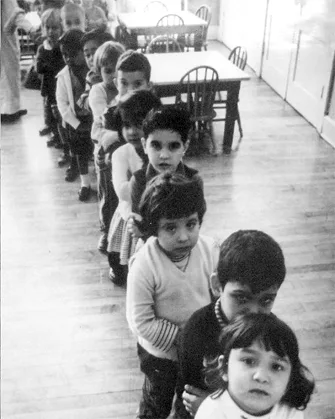
There is something haunting about photographs of Pedro Pan children boarding airplanes.
Look carefully at their faces.
Some seem frightened.
Some appear serious.
Some look confused.
Others appear almost excited, because children are children and an airplane can still be an adventure even when adults around them are quietly falling apart.
One child looks backward.
That child may best represent the entire Cuban exile story.
The body is moving forward.
The face is looking back.
Ahead lies America.
Behind lies Cuba.
The staircase climbs between the two.
For more than fourteen thousand children, that staircase became the dividing line in their lives.
Before it:
home.
Parents.
Cuba.
Childhood.
After it:
Miami.
Exile.
English.
Uncertainty.
America.
They became Los Hijos del Cielo — the Children of the Sky.
Not because the sky rescued them.
But because for one brief flight above the Florida Straits, they belonged completely to neither country.
Cuba was behind them.
America had not yet received them.
They existed somewhere between the two.
The Meaning of Pedro Pan
History likes numbers.
14,048 children.
1960–1962.
Ninety miles.
But numbers cannot explain Pedro Pan.
The real measurement is emotional.
Fourteen thousand children means thousands of mothers watching airplanes leave Havana.
Thousands of fathers pretending not to cry.
Thousands of empty bedrooms.
Thousands of letters beginning with Querida Mamá.
Thousands of children asking when their parents were coming.
Thousands of reunions.
And thousands of memories carried through adulthood.
Pedro Pan also reminds us that historical events rarely fit neatly into categories such as heroism or villainy.
There was propaganda.
There was genuine fear.
There was Cold War politics.
There was revolutionary repression.
There was American intervention.
There was humanitarian generosity.
There was trauma.
There was opportunity.
And above all of it stood the Cuban family trying to survive forces far larger than itself.
Alma de Cuba
Perhaps that is where the soul of Cuba is found.
Not only in Havana’s buildings.
Not only in music.
Not only in politics.
Not only in revolution.
It lives in the extraordinary attachment Cubans have always had to family.
A Cuban mother sending her child away seems, at first, to contradict everything family represents.
Yet Pedro Pan reveals the opposite.
Sometimes love holds tightly.
Sometimes love refuses to let go.
And sometimes history creates circumstances in which love does something almost incomprehensible:
it lets go precisely because it loves.
Thousands of parents stood in Havana and watched their children disappear through an airport gate.
They did not know whether they would see them next month.
Next year.
Or ever again.
But they let them go.
The children climbed the stairs.
The aircraft doors closed.
The engines started.
And Cuba slowly disappeared beneath the clouds.
More than sixty years later, many of those children are grandparents.
The suitcases are old.
The letters have yellowed.
The parents who made the decision are largely gone.
But the story remains.
Because Pedro Pan was never merely about fourteen thousand children leaving Cuba.
It was about the moment when the Cuban Revolution crossed the threshold of the home and forced ordinary families to make extraordinary choices.
It was about the birth of an exile generation.
It was about childhood sacrificed to history.
And it was about a promise whispered at an airport by thousands of Cuban mothers and fathers:
“Go. We will be right behind you.”
For some, the promise was fulfilled.
For others, it took years.
And for some, history never allowed it to be fulfilled at all.
But the children went.
They crossed the ninety miles.
They built new lives.
They carried their language, memories, faith, food, music and family stories with them.
And in doing so, they carried a piece of Cuba into America.
Los Hijos del Cielo. The children who flew away from Cuba— and carried Cuba with them.
The Pedro Pan Generation: What Became of the Children?
A surprising number of Pedro Pan children later became prominent in American politics, business, academia, the arts, diplomacy, and Cuban-American public life.
Mel Martínez — Arrived alone in 1962. He later became U.S. Secretary of Housing and Urban Development and U.S. Senator from Florida. He lived in youth facilities and foster homes before reuniting with his family in 1966.
Willy Chirino — Cuban-American singer, songwriter and producer closely associated with the Miami Sound. He left Cuba at age 14 in 1961 through Pedro Pan.
Carlos Eire — Yale historian and author of Waiting for Snow in Havana, his memoir about childhood in revolutionary Cuba and his Pedro Pan exile. The book won the 2003 National Book Award for Nonfiction.
Ana Mendieta — Internationally important Cuban-American performance and visual artist. She and her sister were sent from Cuba through Pedro Pan when Ana was 12; displacement and connection to homeland later became major themes in her art.
Miguel “Mike” Bezos — Came to the United States as a Pedro Pan teenager and later became the father who raised and adopted Jeff Bezos, founder of Amazon.
Eduardo J. Padrón — Arrived from Cuba at 15 and eventually became longtime president of Miami Dade College. President Barack Obama awarded him the Presidential Medal of Freedom in 2016.
Tomás Regalado — Pedro Pan child who became a journalist, radio personality, Miami commissioner and ultimately Mayor of Miami.
Joe Carollo — Arrived as a child through Pedro Pan, spent part of his youth in Chicago, and later became a longtime Miami political figure and Mayor of Miami.
Eduardo Aguirre Jr. — Arrived alone at age 15 in 1961. He rose through banking and government and became U.S. Ambassador to Spain and Andorra. (
Hugo Llorens — Came to the United States at age seven through Pedro Pan and became a career diplomat, including service as U.S. Ambassador to Honduras and senior U.S. diplomat in Afghanistan.
Guillermo “Bill” Vidal — Pedro Pan child who was sent with his brothers to Colorado. He became an engineer, public administrator and eventually Mayor of Denver. His memoir, Boxing for Cuba, recounts the experience.
Frank Angones — Arrived alone shortly before his 11th birthday and later became the first Cuban-born president of The Florida Bar.
Máximo Álvarez — Arrived at age 13 through Pedro Pan and became a prominent South Florida businessman, founding Sunshine Gasoline Distributors.
Felipe de Jesús Estévez — Pedro Pan child who entered the Catholic priesthood and eventually became Bishop of St. Augustine, Florida. The official Operation Pedro Pan organization lists him among its prominent former children and trustees.
Lissette Álvarez — Cuban-American singer-songwriter and longtime recording artist; she was also a Pedro Pan child. FIU’s Pedro Pan historical program includes her among prominent participants interviewed about the operation. (
Mario García — Became an internationally known newspaper designer and media consultant after arriving through Pedro Pan.
Carlos Mayans — Pedro Pan child who later became Mayor of Wichita, Kansas, illustrating how the Pedro Pan generation spread well beyond Miami.
María de los Angeles Torres. She was herself a Pedro Pan child and later became a political scientist and one of the important scholars examining Pedro Pan, Cuban exile, memory, and the Cold War. The National Archives featured her in its Pedro Pan historical programming.
Those children subsequently became part of the leadership class that helped build modern Cuban-American Miami and influenced American politics, culture, education, diplomacy and business.