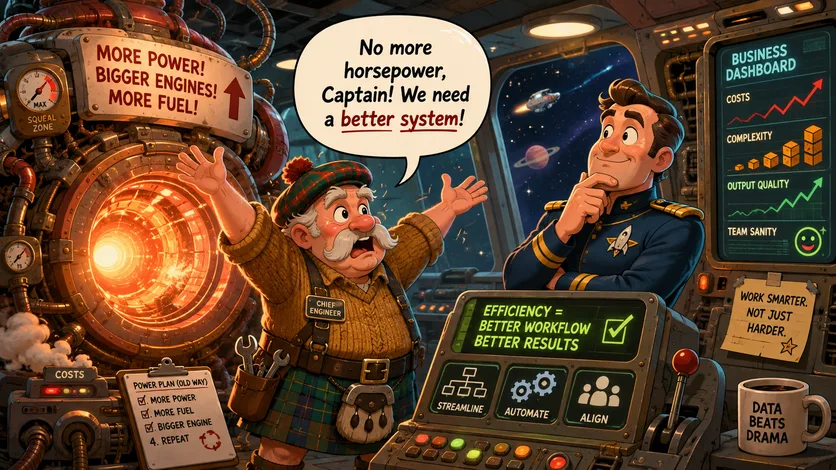
Think of it as Yoga for the brain, we are going to stretch a bit.
Stop Solving Every Business Problem With More Horsepower
Captain, I can’t give her any more power. I canna change the laws of physics!” — Scotty, Star Trek
One of the easiest mistakes in business is assuming that a bigger problem requires a bigger solution.
More employees – More advertising – More servers – More inventory – More meetings.
More managers. – More money.
Sometimes that works. Often it simply creates a larger, more expensive version of the same problem.
A recent open-source communications project provides a useful lesson. Engineers managed to achieve impressive long-distance performance not primarily by throwing more power at the problem, but by designing the system to make better use of the signal it already had.
You do not need to understand the engineering to understand the business lesson.
Better thinking can substitute for brute force.
Business Has Always Loved Horsepower
When a company begins struggling, the first instinct is frequently to add resources.
Sales are slow? Hire more salespeople.
Customer service is overwhelmed? Hire more representatives.
Production is behind? Add another shift.
Website is slow? Buy a larger server.
Marketing isn’t working? Increase the advertising budget.
Management can’t keep track of everything? Add another layer of management.
Those solutions are attractive because they are easy to understand.
If ten people can’t accomplish something, perhaps twenty can.
If spending $10,000 generates some customers, perhaps spending $20,000 will generate twice as many.
Unfortunately, business rarely works that neatly. If the underlying system is inefficient, adding resources can actually multiply the inefficiency.
Twenty people working badly together can create considerably more confusion than ten.
Before Adding Resources, Improve the System
The better question is:
Can we accomplish more with what we already have?
That question leads management in a completely different direction.
Instead of immediately hiring another employee, examine the workflow.
Instead of increasing the advertising budget, improve targeting.
Instead of buying more inventory, improve forecasting.
Instead of adding another manager, improve reporting.
Instead of replacing a computer system, eliminate unnecessary processing.
Instead of creating another meeting, improve the information people receive before the meeting.
You are no longer asking: How much more horsepower do we need?
You are asking: How much of our existing horsepower are we wasting?
That can be a much more profitable question.
The Cheapest Employee May Be the Process You Fix
Imagine a department with five employees.
Management believes it needs a sixth because everyone is overwhelmed.
Before hiring that sixth person, examine what the existing five actually do.
Perhaps each employee spends an hour every day copying information between systems.
That is five hours a day. Twenty-five hours a week. Roughly 1,300 hours a year.
Eliminate that unnecessary step and you may have effectively created a substantial portion of another employee without hiring anyone.
Better yet, the improvement continues producing savings every year.
The same idea applies throughout a company.
A ten-minute improvement repeated once is insignificant.
A ten-minute improvement repeated 100,000 times is a business strategy.
Technology Makes This More Important
Artificial intelligence, automation and modern software make the difference between horsepower and intelligence even greater.
For decades, companies solved administrative growth by adding administrative employees.
More invoices meant more accounting staff.
More customers meant more customer-service personnel.
More products meant more people maintaining catalogs.
More websites meant more web administrators.
That relationship is beginning to break.
Software can increasingly absorb repetitive work.
AI can classify information. Systems can generate reports automatically.
Software agents can monitor systems. Databases can synchronize information.
Customers can perform many administrative functions themselves.
The result is not simply that technology makes employees faster.
The larger opportunity is that companies can redesign how work happens.
That is far more powerful.
Don’t Automate a Bad Process
There is a trap here. Businesses often take a terrible process and automate it.
Now they have a terrible process that runs extremely quickly.
If employees enter the same information three times, don’t immediately build software that enters it three times automatically.
Ask why the information needs to be entered three times.
If management receives twelve reports every Monday morning, don’t immediately have AI generate twelve reports.
Ask whether anybody needs twelve reports.
Good technology should eliminate unnecessary work before accelerating necessary work.
That distinction matters.
Look for Leverage
The best businesses constantly search for leverage.
Leverage means finding something that produces an outcome larger than the effort required to create it.
Software is leverage. Automation is leverage. Brand reputation is leverage.
A good distribution network is leverage. A well-designed process is leverage.
Reusable intellectual property is leverage.
A highly trained employee using good tools is leverage.
A terrible company can grow only by continually adding resources.
A great company attempts to make every existing resource increasingly productive.
That difference compounds over time.
The CEO’s Question
When someone comes into your office asking for additional money, people, equipment or capacity, don’t automatically say no.
Sometimes more resources really are necessary.
But ask one question first:
What would we do differently if additional resources were not available?
That question forces people to think.
Maybe the workflow could change. Maybe a bottleneck could be eliminated.
Maybe something could be automated.
Maybe an unnecessary requirement could disappear.
Maybe customers could perform part of the process themselves.
Maybe the company is solving the wrong problem entirely.
Only after answering those questions should management decide whether additional horsepower is actually required.
Small Companies Have an Advantage
This way of thinking is particularly powerful for entrepreneurs and smaller companies.
A small company usually cannot defeat a large competitor by spending more money.
It cannot hire more people. It cannot purchase more advertising. It cannot build more locations.
Trying to win a horsepower contest against a company fifty times your size is usually foolish.
But the smaller company can redesign the game.
It can move faster. It can automate. It can specialize. It can use technology aggressively.
It can remove bureaucracy. It can experiment rapidly.
It can serve a niche the larger competitor considers too small.
David rarely defeats Goliath by purchasing a larger Goliath.
He wins by using a different weapon.
Intelligence Is Becoming Cheaper Than Horsepower
For most of industrial history, adding capability usually meant adding physical resources.
More factories. More employees. More machinery. More offices. More capital.
More -more – more !
The economics are changing.
Computing keeps getting cheaper.
Software can be duplicated almost without cost.
AI can perform tasks that previously required substantial human effort.
Automation can operate twenty-four hours a day.
That means one of management’s most important jobs is increasingly to identify where intelligence can replace unnecessary horsepower.
Not everywhere. People still matter. Capital still matters. Equipment still matters.
But management should no longer assume that growth requires resources to increase at the same rate as output.
The companies that discover how to break that relationship can become extraordinarily powerful.
The CEO Cookbook Recipe
When confronted with a business problem, use this order:
Define the actual problem.
Find the bottleneck.
Remove unnecessary work.
Simplify the process.
Automate what remains.
Use better information and better tools.
Only then add more resources.
Changing that order can save enormous amounts of money.
Because sometimes the answer really is another employee, another truck, another server or another million dollars of capital.
Sometimes the answer is simply a better idea.
And better ideas are considerably lighter to carry than more horsepower. I learn that racing cars, boats and hiking.