Think of it as Yoga for the brain, we are going to stretch a bit.
Why Trump Is Working With Delcy Rodríguez — And Why Venezuela Is Much More Complicated Than It Looks
Fixing Venezuela is like performing a heart transplant on someone while they’re riding a bicycle. Yes, it can be done. But nobody should pretend it’s simple. -- YNOT!
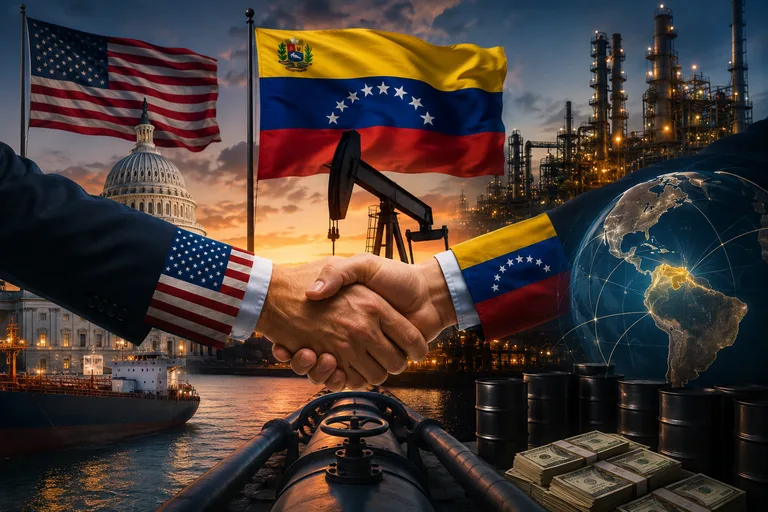
There is a tendency to look at what is happening in Venezuela and reduce it to one sentence: Trump wants the oil. That is certainly part of the story.
But it is nowhere near the whole story.
What is happening in Venezuela involves oil, international law, billions of dollars in old debts, the survival of the Venezuelan state, China, Russia, Iran, Cuba, and one very difficult question:
Who can actually run Venezuela while the country transitions away from Maduro?
That is why Donald Trump is dealing with Delcy Rodríguez rather than simply installing Juan Guaidó, María Corina Machado, or another opposition leader in Caracas.
It may look strange from the outside.
From a practical standpoint, however, there is a logic to it.
Venezuela Has a $200-Billion-Plus Problem
Before talking about politics, you have to understand the financial problem.
Venezuela has an enormous number of creditors.
Estimates of its total debt and creditor claims run as high as roughly $240 billion, including sovereign bonds, PDVSA debt, arbitration awards and court judgments.
Companies including ConocoPhillips and Crystallex have spent years trying to collect money Venezuela owes them.
CITGO is probably the most famous example.
That creates an enormous problem if you are trying to restart Venezuela.
Imagine that American and international companies spend tens of billions of dollars rebuilding Venezuelan oil production.
Production increases.
Venezuela begins selling billions of dollars of oil.
Then the money enters the international banking system and creditors immediately begin trying to seize it.
In simplified form: Venezuela sells oil > Money enters international banks > Creditors find the money > Courts are asked to attach it
Suddenly yesterdays creditors could get first crack at tomorrow’s oil revenue.
That makes rebuilding Venezuela extraordinarily difficult.
Why would someone invest $50 billion or $100 billion rebuilding an oil industry if the resulting revenue could immediately disappear into decades-old judgments?
Trump’s Financial Firewall
This is where one of the most important parts of Trump’s Venezuela policy comes in.
On January 9, 2026, Trump signed Executive Order 14373, “Safeguarding Venezuelan Oil Revenue.”
The structure protects certain Venezuelan natural-resource revenues placed into designated U.S. Treasury accounts from ordinary attachment, judgments, liens, execution and garnishment unless the United States authorizes it.
In other words, Trump did not erase Venezuela’s debts.
He effectively said: You may have a legitimate judgment against Venezuela, but you cannot automatically grab this particular pool of new Venezuelan oil revenue.
That is an important distinction.
The money is structured as Venezuelan sovereign government property being held by the United States for governmental and diplomatic purposes rather than simply sitting in an ordinary commercial bank account.
That creates a much stronger sovereign-immunity argument.
So instead of: Oil → Venezuelan bank account → creditor attachment
you have something closer to: Oil> U.S.-approved sale > Protected Treasury mechanism > U.S. oversight > Funds released for authorized purposes
Trump has therefore gained influence not only over the oil.
He has influence over the financial plumbing through which the oil money travels.
That may ultimately be more important.
Why Delcy Rodríguez?
This brings us to the political question.
Why work with Delcy Rodríguez?
Why not Juan Guaidó?
The answer is remarkably simple: Delcy controls things.
Juan Guaidó once had considerable international recognition.
In 2019, the United States recognized him as Venezuela’s interim president. That recognition gave his representatives standing in foreign courts and influence over Venezuelan assets located overseas.
But Guaidó always suffered from one enormous problem.
He had international recognition without effective control of Venezuela. He could sign a piece of paper.
That did not necessarily mean PDVSA would obey him.
It did not mean the Venezuelan military would obey him.
It did not mean the ministries would obey him.
It did not mean the police, customs service, electrical utilities, central bank or thousands of government employees would follow his orders.
By 2022, Venezuela’s opposition itself voted to abolish the Guaidó interim-government structure.
Guaidó eventually left Venezuela. The political landscape moved on.
Delcy Has Something Guaidó Never Had
Whatever anyone thinks of Delcy Rodríguez politically, she comes from inside the Venezuelan state.
She understands its machinery. And more importantly, much of that machinery recognizes her authority. That matters enormously.
Venezuela still needs somebody who can tell the Energy Ministry what to do.
The Energy Ministry needs to be able to tell PDVSA what to do.
PDVSA needs somebody legally empowered to negotiate production agreements, joint ventures, contracts and oil sales.
The military needs a functioning chain of command. Government employees need to get paid. Electricity needs to remain on. Police need orders. Ports must operate. Food must move. Oil must move. AS we say, “The Spice must flow”
A country of nearly 30 million people cannot simply be switched off while you build another government.
Remember Iraq
The United States has already learned what can happen when you remove a regime and simultaneously destroy the state underneath it.
Iraq should be permanently burned into American foreign-policy memory.
Remove the leadership. Dismantle the institutions. Disband the security apparatus.
Suddenly nobody knows who is in charge.
That vacuum can become more dangerous than the government you just removed.
Venezuela has armed groups, colectivos, criminal organizations, political factions and competing interests.
Imagine simultaneously removing thousands of officials throughout the Venezuelan government and announcing that a completely new opposition government — backed by Washington — is taking over tomorrow morning.
Chaos could follow. And politically, the new government would immediately be attacked as an American puppet government.
Trump appears to have chosen a different strategy.
Remove the Head — Don’t Destroy the Body
The strategy can be understood roughly like this:
Maduro> Remove the person at the top
Delcy Rodríguez >Keep ministries, military and PDVSA functioning
United States >Use sanctions relief, oil access and financial controls as leverage
Oil industry ↓ Restart production and attract investment Economy ↓ Stabilize currency, employment and government finances
Political system ↓ Gradually negotiate reforms and rebuild electoral institutions
Eventually ↓ Hold credible elections
That is a very different strategy from invading a country, destroying its government and trying to rebuild everything from scratch.
Trump is essentially attempting to change the direction of the Venezuelan system without completely destroying the system.
A Negotiation With the Devil
Nobody should confuse this with an endorsement of Delcy Rodríguez.
She was an important figure in the Maduro government. She is part of Chavismo.
The United States is dealing with somebody who helped operate the very political system Washington spent years opposing.
Sometimes international politics works that way.
You negotiate with the person who controls the soldiers, the oil company, the ministries and the government — because that person can actually deliver what was negotiated.
It is, in a sense, a negotiation with the devil to prevent chaos and disaster.
The opposition may represent Venezuela’s democratic future.
Delcy represents the Venezuelan government’s functioning present.
Those are two different things.
The Gamble
And there is a major risk. The longer Delcy controls Venezuela — particularly if billions of dollars of American and international investment begin flowing into the country — the harder it becomes to argue that she is simply a temporary caretaker.
The opposition has legitimate reason to worry.
What happens if Washington succeeds in stabilizing Venezuela, restarting the oil industry and improving living conditions — but Delcy remains in power?
Instead of eliminating Chavismo, America could inadvertently create something very different:
a market-friendly, U.S.-aligned version of Chavismo. That may be more stable.
It may be less hostile toward the United States. It may allow private investment.
But it is not necessarily the democratic transition the Venezuelan opposition has spent decades fighting for. That is the gamble Trump is making.
Then There Is the Oil
Venezuela possesses one of the largest petroleum resource bases on Earth.
Rehabilitating those fields will require enormous investment. Oil wells need work.
Pipelines need repairs. Refineries need modernization.
Electric infrastructure needs rebuilding. Ports need upgrades.
Thousands of skilled workers will be needed.
And after years of economic deterioration, Venezuela itself will require enormous reconstruction.
Which leads to another misconception. Americans should not imagine that the United States simply walks into Venezuela and starts collecting free oil.
Before America gets enormous economic benefits from Venezuelan production, somebody is going to spend many billions of dollars repairing the infrastructure required to produce it.
In the real world, everything costs money.
And Venezuela Is Bigger Than Venezuela
Perhaps the most important part of this entire story is geopolitical.
Venezuela has been one of the principal footholds in the Western Hemisphere for governments hostile to the United States.
Cuba. China. Russia. Iran.
Each developed political, military, intelligence or economic relationships with Caracas.
So from Washington’s perspective, changing Venezuela’s alignment is not simply about Venezuelan oil.
It changes the strategic map of the Caribbean and Latin America.
A Venezuela economically connected to the United States is very different from a Venezuela dependent upon Russia, China and Iran.
And then there is Cuba.
Venezuela has been extraordinarily important to the Cuban government for decades.
If Venezuela permanently moves out of Havana’s orbit, Cuba becomes considerably more isolated.
Viewed that way, Venezuela may be only one piece of a much larger strategy.
Trump is attacking the geopolitical problem one pressure point at a time.
Venezuela Will Not Be Fixed Overnight
There is also something Americans should understand.
Venezuela did not collapse overnight. It will not recover overnight either.
Government institutions have deteriorated. Infrastructure has deteriorated.
The oil industry has deteriorated. Millions of Venezuelans left the country.
Businesses disappeared. Capital fled. Professional talent fled.
The political wounds run deep.
Rebuilding Venezuela may resemble rebuilding after a massive hurricane — except the hurricane lasted for decades.
It may take five years simply for Venezuela to begin looking normal again.
Possibly much longer.
But a functioning Venezuela five years from now — producing oil, attracting investment, rebuilding infrastructure and preparing for legitimate political competition — would be an extraordinary improvement over where the country has been.
So Why Delcy?
Because Venezuela today needs two things simultaneously.
It needs continuity and it needs change. That sounds contradictory. It isn’t.
Trump needs someone capable of operating the existing Venezuelan government while Washington pushes that government in a completely different direction.
Guaidó once had international legitimacy without domestic power.
The opposition may ultimately have democratic legitimacy.
But Delcy Rodríguez currently has something enormously valuable during a transition:
the ability to make the Venezuelan state actually do something.
That does not make her the democratic future of Venezuela.
It makes her the bridge Trump has chosen to try to get there.
Whether that bridge leads to a genuinely democratic Venezuela or merely a more prosperous and American-friendly version of Chavismo remains the billion-dollar question.
Probably the hundred-billion-dollar question.
Because Venezuela is complicated.
International politics is complicated.
Rebuilding destroyed countries is complicated.
And sometimes moving forward means working with people you would never have chosen in the first place.
For now, Venezuela is functioning.
Its oil industry is beginning to move again.
Money is beginning to move again.
Investment is beginning to become possible again.
The country has a long way to go.
But after years of watching Venezuela move steadily backward, simply seeing it move forward matters.
And if this works, the biggest consequence may ultimately not be Venezuelan oil at all.
It may be what happens next in Cuba, China, Russia and Iran’s influence in the Western Hemisphere.