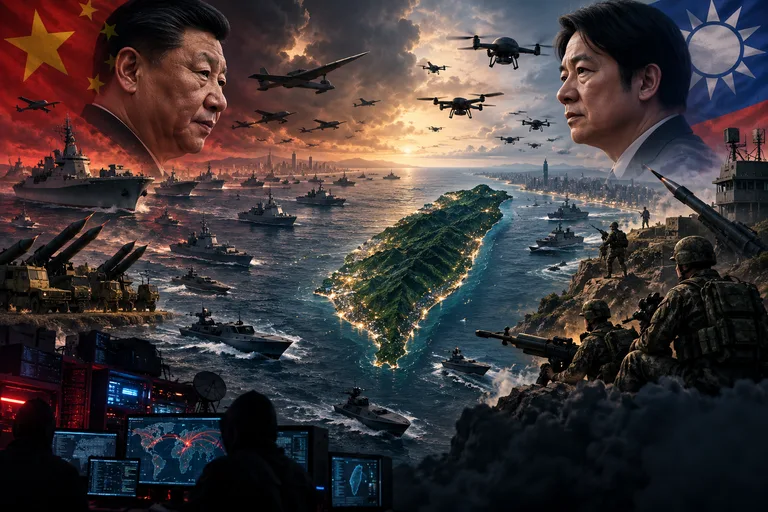
Think of it as Yoga for the brain, we are going to stretch a bit.
China, China, China… Is There Going to Be a War in 2027? Well…
2027 is not an invasion date—it is a capability date. -- YNOT!
For the last few years, 2027 has been floating around Washington like the date on a wedding invitation.
China. Taiwan. 2027. War. Circle the date.
Buy ammunition. Order extra microchips.
Perhaps cancel your vacation to Taipei.
Except there is one small problem.
China has apparently neglected to send out the invitations.
The U.S. intelligence community said in its 2026 Annual Threat Assessment that Chinese leaders do not currently plan to invade Taiwan in 2027, and that Beijing does not appear to have a fixed timetable for reunification. What China is doing is building the military capability to make such an operation possible if its leadership decides to order one.
That is an important distinction. 2027 isn’t necessarily the year of the war.
It is closer to the year when China wants to be able to say: “If we wanted to, we could.”
And unfortunately, the difference between having a weapon and deciding to use it has never been one of humanity’s stronger intellectual achievements.
China Is Preparing
There is no great mystery about whether China is preparing for a possible confrontation over Taiwan.
It is. Ships. Aircraft. Missiles. Cyber units. Satellites. Special forces. Coast Guard vessels. Drones. More drones.
And, because apparently everyone has been watching Amazon, delivery systems for delivering the drones.
Chinese military operations around Taiwan have become routine enough that what once would have generated screaming headlines can now pass for Tuesday.
Taiwan’s latest defense reporting says China is steadily strengthening its ability to control the air and sea around the island while practicing operations that could isolate Taiwan in the early stages of a conflict. Beijing has also been studying drone swarms and other lessons emerging from Ukraine and recent wars.
That last part matters enormously. Because Ukraine changed warfare.
Not theoretically. Not in a Pentagon PowerPoint presentation.
On television. Every night.
Ukraine Changed the Mathematics of War
Before Ukraine, military power was generally measured by counting expensive things.
How many tanks? How many fighter aircraft? How many destroyers? How many missiles?
How many generals with impressive hats?
Then along came a Ukrainian kid with a $2,000 drone carrying explosives who destroyed something worth several million dollars.
Suddenly the mathematics became uncomfortable.
A cheap drone can destroy an expensive tank.
A relatively inexpensive sea drone can threaten a warship.
A swarm of drones can force an enemy to expend enormously expensive air-defense missiles.
And a small country that cannot necessarily control the sea can still make the sea extremely unpleasant for somebody who thinks he does.
The material supplied for this article gets to the heart of the lesson: Ukraine demonstrated that smaller forces using inexpensive drones, anti-ship weapons, dispersed command and asymmetric tactics can impose tremendous costs on a much larger military.
Both sides of the Taiwan Strait have been watching.
But naturally they reached opposite conclusions.
China looked at Ukraine and said:“We need more drones.”
Taiwan looked at Ukraine and said:“We REALLY need more drones.”
Taiwan Is Building Its Porcupine
Taiwan knows something that sometimes gets lost when people compare military inventories.
Taiwan does not have to conquer China.
Taiwan does not have to occupy Shanghai.
Taiwan does not have to march into Beijing and put up a Taiwanese Starbucks.
Taiwan merely has to make invading Taiwan unbearably expensive.
That is a completely different military problem.
And Taiwan is increasingly restructuring around it.
The Taiwanese military says unmanned systems are now a priority, specifically emphasizing systems that can be mass-produced, maintained and upgraded rather than relying solely on small numbers of exquisite weapons.
That is Ukraine talking.
And Taiwan is putting serious money behind the idea.
As of September 2026, Taiwan’s government has proposed buying more than 600 coastal reconnaissance drones, more than 40,000 coastal attack drones and more than 100 unmanned attack boats, alongside missile and surveillance systems.
Forty thousand attack drones.
Now imagine trying to move an invasion fleet across roughly a hundred miles of water while thousands of inexpensive flying cameras and explosives are looking for you.
That does not make Taiwan invulnerable.
Nothing is invulnerable.
But it changes the calculation.
And wars frequently begin—or fail to begin—because somebody changes the calculation.
The First Battle May Not Involve Shooting
But here is where people thinking about Normandy-style beaches may be missing the more interesting part.
China does not necessarily have to begin by invading Taiwan.
And the gradual normalization of Chinese military operations around Taiwan.
The source material describes precisely this spectrum: espionage networks, cyberattacks, disinformation campaigns and partial or total naval blockades that could be used to pressure Taiwan without immediately conducting an amphibious invasion.
That may actually be the more dangerous scenario.
Because everybody recognizes 5,000 landing craft coming across the Taiwan Strait as a war.
But what exactly do you call twenty Chinese Coast Guard vessels inspecting commercial ships?
What happens when China announces a “customs enforcement zone”?
Or a military exercise lasting three weeks?
Or starts stopping fuel tankers?
When does the United States shoot?
At ship number three? Ship number fourteen? Tuesday?
This is the great attraction of gray-zone warfare.
You can boil the frog while arguing about whether the water is technically boiling.
Then There Are the Spies
China also has another weapon considerably cheaper than an aircraft carrier. People.
Taiwan says espionage efforts directed by China have risen dramatically.
Taiwan’s National Security Bureau reported that 64 people were charged in suspected Chinese espionage cases during 2024, compared with 48 in 2023 and just 10 in 2022. Many were current or former members of Taiwan’s military.
And this isn’t ancient history.
Taiwanese prosecutors announced another major case in 2026 involving military personnel accused of passing classified information to mainland Chinese interests in exchange for money.
That is enormously important because the first hours of any attack on Taiwan could be decisive.
Where are the aircraft?
Where are the missile launchers?
Who commands which unit?
Where does the president go?
Which communications systems are redundant?
Which radar systems can be disabled?
Which officer can be bought?
Which official can be blackmailed?
Which computer already has somebody inside it?
A spy costing $100,000 who tells you where a billion-dollar weapon is located may be the finest return on investment in the entire defense budget.
Which brings us to another lesson from Ukraine.
You don’t necessarily destroy the enemy’s entire military.
You find the important pieces and kill those.
The War May Start With a Laptop
Taiwan reported that Chinese-linked cyber activity against its critical infrastructure averaged about 2.6 million attacks per day during 2025, targeting sectors including finance, hospitals, energy and the semiconductor industry. Beijing denies responsibility for such operations.
Again, think about the first morning of a hypothetical war.
The electricity fails. The cell network becomes unreliable.
Banks are unavailable. Government websites disappear.
Fake emergency messages circulate.
Videos appear showing explosions that never happened.
Another video supposedly shows the president fleeing.
Military officers receive false orders.
Social media fills with rumors that America has decided not to help.
Meanwhile Chinese aircraft and ships are moving.
Which attack came first?Nobody knows.
Welcome to modern warfare.
The missile might be the last thing you notice.
And Then There Are the Chips
And this is where Taiwan stops being merely an argument between Taiwan and China.
Taiwan produces almost 90 percent of the world’s high-volume leading-edge semiconductor chips.
These are not simply chips for fancy phones.
They are central to:Artificial intelligence. Data centers. Weapons. Robotics. Automobiles. Telecommunications. Industrial equipment. Medical equipment.
And nearly every other machine we have spent the last thirty years making smarter.
Which means Taiwan possesses something rather unusual.
A factory system so important that blowing it up might wreck the attacker’s economy along with the defender’s.
People sometimes call this Taiwan’s Silicon Shield.
The theory is simple. Taiwan is too important to destroy.
There is, however, an unpleasant alternative.
Don’t destroy it. Blockade it.
Taiwan imports most of its energy and a large share of the resources required to keep its economy operating. Shut down enough shipping and eventually semiconductor production becomes difficult regardless of whether anybody bombs the factories.
And suddenly Beijing isn’t merely negotiating with Taiwan.
It is negotiating with Apple. NVIDIA. America. Europe. Japan.
Every automobile manufacturer. Every AI company.
Every military contractor waiting for sophisticated electronics.
China could theoretically put a hand around Taiwan’s throat and ask the rest of the world:
“How badly do you need your chips?”
That could make a blockade economically more powerful than several divisions of soldiers.
Which Is Why 2027 May Be the Wrong Question
So is China going to invade Taiwan in 2027?
Probably the best answer available today is:
Nobody knows—but there is no credible evidence that Xi Jinping has circled “Invade Taiwan” on his 2027 calendar.
U.S. intelligence specifically says there is presently no fixed 2027 invasion plan.
But that doesn’t make the situation comfortable.
Because China doesn’t need to decide today. It only needs options.
The more ships China has, the more options.
The more missiles China has, the more options.
The more spies China has inside Taiwan, the more options.
The more Taiwan depends on imported fuel, the more options.
The more the world depends on Taiwanese chips, strangely enough, the more options.
And the more capable China becomes, the easier it becomes for some future Chinese leader to convince himself that the gamble might work.
That is the danger.
Taiwan Understands the Assignment
Taiwan appears to understand what Ukraine taught the world.
Don’t try to become China. Become extremely difficult to swallow.
Disperse command. Hide the missiles. Build drones by the tens of thousands.
Build cheap weapons that can destroy expensive ones.
And make every Chinese admiral looking across the Taiwan Strait calculate how many ships he might not be bringing home.
Taiwan’s defense spending is consequently climbing sharply. President Lai Ching-te says the 2027 defense budget will exceed NT$1 trillion for the first time, with increasing emphasis on domestic military production, artificial intelligence and unmanned systems.
This is deterrence in its simplest form.
You don’t have to convince your opponent that you will win.
You merely have to convince him that winning will hurt too much.
China, China, China…
So yes.
China, China, China.
We should be watching China.
But perhaps not while staring at a calendar waiting for 2027.
The real story is happening right now.
China is practicing blockades. Taiwan is manufacturing drones.
Chinese intelligence is trying to penetrate Taiwanese institutions. Taiwan is trying to identify the spies.
Hackers probe electrical grids and semiconductor companies.
Missiles move into position. Factories make chips. Factories make drones.
And both sides are watching Ukraine like students watching somebody else take the final examination first.
Ukraine taught the world something military planners have repeatedly forgotten:
Big armies are powerful. Cheap technology can be powerful too.
And a country defending its own home does not necessarily have to defeat the giant standing outside.
Sometimes it simply has to make the giant look at the front door and decide:
Maybe we should come back another day.
The question therefore isn’t really: “Will China invade Taiwan in 2027?”
The better question is: “By 2027, will China believe it can take Taiwan at a price it is willing to pay?”
Because those are two very different questions.
And unfortunately, history usually gets interesting when somebody answers the second one incorrectly.
The April Window
A Taiwan 2028 Wargame
September 4, 2026.
Everybody is watching 2027.
That may be the first mistake.
Washington has spent years talking about China’s 2027 military readiness goal as though Xi Jinping had booked Taiwan for Tuesday afternoon.
But U.S. intelligence now says Beijing does not have a fixed plan to invade Taiwan in 2027. China would still prefer to get what it wants without fighting if it can.
So for this exercise, let us assume Washington is right.
There is no invasion in 2027.
Instead, China has picked another date.
Mid-April 2028.
And nobody outside a very small circle in Beijing knows it.
Why April? Because geography gets a vote.
The Taiwan Strait is miserable water for an amphibious operation during much of the year. U.S. Army analysis describes April as one of the best, though still imperfect, windows: relatively moderate seas, lower typhoon risk and more stable winds.
But the weather is only half the story.
The other half is politics.
Taiwan’s next presidential election should occur in early 2028 under the normal four-year cycle. The exact election date has not yet been officially announced, so our wargame assumes January 2028.
The incumbent presidential term, however, runs until May. President Lai Ching-te took office on May 20, 2024, and Taiwan’s presidents serve four-year terms.
Which creates a fascinating little window:
Election in January. New political reality established.
Old president still governing. New president not yet inaugurated.
April weather arrives.
If I were writing the spy novel, that is where I would put the war.
SEPTEMBER–DECEMBER 2026
Phase One: Stop Looking Like You’re Preparing for War
The first order from Beijing is surprisingly simple:
Calm down. Not completely. Chinese aircraft still fly.
Ships still sail around Taiwan. Military exercises continue.
But nothing happens that screams: INVASION COMING.
That is the point. China wants military pressure around Taiwan to become boring.
Another aircraft. Another destroyer. Another Coast Guard patrol.
Another exercise. Another hundred drones. Another cyberattack.
Eventually everybody stops putting it on the front page.
This is already partly happening. Taiwan says China now conducts near-daily operations around the island and is studying drone swarms, ammunition consumption and blockade operations based partly on lessons from Ukraine and other recent conflicts.
The extraordinary becomes ordinary.
Which is exactly what you want if one day the ordinary exercise isn’t an exercise.
Beijing’s 2026 checklist
China concentrates on five things. Intelligence. Politics. Drones. Ships. Logistics. Not glamorous.
Wars usually aren’t won by glamorous things.
They are won by knowing where everything is and having enough diesel fuel when you get there.
Chinese intelligence spends the remainder of 2026 updating its map of Taiwan.
Not merely military bases. People. Government officials. Military officers.
People who know where things are. People who know how things work.
And people who might make things stop working.
Taiwan already has reason to worry. The number of Taiwanese charged in suspected Chinese espionage cases rose sharply in recent years, with many involving serving or retired military personnel.
That does not mean China has secretly taken over Taiwan’s government.
It means our fictional Chinese planners have something every spy service wants:
A head start.
TAIWAN — FALL 2026
The Porcupine Starts Growing Quills
Taipei isn’t asleep. Quite the opposite.
Taiwan has just been practicing how to survive a blockade, communications outages, cyberattacks, civil disruption and eventually invasion.
Its 2026 Han Kuang exercises included anti-blockade naval operations and even deliberately restricted mobile internet to simulate wartime communications problems.
And Taiwan is buying drones like somebody just discovered drones.
More than 40,000 coastal attack drones are included in proposed spending, along with hundreds of reconnaissance drones and more than one hundred unmanned attack boats.
Ukraine has taught Taiwan the same lesson it taught China.
You don’t always fight a $10 million weapon with another $10 million weapon.
Sometimes you fight it with something assembled in a factory by the thousand.
China watches Taiwan preparing. Taiwan watches China watching.
Everybody takes notes.
JANUARY–APRIL 2027
Phase Two: The Year Everyone Expected the War
Now comes the clever part. 2027 arrives.
Western newspapers explode. THIS IS THE YEAR.
Think tanks hold conferences. Generals testify.
Television experts discover maps.
Chinese military activity increases.
And then… Nothing happens.
China exercises. Taiwan mobilizes. America moves ships.
China flies aircraft. Taiwan scrambles aircraft.
Everybody waits. Nothing.
By April the weather window passes.
No invasion.
SUMMER 2027
The Boy Who Cried Taiwan
This is useful to Beijing.
Because after years of hearing:
2027! 2027! 2027!
2027 becomes evidence that the experts were wrong.
Investors decide that surely China would not destroy the world’s most important semiconductor manufacturing center.
People begin saying:“We’ve been hearing this Taiwan invasion stuff forever.”
Exactly. The boy has cried wolf.
China still has the wolf.
SUMMER–FALL 2027
Phase Three: The Election
Now the military temporarily moves backstage.
Politics moves forward.
China already appears to be devoting increasing attention to Taiwan’s 2028 elections, including greater outreach to the opposition Kuomintang. That overt political contact should not be confused with espionage, but it demonstrates why the election itself matters enormously to Beijing.
In our scenario, Beijing wants the election fought over one question:
Who is responsible for the danger?
China’s preferred message is not: Vote for China.
That would be stupid.
The message is: Vote for peace.
One candidate is described as reckless.
Another as safe. One policy means confrontation.
Another means prosperity.
One politician will get your children killed.
Another will keep factories open.
Social media fills with arguments. Real videos. Fake videos. Real scandals. Manufactured scandals.
Leaks. Rumors. AI-generated recordings.
Anonymous documents.
Nobody knows where half of it originated.
Which is exactly the point. The objective is not necessarily to make Taiwanese people love Beijing.
The objective is to make Taiwanese people distrust each other.
Airlines adjust schedules. Internet disruptions appear.
Taipei complains. Beijing responds: Military exercise.
Day two. Still an exercise.
Day three. Still an exercise.
Day four. Something changes.
Ships are no longer behaving like training targets.
They’re behaving like a barrier.
The exercise is becoming a quarantine.
And nobody can identify the exact minute when peace ended.
APRIL 13
The Spies’ Last Job
Now the networks inside Taiwan matter.
Not because they “control Taiwan.”
They don’t. Their job is much simpler.
Confusion. Contradictory reports circulate.
False information appears alongside real information.
Officials argue over whether China intends invasion or coercion.
Anonymous claims appear that Washington has privately told Taiwan not to escalate.
Another report says American forces are coming.
Another says they aren’t.
Taiwan arrests suspected intelligence operatives.
Beijing calls the arrests political persecution.
Cyberattacks intensify.
The power stays on. Mostly.
The internet works. Mostly.
The government functions. Mostly.
That word—mostly—becomes enormously important.
APRIL 14
The Last Night of Peace
Taiwan knows. Washington knows. Tokyo probably knows. Beijing knows they know.
But knowing an attack might happen and knowing exactly when it will happen are different things.
Taiwan disperses its forces. Drones come out of storage. Missile units move.
Government continuity plans activate. Emergency communications go live.
Civilian authorities prepare shelters and hospitals.
The Taiwanese military has spent years preparing precisely for this kind of disruption, including blockade, communications failure, cyberattack, disinformation and attacks on infrastructure.
Across the Strait, China waits. Weather reports arrive. Sea state acceptable.
Forecast acceptable.
And somewhere in Beijing a decision that may have been made eighteen months earlier finally becomes an order.
So lets Wargame this
MID-APRIL 2028: The War everybody Thought Would Start in 2027
It does not begin with thousands of soldiers charging onto a beach.
It begins everywhere. Cyber. Electronic warfare. Drones. Missiles. Aircraft.
Naval forces. Blockade operations. Information warfare.
Then, if Beijing still believes the operation can succeed, the attempted crossing begins.
And suddenly everybody understands what happened.
The invasion did not really begin that morning.
It began years earlier. When China mapped Taiwan’s institutions.
When it recruited intelligence sources. When it normalized military operations around the island.
When it studied Ukraine. When it built drones. When it practiced blockades.
When it learned how quickly modern armies consume missiles and ammunition.
When it studied how Taiwan communicates. When it tried to influence Taiwanese politics.
When it waited for everybody to stop believing 2027 mattered.
And, most importantly, when it realized something military planners have understood since people first started crossing rivers with spears:
Never attack when your enemy expects you.
Attack when he has spent so long expecting you that expectation itself has become routine.
And Taiwan?
Taiwan has spent those same eighteen months doing exactly the opposite.
Building drones. Building missiles. Practicing blockades. Finding spies.