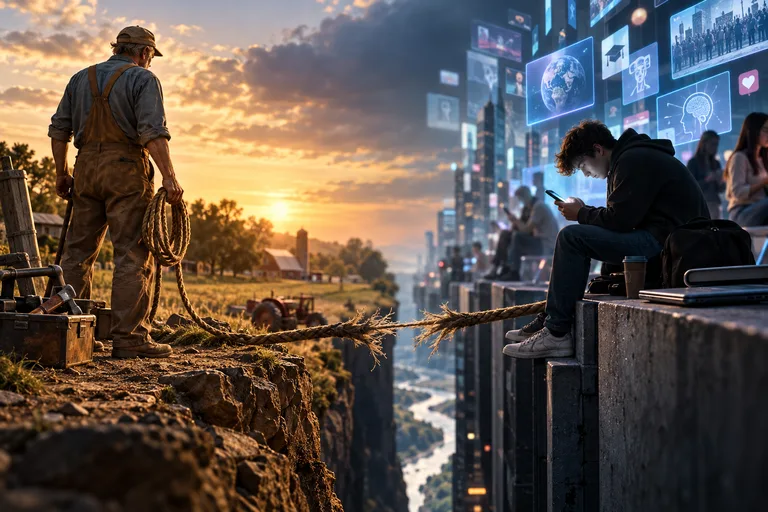
Think of it as Yoga for the brain, we are going to stretch a bit.
UNTETHERED – How Our Current Generations Lost Track of Reality
Somewhere between the invention of the smartphone and the disappearance of the neighborhood mechanic, America managed to produce a generation that can explain how the world ought to work but has absolutely no idea how to fix it when it doesn't. --YNOT!
The Great American Disconnect
There was a time in America when a man could build a house, repair his automobile, grow his dinner, and argue about the Constitution—all before supper.
Today, we have people with master’s degrees who cannot change a tire, politicians who cannot balance a budget, and college professors who could explain the philosophical implications of a leaking faucet but couldn’t stop the water if their lives depended on it.
We call this progress. I suppose it is, provided the electricity stays on.
Somewhere along the way, we lost something that made America extraordinary. Not our technology, our wealth, or even our educational institutions.
We lost our connection to reality. We became untethered from it. And Now AI can make it worse.
And the remarkable thing is that we did it while congratulating ourselves on how much smarter we had become.
The Generation That Could Do Everything
My grandparents belonged to a generation that understood something rather fundamental about life.
The world does not care about your credentials.
If the roof leaks, it leaks.
If the tractor breaks, the crops don’t wait for a committee to investigate.
If the plumbing fails, a master’s degree in sociology will not prevent the basement from flooding.
These people grew up in a world where knowledge had immediate consequences.
You either understood how something worked, or you suffered the consequences of not understanding it.
That did not make them intellectually superior. Many had little formal education.
But they possessed something increasingly rare. Practical intelligence.
They understood that knowledge was not something you displayed. It was something you used.
A farmer might discuss Shakespeare while repairing a fence. An electrician might understand politics better than the senator whose house he wired. A mechanic might know more about physics than a university graduate who had passed three courses on the subject.
Nobody considered this unusual. Intelligence and practical ability were not opposing qualities.
They were simply different tools carried by the same person.
Today, we have managed to separate them into competing social classes.
And somehow, we have convinced ourselves that the people who know how to do things are less sophisticated than the people who know how to talk about doing things.
That is a rather peculiar definition of civilization.
When Education Became a Status Symbol
Education was once supposed to teach people how to think.
Somewhere along the way, it became increasingly concerned with teaching people what to think.
There is an important difference.
A good education should give you the intellectual tools to question the world, examine evidence, solve problems, and recognize when your own assumptions are wrong.
A poor education teaches you the correct vocabulary, the approved opinions, and the comforting belief that everyone who disagrees with you must be intellectually deficient.
One produces independent thinkers.
The other produces expensive parrots.
Historian Victor Davis Hanson, speaking with Mike Rowe in the conversation that inspired this article, described something particularly interesting about his own upbringing.
Hanson grew up farming in California while pursuing an academic career that eventually included advanced degrees, university teaching, and numerous books.
His family never treated his academic accomplishments as evidence that he was somehow superior to the people working the land.
When he returned home after earning his doctorate and complained about the lack of academic employment, his father essentially pointed him toward some electrical work that needed doing.
Congratulations on the PhD.
Now get to work.
There is a certain magnificence in that response.
His father was not dismissing education.
He was reminding his son that education did not exempt him from reality.
That distinction is increasingly missing from modern society. Pasted text
The Rise of the Credentialed Helpless
We have developed a rather strange social arrangement.
A person who can design a computer network, repair a diesel engine, or install an electrical system is frequently classified as a blue-collar worker.
Someone who spends eight hours attending meetings about organizational productivity may be classified as a highly educated professional.
One keeps civilization functioning.
The other may be trying to arrange another meeting.
This is not an argument against intellectual professions. Scientists, writers, teachers, lawyers, historians, and researchers are essential to a sophisticated civilization.
But we have made a serious mistake by confusing credentials with competence.
A degree demonstrates that someone completed a particular course of study.
It does not automatically establish wisdom, judgment, curiosity, honesty, or the ability to solve problems outside that discipline.
And yet, much of our society operates as though the possession of a credential establishes superiority in nearly every intellectual undertaking.
It does not.
A plumber who has spent twenty years diagnosing complicated mechanical failures may possess extraordinary problem-solving abilities.
A farmer who manages equipment, weather, finances, personnel, biology, and unpredictable markets is running an extraordinarily complex operation.
A skilled machinist routinely works with measurements and tolerances that would astonish many people who consider themselves mathematically sophisticated.
These individuals may not possess prestigious credentials.
But the universe has been examining their work every day.
And unlike a university professor, the universe does not grade on a curve.
The Illusion of Independence
Perhaps the most dangerous consequence of becoming untethered is that we have confused convenience with independence.
Consider the average modern household.
Electricity arrives through wires nobody understands.
Water appears when a handle is turned.
Food arrives in packaging that conceals the farms, factories, trucks, refrigeration systems, and thousands of workers responsible for producing it.
Information appears on a screen.
Money moves invisibly between computers.
Almost everything we depend upon is provided by systems we rarely see and increasingly cannot repair.
We are more technologically capable as a civilization than any generation before us.
Yet individually, many of us have become extraordinarily dependent.
There is nothing inherently wrong with specialization. Civilization advances because people develop expertise and exchange their skills.
The problem begins when specialization becomes complete ignorance of everything outside our narrow field.
A person who has never considered where electricity comes from may enthusiastically advocate eliminating one energy source without understanding what must replace it.
Someone unfamiliar with agriculture may propose sweeping changes to food production without appreciating the realities of soil, water, fertilizer, transportation, and economics.
A politician may promise to manufacture more products domestically without understanding the machinery, labor, energy, infrastructure, and supply chains involved.
And increasingly, the loudest voices in these discussions belong to people who have never had to make the systems they are discussing actually work.
They live in a world of abstractions.
Unfortunately, the rest of us live in the physical universe.
And the physical universe is notoriously uncooperative with political slogans.
The Disappearance of Consequences
One of the great teachers in human history has always been failure.
Build a fence incorrectly, and the cattle escape.
Wire something incorrectly, and the circuit breaker trips—or something worse happens.
Spend more money than you earn, and eventually the bank has an unpleasant conversation with you.
Plant the wrong crop at the wrong time, and the harvest provides a rather comprehensive performance review.
Reality offers feedback. Sometimes immediately. Sometimes painfully.
And always without consulting your feelings.
But modern institutions have become remarkably talented at insulating people from the consequences of their decisions.
A corporation makes disastrous choices, and executives depart with generous compensation.
A university graduates students who cannot demonstrate expected competencies, and the institution raises tuition.
A government program fails to achieve its objectives, and the proposed solution is frequently more funding.
A politician makes promises that cannot be fulfilled, and the resulting failures are attributed to circumstances, opponents, or insufficient commitment.
Ordinary people do not always enjoy these protections.
The electrician who installs faulty wiring faces consequences.
The mechanic who damages an engine faces consequences.
The small business owner who repeatedly makes bad decisions eventually stops being a business owner.
The distance between decisions and consequences is one of the most important differences between the physical economy and the world of institutional management.
And that distance can breed arrogance.
It is easy to believe your ideas are brilliant when someone else is responsible for making them work.
How We Became Afraid of the People Who Build Things
There is another element to this disconnect, and it is rather uncomfortable.
We have developed a cultural hierarchy in which intellectual labor is frequently regarded as more prestigious than physical labor.
Yet the people at the top of that hierarchy are often completely dependent upon the people they consider beneath them.
The university administrator needs the electrician.
The politician needs the farmer.
The software executive needs the technician maintaining the electrical grid.
The billionaire needs someone who knows how to repair the elevator.
And when the plumbing fails at the headquarters of an organization dedicated to transforming society, nobody calls the philosophy department.
They call a plumber.
Mike Rowe and Victor Davis Hanson discussed this divide at length, including the possibility that some of the tension between professional elites and skilled workers comes from a simple human emotion.
Fear. Not necessarily fear of physical danger.
Fear of being exposed as helpless.
There is something uncomfortable about realizing that someone with far fewer formal credentials possesses abilities you cannot begin to replicate.
Especially when your social identity depends upon believing yourself to be unusually capable.
Of course, not every academic looks down on tradespeople, and not every skilled tradesperson possesses broad wisdom. Those would be equally foolish assumptions.
The real mistake is treating education and practical competence as mutually exclusive.
They never needed to be.
The ideal society does not force us to choose between the philosopher and the mechanic. It encourages us to become a little of both.
The American Can-Do Spirit
America was not built by people who waited for permission.
It was built by farmers, inventors, immigrants, mechanics, engineers, entrepreneurs, tradespeople, and countless others who encountered problems and decided to solve them.
Often imperfectly. Frequently dangerously. Occasionally with spectacularly bad judgment.
But they tried.
And when their first solution failed, they tried something else.
The American frontier encouraged a particular kind of independence.
If something broke, there might not be anyone available to repair it.
If you needed shelter, you built it.
If you wanted to establish a business, there was often no established institution waiting to explain the proper procedure.
This culture helped produce generations of practical innovators.
It also contributed to America’s industrial development.
During World War II, American manufacturing benefited enormously from a workforce familiar with machinery, automobiles, farming equipment, and mechanical repair.
The ability to maintain equipment in difficult conditions was a military advantage.
But the deeper lesson is not about tanks or factories.
It is about confidence. People who understand how things work tend to approach unfamiliar problems differently.
They do not automatically assume that a problem belongs to someone else.
They investigate. They experiment. They make mistakes. They try again.
That willingness to engage directly with reality is what we risk losing.
The Internet Made Everyone an Expert
Then came the internet. A magnificent invention.
For the first time in human history, ordinary people gained access to an astonishing portion of humanity’s accumulated knowledge.
A teenager could study quantum mechanics, learn computer programming, explore ancient philosophy, or discover how to rebuild an engine.
Information that once required access to a major library could be retrieved in seconds.
It should have produced the most intellectually curious generation in history.
And in some ways, it has. People today can learn extraordinary things independently.
But the internet also produced something else.
The illusion of expertise. People began confusing access to information with understanding.
Reading an article became equivalent to researching a subject.
Watching a video became equivalent to possessing experience.
Repeating a popular opinion became equivalent to thinking.
And accumulating followers became a substitute for demonstrating competence.
We created a world in which someone who has spent forty years studying a subject may be dismissed by someone who watched three videos over breakfast.
Not because the expert is necessarily correct. Experts can be wrong.
But because our culture increasingly struggles to distinguish between evidence, experience, confidence, and popularity.
The internet gave everyone a microphone. Unfortunately, microphones do not come equipped with intelligence filters.
Social Media and the Manufacture of Reality
Social media accelerated the problem. The platforms discovered that outrage, certainty, and emotional stimulation attract attention.
Nuance is difficult to monetize. Anger is wonderfully profitable.
A thoughtful explanation requiring ten minutes of concentration competes against a fifteen-second video declaring that everything you believe is correct and everyone who disagrees is an idiot.
The fifteen-second video frequently wins. Why?
Because thinking requires effort. Agreement requires very little.
Algorithms learned to provide people with increasingly refined versions of what they already wanted to believe.
Political opinions became identities. Disagreements became moral offenses.
Complicated questions became battles between heroes and villains.
And somewhere in the process, millions of people began living in personalized information environments where nearly every source reinforced their existing worldview.
Two neighbors could occupy the same street, encounter the same events, and believe they were living in entirely different countries.
Not because reality had changed. But because their information had been filtered through different ideological machinery.
We did not simply lose the ability to agree. We began losing agreement about what constitutes evidence.
That is a far more serious development.
A democracy can survive disagreement. It cannot function particularly well when its citizens no longer share basic methods for determining what is true.
When Politics Became a Substitute for Thinking
Politics was once largely concerned with practical disagreements.
How much should government spend?
What taxes should be collected?
How should roads, schools, national defense, and public infrastructure be managed?
Those questions remain important.
But much of modern political culture has transformed into something resembling professional sports.
People select teams. They wear the colors. 0They defend their players.
They excuse behavior they would condemn in the opposing team.
And they frequently evaluate information according to whether it benefits their side.
A bad policy becomes acceptable when proposed by someone they support.
A good idea becomes unacceptable when proposed by someone they dislike.
The politician’s personality becomes more important than the policy’s results.
And the ability to admit that an opponent might occasionally be correct is treated as ideological betrayal.
This is not exclusively a problem of the political left or right.
It is a problem of human tribalism amplified by modern communications technology.
The attached conversation between Rowe and Hanson also illustrates how readily discussions of competence, class, and institutional trust can move into intensely partisan territory. Some of Hanson’s political assessments are strongly contested, but the underlying question is broader than any candidate: Can we evaluate leaders by consistent standards rather than personal loyalty or hostility? Pasted text
A functioning society requires citizens capable of saying two things simultaneously.
I agree with this person’s policy. And I disagree with that person’s behavior.
Or the reverse. These are not contradictory positions.
They are evidence that someone is still thinking independently.
The Generation That Inherited Everything
Perhaps the greatest irony is that younger generations inherited an extraordinary civilization.
Reliable electricity. Clean drinking water. Modern medicine. Global communications.
Agricultural systems capable of feeding populations unimaginable to earlier generations.
These achievements required centuries of experimentation, investment, sacrifice, and accumulated knowledge.
They are not natural features of the landscape.
They are engineered systems.
And engineered systems require maintenance.
Yet when people grow up surrounded by functioning infrastructure, they may begin treating it as a permanent condition of nature.
Water simply exists. Electricity simply exists. Food simply exists. The internet simply exists.
The extraordinary becomes ordinary. The ordinary becomes invisible.
And the invisible becomes unappreciated.
This is not entirely the fault of younger generations.
They inherited the environment older generations created.
We taught them that success meant attending college, pursuing prestigious professions, and avoiding the difficult physical work previous generations had performed.
We removed practical education from many schools.
We elevated credentials above demonstrated ability.
We allowed technology to replace experiences that once taught independence.
Then we complained when young people lacked skills nobody had bothered to teach them.
That seems a rather unfair arrangement.
It is also important to recognize that many young people are extraordinarily capable. They are building businesses, writing software, mastering trades, creating technology, and solving problems their grandparents could scarcely imagine.
The problem is not youth. It is a culture increasingly willing to mistake comfort for capability.
Artificial Intelligence: Our Last Chance or Our Greatest Disconnect?
And now we have artificial intelligence.
Possibly the most revolutionary educational tool ever created.
For the first time, an ordinary person can interact with a system capable of explaining complicated subjects, assisting with engineering problems, generating software, translating languages, and helping develop ideas.
Someone with curiosity and determination can access intellectual assistance that previous generations could never have afforded.
A mechanic can learn programming. A programmer can explore electrical engineering.
A farmer can analyze crop data.
A small business owner can develop systems that previously required an entire technical department.
AI has the potential to reconnect knowledge with action.
But it also presents an enormous danger.
It can allow people to produce sophisticated-looking work without understanding any of it.
A person can generate an impressive report without knowing whether its conclusions are valid.
Write software without understanding its security vulnerabilities.
Publish medical information without evaluating its accuracy.
Produce persuasive arguments for positions they have never seriously examined.
We may soon have more information, more content, more analysis, and more apparent expertise than at any time in history.
And potentially fewer people capable of independently evaluating any of it.
AI will not automatically make us intelligent.
It may simply make our ignorance more articulate.
The distinction will depend upon how we use it.
If AI becomes a tool for curiosity, experimentation, education, and practical problem-solving, it could help restore the connection between knowledge and competence.
If it becomes a machine that allows us to avoid learning, questioning, and thinking, it may complete the process of becoming untethered.
A knowledgeable assistant is valuable.
An artificial substitute for independent judgment is dangerous.
The Problem Is Not That the World Changed
Every generation complains about the next.
The ancient Greeks worried about declining standards.
Parents complained about their children long before electricity existed.
Newspapers, radio, television, computers, video games, and smartphones have all been accused of destroying civilization.
And somehow civilization has continued.
So perhaps the problem is not that young people are lazy, unintelligent, or incapable.
They are not.
Nor is it that older generations possessed some magical wisdom that disappeared with the rotary telephone.
They did not. Earlier generations had plenty of ignorance, prejudice, superstition, and terrible ideas.
The difference is that their daily lives often required more direct interaction with the physical world.
They experienced consequences that could not easily be ignored.
They understood, sometimes painfully, that the universe did not negotiate.
Our challenge is not to return to the past.
It is to preserve the strengths of earlier generations while taking advantage of the extraordinary opportunities available today.
We should not abandon advanced education.
We should make it more demanding and more meaningful.
We should not reject specialization.
We should balance it with broader knowledge and practical competence.
We should not fear technology.
We should learn enough about it to remain its masters rather than becoming its dependents.
Above all, we should stop confusing the appearance of knowledge with knowledge itself.
How Do We Reconnect?
The solution is neither complicated nor particularly fashionable.
Teach children how things work. Let them take things apart.
Encourage them to repair something before replacing it.
Teach them about money, taxes, interest, and debt.
Show them where food comes from.
Teach them how electricity is generated, how water is treated, and why infrastructure matters.
Let them experience failure without immediately rescuing them from every disappointment.
Encourage them to question authority—including the authority of their teachers, political leaders, favorite influencers, and artificial intelligence systems.
Teach them to distinguish between facts, opinions, assumptions, and propaganda.
And perhaps most importantly, teach them that there is no shame in not knowing something.
The shame lies in refusing to learn.
We should encourage the future engineer to understand philosophy.
The future philosopher to understand basic mechanics.
The future politician to understand economics and infrastructure.
The future business executive to spend time with the people who actually produce the company’s products.
And the future university graduate to recognize that someone without a degree may possess knowledge worth listening to.
A civilization is not strengthened by dividing its citizens into those who think and those who work.
It is strengthened when thinking and working become complementary human abilities.
The Final Irony
We live in an age where humanity can photograph distant galaxies, edit genetic material, develop astonishing artificial intelligence systems, and communicate instantly across the planet.
Yet some of us cannot explain where our food comes from.
Others cannot distinguish an argument from an insult.
Many cannot evaluate an opposing opinion without becoming emotionally invested.
And an increasing number seem to believe that expressing an opinion is equivalent to accomplishing something.
We have become remarkably skilled at describing the world we want.
Less skilled at understanding the world we have.
That is the essence of becoming untethered.
Not stupidity. Not lack of education.
Not technological advancement.
But the gradual separation of knowledge from experience, opinion from evidence, and ambition from responsibility.
The tragedy is that we have never possessed more tools for understanding reality.
And the opportunity is that we can still learn to use them.
Perhaps the next great American revolution will not involve politics, artificial intelligence, or some extraordinary new invention.
Perhaps it will begin when a young person puts down a smartphone, picks up a screwdriver, discovers how something works, and experiences the satisfaction of making it work again.
Or when a university graduate realizes that the man repairing the air conditioner might have something worthwhile to teach him.
Or when a politician discovers that the laws of economics and physics cannot be repealed by legislative resolution.
That would be progress. Actual progress. The kind you can measure, test, repair, and improve.
Because when the electricity goes out, the water stops flowing, or the machinery breaks, civilization eventually discovers a rather inconvenient truth:
Reality does not care about your political affiliation, your academic credentials, your social media followers, or how passionately you believe you are right.
It only cares whether what you are doing actually works.
And the sooner we remember that, the sooner we can begin finding our way back.