Think of it as Yoga for the brain, we are going to stretch a bit.
Jensen Huang — The American Dream From Immigrant to Founder of NVIDIA in 30 Years
Everyone looks at the billions they made and the mistakes they made along the way. Few look at the 30 years of hard work, sacrifice, failures, and determination it took to get there. --YNOT!
There are people who talk about the American Dream, and then there are people who actually live it.
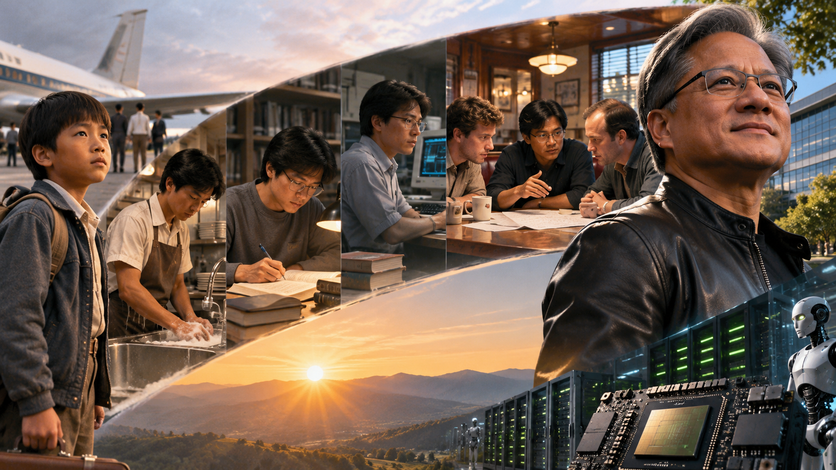
This is the story of a little boy born in Taiwan who was sent to America with his older brother, barely able to speak English, separated from his parents, and placed in a boarding school in rural Kentucky.
He would eventually work washing dishes and cleaning tables at Denny’s, graduate from college, become an electrical engineer, and, by the age of 30, establish a company that would change the world.
His name is Jensen Huang. The company is NVIDIA.
And if you have used artificial intelligence, played a modern video game, watched a computer-generated movie, or benefited from advanced scientific computing, there is a good chance that technology developed by NVIDIA has played some role in your life.
Today, NVIDIA is one of the most consequential technology companies ever created.
But its story didn’t begin with billions of dollars, venture capital, or artificial intelligence.
It began with a family searching for a better future for their children.
And in many ways, that is the story of America.
A Little Boy From Taiwan — 1963
Jensen Huang was born on February 17, 1963, in Taipei, Taiwan.
His father was a chemical engineer working in the petroleum industry. His mother was a schoolteacher.
This is important because Huang did not come from a family that lacked education.
His parents understood the value of learning, engineering, and hard work.
What they lacked was the economic opportunity and stability they hoped to provide their children.
During the 1960s, Taiwan was beginning its transformation from a relatively poor economy into one of the world’s great manufacturing and technology centers.
But that transformation was still in its early stages.
When Jensen was about five years old, his father accepted a position in Thailand helping establish an oil refinery.
The family moved to Bangkok. There, Jensen spent several years of his childhood.
Thailand was politically unstable, and by the early 1970s, his parents were becoming increasingly concerned about their children’s safety and future.
Like millions of parents throughout history, they faced a difficult choice.
Stay where they were, or take a chance on something better.
They chose America. But they couldn’t all leave together.
So they made a decision that most parents today would find almost unimaginable.
They sent their two young sons to the United States ahead of them.
Jensen was about nine years old. His older brother was ten.
Think about that for a moment. Two little boys, traveling halfway around the world, without their mother or father, heading to a country they barely knew.
Neither child could have imagined what was ahead.
Welcome to America — Kentucky, 1973
The boys initially stayed with an uncle in Tacoma, Washington.
Jensen later described being fascinated by America.
The carpeting in the houses. The enormous automobiles.
Television programs. Breakfast cereal. Candy bars.
Everything seemed extraordinary.
He had never experienced many of the things ordinary American children took for granted.
But the boys needed somewhere to live and attend school.
Their parents had limited financial resources, and their relatives found an affordable boarding institution willing to accept them.
It was called the Oneida Baptist Institute.
Located in rural Kentucky, Oneida was about as different from Bangkok as one could imagine.
It was a small community surrounded by Appalachian mountains, farms, and coal country.
The boarding school served children from many backgrounds, including youngsters who had experienced difficult family circumstances.
And suddenly, there was Jensen Huang. A small Asian boy. Speaking limited English.
Far from his parents. Surrounded by older, tougher American kids.
Some of these boys had experienced violence and poverty.
Jensen later recalled sharing a room with a teenager who showed him scars from knife fights.
He encountered prejudice and bullying. He was different, and everyone knew it. Imagine what that must have felt like.
Today, when people talk about immigration, they often discuss statistics, economics, and politics.
But immigration is also the experience of an individual human being.
A child who doesn’t understand the language. A child who misses his mother.
A child who has no idea what tomorrow will bring. And yet something remarkable happened. Jensen adapted. He learned English. He made friends.
He participated in school activities.
He helped another student learn to read, while the older boy helped him learn about weightlifting.
He learned that being different didn’t mean he couldn’t succeed.
And perhaps most importantly, he learned that he could survive difficult circumstances.
Interestingly, Huang has spoken with considerable affection about his years at Oneida.
He has credited the school with teaching him important lessons about life.
Years later, after becoming successful, he would return and support the institution financially.
He didn’t forget the people who helped him. Nor did he forget where he came from.
An American Family in Oregon
After roughly two years, Jensen and his older brother were reunited with their parents.
The family eventually settled in the Portland, Oregon, area.
For Jensen, life began to look a little more like that of a typical American teenager.
He attended Aloha High School. He developed strong interests in mathematics, science, and technology. He was also an excellent table-tennis player.
Not just someone who enjoyed playing ping-pong. He became a nationally ranked junior competitor.
Table tennis may seem insignificant compared with engineering, but competitive sports teach valuable lessons.
You practice. You lose. You improve. You compete again. No amount of complaining changes the score.
And Jensen was becoming accustomed to competing. Academically, he was exceptional.
He progressed through school quickly and graduated from high school at just 16 years old.
But there is another part of his teenage life that I find even more interesting.
Because it tells us something important about the man he would become.
He got a job. Not a prestigious internship. Not some special position arranged through family connections.
He went to work at Denny’s.
The Dishwasher Who Became a Billionaire
At approximately 15 years old, Jensen Huang started working at a Denny’s restaurant in Oregon.
His first job was washing dishes. He also cleaned tables and eventually worked as a waiter.
Now, I have owned businesses and employed people.
And I can tell you something. There are people who look at an entry-level job as an insult.
And there are people who look at it as an opportunity to learn.
Jensen was clearly in the second category. He didn’t just want to wash dishes.
He wanted to become an excellent dishwasher. Years later, speaking at Stanford, he recalled: “I was probably Denny’s best dishwasher.”
He described organizing his work, planning his movements, and finding ways to become more efficient.
When he was promoted to busboy, he approached the new job with the same determination.
He didn’t leave a table unattended. He didn’t waste unnecessary movements.
He didn’t regard the work as beneath him. He learned how to work with customers, coworkers, and managers.
And he learned how to do a difficult job well. That is a lesson many people never learn.
Success doesn’t always begin with an extraordinary opportunity.
Sometimes it begins with doing an ordinary job extraordinarily well.
Washing dishes didn’t make Jensen Huang a billionaire.
But developing the habits of discipline, efficiency, and responsibility certainly didn’t hurt him.
And as we will see, Denny’s would play another important role in his future.
College at 16 — The Engineer Emerges
In 1979, at only 16 years old, Jensen entered Oregon State University.
He decided to study electrical engineering.
This was a fascinating time to become an engineer.
The personal computer revolution was just beginning.
Apple had introduced the Apple II. Intel was developing increasingly powerful microprocessors. IBM was preparing to enter the personal computer market.
Silicon Valley was becoming the center of a technological revolution.
And Jensen wanted to understand how these machines worked.
He was not simply interested in using computers.
He wanted to understand what was inside them.
The electronics. The microprocessors. The circuits. The engineering.
At Oregon State, he also met another electrical engineering student named Lori Mills.
They became laboratory partners. Eventually, they started dating.
Lori would become his wife, and they would raise two children together.
This is an important part of the story.
Because when we discuss successful entrepreneurs, we often imagine isolated geniuses working alone.
But building a company is rarely a solitary achievement.
Families, spouses, colleagues, employees, investors, and friends all play roles.
Jensen graduated from Oregon State in 1984 with a degree in electrical engineering.
He was just 21 years old. He had come a long way from that frightened little boy in Kentucky. But he still wasn’t rich.
And he hadn’t invented anything that would change the world.
He was simply a young American engineer looking for his first professional opportunity.
Working for Someone Else — Learning the Business
After graduation, Huang went to work for Advanced Micro Devices, better known as AMD.
At AMD, he worked on microprocessor technology.
For a young electrical engineer, this was an extraordinary opportunity.
Semiconductors were becoming the foundation of modern computing.
But engineering is not simply about designing something that works.
It is about designing something that can be manufactured, sold, supported, and improved.
A brilliant idea is worthless if you cannot turn it into a product.
And a successful product is not necessarily a successful business.
After approximately a year at AMD, Huang moved to LSI Logic.
LSI specialized in sophisticated integrated circuits.
He spent roughly eight years there, developing engineering and management experience.
During those years, he learned about chip design, manufacturing constraints, product development, and the commercial semiconductor business.
He also built professional relationships with other engineers.
Meanwhile, he continued his education. He enrolled in a master’s program at Stanford University while working full-time. By then, he was married and raising a family.
It took him eight years to complete the program.
Think about that. Working. Studying. Raising children. Building a career.
And continuing to pursue an advanced engineering degree.
He finally earned his Stanford master’s degree in 1992.
The following year, he would make a decision that would change his life.
Three Engineers, a Denny’s Restaurant, and an Idea — 1993
By the early 1990s, Jensen Huang was an experienced semiconductor engineer.
He had a good career. He had a wife and two children. He had a Stanford master’s degree.
He understood the computer industry.
He could have continued working for established technology companies and enjoyed a comfortable professional life. Instead, he decided to take a risk.
He and two other engineers, Chris Malachowsky and Curtis Priem, believed something important was about to happen in personal computing.
Computers were becoming more powerful. Video games were becoming more sophisticated. Three-dimensional graphics were beginning to emerge.
But conventional computer processors weren’t particularly good at handling the enormous mathematical workloads necessary to create realistic graphics.
The three engineers believed specialized processors could solve that problem.
That idea would eventually become the foundation of NVIDIA.
And where did they meet to discuss their plans? Denny’s.
Yes, the same restaurant chain where Jensen had once washed dishes.
In 1993, the three engineers met at a Denny’s in San Jose, California.
They discussed building a company around their vision of accelerated computer graphics.
They weren’t billionaires. They weren’t running an established corporation.
They didn’t have a guaranteed market.
And they certainly didn’t know that artificial intelligence would eventually create an enormous demand for their technology.
They were engineers who believed they understood where computing was heading.
And they wanted to build something. On April 5, 1993, NVIDIA was founded. Jensen Huang was 30 years old.
Thirty years after being born in Taiwan, he had become the co-founder of an American technology company.
Twenty years after arriving in the United States as a young immigrant, he was helping create a business that would eventually transform the entire computing industry.
But there is an important distinction.
The American Dream had given Jensen Huang the opportunity to create NVIDIA.
It had not guaranteed that NVIDIA would succeed.
That was going to require another kind of struggle.
The American Dream Does Not Guarantee Success
People like to tell stories about successful entrepreneurs as if their success was inevitable.
It wasn’t. NVIDIA’s first years were extremely difficult.
The graphics market was crowded with competitors.
Developing semiconductor chips was expensive. Technology changed rapidly.
And mistakes could destroy a company before it ever became profitable.
NVIDIA’s early graphics technology failed to achieve the success its founders had hoped for.
By 1996, the company was in serious trouble. Its original approach to graphics processing was becoming commercially obsolete. Competitors were moving in different technical directions.
The company had spent enormous resources developing products that weren’t selling as expected.
NVIDIA came dangerously close to bankruptcy. Huang faced a decision.
Continue pursuing the original technology and risk losing everything?
Or acknowledge that the company had made a mistake and start over?
He chose to change direction. NVIDIA abandoned much of its original technical approach and committed itself to developing a new generation of graphics chips.
This was not a minor adjustment. It was a fundamental change in strategy.
And the company was running out of money. Ultimately, the gamble worked.
In 1997, NVIDIA introduced the RIVA 128 graphics processor, which helped establish the company as a serious competitor.
In 1999, NVIDIA introduced the GeForce 256, which it marketed as the world’s first GPU, or graphics processing unit.
The company went public that same year.
Years later, NVIDIA developed CUDA, a technology that allowed programmers to use graphics processors for many applications beyond computer graphics.
That decision would eventually prove enormously important for scientific computing and artificial intelligence.
In 2012, NVIDIA GPUs helped researchers achieve a breakthrough in deep learning through the AlexNet neural network.
And with the explosion of generative AI in the 2020s, the company that began by making graphics hardware for video games became a central supplier of the computing infrastructure behind modern artificial intelligence.
Think about the sequence. A graphics chip for video games. Then scientific computing.
Then machine learning. Then artificial intelligence. The enormous AI industry we see today did not emerge from one brilliant idea in 1993.
It was the result of decades of engineering, investment, experimentation, adaptation, and sometimes very expensive mistakes.
That is how major technological revolutions usually happen.
What Makes This an American Story?
There is something about Jensen Huang’s life that I find especially interesting.
He was born in Taiwan. He spent part of his childhood in Thailand.
He arrived in America speaking limited English. He attended a small boarding school in Kentucky. He washed dishes in Oregon. He graduated from two American universities.
He worked for American semiconductor companies. And eventually, he helped establish one of the most important technology companies in the world.
Now consider what America gained from that journey.
NVIDIA grew into a company employing tens of thousands of people.
Its products created opportunities for countless other businesses.
Its technology helped advance scientific research, medicine, engineering, animation, entertainment, robotics, and artificial intelligence.
Entire industries developed around capabilities made possible by advanced graphics processors.
The benefits extended far beyond the company’s founders and shareholders.
Universities used the technology. Hospitals and research institutions used it.
Small businesses used it. Software developers built products around it.
And many of those innovations created additional jobs, companies, and opportunities.
All because three engineers were able to organize a business, raise capital, develop technology, and compete in a marketplace.
There are many countries in the world with intelligent, talented, hardworking people.
America does not have a monopoly on intelligence.
What made America different was the combination of its institutions, educational opportunities, financial markets, entrepreneurial culture, and willingness to accept talented people from around the world.
That combination helped create an environment where someone like Jensen Huang could succeed.
Not everyone who arrived in America became wealthy. Most didn’t.
But the opportunity existed. And that opportunity mattered.
Immigration, Education, and Opportunity
I think we sometimes misunderstand what makes immigration beneficial to a country.
It isn’t simply the number of people who arrive.
It is what those people are able to contribute once they get here.
A country benefits when people can acquire an education, develop skills, create businesses, work productively, and participate in the economy.
Jensen’s parents understood that. They didn’t send their children to America because someone promised them a comfortable life.
They sent them because they believed America offered opportunities that might not exist elsewhere. They were investing in their children’s future.
And they were willing to make enormous personal sacrifices to do it.
But we should also recognize that Jensen had advantages.
His father was an engineer. His mother was a teacher. His family believed strongly in education. He was academically gifted.
Later, he attended excellent universities and worked with talented engineers.
This wasn’t a story of success appearing out of nowhere.
His family brought knowledge, ambition, and values with them.
America provided an environment where those qualities could be developed.
That is an important distinction.
A productive immigrant doesn’t arrive as an empty vessel waiting for a government to create a future.
People bring abilities, ambitions, experience, and ideas.
The question is whether their new country gives them a reasonable opportunity to use those abilities.
In Huang’s case, the answer was yes.
The Entrepreneurial Lesson — Wealth Must Be Created
One of the things that bothers me about how people discuss successful businesspeople is the assumption that great wealth simply appears.
It doesn’t.
There are exceptions involving inheritance, speculation, political favoritism, and other circumstances.
But businesses like NVIDIA illustrate something important about how economic value is created.
Three engineers developed an idea.
They assembled a team.
They convinced investors to risk money.
They hired employees.
They developed products.
Some products failed.
They redesigned them.
They competed against other companies.
And eventually, they created technology that millions of customers wanted.
Nobody could guarantee they would succeed.
If NVIDIA had failed in 1996, its investors could have lost their money, employees could have lost their jobs, and Huang could have returned to working for someone else.
That was the risk.
The reward came because the company eventually created something extremely valuable.
And that value wasn’t limited to the money earned by its founders.
It spread throughout the economy.
Think about it.
When a new semiconductor architecture makes computers more powerful, thousands of other businesses may discover entirely new things they can do.
A manufacturer designs products faster.
A medical researcher analyzes complex biological data.
A scientist models the atmosphere.
A software company creates a new service.
A small business uses AI to automate work that previously required expensive equipment or specialized personnel.
Those benefits create additional economic activity.
One successful technology company can become the foundation for thousands of other productive activities.
That is why innovation matters.
And why entrepreneurship matters.
The value of a company is not simply the money its founder possesses.
It is also the useful economic activity made possible by what the company produces.
A Dishwasher Is Not a Failure
There is another lesson here that I think deserves attention.
Jensen Huang was a dishwasher.
He was a busboy.
He was a waiter.
Those were honest jobs.
And he took pride in doing them well.
We have developed an unfortunate habit of judging people by the prestige of their occupations rather than the quality of their work.
But every successful economy depends on millions of ordinary people doing ordinary jobs.
Someone has to clean the restaurant.
Someone has to maintain the equipment.
Someone has to deliver the supplies.
Someone has to build the buildings.
Someone has to operate the computers.
And someone has to design the semiconductors.
All of those activities contribute to the economy.
Not everyone will become Jensen Huang.
Nor should everyone be expected to.
A society needs skilled workers, technicians, teachers, engineers, entrepreneurs, managers, and professionals in countless different fields.
The important thing is that people have opportunities to become productive, improve their skills, and pursue their ambitions.
An entry-level job can be the first step in a much larger career.
It should not automatically be viewed as a permanent destination.
Jensen’s first job didn’t define his future.
It helped prepare him for it.
America Didn’t Make Jensen Huang Successful — It Gave Him the Opportunity
This is probably the most important distinction in the entire story.
America did not make Jensen Huang intelligent.
America did not give him his work ethic.
America did not invent his ambition.
His parents, his experiences, his education, his personal abilities, and his own choices all contributed to the person he became.
But America gave him opportunities.
He could attend school.
He could work.
He could earn engineering degrees.
He could enter the semiconductor industry.
He could meet people who shared his interests.
He could start a company.
He could raise investment capital.
He could hire employees.
He could compete against established corporations.
And if his company succeeded, he could participate in the wealth it created.
There were obstacles, of course.
Prejudice existed.
Financial limitations existed.
Business failure was a real possibility.
And many equally hardworking people never achieve extraordinary financial success.
The American Dream was never a guarantee that everyone would become a billionaire.
It was the idea that your future did not have to be permanently determined by the circumstances of your birth.
You could begin with very little and build something meaningful.
And perhaps create opportunities for others along the way.
That is what makes Jensen Huang’s story so compelling.
Thirty Years — From Immigrant Child to Entrepreneur
Consider the timeline.
1963: Jensen Huang is born in Taiwan.
1968: His family moves to Thailand.
1973: He and his older brother travel to America, eventually attending school in rural Kentucky.
Mid-1970s: His family reunites in Oregon.
Late 1970s: He works at Denny’s, develops his interests in engineering, and graduates from high school at 16.
1979: He enters Oregon State University.
1984: He graduates with a degree in electrical engineering and begins working at AMD.
1985: He moves to LSI Logic, where he develops his semiconductor industry experience.
1992: He earns a master’s degree from Stanford University while working and raising a family.
1993: At age 30, Jensen Huang co-founds NVIDIA with Chris Malachowsky and Curtis Priem.
Thirty years.
From birth in Taiwan to founding an American technology company.
And that wasn’t the end of the story. It was just the beginning.
The company’s near-collapse, its eventual success in graphics processing, and its transformation into a critical part of the global AI industry would happen over the following decades.
What people see as an extraordinary success story was actually the result of a lifetime of preparation followed by decades of difficult work.
Final Thoughts — The American Dream Is Not Dead
We hear a lot these days about how the American Dream is dead.
That opportunity no longer exists.
That the system is unfair.
That successful people must have obtained their wealth at someone else’s expense.
There are legitimate concerns about inequality, the rising cost of education, housing affordability, and barriers to economic mobility.
Those problems deserve serious attention.
But none of them changes the central lesson of Jensen Huang’s story.
Opportunity matters. Education matters. Work matters. Innovation matters.
The willingness to take risks matters.
And a society that allows people to develop their abilities and create businesses can accomplish extraordinary things.
Imagine if Jensen Huang’s parents had never sent their children to America.
Imagine if that little boy in Kentucky had never received the education that allowed him to become an engineer.
Imagine if he had never been able to start a company with his two colleagues.
Or if NVIDIA had failed in 1996 and disappeared. The world might have developed many of the same technologies eventually. But history would have been different.
The companies, researchers, engineers, and entrepreneurs who benefited from NVIDIA’s innovations would have followed different paths.
And an enormous amount of economic value might have been created somewhere else, by someone else, at another time.
That is something worth remembering.
A country’s greatest resource is not necessarily its oil, minerals, land, or natural resources.
It is the productive potential of its people.
And one of America’s greatest historical strengths has been its ability to attract people from around the world and give them opportunities to contribute.
Jensen Huang did not arrive in America carrying a revolutionary computer chip.
He arrived as a little boy, separated from his parents, carrying the hopes they had for his future.
Twenty years later, he helped found NVIDIA.
And in the decades that followed, that company helped change how the world computes.
That, to me, is the American Dream. Not a promise that everyone will become rich. Not a guarantee that life will be easy.
But the opportunity to start somewhere, work toward something better, and perhaps accomplish far more than anyone could have imagined.
From a little boy in Kentucky to a technology entrepreneur in Silicon Valley.
From washing dishes at Denny’s to founding NVIDIA. From immigrant to entrepreneur in just 30 years.
And perhaps the most remarkable part of the story is that when Jensen Huang arrived in America, nobody knew what he would become.
Including Jensen Huang.
The American Dream was never about guaranteeing success. It was about giving people the freedom and opportunity to pursue it. Sometimes that opportunity turns a dishwasher into an engineer, an engineer into an entrepreneur, and an entrepreneur into someone who changes the world. --YNOT!