Think of it as Yoga for the brain, we are going to stretch a bit.
IS ISLAM A RELIGION OF PEACE? And What Exactly Is Sharia Law?
The Constitution protects your right to follow your religion. It does not give your religion the right to govern everyone else. And that principle should never change. -- YNOT!
INTRODUCTION — A QUESTION AMERICANS ARE AFRAID TO ASK
We have all heard the expression: “Islam is a religion of peace.”
We have also watched Islamic extremist organizations commit acts of terrorism, witnessed governments impose religious restrictions, and seen people punished for violating religious commandments in certain Muslim-majority countries.
So which is it?
Is Islam a peaceful religion practiced by nearly two billion people, or is it a political and religious system fundamentally incompatible with Western democracy?
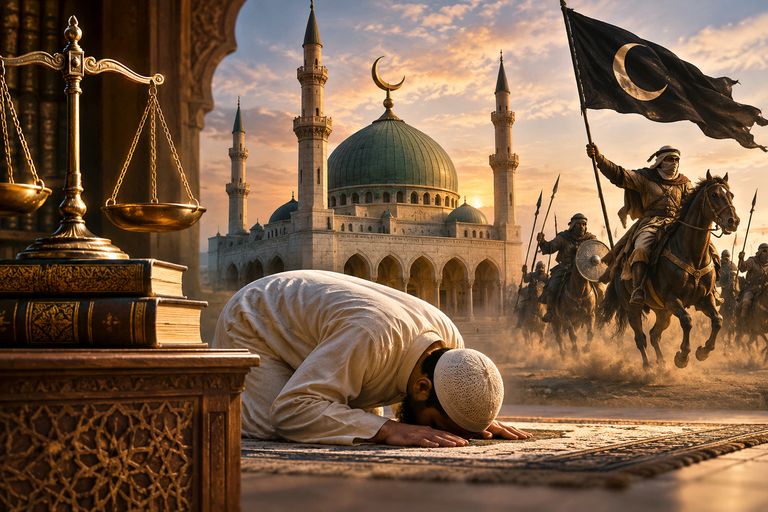
Islam is more than a religion. It it system of laws, government, and warfare—where faith, political authority, and military power have often been intertwined.
Both are true, depending on what part of Islam we are discussing.
And what exactly is Sharia law?
These questions have become increasingly relevant as Muslim communities grow throughout Europe and North America, as Muslim politicians assume public office, and as American communities debate the role of Islamic religious practices in public life.
Some Americans worry that allowing Islamic religious institutions to expand will eventually lead to demands for a separate legal system.
Others dismiss these concerns as religious intolerance.
I think both approaches miss something important.
There is a considerable difference between understanding a religion, respecting someone’s freedom to practice that religion, and allowing religious doctrine to become the law governing everyone else.
That distinction is central to the American constitutional system.
But before we start discussing whether Sharia can coexist with the Constitution, we should understand what Islam actually teaches, how Sharia developed, and why the subject generates so much controversy.
And eventually, we must confront one particularly difficult question:
Can the United States legally ban Islam?
The answer involves theology, history, constitutional law, and the very principles upon which America was founded.
Let’s start at the beginning.
THE PRACTICE OF ISLAM — MORE THAN RELIGIOUS CEREMONY
Islam originated in the Arabian Peninsula during the seventh century.
According to Islamic tradition, Muhammad began receiving revelations from God through the angel Gabriel around 610 AD.
Those revelations became the Quran, Islam’s central sacred text.
The word Islam is commonly understood to mean submission or surrender to God.
A Muslim is someone who submits to that divine authority.
Muslims worship Allah, the Arabic word for God. Arabic-speaking Christians and Jews also use the word Allah, although the religions disagree fundamentally about God’s nature and revelation.
Islam recognizes figures familiar to Judaism and Christianity, including Abraham, Moses, and Jesus.
However, Muslims regard Muhammad as God’s final prophet and do not accept the Christian doctrine of the Trinity.
So far, many of these ideas resemble other Abrahamic religious traditions.
But Islam has historically developed not only as a system of personal faith but also as a framework for organizing society.
To understand that framework, we must first understand the basic religious obligations.
The Five Pillars of Islam
Most Muslims recognize five fundamental practices.
1. Shahada — Declaration of Faith
A Muslim affirms that there is no god but God and that Muhammad is His messenger.
2. Salah — Prayer
Muslims perform prescribed prayers five times daily.
3. Zakat — Charity
Muslims with sufficient qualifying wealth are obligated to contribute a portion to designated charitable purposes.
4. Sawm — Fasting
During Ramadan, Muslims ordinarily fast from dawn until sunset, subject to exemptions.
5. Hajj — Pilgrimage
Muslims who are physically and financially capable are expected to make a pilgrimage to Mecca once during their lifetime.
None of these obligations is inherently incompatible with American law.
An American Muslim can pray, fast, donate to charity, and make a pilgrimage without creating any constitutional conflict.
But Islam also possesses an extensive tradition of religious jurisprudence dealing with marriage, inheritance, commerce, politics, crime, and public morality.
This is where the discussion becomes more complicated.
Islam and Political Authority
Muhammad was not only a religious preacher.
In Medina, he also became the leader of a developing religious and political community.
After his death in 632, Muslim rulers expanded their territories, and Islamic scholars developed principles for governing increasingly large and diverse societies.
Over centuries, religious teachings became intertwined with legal institutions, political authority, and social expectations.
That historical development distinguishes Islam from the predominantly private religious experience familiar to many modern Americans.
However, an important qualification is necessary.
Islam does not have one worldwide governing authority or a universally accepted political model.
Sunni and Shia traditions differ. Islamic legal schools disagree. Secular and reformist Muslims challenge traditional interpretations.
Many Muslims believe religious morality should influence society without requiring government enforcement of religious commandments.
Others advocate Islamic government.
Still others believe the state has a religious obligation to enforce traditional Islamic jurisprudence.
The distinction between Islam as a personal religion and Islamism as a political program is essential.
Islamism generally refers to movements that seek to organize political authority around Islamic principles. Those movements themselves range from electoral and nonviolent organizations to authoritarian and violent extremist groups.
A Muslim practicing Islam is not automatically an Islamist.
And an Islamist is not automatically a terrorist.
Failing to recognize those distinctions makes serious discussion nearly impossible.
WHAT EXACTLY IS SHARIA LAW?
The word Sharia is commonly translated as the path or way.
Within Islam, it refers broadly to the divinely guided way of life.
But Sharia is not simply a religious version of the United States Code.
It is not one universally agreed-upon statute book.
Instead, Sharia represents religious principles derived primarily from two sources.
The Quran: The sacred revelations Muslims believe were given to Muhammad.
The Sunnah: The teachings and example of Muhammad, preserved principally through accounts known as hadith.
Over generations, Islamic scholars interpreted these sources to develop detailed legal doctrines.
That process produced what is known as fiqh, or Islamic jurisprudence.
Here is an important distinction:
Sharia is understood by believers as divine guidance. Fiqh is the human interpretation of that guidance.
And human interpretations differ.
Different Islamic schools have developed different positions on marriage, criminal punishment, commerce, political authority, and individual rights.
Consequently, the laws of Saudi Arabia, Iran, Indonesia, Turkey, and other Muslim-majority nations are not identical.
Some countries incorporate religious principles into substantial portions of their legal systems.
Others primarily apply Islamic rules to family matters.
Still others maintain largely secular civil codes.
This is why saying that every Muslim follows exactly the same Sharia law is inaccurate.
Nevertheless, Sharia has historically addressed something much broader than religious ceremonies.
It provides principles concerning how individuals should live and, in many classical interpretations, how governments should rule.
And that is precisely why the relationship between Sharia and constitutional democracy deserves examination.
WHAT DOES SHARIA LAW TEACH?
To understand Sharia, we need to examine its different areas of application.
Some are relatively uncontroversial.
Others conflict directly with modern American constitutional principles when governments attempt to enforce them.
A. Religious Obligations and Personal Conduct
Sharia provides guidance about prayer, fasting, charity, religious observance, and personal behavior.
Traditional Islamic teachings generally prohibit consuming pork and intoxicating alcohol.
They also prohibit gambling and sexual relationships outside permitted marriage.
Many Muslims observe modesty requirements concerning clothing and behavior.
These are religious standards, comparable in some respects to dietary laws in Judaism or moral restrictions within conservative Christianity.
In America, an individual has the right to follow these standards voluntarily.
The constitutional issue begins when someone attempts to make those religious requirements compulsory for everybody else.
B. Marriage, Divorce, and Women’s Rights
Traditional Islamic jurisprudence regulates marriage, divorce, inheritance, and family responsibilities.
Classical interpretations generally permit Muslim men to have as many as four wives under specified conditions, while women are not granted an equivalent right.
Traditional inheritance rules frequently allocate different shares to male and female relatives.
Classical jurisprudence also assigns differing marriage and divorce rights to men and women.
These distinctions have generated extensive debate among Muslim scholars and reformers.
Some defend the traditional rules as religious obligations.
Others advocate reinterpretation in light of modern principles of equality.
In the United States, religious marriage ceremonies are protected, but civil marriage and divorce remain subject to applicable American law.
Religious beliefs cannot authorize forced marriage, domestic violence, or violations of legally protected rights.
C. Criminal Law and Punishment
Here we reach some of the most controversial elements of classical Sharia.
Traditional Islamic jurisprudence includes categories of criminal offenses and prescribed punishments.
Some classical interpretations authorize punishments such as:
Amputation for certain forms of theft.
Flogging for specified offenses.
Stoning for certain adultery offenses.
Severe penalties for religious apostasy under particular legal doctrines.
These doctrines have historically been subject to different evidentiary requirements, legal interpretations, and applications.
They are not universally enforced throughout the Muslim world.
But their existence should not be ignored.
Modern legal debates over these punishments are substantial.
Human rights organizations have criticized laws permitting such penalties, particularly where they conflict with protections against cruel treatment and unequal enforcement.
The United States Constitution provides protections against cruel and unusual punishment through the Eighth Amendment.
Religious authority cannot override that constitutional protection.
D. Apostasy and Blasphemy
Apostasy means abandoning one’s religion.
Blasphemy generally refers to speech or conduct considered insulting to religious beliefs or sacred figures.
Certain classical Islamic legal doctrines prescribed death for apostasy, although modern Muslim scholars disagree about whether such punishments have religious justification.
Some contemporary states maintain laws criminalizing apostasy, blasphemy, or religious conversion.
These laws can restrict criticism, suppress dissent, and penalize individuals simply for changing their religious beliefs.
The U.S. Commission on International Religious Freedom has documented such restrictions internationally.
But the same rules cannot be imposed as criminal law in America.
Under the First Amendment, Americans have the right to embrace a religion, abandon it, criticize it, or reject religion altogether.
A Christian may become Muslim.
A Muslim may become Christian.
Either may become an atheist.
And a citizen may publicly criticize Muhammad, Jesus, the Pope, or any other religious authority.
That freedom is fundamental to American society.
E. The Treatment of Non-Muslims
Another controversial aspect of classical Islamic governance concerns the status of non-Muslims.
Historically, many Islamic states recognized a category known as dhimmi.
Dhimmi status generally applied to protected non-Muslim communities, particularly Jews and Christians.
These communities were often permitted to continue practicing their religions under Muslim rule.
However, that protection did not necessarily imply legal equality.
Depending on the period and government, non-Muslims faced restrictions on political authority, religious buildings, public worship, and other aspects of civic life.
A special tax known as jizya was commonly imposed on eligible non-Muslim subjects.
In some historical circumstances, protected communities enjoyed considerable autonomy.
In others, they experienced discrimination, coercion, or persecution.
It would be inaccurate to claim that every Islamic government prohibited churches or synagogues.
But it would be equally inaccurate to pretend that classical religious distinctions always provided equality comparable to modern American citizenship.
The American constitutional principle is different: citizenship and civil rights cannot be made dependent upon belonging to a preferred religion.
A Christian, Jew, Muslim, Hindu, Buddhist, or atheist is entitled to the protections of American law.
That is a principle worth defending.
WHAT IS JIHAD — AND DOES IT MEAN HOLY WAR?
Few Islamic terms generate more confusion than jihad.
In Arabic, jihad broadly refers to striving or struggling.
Within Islamic traditions, the concept has been used in multiple ways.
The Personal Struggle
For many Muslims, jihad describes the effort to live according to religious obligations.
It can involve resisting temptation, improving moral behavior, supporting charitable causes, or remaining faithful during hardship.
In this understanding, jihad is not military activity.
The Social and Religious Struggle
The term can also describe promoting religious teachings, defending a community, or working toward what believers regard as a just society.
Again, these activities need not involve violence.
Armed Jihad
But there is another dimension that should not be dismissed.
Islamic history also contains an extensive tradition of armed jihad.
Muslim rulers and scholars developed doctrines concerning warfare, territorial expansion, defense, and relations with non-Muslim political powers.
Classical legal schools differed over the conditions under which warfare could be authorized.
Some medieval doctrines permitted expansionary warfare under specified conditions, while others placed greater emphasis on defense and limits on hostilities.
There is no historical justification for pretending armed jihad was never part of Islamic political and military history.
It clearly was.
However, that historical fact does not establish that every Muslim today considers violence a religious obligation.
Modern Jihadist Extremism
Organizations such as al-Qaeda and ISIS have used particular interpretations of Islamic doctrine to justify terrorism, religious persecution, and authoritarian rule.
Their ideology combines religious claims with political objectives.
But many Muslim scholars and communities reject those interpretations.
The problem becomes especially serious when extremist movements argue that religious ends justify attacking civilians, coercing conversion, or destroying governments through terrorism.
A religious justification for violence does not make violence lawful.
That principle should apply regardless of whether the offender identifies as Muslim, Christian, Jewish, Hindu, or anything else.
So Is Islam a Religion of Peace?
My answer is that the slogan is too simplistic. Islam includes teachings about mercy, charity, moral responsibility, and peaceful relations.
Its history also includes conquest, religious conflict, and legal traditions that modern societies may regard as coercive.
But that does not make nearly two billion Muslims collectively responsible for the actions of historical rulers or modern extremists.
The critical questions are what doctrines a particular movement promotes and what conduct it advocates.
We should be willing to criticize violent religious doctrines without treating every believer as a potential criminal.
Those positions are not contradictory. They are necessary for an intelligent discussion.
CAN SHARIA LAW AND THE U.S. CONSTITUTION COEXIST?
This brings us to the central legal question.
Can someone follow Sharia while living under the United States Constitution?
The answer depends on what we mean by following Sharia.
Personal Religious Practice
An American Muslim can voluntarily observe Islamic dietary rules, pray five times daily, fast during Ramadan, donate to religious charities, or follow religious guidance concerning financial transactions.
These are generally protected religious practices.
Similarly, Jewish Americans may follow Halakha, and Christians may observe religious doctrines affecting marriage, worship, and morality.
American religious liberty accommodates these choices.
Civil and Criminal Authority
Now consider a different situation.
Suppose a religious organization argues that a person should be criminally punished for abandoning Islam.
Or that women must receive fewer rights under state law.
Or that criticism of religious teachings should be prohibited.
Or that an elected government must enforce religious criminal punishments.
Those proposals encounter fundamental constitutional barriers.
The Constitution guarantees religious freedom, due process, equal protection, and restrictions on governmental punishment.
No religious commandment automatically becomes enforceable civil law simply because believers consider it divine.
The Supremacy Clause
Article VI of the Constitution establishes the supremacy of the Constitution, federal laws enacted under its authority, and valid treaties.
American courts cannot disregard controlling constitutional law because a religious text demands something different.
That principle applies equally to Sharia, Christian canon law, Jewish religious law, and every other religious system.
What About Religious Arbitration?
There is another area worth understanding.
American law sometimes allows voluntary private arbitration and agreements influenced by religious principles.
Jewish communities have long used religious dispute-resolution bodies.
Certain Christian and Muslim communities also use religious mediation or arbitration.
But these arrangements do not create independent sovereign governments.
Their legal enforceability depends on American contract law, procedural safeguards, and public policy.
A religious tribunal cannot simply override constitutional protections or authorize criminal punishments.
What Do American Muslims Actually Believe?
It is tempting to assume that every practicing Muslim wants Sharia to replace American law.
But available research does not support that sweeping conclusion.
In a 2017 Pew Research Center survey, 65% of American Muslims said they did not see an inherent conflict between Islam and democracy.
That does not prove everyone interprets Sharia identically.
It does demonstrate why assumptions about millions of Americans require evidence.
So can Sharia and the Constitution coexist?
Yes, when Sharia is practiced as voluntary religious guidance within the American legal framework.
No, when someone seeks to impose religious commands that violate constitutional rights or replace the lawful authority of American government.
That distinction is not complicated.
It is the same basic standard we should apply to every religion.
THE SEPARATION OF CHURCH AND STATE
To understand the American system, we need to examine its historical foundations.
America was founded within a society profoundly influenced by Christianity.
Christian theology shaped many early Americans’ ideas about morality, government, and natural rights.
Some early state governments maintained religious establishments or imposed religious qualifications for public office.
Those historical facts are real.
But they do not mean that the United States Constitution established Christianity as the national religion.
The federal Constitution did something different.
The First Amendment
The First Amendment contains two important protections.
The Establishment Clause prohibits government establishment of religion.
The Free Exercise Clause protects religious exercise.
Together, these provisions help prevent government from favoring an official religion while protecting individuals’ religious freedom.
The constitutional relationship between religion and government has been debated throughout American history.
But the underlying commitment to liberty of conscience is unmistakable.
Thomas Jefferson and the Wall of Separation
In 1802, Thomas Jefferson wrote to the Danbury Baptist Association in Connecticut.
He described the First Amendment as establishing a wall separating church and state.
The expression itself is not written in the Constitution.
It comes from Jefferson’s explanation of the religious liberty principles incorporated into the First Amendment.
This concept was not intended to prohibit religious individuals from participating in government.
It was intended to establish limits on governmental religious authority.
Was America Founded as a Christian Nation?
This question deserves a careful answer.
America’s founding culture was overwhelmingly shaped by Christianity.
The Declaration of Independence invokes a Creator and natural rights.
Christian traditions profoundly influenced many founders and early political institutions.
However, the Constitution does not establish Christianity as an official national religion.
In fact, Article VI expressly prohibits religious tests for federal public office.
That provision is especially important.
It means a person cannot be disqualified from federal office merely for being Jewish, Muslim, atheist, or a member of another religion.
George Washington reinforced this broader commitment in an August 1790 letter to the Hebrew Congregation in Newport, Rhode Island.
He described a national government that offered no support to religious persecution and recognized religious liberty as a right rather than a privilege granted by a religious majority.
This was not simply an invention of twentieth-century secularism.
Religious liberty beyond Christianity was part of the early American constitutional vision, even though the country often failed to apply its ideals consistently.
Why Separation Matters
Consider the alternative.
Suppose Christians gained enough political power to require Americans to attend church.
Or suppose Jewish religious authorities demanded that federal law enforce Jewish dietary restrictions.
Or suppose an Islamic political movement demanded enforcement of religious criminal law.
Each would raise the same fundamental constitutional issue.
The government is not supposed to become the enforcement arm of a religious institution.
Religious freedom means the right to practice your religion. It does not mean the right to force everyone else to practice it.
That is the beauty of the American system.
It protects religious belief while limiting governmental coercion.
And that protection is especially important for people who hold minority religious beliefs.
SO CAN AMERICA BAN ISLAM?
Now we arrive at the question that started this discussion.
Can the United States ban Islam? Under the current Constitution, the answer is no.
Not simply because Islam is a religion practiced by millions of people.
But because the First Amendment protects religious liberty.
American government cannot outlaw an entire religion because politicians disagree with its theology, historical doctrines, or political implications.
A law specifically prohibiting Islamic worship or Muslim religious identity would conflict with fundamental constitutional protections.
But that is only part of the answer.
Religious Freedom Is Not Unlimited Permission to Act
There is an enormous difference between holding a religious belief and committing an unlawful act.
A person may believe that religious law is morally superior to human law.
That belief alone is not a crime.
A person may even peacefully advocate a different constitutional or political system.
That political expression generally receives First Amendment protection.
However, religious motivation does not create immunity from otherwise valid criminal laws.
Terrorism, assault, kidnapping, criminal coercion, and unlawful conspiracies remain punishable.
And speech intentionally directed toward producing imminent lawless action, when likely to produce it, may fall outside constitutional protection.
The same standards apply whether offenders claim religious, political, or ideological justification.
What About Muslim Politicians?
This is another area where Americans need to distinguish genuine constitutional concerns from religious suspicion.
A Muslim may serve in Congress. A Muslim may become a mayor. A Muslim may serve as a judge.
A Muslim may even become President of the United States.
Article VI prohibits religious tests for federal office.
Public officials must fulfill the legal obligations of their positions regardless of personal religion.
If an official violates the Constitution or applicable law, the response must be based on the violation, not religious identity.
But merely believing that God’s commandments are morally superior to human legislation does not establish that an official has violated an oath.
Christians, Jews, Muslims, and others may all hold religious convictions they regard as transcending political authority.
The constitutional question is how an official exercises governmental power.
Should States Ban Sharia Law?
Several American states have debated legislation designed to restrict the use of Sharia or foreign religious law in domestic courts.
The motivation often involves legitimate concerns about protecting constitutional rights, particularly in marriage, divorce, inheritance, and other civil disputes.
But laws singling out Islam for adverse treatment create their own constitutional problems.
The Congressional Research Service has examined these issues, including the difference between neutral protections against unlawful legal outcomes and restrictions targeting a particular religion.
A better principle is straightforward. American courts should enforce American constitutional protections and applicable law.
Religious agreements may be respected when legally valid, voluntary, and consistent with public policy.
No religious tribunal should possess authority to deprive someone of rights that American law protects.
That should apply to every religion.
What Should America Actually Do?
I believe America can protect religious liberty while taking political extremism seriously.
We do not need to pretend that religiously motivated authoritarianism is harmless.
We do not need to ignore the existence of discriminatory laws in countries governed by restrictive religious doctrines.
And we do not need to tolerate threats, coercion, or violence simply because someone claims religious justification.
But we also should not treat millions of peaceful religious believers as collectively guilty because of the actions of extremists.
The appropriate American response is equal citizenship, constitutional supremacy, freedom of conscience, and consistent enforcement of the law.
These principles work together.
They are not competing obligations.
FINAL THOUGHTS — THE CONSTITUTION MUST REMAIN SUPREME
After examining Islam, Sharia, jihad, religious history, and the American Constitution, I think we can draw several important conclusions.
Islam is an enormously diverse religious tradition with a substantial historical body of jurisprudence.
That jurisprudence has sometimes supported systems of government that conflict with modern American constitutional principles.
These conflicts deserve open discussion, especially concerning freedom of expression, equal protection, religious conversion, and criminal punishment.
But practicing Islam does not automatically mean supporting theocratic government.
Millions of Muslims live under secular political systems and regard their religious obligations as compatible with democratic citizenship.
We should judge political movements by their objectives, governments by their laws, and individuals by their actions.
And we should defend constitutional freedoms with the same consistency whether the person exercising them is someone we agree with or someone we do not.
Which brings me back to the opening question.
Is Islam a religion of peace?
For many believers, it is a source of spiritual peace, discipline, charity, and community.
For some movements, religious doctrine has also become the foundation for coercive political authority and violence.
Both realities deserve scrutiny.
But I think the more useful question for Americans is this:
Can any religion claim governmental authority that supersedes the constitutional rights of other Americans?
My answer is no. A person is free to believe that divine law is higher than human law.
That is religious freedom. But the government must still operate within the Constitution.
That is constitutional government.
And here is the point I believe Americans should remember:
You cannot defend the Constitution by abolishing the very religious freedom it guarantees.
You defend it by protecting those freedoms while refusing to permit anyone—regardless of religion—to use government power to take them away.
We should not have to surrender our constitutional principles to accommodate religious authoritarianism.
And we should not have to surrender religious liberty to protect ourselves from it.
That balance is not a weakness.
It is one of the greatest strengths of the American experiment.
The Constitution protects your right to follow your religion.
It does not give your religion the right to govern everyone else. And that principle should never change.
Let us look back at history. How the takeover happens.
How Muhammad and the Muslims Took Control of Medina (622–632 AD)
From a divided Arabian settlement to the first Islamic political state
Muhammad did not initially conquer Medina. He was invited there in 622 AD to help settle conflicts between rival tribes. But during the following decade, he gradually consolidated religious, political, judicial, and military power.
The transformation of Medina is one of the most important events in Islamic history because it marks the transition from Islam primarily being a religious movement to becoming the foundation of a political state.
Before Muhammad: Medina Was Not a Muslim City
Before 622 AD, Medina was known as Yathrib.
It was an agricultural oasis approximately 200 miles north of Mecca. Its population included Arab polytheists, Jewish communities, and people belonging to numerous tribal alliances.
Two major Arab tribes dominated much of its political life: the Aws and the Khazraj.
Three important Jewish tribes were the Banu Qaynuqa, Banu Nadir, and Banu Qurayza.
These communities had lived in the region for generations.
There was no unified central government. Political power was distributed among tribal leaders, and the Aws and Khazraj had fought bitterly for years.
This division created an opportunity for an outside mediator. Cambridge Assets
Muhammad Was Invited to Medina — 620–622 AD
Muhammad had been preaching Islam in Mecca since approximately 610 AD.
His teachings challenged the religious practices of the city’s polytheistic population and brought him into conflict with influential Meccan leaders.
Meanwhile, representatives from Yathrib encountered Muhammad and became interested in his religious message.
Several converted to Islam. During meetings near Mecca in 621 and 622, groups from Yathrib pledged allegiance to Muhammad.
The second pledge included an agreement to protect him and his followers.
In 622, Muhammad and his followers migrated from Mecca to Yathrib.
This migration is known as the Hijra, and it marks the beginning of the Islamic calendar.
The critical point is that Muhammad arrived through an agreement with local supporters, not through a military invasion of the city. However, not every tribe or resident necessarily supported his arrival. Library of Congress
Establishing Political Authority — 622 AD
Once Muhammad arrived, he began organizing a new community.
An agreement commonly known as the Constitution of Medina established principles governing relations among his followers and participating local groups.
It addressed collective defense, tribal obligations, dispute resolution, and relations between different religious communities.
Muhammad became a central authority for resolving disputes.
The agreement recognized a political community that included Muslims and some non-Muslims.
However, historians disagree about precisely when the agreement’s different provisions were established and whether Medina’s three largest Jewish tribes were direct parties to it.
The significance was considerable. Muhammad was no longer simply preaching to followers.
He was now exercising religious and political authority within an organized community.
That authority would continue expanding over the following years. Bibliographie Tübingen
Military Victories Increased His Power — 624–627 AD
Muhammad’s community remained in conflict with Mecca.
His followers conducted raids against Meccan caravans, and a series of major military engagements followed.
In 624 AD, at the Battle of Badr, Muhammad’s forces defeated a larger Meccan force.
This victory strengthened his political standing and increased his prestige among supporters.
In 625 AD, at the Battle of Uhud, the Muslims suffered a serious military setback.
In 627 AD, during the Battle of the Trench, Muhammad’s community successfully resisted a coalition attempting to capture Medina.
These military conflicts mattered because Muhammad’s political survival depended partly on defending the community against Meccan attacks.
They also helped consolidate authority among Medina’s competing factions.
By 627, Muhammad’s position was substantially stronger than when he had first arrived. PagePlace
What Happened to Medina’s Jewish Tribes?
Relations between Muhammad’s community and several Jewish tribes deteriorated, resulting in expulsions and, in one particularly severe case, mass executions described in early Islamic historical accounts.
Banu Qaynuqa — Approximately 624 AD
Following the Battle of Badr, Muhammad’s forces besieged the Banu Qaynuqa.
Traditional Muslim accounts describe a dispute that escalated into conflict, although the specific causes and details are historically uncertain.
The tribe eventually surrendered and was expelled from Medina.
Banu Nadir — Approximately 625 AD
Relations also deteriorated with the Banu Nadir.
Traditional accounts accuse members of the tribe of plotting against Muhammad.
His forces besieged their settlements, and the tribe was expelled.
Some members relocated to other Jewish communities, including Khaybar.
Banu Qurayza — 627 AD
The fate of the Banu Qurayza was considerably more severe.
Following the Battle of the Trench, Muhammad’s forces besieged their fortified settlements.
Muslim accounts accuse the tribe of violating its agreement with Muhammad during the Meccan coalition’s attack.
After surrendering, the tribe faced a judgment attributed to Sa’d ibn Mu’adh, an Arab leader associated with their former allies.
According to widely transmitted traditional accounts, hundreds of male captives were executed, while women and children were enslaved.
The precise number of those killed and the reliability of particular details remain debated among historians.
Some scholarship also questions whether the tribe’s conduct during the siege constituted the betrayal described in later accounts. Academia
Why does this matter?
The elimination of the three major Jewish tribes as independent political powers substantially changed Medina’s balance of power.
Muhammad no longer faced the same degree of resistance from these established tribal communities.
However, this did not mean that every Jewish individual was expelled from Medina.
Smaller Jewish groups and individuals remained.
It is also important to distinguish the specific conflicts of seventh-century Arabia from Jewish-Muslim relationships throughout subsequent Islamic history.
By 627–630 AD, Muhammad Had Consolidated Control
By the late 620s, the political situation had changed dramatically.
Muhammad had growing support among Medina’s Arab tribes.
His followers had survived major military challenges.
His authority over religious and political questions had increased.
And the three major Jewish tribes were no longer independent political forces in the city.
As his influence expanded, alliances formed with additional Arabian tribes.
In 630 AD, Muhammad entered and took control of Mecca, an event that further consolidated his authority throughout western Arabia.
When Muhammad died in Medina in 632, he was not merely the leader of a religious congregation.
He had become the head of a substantial political and military community whose influence extended well beyond Medina.
So Was Medina Taken Over by Muslims?
Yes, Medina ultimately came under Muslim political control. But describing the entire process as a military takeover would be misleading.
Muhammad’s initial arrival was made possible by invitations and agreements with local supporters.
His subsequent consolidation of power involved religious conversion, tribal alliances, political negotiations, military victories, and the defeat or expulsion of opposing groups.
Historians broadly agree on that transformation, although they continue to debate the motivations and details of individual conflicts.
The Connection to Sharia Law
This history helps explain an important difference between Muhammad’s historical role and that of Jesus.
Jesus did not establish a government during his lifetime. Muhammad did.
Consequently, Islamic traditions preserved Muhammad’s decisions not merely as religious teachings but also as precedents concerning political authority, justice, diplomacy, and warfare.
Those precedents subsequently influenced the development of Islamic jurisprudence.
This is one of the principal historical reasons that Sharia addresses governmental and civil matters as well as personal religious obligations.
It does not follow, however, that every Muslim today advocates reproducing the political institutions of seventh-century Medina.
Modern interpretations of Islam differ substantially on the proper relationship between religion and government.
One Final Historical Point
There is an important distinction between what happened in Medina and the later expansion of Islam.
Muhammad entered Medina through an arrangement with local supporters and consolidated his authority over approximately ten years.
After Muhammad died in 632, his successors launched a series of military campaigns that expanded Muslim political control across large territories outside Arabia.
Those later conquests are a separate chapter in Islamic history.
Research and References
Islamic law and its interpretation: Council on Foreign Relations, Understanding Sharia: The Intersection of Islam and the Law.
International differences in Muslim attitudes toward religious government: Pew Research Center, January 2025 study of religion and national law.
Religious conversion and apostasy restrictions: U.S. Commission on International Religious Freedom and the Law Library of Congress.
American Muslim attitudes toward democracy: Pew Research Center, 2017 survey.
Religious law in American courts: Congressional Research Service, Application of Religious Law in U.S. Courts: Selected Legal Issues.
American constitutional framework: U.S. Constitution, Article VI and the First Amendment.
Historical separation of church and state: Library of Congress, Jefferson’s 1802 letter to the Danbury Baptists.
George Washington and religious liberty: Washington’s 1790 letter to Newport’s Hebrew Congregation.