Think of it as Yoga for the brain, we are going to stretch a bit.
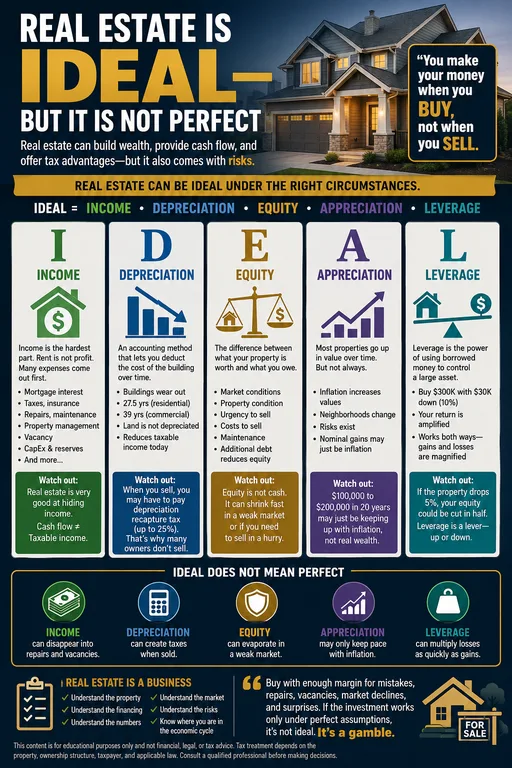
Real Estate Is IDEAL—But It Is Not Perfect
Real estate is not perfect—it is IDEAL only when income survives the expenses, equity survives the market, appreciation beats inflation, and leverage works for you instead of against you. -- YNOT!
Many people describe real estate as the perfect investment. It is not.
Real estate can produce wealth, cash flow, tax advantages, and long-term financial security. It can also consume cash, conceal problems, trap equity, and magnify losses.
Real estate is not perfect—but under the right circumstances, it can be IDEAL.
IDEAL is an acronym that has circulated among real estate investors for years:
I — Income
D — Depreciation
E — Equity
A — Appreciation
L — Leverage
Each one represents a potential advantage of owning real estate. The important word is potential. None of these benefits is automatic, and every one of them comes with limitations.
I — Income
Income is probably the most misunderstood part of real estate investing.
People look at the monthly rent and call it income. But rent is not profit. Rent is gross revenue.
Before you have real income, you must subtract:
Mortgage interest
Property taxes
Insurance
Repairs
Maintenance
Property management
Utilities paid by the owner
Vacancy
Legal and accounting expenses
Capital expenditures
Unexpected disasters
A property collecting $4,000 a month is not necessarily producing $4,000—or even $1,000—a month in spendable income.
Real estate is actually very good at hiding income.
That can be frustrating when you need cash, but it can also be beneficial at tax time. A property may generate positive cash flow while reporting considerably less taxable income after deductible operating expenses and depreciation are considered.
This is one of the unusual characteristics of real estate: cash flow and taxable income are not always the same thing.
The same general principle can affect investors in real estate investment trusts, or REITs. REIT distributions may be classified as ordinary income, capital gains, or return of capital, each with different tax treatment.
Income is therefore not simply the rent check that arrives every month. It is what remains after the property has paid its bills, maintained itself, survived vacancies, and prepared for future expenses.
D — Depreciation
Depreciation is one of the most powerful—and most confusing—advantages of real estate.
For tax purposes, the government recognizes that buildings and their components wear out over time. Roofs fail. Air-conditioning systems break. Plumbing deteriorates. Kitchens become outdated. A 20-year-old building usually has more physical deterioration than a five-year-old building.
Depreciation allows an investor to deduct a portion of the building’s cost over time, even when the total market value of the property may be increasing.
Under current federal tax rules, residential rental buildings are generally depreciated over 27.5 years, while most nonresidential real property is depreciated over 39 years. Land itself is not depreciated.
That creates an apparent contradiction.
According to the accounting records, the building is losing value every year.
According to the market, inflation, land scarcity, construction costs, population growth, and neighborhood demand may be pushing the property’s total value higher.
Both can be true at the same time.
Depreciation is sometimes called an accounting trick, but it is not a trick in the dishonest sense. It is a legally recognized, noncash expense reflecting the fact that physical buildings deteriorate.
However, depreciation is not necessarily free money forever.
When you sell a depreciated property for a gain, part of that gain may be attributable to depreciation previously claimed. That portion can be subject to depreciation-recapture rules, including a federal tax rate of up to 25% for certain unrecaptured Section 1250 gains.
This is one reason commercial property owners sometimes hesitate to sell. A property may be producing income, carrying favorable financing, and sheltering part of its cash flow from current taxation. Selling it may trigger capital-gains taxes, depreciation-related taxes, transaction costs, and the loss of an attractive mortgage.
Sometimes selling makes sense.
Sometimes it makes more sense to keep collecting rent.
Either way, eventually the taxes must be considered. Depreciation usually postpones taxation; it does not necessarily eliminate it.
E — Equity
Equity is the difference between what the property is worth and what you owe against it.
If your property is worth $500,000 and your mortgage balance is $300,000, you appear to have $200,000 in equity.
But be careful.
Equity is not the same as cash in a bank account.
Your estimated equity depends on several things:
The price a buyer will actually pay
The condition of the property
The strength of the market
The time available to sell
Brokerage commissions and closing costs
Unpaid taxes, liens, or assessments
The remaining loan balance
Repairs required before or after an inspection
You might believe that you have $200,000 in equity during a strong market. If you suddenly need to sell during a recession, after a hurricane, or when interest rates have reduced buyer demand, that equity may shrink quickly.
You may still have $100,000 in equity, but not the $200,000 you expected.
Urgency changes value.
Deferred maintenance also changes value. A property that needs a new roof, electrical work, plumbing repairs, and air-conditioning systems is not worth the same amount as an identical property with those improvements already completed.
Cash flow can affect equity as well. If the property does not produce enough money to maintain itself, you may have to borrow against it. Every additional dollar of debt reduces your equity.
Equity is valuable, but it is not necessarily liquid, guaranteed, or immediately accessible.
It is wealth trapped inside an asset until you sell, refinance, or borrow against it.
A — Appreciation
Most investors expect real estate to appreciate over long periods.
Often it does.
Land is limited. Construction costs rise. Populations change. Rents increase. Inflation reduces the purchasing power of money. In desirable areas, these forces can push property values higher.
But appreciation is not guaranteed.
A neighborhood can deteriorate. A major employer can leave town. Insurance costs can become unbearable. Environmental problems can be discovered. Zoning rules can change. A building can become functionally obsolete. A condominium association can face enormous assessments.
There is also an important distinction between nominal appreciation and real appreciation.
Suppose you bought a property 20 years ago for $100,000 and it is now worth $200,000.
You might say:
“I made $100,000.”
Yes, the property doubled in nominal value.
But how much of that increase represents genuine purchasing-power growth, and how much merely reflects inflation?
If the cost of food, labor, construction, insurance, vehicles, and almost everything else also increased substantially during those 20 years, your property may not have doubled in real economic value.
You could have owned gold, farmland, livestock, stocks, or another scarce asset and also experienced nominal appreciation.
That does not make appreciation meaningless. It simply means that investors should distinguish between becoming wealthier and merely owning an asset whose price rose along with everything else.
True appreciation should be measured against inflation, carrying costs, improvements, and the opportunity cost of the money invested.
L — Leverage
Leverage may be the most powerful feature of real estate.
It is also the most dangerous.
With stocks, federal Regulation T generally allows a brokerage firm to lend an investor up to 50% of the purchase price of eligible margin securities. In other words, the investor generally must supply at least half of the initial purchase price.
Real estate can sometimes be purchased with considerably less equity.
Suppose you buy a $300,000 property with a $30,000 down payment.
You control a $300,000 asset with $30,000 of initial equity.
If the property appreciates by 10%, its value rises by $30,000.
That $30,000 increase equals 100% of your original $30,000 down payment—before accounting for interest, repairs, taxes, closing costs, selling expenses, and other carrying costs.
That is leverage working in your favor.
But remember that the down payment is not your total investment.
If you put down $30,000 and spend another $15,000 on closing costs, inspections, repairs, reserves, and loan fees, you have actually invested $45,000. Your return must be calculated against the full amount of money you contributed—not merely the down payment.
Leverage also works in reverse.
If the same $300,000 property falls by 5%, it loses $15,000 in value.
That $15,000 decline represents half of your original $30,000 down payment. Your mortgage did not fall by 5% simply because the property value declined. The lender is still owed the same principal balance.
Leverage magnifies gains, but it also magnifies losses.
The interest rate matters too.
I have owned properties financed at approximately 3% and leveraged at around 90%. With financing that inexpensive, the property can feel like a money-making machine. You collect rent, pay down the loan, allow inflation to reduce the real burden of the debt, and wait.
But I have also owned properties with mortgage rates closer to 10% that did not appreciate at all.
The same property can be an excellent investment at one point in the economic cycle and a terrible investment at another.
Purchase price matters.
Interest rate matters.
Rent matters.
Expenses matter.
Timing matters.
IDEAL Does Not Mean Perfect
Real estate can be IDEAL:
Income can provide recurring cash flow.
Depreciation can reduce current taxable income.
Equity can create long-term wealth.
Appreciation can increase the property’s value.
Leverage can multiply the return on the investor’s capital.
But every advantage has a corresponding risk.
Income can disappear into repairs and vacancies.
Depreciation can create taxes when the property is sold.
Equity can evaporate when you need to sell quickly.
Appreciation may merely keep pace with inflation.
Leverage can multiply losses just as quickly as it multiplies gains.
Real estate is not magic. It is a business.
You must understand the property, the financing, the neighborhood, the tenants, the expenses, the tax consequences, and your place in the economic cycle.
Most importantly, always remember the oldest rule in real estate:
You make your money when you buy—not when you sell.
The selling price is determined by the future market.
Your purchase price is the part you can negotiate today.
Buy with enough margin for mistakes, repairs, vacancies, market declines, and surprises. If the investment works only under perfect assumptions, it is not an ideal investment.
It is a gamble disguised as real estate.
This article is for general educational purposes. Tax treatment depends on the property, ownership structure, taxpayer, and applicable law. Consult a qualified tax professional before making investment or disposition decisions. Use a Realtor, they can be an asset, Build your team before you buy anything. And, No I am not a Realtor, but I have bought and sold more RE than most of them.