Think of it as Yoga for the brain, we are going to stretch a bit.
Defending the Revolution
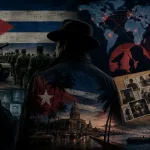
How Castro Fought the CIA, the ounterrevolution, and the Secret War Against Cuba
When Fidel Castro entered Havana in January 1959, the Cuban Revolution had won the war against Fulgencio Batista.
It had not won peace.
Within a remarkably short period, Cuba became the center of another conflict—one fought with guerrillas in the mountains, clandestine radios, boats crossing the Florida Straits, intelligence agents, neighborhood informants, sabotage teams, political prisoners, double agents, hijacked airplanes and competing governments that each believed the other was trying to destroy it.
From Washington and Miami, the story looked like a struggle to overthrow an increasingly communist dictatorship.
From Havana, it looked like a struggle to keep a revolution alive while the most powerful country in the hemisphere was actively trying to remove it.
Both descriptions contain truth.
And to understand how Fidel Castro remained in power despite the Bay of Pigs, CIA covert operations, exile attacks and internal armed opposition, it is necessary to understand the security and intelligence machine Cuba built to defend the revolution.
Before Castro: The Other Cuban Government
There is an important dividing line in this history.
During most of the 1950s, the Cuban government fighting revolutionaries was not Castro’s government.
It was Fulgencio Batista’s. Batista’s police, military and intelligence organizations pursued members of Fidel Castro’s July 26 Movement, the Directorio Revolucionario and other opposition organizations.
People were arrested, interrogated, tortured and killed.
Castro himself went from prisoner to exile to guerrilla leader.
Then, on January 1, 1959, the positions reversed.
Batista fled. The revolutionaries became the government.
And the men who had spent years hiding from government security forces suddenly had to create their own security forces.
Their enemies had not disappeared. Some fled Cuba. Others remained.
Some simply wanted to live quietly. Some organized political opposition.
And some began preparing to overthrow the new government.
The Revolution Begins Removing Its Enemies
One of the revolutionary government’s earliest priorities was dismantling Batista’s old security apparatus.
Former police officers, soldiers, intelligence officials and political figures were investigated.
Some were imprisoned. Some fled. Many were executed following revolutionary tribunals.
Properties belonging to Batista supporters and later other opponents were confiscated.
The government progressively eliminated competing centers of political power.
But an important distinction was quickly lost. Not every person who opposed Castro had supported Batista.
Some of the men who would soon fight Castro had themselves fought Batista.
They believed they had participated in a revolution to restore constitutional government—not to create a Marxist-Leninist state.
That distinction becomes especially important in the mountains of central Cuba.
The War in the Escambray
Beginning soon after the revolution, armed opposition appeared in the Sierra del Escambray.
The rebels were not one unified organization. They included former Batista personnel, farmers resisting revolutionary policies, anti-communists, former revolutionaries who had broken with Castro, and members of organizations that had previously opposed Batista.
Washington saw these groups as a potential nucleus for resistance.
Havana saw them as counterrevolutionaries.
The Castro government called many of them bandidos—bandits.
The campaign against them became known as the:
Lucha Contra Bandidos
The Struggle Against Bandits
It became a genuine counterinsurgency war.
By late 1960, U.S. diplomatic reporting estimated that the Cuban government had placed thousands of militiamen around the Escambray and was attempting to defeat the insurgents through isolation, infiltration and containment.
By early 1961, the campaign had intensified dramatically.
A U.S. intelligence report described Cuban militia forces surrounding isolated rebel groups with rifles, submachine guns, mortars, bazookas and artillery.
CIA assessments themselves acknowledged how difficult the situation had become for the guerrillas. Opposition bands were poorly equipped, communications were difficult, and potential coastal landing points were guarded by militia positions.
This mattered enormously because American planning assumed that internal resistance could eventually combine with forces introduced from outside Cuba.
The Cuban government’s strategy was therefore straightforward:
destroy the internal resistance before it could connect with an invasion.
Castro Builds a Security State
Military force alone was not enough. Cuba needed intelligence.
The revolutionary government began reorganizing police, military intelligence and investigative organizations almost immediately after taking power.
Over time these organizations became concentrated under the Ministry of the Interior—MININT.
Within that system developed powerful intelligence and counterintelligence organizations responsible for:
internal security;
foreign intelligence;
surveillance;
penetration of opposition groups;
counterespionage;
interrogation;
communications intelligence;
foreign revolutionary operations.
The names and organizational structures changed over time, but two broad missions emerged.
State Security
Its principal battlefield was Cuba itself. Its job was to find underground organizations, spies, saboteurs, armed opponents and political threats.
Cuban foreign intelligence
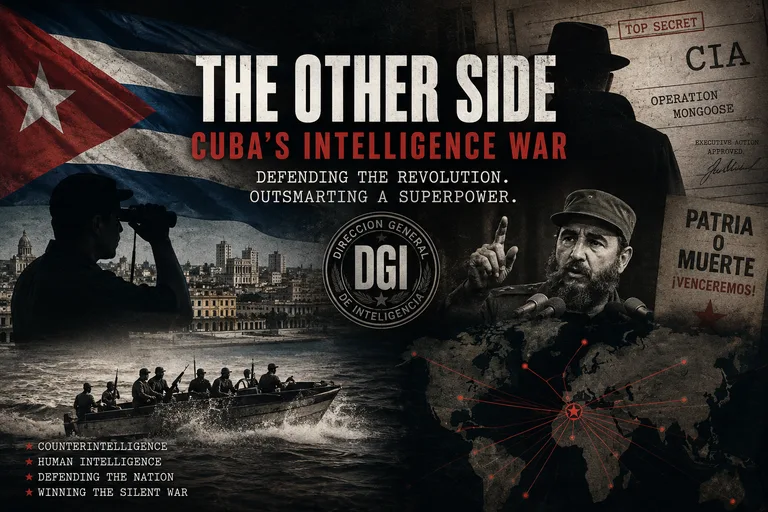
Often associated with the Dirección General de Inteligencia—DGI, its battlefield extended beyond Cuba. Its officers sought information about the United States, Miami exile organizations, Latin American governments, revolutionary movements and foreign intelligence services.
For a relatively small country, Cuba would eventually develop an extraordinarily capable human-intelligence service.
Ramiro Valdés
One of the central figures in this system was Ramiro Valdés Menéndez.
Valdés was an old revolutionary. He had participated in the attack on the Moncada Barracks, sailed aboard the Granma and fought with Castro’s guerrillas.
After the revolution, he became deeply involved in the creation of the new state’s security apparatus. His importance is difficult to exaggerate.
If the CIA had specialists designing operations against Castro, Valdés was among the men building the machinery intended to detect and destroy those operations.
Under the revolutionary government, intelligence and police functions were progressively centralized. After the establishment of MININT in 1961, security and intelligence became institutional parts of the new Cuban state.
Castro was not improvising a temporary police force. He was constructing a permanent counterintelligence system.
Manuel Piñeiro — “Barbarroja”
Then there was one of the most colorful figures in revolutionary Cuban intelligence:
Manuel Piñeiro Losada
His nickname was: Barbarroja Red Beard
Piñeiro would become one of the most important architects of Cuba’s overseas revolutionary and intelligence operations.
Where Valdés is closely associated with the internal security machinery, Piñeiro became particularly important in the international side of the revolution.
Cuba wasn’t merely preparing to prevent the CIA from exporting counterrevolution into Cuba. It increasingly intended to export revolution outward.
Piñeiro’s organizations cultivated relationships with revolutionary movements throughout Latin America and elsewhere.
Men could receive political assistance, training, sanctuary, communications support and other forms of assistance from Havana.
In that respect, something remarkable was developing.
Washington was building networks of anti-Castro Cubans.
Havana was building networks of pro-revolutionary Latin Americans.
The CIA and Cuban intelligence were beginning to play versions of the same game.
The CDR: When Counter intelligence Came to Your Street
Castro possessed another defensive mechanism that the CIA could not easily duplicate.
On September 28, 1960, he announced the creation of the:
Comités de Defensa de la Revolución
Committees for the Defense of the Revolution — CDR
They spread through Cuban neighborhoods. The principle was remarkably simple.
Instead of depending exclusively on professional policemen and intelligence officers to detect opposition, the revolution would create a system of revolutionary vigilance at neighborhood level.
Who lives in that house? Who visits them? Who has disappeared for three nights?
Who suddenly has money? Who has relatives in Miami?
Who has been criticizing the government? Who has a stranger staying with them?
Who might have received something from a boat arriving at night?
From the perspective of the government, this was an extraordinarily inexpensive intelligence network.
From the perspective of a dissident, it could be suffocating.
Your government did not necessarily need a hidden microphone in your living room.
It might only need someone across the street.
The CIA’s Fundamental Problem
Now imagine attempting to operate an underground intelligence network inside this environment.
A CIA agent enters Cuba. He needs someplace to sleep. Someone has to meet him.
Someone has to provide transportation. Someone may need to hide his radio.
Someone has to deliver documents. Someone has to receive his money.
Someone has to know when a boat is arriving.
Every additional contact becomes another potential point of compromise.
And every Cuban security officer understands the same mathematics.
Instead of immediately arresting one suspicious man, surveillance might lead to:
three contacts, then six, then twelve, then an entire underground network.
The safest-looking member of the resistance might also be an informant.
That uncertainty became one of Havana’s most powerful weapons.
Cuba Knew an Invasion Was Coming
The Bay of Pigs is normally remembered as a CIA operation that went disastrously wrong.
But there is another side of that story Cuban intelligence was already collecting detailed information about preparations for an invasion before Brigade 2506 landed.
A Cuban military intelligence report dated January 12, 1961 contained information about CIA-supported exile training operations, including activities in Guatemala.
That was months before the April invasion.
This does not mean Fidel Castro knew every detail of the final invasion plan.
He did not. Plans changed. Intelligence could be incomplete.
But Havana clearly knew that something large was being prepared.
And on April 15, 1961, exile-operated B-26 aircraft attacked Cuban airfields.
Whatever remaining uncertainty existed was disappearing quickly.
Two days later, Brigade 2506 landed at the Bay of Pigs.
Havana Neutralizes the Internal Opposition
One of the crucial assumptions behind American planning was that an invasion might stimulate an uprising within Cuba.
The CIA’s own Inspector General later noted estimates of thousands of insurgents or potential resistance participants, although the degree to which they were actually organized or controlled was uncertain.
The original planning even contemplated coordinating invading forces with local guerrilla groups and, under earlier plans, using the Escambray as a fallback area for continued resistance.
Havana understood the danger. Around the invasion, Cuban authorities arrested enormous numbers of suspected opponents.
From a counterintelligence standpoint, the logic was brutal but effective:
If an invasion depends upon an internal uprising, remove the people most likely to participate before the invasion can reach them.
The rebellion Washington hoped to ignite never materialized on the scale necessary to save Brigade 2506.
Within three days the invasion had been defeated.
The Bay of Pigs Changed Everything
The political importance of the Bay of Pigs went far beyond the battlefield.
Until April 1961, Castro could tell Cubans: The United States is organizing exiles to invade Cuba. His enemies could call it propaganda.
After April 1961, Castro could point toward prisoners from an actual CIA-supported exile brigade.
Washington had provided the revolutionary government with extraordinarily powerful evidence for its central political argument:
The revolution really was under attack.
That fact became inseparable from Cuba’s increasingly repressive internal politics.
A dissident might merely oppose communism. But perhaps he knew somebody in Miami.
Perhaps that person knew somebody connected with the CIA.
Perhaps the dissident really was part of an underground organization.
Sometimes the suspicion was justified. Sometimes it wasn’t.
The security system increasingly treated that distinction as a luxury.
Then Washington Tried Again
The Bay of Pigs did not end American covert operations.
It intensified them. President Kennedy authorized what became Operation Mongoose.
The official objective was extraordinarily ambitious.
The United States intended to help create conditions under which Cubans could overthrow Castro’s government. U.S. planning documents describe efforts to develop intelligence networks, internal resistance, infiltration and other covert capabilities.
CIA planning contemplated teams entering Cuba, establishing contacts, creating clandestine cadres and developing resistance networks.
To Washington, this was covert warfare against an enemy government.
To Havana, it confirmed almost every accusation Castro had made about the United States.
And it produced a vicious feedback loop.
Washington: Castro is suppressing political opposition. We need clandestine resistance.
Havana: Clandestine resistance is being supported by Washington. We need more security.
Washington: Cuban security has destroyed legitimate opposition. Covert operations are now even more necessary.
Havana: The continued covert operations prove that opposition groups cannot be trusted.
Neither side needed to invent the actions of the other.
They were really happening.
The Double-Agent War
One of the most sophisticated weapons available to Cuban intelligence was not arrest.
It was deception. Suppose State Security discovers a CIA agent.
The obvious option is: arrest him.
But there is a potentially better option. Turn him.
Now Washington continues to believe it has an agent inside Cuba.
The man sends reports. Most of the reports may even be accurate.
That is important. A double agent who lies constantly becomes useless because the enemy stops believing him.
A good double agent provides enough truth to establish credibility.
Then, when something truly important occurs, the controlling intelligence service introduces the deception.
The CIA therefore faced a terrifying question: Is the Cuban reporting to me actually my agent—or Castro’s?
That problem became increasingly serious as Cuban counterintelligence matured.
Cuba Did Not Have to Capture Every Agent
The objective of counterintelligence is not perfection. Havana did not need to identify every CIA operative. It only needed to create sufficient uncertainty that Washington could never be completely certain which networks remained secure.
One compromised radio could transmit misleading information.
One compromised courier could expose a cell.
One infiltrator could reveal a boat landing.
One captured organizer could identify an entire underground group.
One apparent exile could actually be reporting to Havana.
That produces something more destructive than arrests.
It produces paranoia inside the opposition itself. Who can be trusted?
Who was arrested too easily?
Why did that operation fail?
Who knew about it?
Who wasn’t arrested?
Is that because he escaped—or because he works for them?
Intelligence organizations can sometimes destroy themselves simply trying to answer those questions.
Miami Becomes a Cuban Intelligence Target
The war crossed the Florida Straits in both directions. Miami became the principal center of anti-Castro exile activity.
There were political organizations. Fundraisers. Former military personnel. CIA contacts. Boat operators. Militant groups. People planning infiltration missions. People discussing sabotage. People collecting intelligence. People planning operations against Cuba.
From Havana’s perspective, Miami was therefore not merely a city containing refugees.
It was an enormous intelligence target.
Cuban intelligence wanted to know:
Who is planning an attack?
Which organization has weapons?
Which boat is leaving tonight?
Who communicates with the CIA?
Who funds the operation?
Which exile leaders hate each other?
Which organization can be penetrated?
Which member might be recruited?
The CIA was attempting to build networks inside Cuba.
Cuba was attempting to build networks inside the exile community.
The Florida Straits became a two-way clandestine highway.
Cuba Also Went on the Offensive
It would be misleading to portray Havana merely as defending itself. Castro’s revolution had international ambitions.
Che Guevara openly argued that revolutionary warfare could spread throughout the developing world.
Cuba provided varying levels of support to revolutionary organizations in Latin America and eventually Africa.
Cuban intelligence became intertwined with many of these relationships.
The revolution that Havana claimed Washington was trying to destroy became something Havana itself wanted others to reproduce.
That produced another remarkable symmetry. Washington supported anti-communist organizations.
Havana supported revolutionary organizations. Washington trained exiles.
Havana trained revolutionaries. Washington supplied clandestine communications.
Havana developed clandestine networks of its own. Washington wanted regime change in Cuba.
Havana hoped revolutionary movements might produce regime change elsewhere.
The Cold War had turned Cuba from a small Caribbean island into an international actor.
And Then People Started Hijacking Airplanes to Havana
Against this background came one of the strangest phenomena of the entire period.
“Take this plane to Cuba.”
By the late 1960s the phrase had become almost a cultural cliché.
Aircraft hijacking occurred elsewhere, but Cuba became an extraordinarily common destination. The FAA records how dramatically the problem exploded.
In January 1969 alone, eight American airliners were hijacked to Cuba. The people doing it were not one coherent revolutionary movement.
They included:
American political radicals;
fugitives;
criminals;
mentally unstable individuals;
people seeking publicity;
people claiming political asylum;
Cubans attempting to return to the island;
people who simply thought Havana represented sanctuary from American authorities.
For some Americans on the radical left, Cuba had become symbolic. It was the tiny country that had stood up to the United States. It had defeated the Bay of Pigs invasion.
It had survived the Missile Crisis. Fidel Castro and Che Guevara had become revolutionary icons. To such people, Havana could look like a promised land.
Then they arrived.
Havana Wasn’t Necessarily Happy to See Them
American popular mythology sometimes suggests that anyone hijacking an American aircraft to Cuba was welcomed as a hero of the revolution.
The historical record is considerably more complicated. Cuba generally returned the aircraft, passengers and crews.
By 1970, a U.S. government assessment actually described Cuba as one of the better-behaved destinations for hijacked aircraft because planes and passengers were normally permitted to leave and Cuban authorities often jailed the hijackers.
Think about the problem from State Security’s perspective.
A stranger walks off an American aircraft and says: “I am a revolutionary.”
Cuban intelligence now has several possibilities.
Perhaps he really is an ideological revolutionary. Perhaps he is a criminal avoiding prison.
Perhaps he is mentally unstable. Perhaps he wants money. Perhaps he is dangerous.
And perhaps—
he is an American intelligence operation.
The Cuban authorities had every reason to interrogate him.
For some hijackers, the revolutionary paradise they imagined became detention, surveillance or prison.
Hijacking Exposed an Extraordinary Double Standard
There was another complication. Americans were not the only people seizing aircraft.
Cubans sometimes hijacked or commandeered aircraft and vessels while escaping from Cuba to the United States.
Havana therefore asked an uncomfortable question.
Why should Cuba automatically return an American who hijacks an airplane to Havana if the United States treats a Cuban who seizes transportation and escapes to Florida as a political refugee?
Washington answered that Cubans escaping communism could have legitimate claims to political asylum.
Havana replied that Americans claiming to escape American capitalism could make the same argument.
Each government accused the other of calling politically convenient hijackers: refugees while calling politically inconvenient ones: criminals.
Hijacking became another miniature Cold War.
Even Cuba Eventually Had Enough
By the early 1970s, the hijacking epidemic had become dangerous and ridiculous.
Some hijackers were no longer pretending to be revolutionaries.
They wanted money. They threatened passengers. They used weapons. They endangered aircraft.
One of the most notorious incidents occurred in November 1972 with Southern Airways Flight 49. Three armed men seized the aircraft, demanded millions of dollars and threatened catastrophic violence.
They eventually reached Havana. Instead of receiving them as revolutionaries, Cuban authorities arrested them.
This was becoming a Cuban problem as much as an American one.
The Enemies Quietly Agree on Something
Then came one of the great ironies of the Cold War.
The United States and Cuba did not have normal diplomatic relations.
Washington had backed an invasion. The CIA had conducted covert operations.
Cuba had aligned itself with the Soviet Union. Both countries had intelligence services attempting to penetrate the other.
And yet they discovered one issue on which they largely agreed:
Stop stealing airplanes.
Through intermediaries, particularly the Swiss representation of American interests in Havana, negotiations progressed.
A U.S. memorandum from January 1973 records Cuba’s willingness to enter an agreement and Washington’s proposal that hijackers reaching the other country should generally be returned or prosecuted.
The resulting U.S.-Cuba agreement was concluded in February 1973.
It was an extraordinary little moment of practical cooperation between two governments that otherwise regarded each other as enemies.
The CIA and Cuban intelligence could continue fighting their secret war.
But neither side particularly wanted another lunatic commandeering a Boeing 727.
The Revolution’s Defense Had a Cost
There is a danger in telling this story exclusively as an intelligence success story.
The Castro government faced real enemies. That is beyond serious dispute.
The Bay of Pigs happened. CIA covert operations happened.
American planning to overthrow Castro is documented extensively in the American government’s own records.
Castro did not invent the existence of a clandestine war against his government.
But that does not mean everyone imprisoned as a counterrevolutionary was a CIA agent.
The revolutionary government progressively restricted independent political activity, journalism, association and public dissent.
Surveillance and arbitrary detention became enduring characteristics of the Cuban political system. Human Rights Watch has documented the continuity of many of those repressive practices from the Castro era onward.
The distinction is essential.
Cuba had a genuine security problem.
And:Cuba built an authoritarian security state.
Those facts are not mutually exclusive.
In important ways, they reinforced one another.
By the 1970s, Havana Had Won the Internal War
The armed resistance that had once existed in the Escambray was essentially gone.
The Bay of Pigs had failed. The expectation that a few hundred or a few thousand armed exiles could land and trigger a national uprising had largely disappeared.
Cuban State Security had become institutionalized.
The CDR network covered neighborhoods throughout the island.
Potential underground organizations operated under constant danger of infiltration.
The Soviet Union provided enormous strategic and economic backing.
And Castro remained firmly in power. The battlefield consequently changed.
The struggle was increasingly about:
espionage
counterintelligence
propaganda
political influence
overseas revolutionary movements
diplomacy
proxy wars.
Cuba had survived the revolutionary state’s most vulnerable years.
Now Havana could devote more attention to projecting power beyond the island.
From a Besieged Revolution to an International Intelligence Service
This may be one of the most remarkable transformations of the entire Cuban Revolution.
In 1959, Fidel Castro controlled a victorious guerrilla movement.
Within little more than a decade, his government possessed:
a professional military;
a national internal-security system;
neighborhood surveillance organizations;
counterintelligence networks;
a foreign intelligence service;
agents abroad;
relationships with revolutionary movements across several continents;
Soviet strategic backing.
For a country of Cuba’s size, that was an extraordinary development.
And Cuban intelligence proved repeatedly that it could compete with much larger organizations.
Not because Cuba possessed more money than the CIA.
It did not. Not because it possessed more technology. It did not.
Cuba possessed something enormously valuable: Cubans.
Language.
Families.
Neighborhoods.
Exiles.
Revolutionaries.
Former revolutionaries.
People who could plausibly appear on either side.
The same Cuban exile community from which the CIA recruited operatives also provided Cuban intelligence with potential targets for infiltration.
That made the Cuban conflict ideally suited to human intelligence.
A War Where Everyone Could Be a Spy
The strangest characteristic of this period may be the uncertainty surrounding individual loyalties.
A Cuban living in Miami might genuinely hate Castro. Or he might secretly report to Havana.
A revolutionary official in Cuba might genuinely support Castro. Or he might secretly work for the CIA.
An underground resistance fighter might actually be a government informant.
A supposed CIA agent might have been turned months earlier.
A refugee might be precisely what he appeared to be. Or he could be an intelligence officer establishing a legend.
A man arriving in Havana on a hijacked aircraft might be an American radical. Or a criminal. Or a provocateur. Or simply insane.
Nobody could ever be completely certain. That uncertainty became a weapon.
Why Castro Survived
Fidel Castro’s survival for nearly half a century is sometimes explained almost entirely through Soviet support.
Soviet support was enormously important But it is not the whole explanation.
The revolutionary government also became very good at counterintelligence.
It received intelligence about hostile preparations before the Bay of Pigs. Cuban intelligence was reporting on CIA-supported exile training months before the invasion.
It destroyed much of the armed resistance in the Escambray.
It prevented the Bay of Pigs invasion from linking with the internal uprising Washington hoped might emerge.
It progressively made infiltration of Cuba more difficult. It developed agents and informants inside opposition networks. It forced hostile intelligence services to question whether their own Cuban sources could be trusted.
And it increasingly carried that intelligence war beyond Cuba itself.
Cuba was not merely the passive target of the CIA.
Havana was fighting back.
Sometimes effectively. Sometimes brutally. Often both.
The Other Side of the Cuban Story
For decades, Cubans on opposite sides of the revolution have told radically different versions of this history.
One version says: Castro invented foreign enemies to justify dictatorship.
Another says: Cuba was an innocent revolution relentlessly attacked by the American empire.
Neither explanation is sufficient. There really were Cubans imprisoned simply for opposing the government.
There really was extensive repression. There really were executions.
There really were people whose property was confiscated and whose families were driven into exile.
But there also really were CIA agents. There really were infiltration teams.
There really were armed exile organizations. There really were sabotage programs.
There really was an invasion. There really was Operation Mongoose.
There really were American officials attempting to bring down Fidel Castro.
The tragedy is that the two realities fed each other.
American attempts to overthrow Castro strengthened Castro’s argument for expanding State Security.
Castro’s repression created more exiles determined to overthrow him.
Those exiles became recruits for American covert operations.
Those operations produced more Cuban counterintelligence.
More counterintelligence produced more prisoners and exiles.
And those exiles returned to Miami angrier than before.
The conflict became self-perpetuating.
Cuba Had Won the Revolution.
Now It Had to Survive It.
By the end of the 1970s, the young revolution that had once fought Batista from the Sierra Maestra had become something completely different.
It was a state. It had ministries. Prisons. Intelligence officers. Foreign agents. Soldiers perating overseas. Neighborhood surveillance. Professional counterintelligence.
And its own clandestine networks stretching far beyond Cuba.
The men who once hid from Batista’s police were now commanding one of the most formidable security systems in Latin America.
And ninety miles away, in Miami, thousands of Cubans who had once believed the revolution belonged to them were still trying to destroy it.
Between the two shores sat the CIA. Boats crossed south. Refugees crossed north. Airplanes were hijacked in both directions. Agents changed sides. Radios transmitted messages whose authors could not always be trusted.
Men disappeared. Others reappeared years later.
Everybody claimed to be defending Cuba.
And everybody believed someone else was betraying it.
The revolution had defeated Batista in 1959.
The much longer war was the struggle over who would decide what Cuba became afterward.
People Caught Inside the Secret War
The machinery of intelligence becomes easier to understand when reduced to individual people.
The Cuban-American struggle was filled with men who discovered that the person they trusted was not necessarily working for the side they thought he was.
Pedro Cuellar — The CIA Agent Who Wasn’t
One early example was Pedro Cuellar.
CIA records eventually described Cuellar as a double agent working against the Cuban underground.
According to information received by the CIA, Cuellar had betrayed several underground leaders to Castro’s authorities. A CIA document concluded that the information confirmed earlier suspicions that he was a double agent.
The episode became even stranger because American intelligence apparently received information suggesting that Cuellar had been executed.
Later evidence indicated that he was still alive.
Meanwhile, administrative arrangements connected to the CIA project involving him apparently continued.
It is a small story, but it captures the fundamental problem Washington faced.
Recruiting a Cuban who said he opposed Castro was relatively easy.
Knowing whom that Cuban really served was considerably more difficult.
A man could work for the CIA.
He could work for State Security.
He could begin with one and later be turned by the other.
Or he could attempt to survive by cooperating with both.
That ambiguity became one of Havana’s greatest counterintelligence weapons.
Fidel Castro Knew More Than the Invaders Realized
Another example came before the Bay of Pigs.
By January 1961, Cuban intelligence had already collected information concerning the exile forces training in Guatemala.
The reports described camps, aircraft, military instruction and preparations for operations against Cuba.
Then, only days before the invasion, additional information reached Cuban leadership indicating that an attack was approaching.
The precise details available to Fidel Castro remain a matter of historical debate.
But the important point is clear:
The invasion was not arriving against a completely unsuspecting government.
Cuban intelligence had been watching.
That helps explain why Castro’s forces could move so rapidly once the operation began.
It also reveals one of the greatest weaknesses of the invasion plan.
Washington hoped that secrecy would allow the exile force to establish itself before Castro could react.
But maintaining secrecy was extraordinarily difficult when thousands of people were involved in recruiting, training, transportation and preparations spread across several countries.
Somebody talked.
Somebody observed.
Somebody reported.
And Havana was listening.
The Escambray Shows What “Defending the Revolution” Actually Looked Like
The Escambray campaign provides another concrete example.
The mountains contained genuine armed opponents of Castro.
Some had been Batista supporters.
Others had opposed Batista themselves and later became convinced that Castro had betrayed the revolution.
Some received American assistance.
Others had little or no direct CIA connection.
Havana did not spend years debating every man’s political biography.
It treated the insurgency as a military threat.
Large militia formations moved into the region.
Roads and movement were controlled.
Communities suspected of assisting rebels came under intense pressure.
Intelligence networks were used to identify supporters.
Guerrilla groups were isolated from food, recruits and weapons.
Captured insurgents could face imprisonment or execution.
By the middle of the 1960s, organized armed resistance inside Cuba had largely been defeated.
Militarily, the campaign worked.
Politically and morally, it also demonstrated something that would characterize the Castro government for decades:
Once the state classified somebody as a counterrevolutionary, the distinction between armed enemy, peaceful opponent and suspected sympathizer could become dangerously thin.
sible a few years earlier.
By 1969, however, hijacking an American airliner to Havana had become so familiar that passengers could momentarily believe it was television entertainment.
Southern Airways Flight 49 — The Point at Which Cuba Had Enough
The situation became considerably less amusing in November 1972.
Three armed men hijacked Southern Airways Flight 49.
They demanded millions of dollars.
They threatened passengers.
They even threatened to crash the aircraft into the nuclear facilities at Oak Ridge, Tennessee.
Eventually the plane reached Havana.
Whatever expectations the hijackers had about revolutionary sanctuary quickly disappeared.
Cuban authorities arrested them.
That case is important because it shows how dramatically Cuba’s position had evolved.
Havana might have once regarded some politically motivated arrivals sympathetically.
But armed men threatening hundreds of civilians and nuclear facilities were not useful revolutionaries.
They were dangerous criminals.
Cuba now had essentially the same problem Washington had.
The governments still hated each other.
But neither wanted people stealing airplanes.
That helped produce the extraordinary 1973 anti-hijacking agreement between Cuba and the United States.
In the middle of a Cold War intelligence conflict, the two enemies quietly agreed that people hijacking aircraft between their countries should generally be prosecuted or returned.
Manuel Piñeiro — From Defense to Revolution Abroad
The story also moved outside Cuba.
Manuel Piñeiro, “Barbarroja,” represents that transition.
Cuba’s intelligence apparatus was originally consumed with survival.
By the later 1960s, Havana increasingly had the ability to assist revolutionary movements elsewhere.
Cuba became involved with political and guerrilla organizations across Latin America.
Che Guevara’s ventures in Congo and Bolivia were the most famous manifestations of this revolutionary internationalism, but the network extended considerably further.
Piñeiro became one of the principal officials responsible for relationships with foreign revolutionary movements.
This created one of the great contradictions of the period.
Cuba condemned the United States for attempting to overthrow the Cuban government.
At the same time, Cuba supported movements seeking to overthrow other governments.
Washington justified its operations as resistance to communist expansion.
Havana justified its operations as solidarity with oppressed peoples.
Both governments described their own covert intervention as necessary.
Both condemned intervention by the other.
Florentino Aspillaga — The Revelation That Came Years Later
One of the strongest indications of how effective Cuban counterintelligence had become emerged much later.
In 1987, Cuban intelligence officer Florentino Aspillaga Lombard defected.
His information shocked American intelligence officials.
Aspillaga described the extent to which Havana had penetrated, controlled or turned people whom American intelligence believed were reporting secretly from inside Cuba.
Not every CIA source was controlled by Havana.
But enough were compromised that an uncomfortable historical conclusion became unavoidable:
The CIA had sometimes been communicating with Cuban intelligence without realizing it.
That revelation helps us understand events decades earlier.
When CIA officers complained that operations inside Cuba repeatedly failed, simple bad luck was not always the explanation.
Some operations may have been detected.
Some networks had been infiltrated.
Some agents had been turned.
Some information flowing out of Cuba was information Havana wanted Washington to receive.
That is a far more sophisticated defense than simply arresting spies.
Cuba Was Under Attack — and Cuba Became Something Different in Order to Survive
It is tempting to reduce this history to a simple argument.
One side says Fidel Castro created a police state and then invented foreign enemies to justify it.
The other says Cuba was an innocent revolution forced to defend itself against relentless American aggression.
The historical record is considerably more uncomfortable.
Castro did not have to invent the CIA. The CIA really was there.
The Bay of Pigs really happened. Operation Mongoose really happened.
American intelligence really recruited Cubans, inserted agents, supported underground organizations, conducted maritime operations and searched for ways to remove Castro.
Armed exile groups really did attack Cuba. Insurgents really did fight the government in the Escambray.
Assassination plots against Fidel Castro were not imaginary.
For the men responsible for defending the revolution, the threat was real.
And they became remarkably good at defeating it.
Cuban intelligence learned to infiltrate organizations rather than simply attack them.
It learned that a captured agent could be more valuable alive than dead.
It developed neighborhood intelligence networks capable of detecting activities that foreign agents could barely conceal.
It penetrated opposition organizations. It collected information on invasion preparations.
It turned hostile agents. Eventually it carried the intelligence struggle into Miami, Latin America and beyond.
For a small Caribbean country confronting the world’s most powerful intelligence service, that was an extraordinary achievement.
But there was another consequence. Once the government learned to see enemies everywhere, it became increasingly difficult to distinguish between: a CIA operative, an armed counterrevolutionary, a political dissident, a journalist, a dissatisfied worker, a religious activist, and an ordinary Cuban who simply disagreed with Fidel Castro.
The CIA gave Castro genuine enemies.
Castro’s government then constructed a security apparatus capable of treating almost anyone as one. That distinction is essential.
Without American covert intervention, it is difficult to understand the intensity of Cuban State Security. Without Cuban political repression, it is equally difficult to understand why so many Cubans became willing to work with Washington against their own government.
Each side helped create the other. A man imprisoned by Castro could flee to Miami and become an anti-Castro militant. That militant could participate in an operation against Cuba. The operation would reinforce Havana’s conviction that exiles were dangerous.
By the end of the 1970s, however, there was no longer much doubt about who had won the struggle inside Cuba. Fidel Castro remained in power.
The armed opposition had been destroyed. The CIA had failed to remove him.
The exile community remained overwhelmingly outside the island.
And Cuban intelligence had evolved from a hastily constructed revolutionary security service into a professional organization capable of operating far beyond Cuba.
That may ultimately be one of the least appreciated reasons the Cuban Revolution survived.
It was not simply protected by Moscow. It learned how to protect itself.
Sometimes with extraordinary intelligence work. Sometimes with overwhelming military force. Sometimes through ordinary Cubans who believed they were defending their revolution. And sometimes through imprisonment, surveillance and repression directed at people whose only crime was opposing the government.
That is what makes this history difficult.
There is no requirement that we choose between acknowledging American aggression and acknowledging Cuban repression.
Both existed.
There is no contradiction in recognizing that some anti-Castro fighters were genuine CIA-supported insurgents while others were Cubans who simply believed Castro had betrayed the revolution they themselves had helped create.
And there is no contradiction in recognizing the skill of Cuban counterintelligence while condemning the political system that grew around it.
Perhaps the greatest irony is that both sides believed they were saving Cuba.
The exiles believed Cuba had been stolen by communism.
The revolutionaries believed Cuba had finally escaped American domination.
The CIA believed Castro represented a strategic threat ninety miles from Florida.
Castro believed Washington would never willingly permit his revolution to survive.
And across the Florida Straits, each side accumulated enough evidence to convince itself that the other was right to be feared.
By then, Cuba was no longer simply an island divided between revolutionaries and counterrevolutionaries.
It had become one of the principal battlefields of the Cold War.
And behind the speeches, invasions and missile crises was another war—a quieter one fought by men whose names rarely appeared in newspapers.
They watched houses. They recruited informants. They landed from boats at night.
They intercepted messages. They betrayed friends. They changed sides.
They sent reports to Washington. They sent reports to Havana.
And sometimes the same man did both. The revolution had won Cuba in 1959.
The achievement of Cuban State Security was making sure that no one could take it away.
The price was building a system powerful enough that, eventually, almost no one inside Cuba could challenge it either.
What began in 1959 as an internal effort to protect a vulnerable revolutionary government eventually grew into something much larger: a Cuban intelligence and security system operating across Latin America, Africa, Europe and the United States. As the revolution matured, Havana no longer limited itself to finding CIA agents and counterrevolutionaries inside Cuba; it developed foreign intelligence networks, supported allied movements abroad and projected Cuban influence thousands of miles from the island.
Financing that worldwide presence came from the resources of the Cuban state as a whole—first heavily dependent on sugar exports and Soviet economic support, and increasingly supplemented by other hard-currency industries. In later decades, tourism became one of Cuba’s most important sources of foreign exchange, bringing billions of dollars into a state-controlled economy and helping sustain the broader government apparatus.
In that sense, the transformation was extraordinary: what began with revolutionaries watching neighborhoods and hunting infiltrators in the mountains eventually became an international operation supported by the revenues of a country that learned to turn its beaches, hotels and foreign visitors into badly needed hard currency. The revolution that had once struggled simply to survive inside Cuba had developed the resources and institutions to operate around the world.
By the 1980s and 1990s, Cuban intelligence had developed into a remarkably capable service, especially when judged against the size and resources of the country behind it. Cuba did not possess the worldwide infrastructure, budgets, technology, or diplomatic reach of the United States or the Soviet Union, but many of its individual intelligence officers, recruiters, handlers, and counterintelligence specialists were exceptionally effective. Their strength was often human intelligence: identifying ideological sympathies, building trust, recruiting agents, penetrating organizations, and maintaining long-term clandestine relationships. One does not have to admire the Cuban government—or ignore the repression carried out in its name—to recognize that, at its height, its intelligence personnel were highly professional and often able to outperform much larger services in specific areas of espionage and counterintelligence.