Think of it as Yoga for the brain, we are going to stretch a bit.
Miami, in the Center of It All – Drugs, Spies, Exiles, Covert Wars
The City Where Everybody Eventually Passed Through
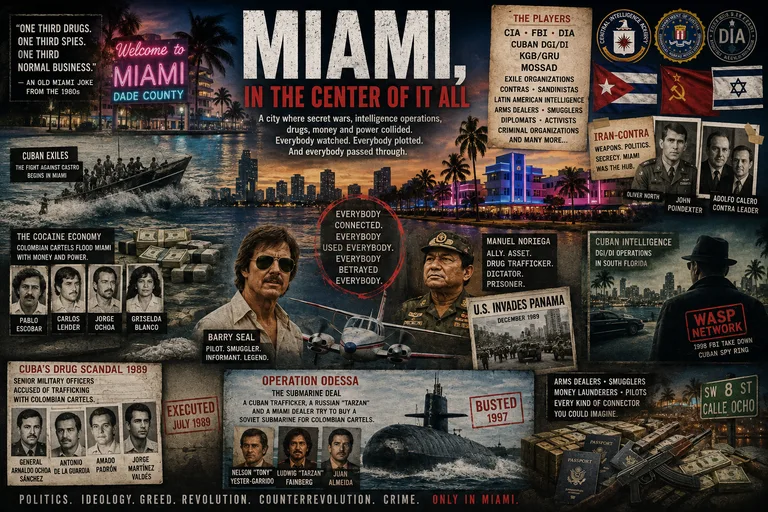
There was an old joke about Miami in the 1980s: one-third of the city was supported by drugs, another third by the CIA, Cuban intelligence or the clandestine war, and only the remaining third was involved in normal business.
The mathematics were almost certainly nonsense.
But the fact that people could tell the joke—and that everyone in Miami understood what it meant—says something about the city at the time.
Because for a remarkable period during the Cold War, it sometimes seemed as if every secret war in the Western Hemisphere eventually passed through South Florida.
There were CIA officers and former CIA officers.
FBI counterintelligence agents.
DIA personnel.
Cuban DGI and State Security officers.
Soviet KGB and GRU interests.
Cuban exile organizations.
Nicaraguan Sandinistas.
Nicaraguan Contras.
Colombian drug cartels.
Latin American intelligence officers.
Diplomats.
Mercenaries.
Pilots.
Arms brokers.
Smugglers.
Political activists.
Former soldiers.
Revolutionaries.
Counterrevolutionaries.
And people whose real employer could be surprisingly difficult to determine.
Israel belonged somewhere in that world as well. Israeli military and intelligence veterans, private security advisers and arms dealers operated extensively throughout Latin America during the period, and figures associated with Israeli intelligence appeared around governments such as Manuel Noriega’s Panama. But, as with the CIA, one has to distinguish carefully between an official intelligence operation and a former officer subsequently operating privately. In 1980s Miami those distinctions were not always obvious from the outside.
Miami was not simply a city.
At times it functioned like a giant geopolitical intersection.
It Started With Cuba
The transformation began after Fidel Castro took power in 1959.
Within weeks, the CIA had begun establishing a presence in Miami.
Then came Cuban refugees.
Then political organizations.
Then paramilitary groups.
Then CIA recruiters.
Then training camps.
Then boats.
Then weapons.
Then radios.
Then the Bay of Pigs.
The CIA recruited approximately 1,400 Cuban exiles for what became Brigade 2506, training men in weapons, guerrilla tactics, amphibious operations and parachuting.
When the invasion failed in April 1961, the clandestine war did not disappear.
It became larger.
The CIA created JM/WAVE, its massive Miami station, and South Florida became the operational rear area for attempts to infiltrate, sabotage, undermine and collect intelligence on Castro’s Cuba.
By some accounts JM/WAVE eventually became one of the largest CIA installations outside headquarters.
Thousands of Cubans became connected in one way or another to the covert struggle.
Some knew exactly whom they were working for.
Others worked through front organizations, maritime companies, intelligence contacts and exile organizations where the formal relationship with the U.S. government was considerably less obvious.
The Organizations Multiplied
The alphabet soup of anti-Castro organizations became almost impossible to follow.
There was:
Brigade 2506
Alpha 66
Movimiento de Recuperación Revolucionaria — MRR
Directorio Revolucionario Estudiantil — DRE
Comandos L
CORU — Coordination of United Revolutionary Organizations
Omega 7
Movimiento Nacionalista Cubano
and numerous smaller organizations that appeared, split, merged, fought among themselves and sometimes disappeared.
Some cooperated with American intelligence.
Some rejected American control.
Some received support during one period and lost it during another.
Some concentrated on propaganda.
Some conducted maritime raids.
Some infiltrated Cuba.
Some became associated with bombings or assassination attempts.
And some spent almost as much energy fighting other Cuban exile groups as they did fighting Castro.
Miami became their natural headquarters.
And Castro Sent His Own People
Havana understood exactly what Miami had become.
So Cuban intelligence came too.
The Cuban DGI/DI and State Security developed networks inside the exile community.
They wanted to know:
Who was working with the CIA?
Who was buying weapons?
Which boat was leaving tonight?
Where was it going?
Who financed it?
Who hated whom?
Which organization was planning an attack?
Who could be recruited?
Who could be manipulated?
Who could be turned?
Decades later the FBI would expose a substantial Cuban intelligence network operating in South Florida. In 1998, ten members of what became known as the Wasp Network were arrested; the FBI said the ring targeted military installations including U.S. Southern Command as well as Miami’s Cuban exile community.
That operation came later, but the doctrine behind it was much older.
Miami was not simply where Havana’s enemies lived.
It was a place Havana wanted to penetrate.
Then Came Cocaine
While one secret war was being fought over Cuba, another economy was exploding.
Cocaine.
By the late 1970s and early 1980s, South Florida had become one of the principal entry points for cocaine moving from Colombia into the United States.
The Medellín Cartel included names that became internationally notorious:
Pablo Escobar
Carlos Lehder
Jorge Ochoa
José Gonzalo Rodríguez Gacha
and Griselda Blanco.
The DEA records how rapidly the cocaine trade expanded and how South Florida became saturated with product. By early 1984, cocaine was so plentiful that wholesale prices in South Florida had fallen dramatically.
Escobar’s organization even dispatched people directly to Miami to supervise distribution, acquire property, create businesses and move money. Federal records later showed Medellín Cartel associates controlling South Florida properties and businesses while moving millions of dollars in cash through Miami.
There were aircraft.
Speedboats.
Freighters.
Bahamas routes.
Warehouses.
Cash houses.
Money laundering.
Banks suddenly receiving extraordinary deposits.
Real estate purchased with cash.
Businesses that existed partly to disguise other businesses.
At the same time that intelligence officers were watching Cuban exile boats, DEA agents and customs officers were watching Colombian drug boats.
Sometimes they were watching remarkably similar aircraft and vessels.
Miami Vice Was Exaggerated — But Not By Much
The television series Miami Vice turned all of this into neon-colored entertainment.
But reality was often stranger. The FBI’s Miami office recalls enormous drug investigations during the period.
In 1987 agents seized a yacht carrying 613 kilograms of cocaine.
That same year they discovered a stash house containing more than $3.8 million in cash hidden above false closet ceilings.
In 1988 another investigation targeted an organization responsible for importing multi-ton quantities of cocaine and seized a 400-foot freighter believed to have transported roughly four thousand kilograms.
The cocaine economy was not happening somewhere far from the intelligence world.
It was happening in exactly the same geographical space.
South Florida. The Bahamas. Central America. Panama. Colombia. Small airports.
That overlap is where the story becomes much more complicated.
Barry Seal
Few individuals better represent the blurred boundaries of the era than Adler Berriman “Barry” Seal.
Seal was an extraordinary pilot who became one of the most notorious cocaine smugglers of the period.
He transported drugs for the Medellín Cartel.
After being caught, he became a government informant.
In 1984 he participated in a covert operation in which an aircraft secretly photographed Pablo Escobar and other traffickers loading cocaine in Nicaragua.
Those photographs became politically explosive because the Reagan administration used the operation to argue that Sandinista Nicaragua was involved with narcotics trafficking.
Seal therefore existed in several worlds.
Pilot.
Smuggler.
Medellín associate.
Federal defendant.
DEA informant.
Government intelligence asset in a politically sensitive operation.
He was eventually murdered in Baton Rouge in 1986 by Colombian hit men.
Seal’s life has subsequently accumulated enormous mythology, particularly claims about the CIA.
Some allegations are well documented.
Others remain disputed.
That distinction matters.
But the reason the legends continue is obvious:
Barry Seal looked exactly like the kind of man who belonged in 1980s Miami’s shadow world.
Nicaragua Arrives in Miami
Then Central America exploded.
After the Sandinista Revolution of 1979, Nicaragua became another Cold War battlefield.
The Reagan administration supported the Contras, armed opponents of the Sandinista government.
Miami became deeply connected to the Contra political and logistics network.
Contra leaders lived, traveled and raised money there.
Exile communities supported them.
Arms brokers moved through the city.
Pilots and aviation companies entered the picture.
Former intelligence officers entered the picture.
The old Cuban anti-Castro networks suddenly became valuable again because many of the same Cubans had decades of experience with:
clandestine logistics,
radio communications,
air operations,
boat operations,
weapons,
guerrilla warfare,
and anti-communist organizing.
The war had moved from Cuba to Central America, but some of the people involved had not changed.
Félix Rodríguez Comes Back Into the Story
One of them was Félix Rodríguez.
The Cuban exile and CIA veteran who had participated in the operation surrounding Che Guevara’s capture in Bolivia later became involved in the Central American theater.
During the Contra war, Rodríguez worked around the clandestine resupply operation supporting anti-Sandinista forces.
Once again the same patterns appeared:
aircraft,
weapons,
secret bases,
intelligence contacts,
former CIA personnel,
Cuban exiles,
Central American military officers.
The geographical battlefield had changed.
The network had survived.
Iran-Contra
Then came the affair that exposed just how complicated this world had become.
The Reagan administration secretly sold weapons to Iran.
Money generated through the transactions was diverted toward support for the Nicaraguan Contras, despite congressional restrictions.
The resulting Iran-Contra affair pulled together people from seemingly unrelated worlds.
Oliver North
John Poindexter
Richard Secord
Albert Hakim
John Singlaub
Contra leaders such as Adolfo Calero
former intelligence figures
private arms dealers
aircraft operators
Middle Eastern intermediaries
Central American governments
and anti-communist networks.
Miami inevitably appeared around the edges and sometimes near the center.
A 1986 lawsuit filed in Miami attempted to connect former CIA figures Theodore Shackley and Thomas Clines, retired generals Richard Secord and John Singlaub, arms dealer Albert Hakim, and Contra figures in a sprawling alleged network involving arms and Central America. Many of the allegations in that lawsuit were disputed and should not be treated as established fact, but the list of defendants itself demonstrates how intertwined these communities had become.
Southern Air Transport
Even the airplanes had histories.
Southern Air Transport, based for a period in Miami, had once been owned by the CIA.
Years later, during Iran-Contra, investigators examined its role in transportation connected to the Contra resupply system and Iranian arms transactions.
That is almost a perfect metaphor for the entire period.
A company could begin as a CIA proprietary operation.
Become ostensibly private.
Continue employing people familiar with covert logistics.
Then reappear years later around another secret war.
Where did government end?
Where did private enterprise begin?
Sometimes even congressional investigators struggled to answer that question.
Former CIA Did Not Necessarily Mean Former Intelligence World
Miami was full of another category:
former intelligence officers.
A person could leave the CIA but retain:
contacts,
knowledge,
foreign relationships,
security clearances or former access,
aviation contacts,
arms contacts,
military contacts,
and friendships with people still inside government.
People such as Ted Shackley, Thomas Clines, and other veterans of Cold War covert operations repeatedly appeared in the broader universe surrounding private intelligence, arms dealing and anti-communist networks.
This did not mean every action undertaken by a former CIA officer was secretly authorized by the CIA.
Quite the opposite.
That assumption has generated decades of conspiracy theories.
But the practical problem was obvious:
when a man who had spent twenty years conducting covert operations began privately arranging international deals with other former intelligence officers, foreign military officials and arms brokers, outsiders could rarely know where the private network ended and the government network began.
Mossad and the Israeli Connection
Israel also intersected with the Latin American security world.
Israeli weapons, military trainers, security consultants and former intelligence personnel operated throughout the region.
One famous example was Mike Harari, a veteran Israeli intelligence figure associated with Mossad who later became closely connected to Panamanian ruler Manuel Noriega.
Panama mattered enormously to the Miami ecosystem.
Money moved through Panama.
Aircraft moved through Panama.
Weapons moved through Panama.
Intelligence services operated there.
The Medellín Cartel dealt there.
Contra-related activities touched the country.
Cuban interests touched it.
American intelligence watched it.
And Miami was one of Panama’s principal commercial and human connections to the United States.
Again, care is necessary: the presence of a former Mossad figure did not automatically make every operation an official Israeli intelligence operation.
But it added another layer to an already crowded intelligence environment.
Manuel Noriega: Everyone’s Useful Enemy
Few men understood this world better than Manuel Noriega.
Noriega dealt with the United States intelligence community for years.
He dealt with Cuba.
He dealt with regional governments.
He dealt with intelligence services.
He had connections to narcotics traffickers.
He interacted with Contra-related operations.
He understood that information itself was a commodity.
For years, Washington tolerated behavior it increasingly found unacceptable because Noriega also remained useful.
Then usefulness ended.
In 1989 the United States invaded Panama and removed him.
Even that story had a strong South Florida dimension.
Noriega was eventually brought to Miami to face federal narcotics charges.
Once again:
everyone eventually seemed to arrive in Miami.
Cuba’s Own Drug Scandal
And then, in 1989, Havana produced one of the most extraordinary episodes of the entire period.
The Cuban government arrested senior military and Interior Ministry officers and accused them of narcotics trafficking.
Among them were:
General Arnaldo Ochoa Sánchez
Colonel Antonio de la Guardia
Major Amado Padrón
and
Captain Jorge Martínez Valdés.
These were not street criminals.
Ochoa was one of Cuba’s most decorated military officers, a veteran of overseas campaigns.
Antonio de la Guardia was associated with the Ministry of Interior’s clandestine activities.
His department was involved in obtaining foreign currency, technology and goods that Cuba had difficulty acquiring because of the American embargo. Contemporary reporting identified Department MC precisely with efforts to circumvent those restrictions.
The government alleged that the defendants became involved in cocaine trafficking connected to the Medellín Cartel.
Evidence presented during the proceedings included allegations that Jorge Martínez Valdés met Pablo Escobar in Medellín and that a series of operations had attempted to move cocaine through Cuba.
Ochoa, Antonio de la Guardia, Amado Padrón and Jorge Martínez Valdés were convicted and executed in July 1989.
The official Cuban position was that corrupt officials had independently betrayed the revolution.
Critics suspected that senior leaders must have known more than they admitted.
That argument continues.
What is certain is that the case demonstrated how closely the worlds of:
intelligence
sanctions-busting
foreign procurement
military operations
and drug trafficking
could approach one another.
Antonio de la Guardia Is Particularly Important
Antonio de la Guardia deserves special attention because his career illustrates how Cuba itself had developed clandestine commercial structures.
The Cuban government needed:
hard currency,
technology,
restricted equipment,
industrial components,
and products difficult to purchase openly under the American embargo.
That created organizations whose job was essentially to figure out:
How do we get what Cuba isn’t supposed to be able to get?
Front companies.
Intermediaries.
Third countries.
False paperwork.
Friendly businessmen.
Private aircraft.
Ships.
Foreign bank accounts.
Those are also precisely the tools used by intelligence agencies, arms smugglers and drug traffickers.
That does not mean the activities were identical.
But they frequently required the same infrastructure.
And people who became skilled at moving one prohibited commodity could potentially move another.
Meanwhile the FBI Was Watching Everybody
Through all of this, the FBI Miami Field Office had an almost impossible portfolio.
It dealt with:
organized crime,
drug trafficking,
Cuban espionage,
politically motivated violence,
bombings,
foreign counterintelligence,
terrorism,
fraud,
and eventually Cuban spy networks.
The FBI’s own history of its Miami office describes investigations involving drugs, bombings, Cuban intelligence officers and violent exile activity.
And the FBI had another difficult problem.
Some people it might normally investigate as militants had previous relationships with the CIA.
Some foreign intelligence targets were living among communities strongly supportive of American anti-communist policy.
Some people considered heroes by one part of Miami were considered terrorists by another.
Law enforcement and intelligence priorities did not always align cleanly.
Everyone Was Watching Everyone
That may be the best way to understand Miami.
The CIA watched Cuba.
Cuban intelligence watched the CIA.
Cuban intelligence watched Cuban exiles.
Cuban exile organizations watched one another.
The FBI watched Cuban intelligence.
The FBI watched violent exile organizations.
The DEA watched Colombian traffickers.
The traffickers watched the DEA.
The KGB watched American intelligence.
American intelligence watched Soviet activity.
The Sandinistas watched the Contras.
The Contras watched the Sandinistas.
Latin American governments watched both.
Israeli security and arms networks appeared around regional governments.
Former intelligence officers operated private businesses with contacts accumulated during government careers.
Arms dealers talked to everyone.
Smugglers moved things for whoever paid them.
Pilots sometimes transported cargo without asking enough questions.
And occasionally the same man appeared in several of those worlds.
The Hotel Lobby Problem
Imagine sitting in the lobby of a Miami hotel in 1986.
The man at the next table could be:
a legitimate businessman from Venezuela,
a Colombian money launderer,
a Cuban exile raising money for an anti-Castro operation,
a Cuban intelligence officer pretending to be an exile,
an FBI informant watching him,
a former CIA officer arranging an aviation deal,
a Contra representative looking for weapons,
an arms broker looking for the Contra representative,
or simply an accountant attending a convention.
The remarkable thing is that all of those possibilities were plausible.
That was Miami.
And Then There Were the Businesses
This is where the old joke about one-third of the city being involved in drugs and another third in espionage becomes meaningful.
Nobody seriously audited Miami’s economy and discovered those percentages.
But clandestine operations require legitimate-looking infrastructure.
You need:
warehouses.
Marinas.
Air charter companies.
Freight forwarders.
Import-export businesses.
Real estate companies.
Banks.
Lawyers.
Accountants.
Radio shops.
Electronics companies.
Travel agencies.
Restaurants.
Hotels.
Construction companies.
Boat repair yards.
A clandestine economy hides inside a legitimate economy.
And Miami’s explosive growth made that particularly easy.
A company suddenly receiving huge amounts of cash did not necessarily look unusual in a city where huge amounts of money were arriving every day.
Miami Was Also Building a Real City
And this is the part the joke misses.
Most people in Miami were not spies, smugglers or drug dealers.
They were building families. Businesses. Banks. Restaurants. Construction firms. Medical practices. Schools. Real estate companies. Latin American corporate headquarters.
The Cuban exile population helped transform Miami from a relatively provincial Southern tourist city into the commercial capital of Latin America.
Major American companies established Latin American operations there precisely because Miami possessed a rapidly growing bilingual professional workforce.
So while clandestine money unquestionably passed through Miami, enormous amounts of legitimate wealth were being created at the same time.
The two histories grew beside each other.
The Perfect Cold War City
That is why Miami was different from Washington.
Washington was where policies were written.
Miami was where many of them became real.
A memorandum in Washington might say:
support the Cuban resistance.
In Miami, somebody had to find the Cuban.
Train him.
Buy the boat.
Acquire the radio.
Load the weapons.
Arrange the fuel.
Find someone who knew the coastline.
A Washington directive might say:
support the Contras.
Somewhere farther down the chain, somebody had to locate an aircraft, pilot, landing strip and warehouse.
The policy eventually became physical.
And physical things require places.
Miami was one of those places.
Conclusion
Everybody Eventually Passed Through Miami
It is probably impossible to reconstruct the complete clandestine history of Miami during the 1960s, 70s and 80s.
Too many operations were never documented publicly.
Too many records remain classified or were destroyed.
Too many participants died without talking.
Others talked constantly but exaggerated what they had done.
Intelligence officers protected sources.
Smugglers lied.
Politicians denied knowledge.
Criminals became informants.
Informants became criminals again.
Former intelligence officers insisted they were acting privately.
Private businessmen sometimes turned out to be intelligence assets.
And every genuine revelation produced three new conspiracy theories.
That is why the history must be approached carefully.
But beneath the mythology is an extraordinary amount of documented reality.
Brigade 2506 was real.
JM/WAVE was real.
Operation Mongoose was real.
Alpha 66 was real.
CORU and Omega 7 were real.
Cuban intelligence penetration of South Florida was real.
The KGB-Cuba relationship was real.
The Contra war was real.
Iran-Contra was real.
Barry Seal was real.
The Medellín Cartel was real.
The cocaine mountains arriving in South Florida were real.
Southern Air Transport’s CIA history was real.
Manuel Noriega’s intelligence relationships and drug charges were real.
Arnaldo Ochoa, Antonio de la Guardia, Amado Padrón and Jorge Martínez Valdés were real—and four of them ended before a Cuban firing squad.
What remains difficult is determining where one world ended and another began.
Where did intelligence become politics?
Where did politics become covert action?
Where did covert action become private enterprise?
Where did private enterprise become arms dealing?
Where did arms dealing become smuggling?
Where did smuggling become narcotics trafficking?
And when a former intelligence officer did something privately, how private was it really?
Those questions made Miami unique.
At various moments, people working for the United States, Cuba, the Soviet Union, Latin American governments and private organizations could all be operating in the same city.
Sometimes they cooperated.
Sometimes they used one another.
Sometimes they betrayed one another.
Sometimes they were trying to kill one another.
And sometimes they probably sat three tables apart in the same restaurant without knowing it.
So perhaps the old Miami joke was never intended to be mathematically accurate.
Maybe that was not the point.
The point was that in 1980s Miami, nothing seemed impossible.
The cocaine trafficker might know an intelligence officer.
The intelligence officer might know an arms dealer.
The arms dealer might know a Contra commander.
The Contra commander might know a Cuban exile.
The Cuban exile might unknowingly be talking to a Cuban agent.
The Cuban agent might be watched by the FBI.
The former CIA officer might know all of them.
And somewhere nearby, an ordinary businessman was just trying to sell air conditioners.
Washington made policy.
Havana plotted survival.
Bogotá shipped cocaine.
Managua fought a revolution.
Moscow and Washington fought the Cold War.
Panama moved money and people.
But somehow, sooner or later—
everybody passed through Miami.
And for a brief period, Miami really did feel like it was in the center of it all.
Operation Odessa — When a Strip Club Tried to sell a Soviet Submarine
Like something out of a Bond Movie, one story captures just how surreal Miami’s criminal and clandestine world had become by the 1990s, it may be the attempt to buy a former Soviet submarine for Colombian drug traffickers.
At the center of the scheme was Nelson Pablo “Tony” Yester-Garrido, a Cuban-born trafficker who operated in the South Florida underworld and had connections with major Colombian cocaine organizations.
But Yester was only one character in an extraordinary cast.
There was also Ludwig “Tarzan” Fainberg, a Ukrainian-born Miami nightclub owner with connections to Russian and Eastern European organized crime. BTW, the club was called Porky’s yeah like the movie.
And there was Juan Almeida, a Miami businessman and luxury-car dealer who became involved in the negotiations.
Together they entered into a plan that sounded more like a movie script than an actual criminal investigation.
Buy a Russian military submarine.
The Soviet Union had collapsed.
Military equipment from the former Soviet bloc was suddenly available through poorly controlled markets, corrupt officials, brokers and businessmen looking for money.
Aircraft could be purchased. Helicopters could be purchased.Weapons could be purchased. So someone eventually asked the logical Miami question:
Why not a submarine?
The concept was breathtakingly simple.
Acquire a diesel-powered submarine from the former Soviet military.
Modify it.
Then use it to transport enormous quantities of cocaine from Colombia while traveling beneath the surface, where conventional maritime surveillance would have difficulty detecting it.
For Colombian traffickers, a submarine represented potentially enormous capacity combined with extraordinary stealth.
For the brokers, it represented an equally enormous payday.
From Havana to Moscow to Medellín to Miami
The characters themselves illustrate how much the world had changed.
Yester was Cuban. Fainberg came from the former Soviet world.
The buyers were connected to Colombian narcotics organizations.
The negotiations passed through Miami. And the hardware they wanted had once belonged to the military apparatus of America’s Cold War enemy.
Only a few years earlier, Soviet submarines represented one of the most serious strategic threats confronting the United States.
Now Miami criminals were discussing buying one to haul cocaine.
The Cold War had ended. The equipment had not disappeared.
It had simply entered the marketplace.
“Tarzan”
Ludwig Fainberg was better known around Miami as Tarzan.
He operated a nightclub and moved in circles containing Russian businessmen, criminals, entertainers and wealthy foreigners.
Men like Fainberg became increasingly important during the 1990s because the collapse of the Soviet Union created an entirely new international marketplace.
People who understood both sides could become extremely valuable.
A Colombian trafficker might have millions of dollars.
But he did not know whom to call in Russia about buying military equipment.
A Russian broker might know exactly whom to call. Miami provided the introduction.
Once again, the city’s importance was not necessarily that the final transaction occurred there.
Miami’s importance was that people from completely different worlds could find one another there.
Tony Yester
Nelson “Tony” Yester-Garrido was another quintessential Miami character.
Cuban-born and connected to large-scale cocaine trafficking, Yester operated within the networks linking South Florida with Colombian drug organizations.
His world included smugglers, traffickers, businessmen and intermediaries capable of arranging international transactions.
And according to federal authorities, Yester became involved in negotiating the submarine purchase.
Think about how far that world had traveled.
The earlier generation of Cuban clandestine operators worried about secretly transporting: guns, radios, explosives, men, and equipment between Miami and Cuba.
A generation later, people operating within overlapping Cuban and narcotics networks were discussing buying an entire Soviet submarine.
The scale had changed enormously. The mentality had not.
Find someone who can get what you’re not supposed to have.
The Luxury-Car Dealer
Then there was Juan Almeida.
Luxury automobiles occupied their own interesting corner of Miami’s international economy. Expensive cars moved between wealthy clients, foreign businessmen and people with large amounts of cash.
A legitimate luxury-car business could therefore place someone in contact with: wealthy colombians, Russian businessmen, international brokers, and people who preferred not to explain where their money came from.
Again, none of that automatically made such a business criminal.
But Miami contained countless legitimate commercial environments in which people from otherwise unrelated clandestine worlds could meet.
A marina could connect smugglers. An air-charter company could connect pilots.
A nightclub could connect Russians and Colombians. A luxury-car dealership could connect buyers and brokers. That was how Miami worked.
The Submarine Deal
The proposed submarine was reportedly a diesel-electric former Soviet vessel.
The traffickers envisioned using it to carry enormous cocaine shipments.
A military submarine offered capabilities traditional smugglers could only dream about: long range, large cargo capacity, ocean-going endurance, and the ability to disappear beneath the surface. But acquiring something that large required an international network.
There had to be sellers. Military contacts. Brokers. Money. Transportation. Technical personnel. Negotiations. Potential modifications.
And somewhere in the middle of all of it were people connected through South Florida.
Federal investigators ultimately penetrated the operation.
The submarine purchase never became operational.
The scheme was broken up in 1997.
Operation Odessa
Years later the story became the basis for the documentary:Operation Odessa
The title referred to the Ukrainian port city and the post-Soviet environment from which extraordinary quantities of military hardware and other assets could potentially be obtained.
But the story could just as easily have been called: Operation Miami.
Because Miami was where the characters connected.
A Cuban trafficker. A Russian mob-connected nightclub owner. A luxury-car dealer.
Colombian cocaine organizations. Former Soviet military hardware.
Federal investigators. They should have had almost nothing in common.
Yet somehow they ended up discussing the same submarine.
The Perfect Epilogue to the Miami Story
Operation Odessa occurred after the peak Cold War years, but that is precisely why it belongs in this story.
It demonstrates what happened when the clandestine infrastructure built during decades of Cold War conflict did not simply disappear when the Soviet Union collapsed.
The people were still there. The aviation contacts were still there.
The smugglers were still there. The brokers were still there.
The Colombian cocaine money was certainly still there.
And now an entirely new source of military equipment had become available from the shattered Soviet bloc. The Cold War networks mutated into something different.
Politics became business. Intelligence contacts became commercial contacts.
Military equipment became merchandise. Former adversaries became trading partners.
And Miami remained the meeting place. If the 1980s seemed unbelievable because CIA veterans, Cuban agents, Contras, cocaine traffickers and arms dealers could all operate in the same city, the 1990s somehow produced an even more appropriate ending:
a Cuban trafficker, a Russian named Tarzan and a Miami car dealer trying to buy a Soviet submarine for Colombian cocaine smugglers.
You could hardly invent a better Miami story. Except that someone actually did it.