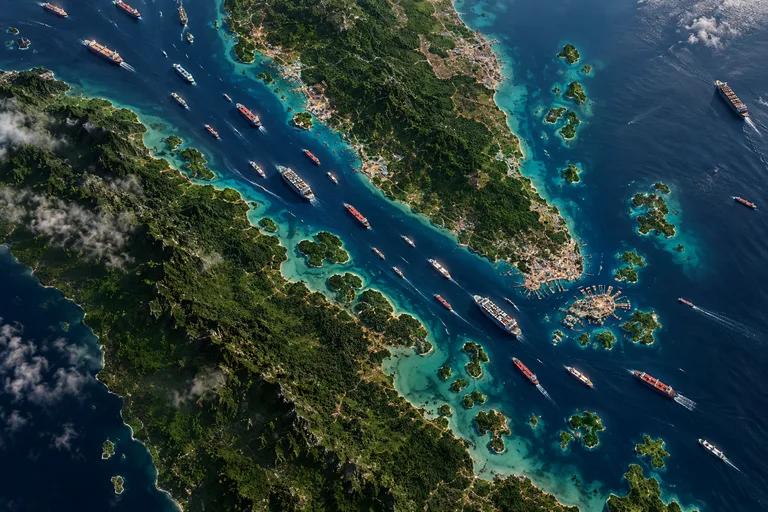
Every great power has a back door. China’s problem is that it is surrounded by them—and everyone knows where they are. --YNOT!
There are certain words that keep showing up whenever you seriously study China.
Taiwan. Semiconductors. Oil. The South China Sea.
But there is another word that ought to be written on the wall in Beijing in letters ten feet high: Malaca. Malaca. Malaca.
Because for all the aircraft carriers, missiles, factories, satellites, cyberwarfare, artificial intelligence and increasingly impressive military parades, China still has a very old-fashioned problem.
Ships have to get there.
And a tremendous number of those ships have to squeeze through one narrow stretch of water.
The Strait of Malacca.
THE MALACCA DILEMMA
This is not some theory invented by an American think tank.
The Chinese themselves have worried about it for decades.
In 2003, Chinese leader Hu Jintao famously described what became known as the “Malacca Dilemma”: China’s dependence upon maritime trade routes passing through a narrow strategic chokepoint that China itself does not control.
And China has good reason to worry.
A huge share of the energy feeding China’s industrial economy arrives by sea. Much of the petroleum coming from the Persian Gulf and Africa travels across the Indian Ocean, through the Strait of Malacca, past Singapore and into the South China Sea before finally reaching Chinese ports.
That is an astonishing vulnerability for a country aspiring to become the dominant power in Asia.
China may manufacture the television.
China may manufacture the batteries.
China may manufacture the solar panels.
China may manufacture the drones.
But somebody still has to deliver the oil.
And oil does not care how many TikTok followers you have.
GEOGRAPHY IS STILL UNDEFEATED
We occasionally talk as though technology has abolished geography.
It hasn’t.
The Strait of Malacca sits between the Malay Peninsula and the Indonesian island of Sumatra.
At its narrowest navigable section near Singapore, the maritime corridor becomes remarkably constrained.
And through this neighborhood moves an enormous portion of the commerce connecting the Indian Ocean with East Asia.
Which means that somebody looking at a map in Beijing eventually has to ask a very uncomfortable question:What happens if we go to war and those ships stop coming?
Factories require energy. Trucks require diesel. Aircraft require fuel. Ships require fuel.
Petrochemical plants require feedstocks.
Modern civilization is basically an elaborate machine for turning energy into everything else.
China built perhaps the greatest manufacturing machine the world has ever seen.
But the machine needs to eat.
ENTER INDIA
Now look west. Not toward America. Toward India.
India possesses something extremely interesting called the Andaman and Nicobar Islands, stretching south through the Bay of Bengal.
And at the bottom sits Great Nicobar Island.
Great Nicobar is remote. Very remote.
It is closer to parts of Southeast Asia than it is to much of mainland India.
For decades hardly anybody outside the region paid much attention to it.
That is changing.
India is planning enormous infrastructure investments there—a major container port, airport, power infrastructure and related development. The island sits near shipping routes approaching the Malacca Strait, giving India potentially important commercial and military reach.
Suddenly that forgotten island looks considerably less forgotten.
Because geography has given India something money cannot easily manufacture:
position.
THE STRING OF PEARLS
China understands this problem. It has spent decades trying to solve it.
Beijing has developed ports, infrastructure and relationships stretching across the Indian Ocean.
Djibouti. Pakistan. Sri Lanka. Myanmar. Bangladesh.
The collection has often been described as China’s “String of Pearls.”
Look at a map and you understand the logic immediately.
China wants places where its ships can operate.
Places where goods can move. Places where energy can arrive.
Places that reduce China’s dependence upon maritime routes dominated by other countries.
And above all:China wants alternatives.
Because great powers do not like having only one road into town.
China’s investments around the Indian Ocean therefore aren’t merely economic curiosities. They also make strategic sense for a country worried about maintaining maritime access during a crisis.
CHINA BUILT A BACK DOOR
One of China’s biggest attempts to escape the Malacca problem is Pakistan.
The theory was beautiful.
Build the port of Gwadar on the Arabian Sea.
Unload oil and cargo there. Move it north through Pakistan toward western China. Voilà.
China now has a back door to the Indian Ocean. No Malacca.
At least that was the brochure.
The problem is that between a port on the Arabian Sea and western China lies a rather inconvenient collection of things called:
Pakistan, mountains, distance, cost and politics. Infrastructure can overcome geography.
But geography charges rent. And sometimes the rent is enormous.
THEN THERE WAS MYANMAR
China tried another approach.
Bring oil into Myanmar from the Bay of Bengal and send it through pipelines toward Yunnan province.
This one actually works. To a point. It gives China another route.
It reduces some pressure.
But it doesn’t replace the enormous volume of maritime commerce moving through Southeast Asia.
And Myanmar has spent recent years dealing with military rule, armed conflict and political instability.
So China’s solution to one geopolitical vulnerability introduced another geopolitical vulnerability.
Welcome to geopolitics. There are very few solutions.
Mostly there are different collections of problems.
JUST GO AROUND
Someone inevitably says: “Why don’t the ships simply go around Malacca?”
They can. There are alternative routes through Indonesia, including the Sunda and Lombok Straits.
But longer routes mean more sailing. More sailing means more fuel.
More fuel means more tankers. More tankers mean more money.
More distance means fewer deliveries per ship per year.
And during a major military conflict, taking a longer route does not necessarily eliminate the strategic problem.
You have simply moved the problem several hundred miles down the road.
Or in this case, down the ocean.
AND THEN THERE IS TAIWAN
Now we return to Taiwan.
Because this is where Malacca becomes especially interesting.
People often look at a Taiwan war primarily as a military contest:
Chinese missiles versus Taiwanese defenses.
Chinese aircraft versus American aircraft.
Chinese ships versus American submarines.
Chinese soldiers trying to cross the Taiwan Strait.
But wars are not merely fought by soldiers.
Wars are fought by economies.
Imagine China launching a major operation against Taiwan.
The first question might be:Can China take Taiwan?
But the second question becomes:Can China continue feeding a gigantic industrial economy while doing it?
China imports enormous quantities of petroleum, natural gas, minerals, food and industrial commodities.
Ships carrying those materials travel through waters where China does not possess uncontested control.
That is the part of the Taiwan equation sometimes overlooked.
China would not simply be attacking Taiwan.
China would be betting that its entire global logistics system continues functioning during the conflict.
That is a much larger bet.
BUT DON’T GET CARRIED AWAY
There is another side to this story.
People sometimes talk about “closing Malacca” as though somebody just walks over and shuts a gate.
It isn’t that simple. Indonesia exists. Malaysia exists. Singapore exists.
International shipping law exists.
Other Asian economies depend upon the same route.
Japan needs it. South Korea needs it. India needs it. Europe needs it.
The United States has economic interests there.
Everybody’s containers are mixed together.
Everybody’s oil tankers sail through the same ocean.
And India itself depends heavily upon maritime trade.
An Indian naval officer quoted in the source makes the essential point: strangling Malacca would damage far more than China. The Strait is bordered by Indonesia, Malaysia and Singapore, and maintaining a blockade would be far more complicated than simply announcing one.
Which brings us to one of my favorite rules of geopolitics:
Never confuse having someone’s throat within reach with being able to squeeze it without breaking your own fingers.
SO WHY DOES IT MATTER?
Because deterrence is not always about actually doing something.
Sometimes it is enough that the other fellow knows you could.
India does not necessarily need to close Malacca.
America does not necessarily need to close Malacca.
Indonesia does not necessarily need to close Malacca.
Nobody needs to close anything.
The strategic value lies partly in Beijing having to think about the possibility.
Every tanker. Every pipeline. Every port. Every naval base. Every alternate trade route.
Every strategic petroleum reserve. Every ship China builds.
Every relationship it develops with Pakistan, Myanmar, Sri Lanka or countries around the Indian Ocean.
Somewhere buried inside those decisions is the same little geographical problem.
Malaca.
THE GREAT IRONY
China has spent decades attempting to reduce its vulnerability.
Ports. Pipelines. Railroads. The Belt and Road Initiative. Naval expansion.
Overseas bases. Strategic petroleum reserves. Alternative routes.
And yet geography remains stubborn. China sits on the Pacific.
Much of China’s energy sits on the other side of the Indian Ocean.
Between the two lies a series of narrow places controlled or influenced by countries that are not China.
That doesn’t mean China is helpless. Far from it.
China is building one of the world’s most powerful navies precisely because it understands the problem.
But it does mean that China’s enormous industrial strength contains an equally enormous logistical dependency.
And perhaps that is the lesson. Every great power has an Achilles’ heel.
America has debt.
Russia has demographics and economic concentration.
Europe has political fragmentation.
China has several. But one of the easiest to find requires nothing more sophisticated than opening a map.
Follow the oil tankers. Across the Persian Gulf. Across the Indian Ocean. Past India. Toward Singapore.
And eventually the ocean becomes very narrow.
Malaca. Malaca. Malaca.
China knows where its weakness is.
The interesting question is not whether Beijing understands it.
The interesting question is what China is willing to do to make sure nobody ever gets the opportunity to use it.
China’s Malacca Exposure
Source says roughly 80% of China’s imported oil and about two-thirds of its trade pass through the Strait, while China accounts for about 48% of the oil moving through Malacca. It also gives a 2024 estimate of $390 billion in Chinese energy imports, with about $312 billion passing through Malacca.
China is a continental-sized industrial power whose oil supply still has to squeeze through a narrow maritime doorway.
| measure | share |
|---|---|
| China’s imported oil passing through Malacca | 80 |
| China’s trade passing through Malacca | 67 |
| Oil transiting Malacca destined for China | 48 |
So where is it?
The Strait of Malacca looks enormous on a globe. At ship level, it is a funnel. It runs between the Malay Peninsula—Malaysia and Singapore—and the Indonesian island of Sumatra, connecting the Indian Ocean with the South China Sea and ultimately the Pacific.
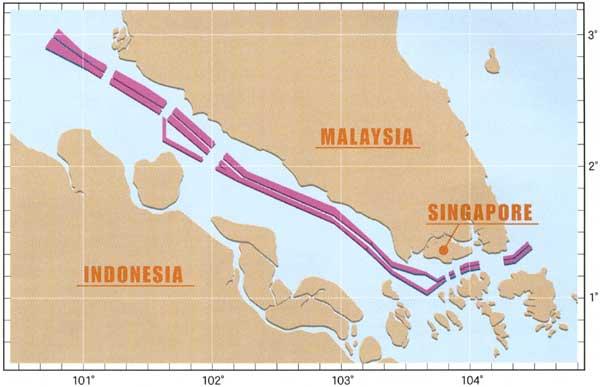
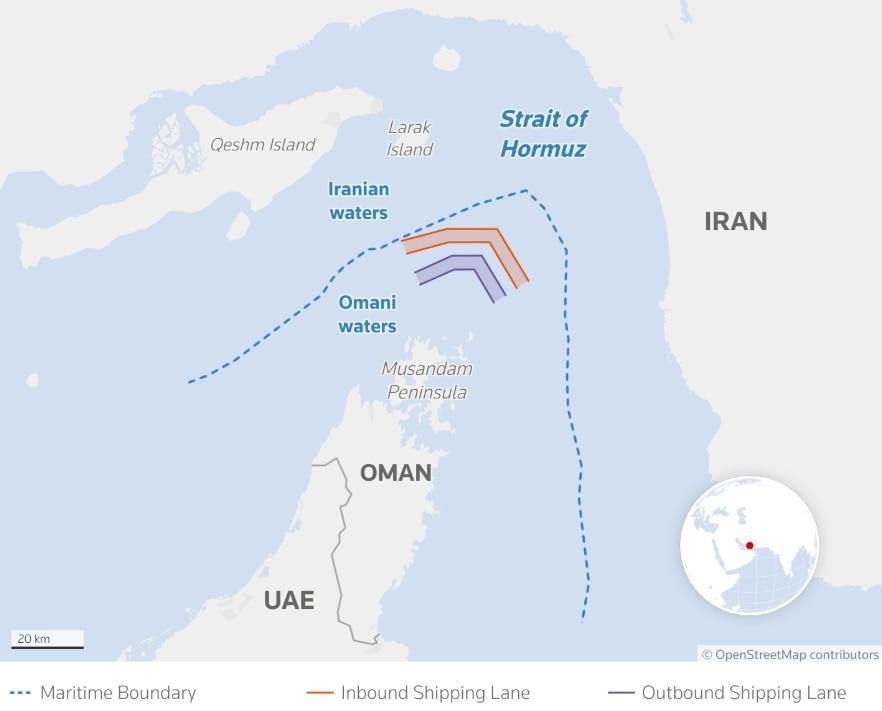
The important measurement is not simply the distance from one coastline to another. Commercial ships have to follow safe, navigable channels. Near Singapore, at the Phillips Channel, the usable passage constricts to roughly 1.7 miles (2.7 km). Large tankers also face depth and maneuvering constraints; the maximum ship class commonly associated with the route is appropriately called Malaccamax. (U.S. Energy Information Administration) Your source makes essentially the same point, describing the Singapore-area bottleneck as only about 2.5 km wide.
And there is a staggering amount of energy moving through that funnel. EIA estimates 23.2 million barrels per day of petroleum passed through Malacca in the first half of 2025, more than through Hormuz, and China accounted for about 48% of the import volumes transiting Malacca. (U.S. Energy Information Administration)
Malacca versus Hormuz
| Strait of Malacca | Strait of Hormuz | |
|---|---|---|
| Geography | Between Sumatra and Malaysia/Singapore | Between Iran and Oman |
| Physical bottleneck | About 1.7 miles at Phillips Channel | About 21 miles overall at narrowest point |
| Actual designated ship lanes | Constrained channel varies along route | 2-mile inbound + 2-mile outbound, with 2-mile separation |
| Oil flow, 1H 2025 | 23.2m barrels/day | 20.9m barrels/day |
| Main vulnerability | Extremely congested, narrow, shallow in places | Shipping concentrated into very narrow traffic lanes |
| Main alternatives | Sunda and Lombok Straits, but longer/costlier | Pipelines, but nowhere near enough capacity to replace Hormuz |
| Political geography | Indonesia + Malaysia + Singapore | Iran + Oman |
Hormuz sounds wider because it is wider physically. At its narrowest it is about 21 miles across. But that’s misleading too: international tanker traffic moves through designated lanes only about two miles wide in each direction, separated by a two-mile buffer. (U.S. Energy Information Administration)
So both have the same strategic feature:
Thousands of miles of ocean eventually become a couple of miles of usable roadway.
Why Malacca is vulnerable
Malacca isn’t “easy to close” in the sense that somebody throws a chain across it.
It is easy to disrupt relative to the enormous amount of commerce dependent upon it.
Think of I-95 narrowing from twelve lanes to one lane.
You don’t have to eliminate traffic forever to create an economic crisis. A serious accident, grounding, collision, security incident or military confrontation could produce delays, congestion, rerouting and sharply higher insurance and freight costs. EIA specifically describes the narrow Phillips Channel as presenting risks of collision, grounding and oil spills. (U.S. Energy Information Administration)
And because the traffic density is so high, disruption compounds.
A tanker stops. Ships behind it slow. Anchorage areas fill.
Arrival schedules collapse. Refineries don’t receive scheduled cargoes.
Replacement ships take longer routes.
Freight and insurance prices rise.
And suddenly a physical problem a few miles wide becomes an economic problem several thousand miles away.
That’s what makes a chokepoint a chokepoint.
But Hormuz is actually the scarier military chokepoint
There is an important distinction for your article.
Malacca may be China’s greater strategic vulnerability, but Hormuz is arguably easier for a single country to threaten militarily.
Iran sits directly on the northern side of Hormuz and controls nearby coastline and islands. Oman sits on the southern side. Almost all Persian Gulf exports headed east or west have to pass through those tightly organized shipping lanes.
There are bypass pipelines, but their spare capacity could replace only a fraction of normal Hormuz traffic. EIA puts 1H25 Hormuz petroleum traffic at 20.9 million barrels/day, while the major Saudi and UAE bypass pipelines together offered roughly 4.7 million barrels/day of available bypass capacity.
Malacca is politically more complicated.
Indonesia, Malaysia and Singapore border it. India is nearby strategically through the Andaman and Nicobar Islands, but India does not own the Strait of Malacca. And shutting it would hammer Japan, South Korea, Singapore, India and much of the world economy along with China.
Your original source actually makes this caveat very well: interfering with Malacca is one thing; sustaining a blockade is another, particularly because the waterway involves Indonesia, Malaysia and Singapore and because India itself depends heavily on maritime commerce.
Hormuz is a gun pointed at the world’s oil supply. Malacca is a hand wrapped around the throat of Asian industry. The frightening part is that China’s factories are on the other end of that throat.
And that makes the Chinese Malacca Dilemma more interesting than simply saying, “India can close the Strait.”
China’s real nightmare isn’t necessarily that Malacca stays closed forever.
It is that during a Taiwan war, China suddenly has to protect Taiwan operations, the South China Sea, its Pacific coast—and an energy lifeline extending thousands of miles across the Indian Ocean at the same time.
And sometimes you just can’t win against the geology…