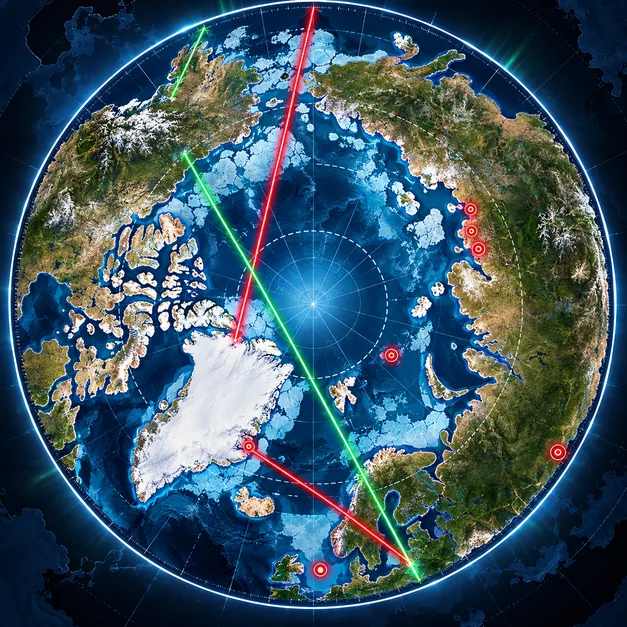
We are all used to seeing the world at eye level. But look down from the top of the world, and suddenly the geography, the threats, and the balance of power look completely different, and you begin to understand why the Arctic may be the most important high ground on Earth. --YNOT!
Greenland, Golden Dome, and the quiet restructuring of Arctic defense
For most of human history, the military meaning of high ground was simple: get above your enemy.
Take the hill. Hold the mountain pass. Put your artillery where it can see farther than the other side.
In the twenty-first century, the definition has changed.
High ground can now mean latitude.
It can mean a radar installation close enough to the North Pole to see a ballistic missile hundreds or thousands of miles before another sensor can see it. It can mean a satellite ground station that gets repeated contact with spacecraft moving in polar orbits. It can mean a submarine operating under Arctic waters, an over-the-horizon radar looking beyond the curvature of the Earth, or a network of space-based sensors looking down on the entire planet.
And viewed through that lens, Greenland is not some remote frozen island sitting on the edge of the world.
Greenland is sitting on top of it.
On September 22, 2026, President Donald Trump, Danish Prime Minister Mette Frederiksen and Greenlandic Prime Minister Jens-Frederik Nielsen signed a sweeping new agreement governing the American military presence in Greenland. The agreement amends the original 1951 defense treaty and explicitly connects Greenland to the future American Golden Dome missile-defense system. It expands U.S. basing, military movement, submarine access, investment-security controls and the possibility of future American military installations. (The White House)
It is one of those agreements where both the exaggerations and the attempts to minimize it can obscure what actually happened.
No, Greenland did not become an American state.
No, Denmark did not sell Greenland.
And no, the treaty does not legally turn Greenland into an American protectorate.
In fact, the opening of the agreement explicitly reaffirms the sovereignty and territorial integrity of the Kingdom of Denmark and recognizes Greenlanders as a people under international law with the right to self-determination. (The White House)
But dismissing this as merely another routine basing agreement would miss the significance of what has changed.
The United States has obtained a substantially expanded and deliberately long-term military framework on one of the most strategically located pieces of territory on Earth.
And that has implications far beyond Greenland.
Why Greenland matters so much
Pull out a normal flat map of the world and Greenland looks remote.
Look at the Earth from directly above the North Pole and the picture changes dramatically.
North America, Greenland, Scandinavia and Russia wrap around the Arctic Ocean. What looks like a long east-west journey on a Mercator map can become a relatively short polar route on a globe.
That geometry is one reason the United States has maintained a military presence in Greenland for more than 80 years.
The most important existing American installation is Pituffik Space Base, formerly Thule Air Base, on Greenland’s northwest coast.
Pituffik is at approximately 76°32′ north latitude, about 750 miles north of the Arctic Circle and roughly 947 miles south of the North Pole. It is the northernmost U.S. Department of Defense installation. (U.S. Space Force)
And Pituffik isn’t primarily there to launch fighter aircraft.
Its value is information.
The U.S. Space Force’s 12th Space Warning Squadron operates the massive Upgraded Early Warning Radar there. Its missions are:
missile warning, missile defense and space-domain awareness.
The radar watches for intercontinental ballistic missiles and submarine-launched ballistic missiles threatening the United States and Canada, while also tracking objects in orbit. (Buckley Space Force Base)
Pituffik also participates in the Satellite Control Network. Its extreme northern latitude gives it frequent access to satellites moving through polar orbits, making Greenland useful not only for terrestrial defense but for military operations in space. (United States Space Force)
That distinction matters.
The battle for Greenland is not simply about having somewhere to park airplanes.
It is about seeing first, communicating first and reacting first.
What actually changed on September 22
The new agreement builds upon the existing 1951 defense framework rather than replacing it.
And some of the supposedly revolutionary powers being discussed online aren’t actually new.
The United States has had extraordinarily broad rights in Greenland since the early Cold War.
The 1951 treaty already permitted U.S. military vessels, aircraft, troops and vehicles to move between defense areas through Greenland by land, sea and air. It already allowed U.S. aircraft to fly over and land throughout Greenland, subject to mutually agreed restrictions. (Avalon Project)
That is worth remembering whenever someone claims that Washington suddenly received complete access to Greenland yesterday.
A lot of that access existed already.
What has changed is the scale, geographic reach, underwater access, investment-security structure and intended permanence of the relationship.
Pituffik can now expand
The agreement explicitly permits the United States to modernize and expand activities at Pituffik Space Base. (The White House)
That is important because Pituffik already performs missile warning, missile-defense support, orbital tracking and satellite command-and-control.
What an expanded Pituffik eventually looks like has not yet been disclosed.
It could mean additional sensors.
It could mean communications infrastructure.
It could mean greater space-control capabilities.
It could eventually involve parts of Golden Dome.
But the agreement itself does not identify particular new weapons systems.
Two additional American defense areas
The United States is also being permitted to establish defense areas at Narsarsuaq and Mestersvig.
Reuters reported immediately before the signing that Narsarsuaq would restore an American military presence at a historic southern Greenland base, while Mestersvig on Greenland’s east coast is currently associated with Danish military activity, including the Sirius Dog Sled Patrol. (Reuters)
Put the three locations together geographically:
Pituffik gives the United States the far northwest.
Narsarsuaq gives it the south.
Mestersvig gives it the east.
That does not mean that America controls every square mile between them.
But strategically, it creates a much broader Greenlandic operating footprint than a single isolated base at Pituffik.
And there is another clause that could ultimately be more important than either of those two new sites.
More bases can come later
The agreement allows the creation of additional future defense areas.
Either side can identify a need for one. A proposal must describe the location, size, scope and intended activities. The three parties then negotiate the implementation through their Permanent Committee.
If agreement isn’t reached there within 90 days, the issue escalates first to deputy-minister level and then to ministers. (The White House)
That is important for two reasons.
First, Washington doesn’t have to negotiate an entirely new international treaty every time military technology changes and another location becomes desirable.
A mechanism now exists inside the agreement.
Second, this directly contradicts the claim circulating online that Copenhagen and Nuuk will have “no say” over what the United States does.
They do.
Additional defense areas require consultation and mutually agreed implementation arrangements. (The White House)
The American position has nevertheless become easier to expand because the process itself is now institutionalized.
And then there are the unmanned installations
One easily overlooked provision concerns facilities outside established defense areas.
Denmark and Greenland agreed to consider U.S. requests for unmanned military installations using accelerated governmental approval procedures. (The White House)
Think about what modern unmanned military infrastructure might include.
Radar.
Communications.
Electronic surveillance.
Tracking equipment.
Space-related facilities.
Remote sensors.
There is no need for thousands of troops surrounding every strategically important installation anymore.
A small automated site connected by satellite or fiber can sometimes provide enormous military value.
Again, the treaty does not automatically authorize every future American request.
But it creates a streamlined pathway for considering them.
The submarine clause deserves much more attention
One of the genuinely new elements is underwater access.
The agreement provides U.S. public vessels with undersea access and movement inside Greenland’s territorial waters, except where the parties mutually agree on restrictions. (The White House)
Frederiksen highlighted precisely this point after the signing.
American vessels — including submarines — could already enter Greenlandic territorial waters. The change, she explained, is that submarines can now explicitly remain submerged while operating there. (Prime Minister’s Office)
That sounds like a technical change.
It isn’t insignificant.
Submarines are useful precisely because of their ability to operate unseen.
The Arctic and North Atlantic are central areas for submarine operations, strategic deterrence, undersea surveillance and protection of maritime approaches.
So when people focus exclusively on aircraft and missile bases, they may be overlooking another dimension of the agreement:
the battle at the top of the world also runs beneath the water.
But “all the waters around Greenland” is an exaggeration
Another claim circulating online says America effectively gained control over all waters surrounding Greenland.
That is not what the agreement says.
The treaty specifically defines “Territorial Waters” as Greenland’s territorial sea under national and international law. (The White House)
Under the international law-of-the-sea framework, a territorial sea extends up to 12 nautical miles from the baseline.
An Exclusive Economic Zone can extend as far as 200 nautical miles, and continental-shelf rights can extend differently depending on geography. (United Nations)
Those are not interchangeable concepts.
The agreement gives the U.S. unusually broad military rights in Greenland’s territorial waters.
It does not convert Greenland’s entire surrounding 200-mile economic zone into American territory or American-controlled waters.
What Washington obtained is access, not sovereignty
This distinction runs through the entire agreement.
Washington obtained extraordinary military privileges.
But the United States did not receive sovereignty over Greenland.
The treaty explicitly recognizes Danish sovereignty and Greenlandic self-determination. (The White House)
Denmark and Greenland also retain involvement in expansion decisions, operational implementation and investment screening.
So calling Greenland a “U.S. protectorate” may work as political rhetoric for someone trying to describe the scale of American defense influence, but it is not Greenland’s new legal status.
What is perhaps more interesting is the gap between the language being used by Washington and the language being used by Copenhagen.
The White House described the agreement as providing the United States “lasting control over security interests in Greenland,” permanent basing rights and an ability to prevent adversarial military or sensitive economic penetration. (The White House)
Frederiksen was asked directly about Trump’s description of “complete and eternal security control.”
Her response was essentially: read the legally binding agreement.
She emphasized that consultation, agreement and the existing trilateral process remain in force. (Prime Minister’s Office)
Those aren’t necessarily contradictory statements.
Washington is emphasizing the permanence and strategic privileges.
Copenhagen and Nuuk are emphasizing sovereignty and the joint decision-making structure.
Both features exist in the document.
“Permanent” is not an exaggeration
There is, however, one word people are using that is directly supported by the treaty:
permanent.
Article XI is literally titled “Permanent nature of this Agreement.”
The document says:
there is no end date.
Amendments require mutual consent.
And then comes one of the most interesting provisions in the entire agreement.
If Greenland eventually becomes independent, Denmark and Greenland are supposed to ensure that the new independent Greenlandic state remains — or becomes — a NATO member and assumes the rights and obligations created by this defense arrangement. (The White House)
Think about what that means.
The treaty was written not merely for Greenland’s current political status.
It was designed with the possibility of a future independent Greenland already built into it.
That is serious long-range strategic planning.
The old 1951 agreement was already highly durable and remained effective for the duration of the North Atlantic Treaty. (Avalon Project)
But the new agreement makes continuity following possible Greenlandic independence explicit.
Golden Dome changes the context
The words Golden Dome actually appear in the treaty.
This isn’t a commentator connecting dots after the fact.
The agreement explicitly says U.S. military access to Greenland may be used in defending Greenland, NATO territory and the American continent, including through establishment of a Golden Dome defense system. (The White House)
Golden Dome is not one weapon. It is intended as a system of systems.
The Department of Defense has described the emerging architecture as including space-based sensors, space-based interceptors, ground-based radar, existing and future interceptors and integrated battle-management and command systems. It is intended to counter ballistic missiles, hypersonic weapons, cruise missiles and other aerial threats. (Defense.gov)
That makes Greenland potentially useful at several levels.
It can provide early warning. It can provide tracking.
It can communicate with satellites. It can host additional sensors.
It can support command-and-control. And depending on future decisions, it could potentially host intercept-related infrastructure.
But this is where speculation needs to stop.
There is no publicly announced decision yet to station Golden Dome missiles in Greenland.
A Danish journalist asked Frederiksen that exact question after the signing.
Her answer was that the content of Greenland’s future Golden Dome role has not been decided and that even the American system itself is not yet completely defined. (Prime Minister’s Office)
So the treaty opens the door. It does not tell us what will ultimately walk through it.
The economic side is about strategic denial, not American ownership
Another interesting section concerns foreign investment.
The treaty defines particularly sensitive sectors as including areas such as critical infrastructure and resource extraction. (The White House)
Investors associated with countries that are not NATO members, NATO partners or EU members can be prevented from obtaining control, significant influence or sensitive nonpublic information where national security or public order would be threatened. (The White House)
In practical geopolitical terms, that makes it considerably harder for powers outside the Western alliance network to establish strategic economic positions in Greenland.
But again, the online version goes too far when it says America can simply develop Greenland’s economy unilaterally.
There is no general clause giving American companies unilateral rights to Greenland’s minerals.
Greenland administers its own mineral-resource framework, and Greenlandic law governs exploration and exploitation rights. (GovMin)
The new defense agreement instead adds a security-screening layer to sensitive investment. There is another economic provision worth noting.
For construction, servicing and other commercial work associated with the defense areas, the United States commits to awarding contracts to Greenlandic sources to the maximum extent possible, subject to their ability and feasibility. (The White House)
So the treaty is structured to make Greenland economically involved in the growing military presence rather than simply serving as land beneath foreign installations.
Russia and China are the larger strategic backdrop
The treaty itself frequently uses the more general word “adversaries.”
But NATO Secretary General Mark Rutte has been more explicit.
At the July 2026 NATO summit in Ankara, he described the central Arctic concern as the possibility of Russia and China gaining increasing access to the High North. He said the NATO response involves the United States, Canada and the European Arctic allies working collectively through the alliance. (NATO)
That helps explain two otherwise unusual clauses in the new Greenland agreement.
First, a non-NATO state cannot establish its own manned or unmanned military installation or maintain a persistent military-force presence in Greenland unless the three parties agree otherwise. (The White House)
Second, investment from outside the NATO/NATO-partner/EU framework can face additional screening in sensitive sectors. (The White House)
Taken together, the strategy is fairly clear: Greenland is being more tightly integrated into the Western security architecture while making it more difficult for outside powers to obtain military or strategically sensitive economic footholds there.
So is Canada suddenly irrelevant?
No. That claim doesn’t survive contact with the actual North American defense architecture. Canada and the United States jointly operate NORAD.
Canada contributes fighter aircraft, bases, air-to-air refueling, forward-operating locations and roughly 1,000 personnel to the NORAD mission. Canada also manages its portion of the North Warning System, including 47 Canadian radar sites. (Canada)
Canada is additionally developing a new Arctic Over-the-Horizon Radar capability designed to detect threats thousands of kilometers beyond the conventional radar horizon and feed that information into continental defense and NORAD. Initial capability is expected around the end of 2029. (Canada)
And remember what Pituffik’s own U.S. Space Force mission statement says.
Its radar detects missiles threatening: the United States and/or Canada. (Buckley Space Force Base)
NATO’s Rutte also explicitly included Canada, through NORAD, in his description of Arctic defense planning. (NATO)
The more nuanced interpretation is this: Expanded Greenland access can give American planners additional geographic options for sensors, space systems and other military infrastructure without those systems necessarily having to be located on Canadian territory.
That could change the relative value of particular locations.
It does not make Canada’s enormous territory, radar network, airspace, military forces or role in NORAD irrelevant.
And Carney wasn’t unaware that Greenland talks were happening
Another assertion in the original post was that Canadian Prime Minister Mark Carney had no idea negotiations were underway. There is no public evidence supporting that claim. The negotiations themselves weren’t secret.
Reuters reported on January 28, 2026 that U.S., Danish and Greenlandic officials had begun formal diplomatic talks dealing with American Arctic-security concerns. (Reuters)
By July, NATO’s Secretary General was discussing the trilateral talks publicly and even specifically mentioning future Golden Dome investment, troop deployments and the problem of ensuring agreements remained effective if Greenland’s constitutional status changed. (NATO)
Carney also repeatedly discussed Greenland and Arctic security with Frederiksen.
In January he publicly affirmed Danish sovereignty including Greenland and discussed Arctic defense. In February the two discussed strengthening Arctic security through NATO. And on August 28 they again discussed Arctic defense, security and closer allied cooperation. (Prime Minister Canada)
That doesn’t mean Canada was sitting at the negotiating table. It wasn’t.
Nor does it establish that Carney knew the confidential terms being negotiated.
But “Canada wasn’t a party to the talks” and “Carney had no clue talks were happening” are very different claims.
The latter conflicts with the public record.
The Canada-Europe story is happening at the same time
There is a larger geopolitical backdrop here as well.
Carney is simultaneously pursuing significantly closer economic and strategic ties with Europe. European Commission President Ursula von der Leyen recently floated the unprecedented idea of Canada becoming some form of EU “associate member.” Carney has endorsed the broader goal of deeper cooperation while avoiding treating the phrase as an established legal status; EU governments themselves remain divided over what such an arrangement could actually mean. (Reuters)
That is significant for Canadian foreign policy. But it doesn’t remove Canada from the U.S.-led North American defense system. Canada can deepen relations with Europe while remaining physically tied to the defense of North America through geography and NORAD.
Those relationships aren’t mutually exclusive.
Was the Greenland agreement really negotiated without a leak?
The final details were held closely. But the negotiations themselves were known.
Formal trilateral talks were publicly reported in January. (Reuters)
NATO publicly discussed aspects of them in July. (NATO)
And Frederiksen acknowledged after signing that the negotiations had been a long process involving substantial work by government officials. She also indicated that the parties felt the agreement coming together particularly after the summer. (Prime Minister’s Office)
So a more accurate description would be: The negotiations were public, but the final bargaining and treaty language were kept unusually quiet.
That is different from nine months of completely secret negotiations.
And that dramatic Arctic map? It isn’t a military map
This may be my favorite part of the entire viral post.
The map being circulated underneath the claims about Greenland and Golden Dome looks extremely convincing.
There are red circles. Lines crossing the Arctic. Russia. Greenland. Northern Alaska. The Laptev Sea. The Sverdrup Basin.
It looks like somebody leaked a diagram showing missile paths or strategic installations. They didn’t.
The original graphic comes from a 2006 geology paper titled New insights into Arctic paleogeography and tectonics from U-Pb detrital zircon geochronology.
The numbered red circles are geological sample locations.
The map is showing Triassic detrital-zircon samples and tectonic features used to study the ancient development of the Arctic Basin and the Arctic Alaska–Chukotka microplate. (AGU Journals)
In other words:they’re rocks. Not missile batteries. Not Russian targets. Not Golden Dome interceptors. Not secret bases. Rocks.
That doesn’t invalidate the very real strategic importance of Greenland.
But it is an excellent example of how quickly a legitimate geopolitical story can pick up visual “evidence” having absolutely nothing to do with the event.
The most important part may be what comes next
Right now we know the legal framework.
We don’t yet know the full military implementation.
There are still enormous unanswered questions.
How large will the American presence at Narsarsuaq become?
What exactly will be constructed at Mestersvig?
How extensively will Pituffik be modernized?
Will Greenland receive additional long-range radar?
Will it host new communications or satellite-control facilities?
Will Golden Dome interceptors ever be stationed there?
Will unmanned stations appear elsewhere around Greenland?
Will submarine activity increase?
How much infrastructure will be required?
How much of that work will go to Greenlandic companies?
And eventually, will the United States request still more defense areas?
The agreement makes many of those possibilities easier.
It does not answer them. There is also one immediate legal step still outstanding.
Although the three leaders have signed the agreement, the treaty says it enters into force only after the required parliamentary procedures involving Denmark and Greenland are completed and Washington is formally notified. (The White House)
So even this story is not finished.
The real battle for the High North
It is tempting to reduce the Greenland story to one question:
Did Trump get Greenland? Legally, no.
Greenland remains Greenland.
Danish sovereignty remains explicitly recognized.
Greenland’s right to self-determination is explicitly protected.
No deed changed hands. No American flag replaced Greenland’s flag.
But that question is also too narrow.
Because ownership may not have been necessary to accomplish many of the military objectives Washington actually wanted.
The United States now has an agreement designed to expand Pituffik, establish two additional defense areas, permit future defense areas, accelerate consideration of unmanned installations, protect underwater submarine movement, strengthen NATO’s Arctic posture, restrict non-NATO military footholds, screen strategically sensitive foreign investment and integrate Greenland into the future Golden Dome system. And the arrangement has no expiration date and was deliberately written to continue even if Greenland one day becomes an independent country. (The White House)
That is a substantial change in the strategic architecture of the Arctic.
And the Arctic itself is changing. Space systems are becoming central to warfare.
Submarines remain central to nuclear deterrence.
Hypersonic and advanced cruise missiles are challenging traditional warning systems.
Russia remains the largest geographic Arctic power.
China continues pursuing strategic interests in the region.
Canada is investing billions into northern surveillance and defense.
NATO is increasing its focus on the High North.
And the United States is building a missile-defense architecture intended to combine sensors and weapons operating on land, sea and in space. (Defense.gov)
The old military maxim still applies: Whoever holds the high ground can see farther, respond sooner and force everyone else to account for their position.
Only now the high ground isn’t necessarily a hill. It can be a phased-array radar at 76 degrees north. It can be a tracking station talking to satellites passing overhead. It can be a submarine silently moving beneath Arctic water. It can be an unmanned sensor staring across the polar approaches.
And ultimately it can be the space above all of them.
That is why a place with only about 56,000 inhabitants has become one of the most consequential pieces of geography in the emerging defense architecture of North America. (U.S. Space Force)
The battle for the high ground has moved north. All the way to the top of the world.