Think of it as Yoga for the brain, we are going to stretch a bit.
Another Thursday at the Pub – USAID
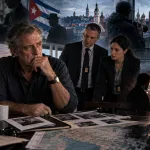
Evan Mercer found Jack Calloway in the same booth, in the same corner, with the same glass of bourbon sitting in front of him like evidence.
The pub was quiet. Rain scratched against the windows. An old ceiling fan turned lazily above them, moving nothing but cigarette ghosts from a time when men were allowed to kill themselves indoors.
Evan stopped at the edge of the booth.
Jack did not look up.
“Another Thursday,” Evan said.
Jack lifted his glass.
“I guess you come here every Thursday,” Evan said.
Jack finally looked at him.
“What are you, following me?”
Evan smiled. “I could ask you the same thing.”
“I was here first.”
“You were probably here before the building was.”
Jack gestured to the seat across from him.
“Sit down before you say something useful.”
Evan slid into the booth. He looked tired again. That was becoming his natural condition. Washington did that to a man. It took bright young officers and slowly converted them into mahogany furniture.
The bartender brought Evan a bourbon without being asked.
Jack noticed.
“Well, look at that,” he said. “You’re becoming a regular.”
“That should worry both of us.”
“It does.”
They drank.
For a few minutes, they watched the rain.
Then Evan said, “I’ve been reading old files.”
“That is how idealism dies.”
“USAID files.”
Jack’s face did not change, but something behind his eyes shut a door.
Evan noticed.
“So it’s true.”
“What’s true?”
“That USAID was used as a CIA slush fund.”
Jack gave a tired little laugh.
“That sentence is wrong in three different ways, which means it’s perfect for television.”
Evan leaned forward.
“Then fix it.”
Jack turned his glass slowly on the table.
“USAID was not the CIA in a cheap suit,” he said. “That’s the first thing. Most USAID people were exactly what they claimed to be. Development officers. Agriculture people. Health people. Engineers. Food-aid people. A lot of them were decent, overworked, underpaid, and trying to keep children from starving while idiots in Washington moved colored pins around a map.”
“But?”
“But USAID operated in the same weather system as the CIA.”
Evan nodded slowly.
“Same storm, different umbrellas.”
“Exactly.”
Jack took a drink.
“USAID was the public hand. The CIA was the hidden hand. During the Cold War, both hands often reached for the same throat.”
Evan sat back.
“That’s one hell of a line.”
“It’s not a line. It’s a confession.”
The bartender passed by. Jack waited until she moved away.
“People imagine a slush fund like some secret bank account marked CIA murder money,” Jack said. “That’s childish. The real world is cleaner and dirtier than that. Money doesn’t have to be covert to be useful. It just has to move people, build access, create dependence, and open doors.”
“So how did it work?”
Jack pointed at him.
“Careful.”
“I’m not asking for a manual.”
“Yes, you are. You just don’t know it.”
Evan held up both hands.
“Then give me the version that won’t get either of us indicted.”
Jack smiled faintly.
“That version still has teeth.”
“Good.”
Jack leaned back.
“Think of a country in 1964. Poor. Unstable. Maybe there’s a leftist student movement. Maybe unions are getting loud. Maybe the military is nervous. Maybe some colonel is telling our embassy that Moscow is sniffing around. Washington looks at the country and says, ‘We need influence there.’”
“So USAID comes in.”
“USAID comes in smiling,” Jack said. “Food programs. Road projects. School construction. Agricultural modernization. Public health. Police training. Civil society grants. Radio equipment. Scholarships. Technical advisors. Consultants with nice briefcases and bad marriages.”
Evan smiled.
“And the CIA?”
“The CIA comes in through the cracks those programs create.”
Jack tapped the table once.
“USAID gives you legitimacy. The CIA needs access. USAID can meet ministers, mayors, police chiefs, university leaders, journalists, church groups, farmers, labor organizers, and military-adjacent bureaucrats without looking like a burglary in progress.”
“So the aid program becomes the map.”
“The aid program becomes the map, the road, the hotel, the introduction, and sometimes the excuse.”
Evan was quiet.
Jack continued.
“Let’s say USAID funds a rural development project. Wells, clinics, seed distribution, road surveys. All legitimate. All useful. But now Americans and contractors are moving through villages nobody at the embassy could otherwise visit. They learn who has power. Who hates the government. Who takes bribes. Who has cousins in the guerrillas. Who drinks too much. Who wants his son in an American university. That information may never be written as an intelligence report, but it becomes atmosphere. And atmosphere is what case officers breathe.”
Evan said, “That sounds almost accidental.”
“Sometimes it was. Sometimes it wasn’t.”
Jack’s voice dropped.
“The best cover in the world is something that is mostly true.”
Evan looked at him.
“That’s the rule?”
“That’s the oldest rule.”
Jack held up a finger.
“If you pretend to be a doctor and can’t take a pulse, you’re finished. If you pretend to be an aid worker and don’t understand food distribution, you’re finished. But if there’s a real aid program, with real trucks, real grain, real doctors, real engineers, then influence can ride along without wearing a name tag.”
Evan turned his glass between his palms.
“Give me an example.”
Jack nodded.
“Police training.”
“Office of Public Safety.”
Jack looked almost impressed.
“You did read.”
“Some.”
“Then you know. USAID ran police and internal security assistance in allied countries. Public Safety. Sounds harmless, doesn’t it? Like crossing guards and traffic whistles.”
“It wasn’t harmless.”
“No,” Jack said. “Because in unstable countries, police are not just police. They are the nervous system of the regime. They know dissidents. Students. Priests. Labor leaders. Smugglers. Informants. Guerrillas. Opposition politicians. They know who sleeps where and who whispers after midnight.”
“So if you train the police…”
“You are helping build the state’s eyes and ears.”
“And if the CIA wants sources?”
“Foreign police officers make excellent sources,” Jack said. “Not always good men. But useful ones. They have access. They have files. They know who is afraid. They know who can be bought. They know who is already compromised.”
Evan looked uncomfortable.
Jack noticed.
“Good,” Jack said.
“What?”
“That look. Keep it. It means you still understand consequences.”
Evan took a drink.
“So USAID trains police. CIA spots possible assets.”
“Sometimes directly. Sometimes indirectly. Sometimes the same policy machine simply benefits from the same program. Don’t make it too neat. History is not a filing cabinet. It’s a junk drawer with blood on the handle.”
Evan exhaled.
“And Congress shut that down.”
“Eventually. Congress occasionally wakes up, looks around, and asks why the kitchen is on fire.”
Jack leaned forward.
“The reason they restricted foreign police training wasn’t because everybody suddenly discovered morality. It was because these programs were getting too ugly to defend. You cannot preach democracy while helping some interior ministry build a better cage.”
Evan stared at the table.
“That’s the part nobody wants to say.”
“No,” Jack said. “They prefer words like stabilization.”
“Stabilization.”
“One of the most dangerous words in government. It means we found a local bastard and decided he is our bastard.”
Evan laughed despite himself.
Jack did not.
“Example two,” Jack said. “Laos.”
Evan’s smile faded.
“Air America.”
Jack nodded.
“Laos was where humanitarian aid, covert war, logistics, refugees, anti-communism, and plausible deniability all got thrown into the same blender. You had aircraft moving people, supplies, wounded men, friendly forces, not-so-friendly forces, rice, radios, ammunition, and God knows what else through mountain country most Americans couldn’t find on a map.”
“USAID and CIA side by side.”
“Side by side, over side, under side. Not every aid worker was CIA. Not every pilot was doing the same mission. But the ecosystem was blended. Refugee support over here. Covert logistics over there. Anti-communist tribal forces in the middle. Washington loved arrangements where everyone could deny the part they didn’t officially control.”
Evan said, “So the aid gave the war a humanitarian face.”
“Sometimes. And sometimes the humanitarian work was real and necessary. That’s what makes it morally poisonous. The food might be real. The medicine might be real. The refugees might be desperate. But if the same machinery also supports covert war, then the enemy stops seeing aid workers as aid workers.”
“They become targets.”
“They become suspected spies,” Jack said. “And sometimes they are. Sometimes they aren’t. The bullet does not care.”
The rain tapped harder against the glass.
Evan said, “You said money doesn’t have to be covert to be useful.”
“That’s right.”
“Explain that.”
Jack looked at him for a long moment.
“Fine. But this is not a how-to. This is a how-it-went-wrong.”
Evan nodded.
Jack held up his hand and counted with his fingers.
“One. Grants. You fund local organizations. Newspapers, civic groups, labor education centers, election monitors, youth programs. Some are legitimate. Some are cutouts. Some begin legitimate and become useful later.”
“Useful to whom?”
“To whoever controls the funding stream.”
Jack raised a second finger.
“Two. Contractors. Contractors are the great fog machine of empire. USAID hires a contractor. Contractor hires a subcontractor. Subcontractor hires local staff. Local staff knows everyone. Money moves legally, but influence moves quietly.”
A third finger.
“Three. Training programs. Bring foreign officials to seminars. Police, judges, journalists, agriculture ministers, telecom regulators, election officials. Teach them something real. Also learn who they are. Who is ambitious. Who hates his boss. Who wants a visa. Who can be invited back.”
A fourth.
“Four. Infrastructure. Radios, vehicles, clinics, warehouses, airstrips, communications gear. Every piece of infrastructure changes who has power. A radio tower is not just a radio tower. A road is not just a road. A warehouse is not just a warehouse. In the right country, logistics is politics.”
A fifth.
“Five. Humanitarian access. Disasters open doors war cannot. Earthquakes, famines, epidemics, floods. Aid workers arrive first. Then security people. Then advisors. Then assessments. Then permanent programs. Everyone says temporary. Nothing is more permanent than a temporary government program with a budget line.”
Evan was silent for several seconds.
“That sounds like empire by invoice.”
Jack smiled grimly.
“You’re learning.”
Evan said, “And Cuba?”
Jack nodded.
“Cuba is the modern cautionary tale. Not Cold War jungle stuff. Digital influence. USAID-backed contractors built a communications platform. Looked like a social network. Text messages. Youth culture. Connectivity. But the suspicion was that it could be used to build political opposition or push unrest.”
“ZunZuneo.”
“Cuban Twitter,” Jack said. “A stupid nickname for a serious problem.”
“The government said it wasn’t covert.”
“Governments say many things. Sometimes they are even true by the legal definition they wrote for themselves.”
Evan smiled faintly.
“That’s cynical.”
“That’s experience with a better vocabulary.”
Jack leaned forward.
“The Cuba case matters because it shows the new model. You don’t need a jungle airstrip anymore. You build a platform. You gather users. You map relationships. You identify influencers. You test messages. You create a channel the target government does not control. Then one day, if policy requires it, that channel can become political.”
“Soft power with a detonator.”
Jack pointed at him.
“That one’s yours. Keep it.”
Evan looked almost pleased, then serious again.
“But where is the CIA in that?”
“Maybe nowhere directly. Maybe nearby. Maybe watching. Maybe advising through another office. Maybe just benefiting from the same policy objective. That’s the point. People want a clean villain. Real systems create dirty alignment. USAID, State, CIA, Defense, contractors, NGOs, local elites — all moving in the same direction because the president or the national security crowd wants pressure on a regime.”
“So USAID becomes a platform.”
“USAID becomes permission,” Jack said. “Permission to enter. Permission to fund. Permission to ask questions. Permission to build networks. Permission to stay.”
Evan took that in.
“Was there ever an actual slush fund?”
Jack smiled.
“You keep wanting the movie version.”
“I want the truth.”
“The truth is more boring and worse. A slush fund doesn’t have to be a suitcase of cash. It can be a development budget flexible enough to pay for things nobody wants to describe honestly.”
“Such as?”
“Conferences that are really recruitment pools. Media programs that are really influence operations. Agricultural surveys that are really political mapping. Police modernization that is really internal security support. Democracy grants that favor one side of a country’s politics. Communications projects that create channels around a hostile government. Technical assistance that lets you place people close to ministries.”
Evan said nothing.
Jack said, “And before you get too morally pure, remember something. The Soviets were doing their version. The Chinese do theirs now. The Iranians. The Russians. The Turks. The Gulf states. Everybody uses money, aid, religion, infrastructure, scholarships, media, and business as instruments of power.”
“That doesn’t make it right.”
“No,” Jack said. “It makes it normal. Those are not the same thing.”
The pub door opened. Cold wet air rolled in. A couple entered laughing under one umbrella. Jack watched them in the mirror until they sat by the window.
Evan noticed.
“You still do that.”
“Do what?”
“Track every door.”
“I’m not dead yet.”
Evan looked down at his glass.
“What was the worst part?”
“Of USAID?”
“Of mixing aid and intelligence.”
Jack answered immediately.
“The contamination.”
Evan waited.
“Real aid depends on trust,” Jack said. “A doctor walks into a village with vaccines. A food worker hands out grain. An engineer repairs a water system. Those people need the local population to believe they are there for the reason they claim.”
“And if the CIA uses the same ecosystem…”
“Then every doctor becomes suspect. Every food truck becomes a Trojan horse. Every school program becomes indoctrination. Every vaccination team becomes a spy ring in somebody’s imagination. And sometimes, because we were clever, it wasn’t imagination.”
Evan winced.
Jack’s face hardened.
“That is the cost nobody puts on the budget. You spend credibility like cash. Then one day the account is empty and everyone acts surprised.”
Evan said, “So should USAID and intelligence have been completely separate?”
“Yes.”
“You don’t hesitate.”
“No.”
“But foreign aid is always foreign policy.”
“Of course it is. I’m not naïve. Aid will always serve national interest. But there is a difference between aid that reflects policy and aid that becomes cover.”
Evan said, “Where’s the line?”
Jack tapped the table.
“The line is deception.”
“That simple?”
“That hard. If you build a clinic because healthy countries are more stable and less vulnerable to hostile powers, fine. That’s policy. If you build a clinic because you want a reason to move officers, collect names, or support a political faction, then the clinic is bait.”
Evan sat back.
“That’s brutal.”
“No,” Jack said. “Brutal is what happens when the village figures it out.”
For a while, neither man spoke.
The bartender changed the music to something old and low. Saxophone. Maybe Coltrane. Maybe not. Jack had never trusted jazz musicians enough to identify them.
Evan finally said, “You know what bothers me?”
“Many things, I hope.”
“My generation inherited the machinery, but not the confidence.”
“Good.”
“You keep saying good.”
“Confidence is overrated. The most dangerous man in Washington is the one who thinks history started when he got clearance.”
Evan gave a tired laugh.
Jack continued.
“You should be suspicious. Suspicion is healthy. The CIA should be suspicious of itself. USAID should be allergic to covert entanglement. Congress should be nosy. Journalists should be rude. Citizens should be difficult. That is how republics survive their own security services.”
“And if they aren’t?”
“Then the security services become the republic.”
Evan looked at him.
“Do you think that happened?”
Jack looked into his glass.
“No,” he said. “But I think we rehearsed.”
That landed between them.
Evan shifted.
“I need this conversation for something.”
“I assumed.”
“I’m testifying next month. Closed session.”
“About?”
“Foreign assistance authorities. Influence operations. Whether development agencies should be used in strategic competition.”
Jack laughed softly.
“There it is.”
“I want to say it cleanly.”
“Then say this: USAID should be an instrument of American values, not a costume closet for American intelligence.”
Evan repeated it quietly.
“An instrument of American values, not a costume closet for American intelligence.”
Jack nodded.
“And say this too. When humanitarian aid is used as cover, it may win an operation and lose a generation.”
Evan wrote that down on a napkin.
Jack frowned.
“You’re really writing on a napkin?”
“It feels appropriate.”
“It feels prosecutable.”
Evan put the pen away.
“You ever use USAID cover?”
Jack’s expression went still.
“No.”
Evan waited.
Jack said, “But I knew people who moved near it. Around it. Through the same doors. You could smell the overlap. Embassy country team meetings. Development officers talking about stability. Political officers talking about reform. Station people listening for names. Military attachés talking about capacity building. Everybody pretending their lane was painted in bright white lines.”
“But it wasn’t.”
“No. It was chalk in the rain.”
Evan looked out the window.
“Did the good outweigh the bad?”
Jack stared at him for a long time.
“That is the question bureaucrats ask when they want forgiveness without confession.”
Evan looked back.
“What question should they ask?”
Jack leaned forward.
“Would we accept another country doing it to us?”
Evan said nothing.
Jack continued.
“If China funded American police training, youth media, activist networks, communications platforms, agricultural surveys, labor groups, local newspapers, and political reform organizations, would we call it development?”
“No.”
“What would we call it?”
“Foreign subversion.”
Jack nodded.
“Now you understand.”
The rain began to slow.
Evan finished his drink.
“So what do I do with this?”
“Tell the truth carefully.”
“That sounds cowardly.”
“No,” Jack said. “Carelessly telling the truth can be vanity. Carefully telling it can be strategy.”
Evan smiled.
“There’s the old case officer.”
“There’s the old convict.”
They both laughed, but only briefly.
Evan stood.
“I’ll see you next Thursday?”
Jack looked up at him.
“What are you, following me?”
“Maybe.”
Jack lifted his glass.
“Then learn something.”
Evan put on his coat.
At the door, he turned back.
“Jack.”
“What?”
“Was America the good guy?”
Jack looked tired now. Very tired.
“Sometimes,” he said.
Evan waited.
Jack looked at the rain on the glass.
“But good guys don’t stay good by assuming they are.”
Evan nodded once and stepped out into the wet street.
Jack stayed in the booth, alone with the bourbon and the old ghosts.
Outside, the city glittered under surveillance cameras, traffic lights, bank towers, charity offices, federal buildings, and flags soaked dark by the rain.
The empire still knew how to smile.
That had always been the trick.
Epilogue — The Mirrors
Factual spine: USAID was created in the Kennedy era as part of a broader restructuring of U.S. foreign assistance under the Foreign Assistance Act of 1961. U.S. foreign police training through aid-related authorities became controversial enough that GAO later reviewed legal limits and foreign police assistance issues. Modern foreign influence operations are not unique to the U.S.; recent reporting has documented operations linked to Russia, China, Iran, Israel, and others.
Jack Calloway had learned one thing after a lifetime in the shadows: power rarely walks into a country wearing a uniform.
Sometimes it arrives with a rifle, a loan, it arrives carrying sacks of rice, medicine, textbooks, laptops, radios, or promises about democracy.
That was the part most people never understood.
USAID was not simply the CIA in disguise. Most aid workers were not spies. Most doctors, engineers, teachers, missionaries, disaster workers, and nonprofit people were exactly what they appeared to be: people trying to help. But empires do not waste roads once they are built. When an aid agency opens a door, someone else eventually notices the door. USAID was the public hand. The CIA was the hidden hand. And during the Cold War, both hands often worked toward the same foreign-policy goal: stop communism, influence governments, stabilize friendly regimes, weaken hostile ones, and make sure the right people — Washington’s people — had leverage.
But America was not alone in this. China does it. Russia does it. Iran does it. Israel does it. Every serious power does some version of it. They use charities, cultural programs, business groups, religious missions, student organizations, media projects, infrastructure loans, foundations, police training, humanitarian relief, technology grants, and nonprofits.
Some are real. Some are fronts. Some begin honestly and are later used.
Some never know they are being used at all.
That is how the game works.
The truth is smoke and mirrors — and these organizations are often the mirrors.
A food program can feed children and create political loyalty.
A school project can teach math and shape ideology.
A medical mission can save lives and map a village.
A democracy grant can support freedom or quietly favor one faction over another.
A police-training program can improve public safety or help build an internal security network.
A social media project can connect people or become a pressure valve aimed at a government Washington wants weakened.
The trick is that both things can be true at the same time.
That is what makes it dangerous. The clean humanitarian story is usually too clean. The conspiracy version is usually too simple. The real world lives in the muddy middle, where good people do good work inside systems that are also serving power.
Jack had seen enough to know that aid was never just aid once governments got involved. Foreign assistance was policy. Policy was influence. Influence was intelligence waiting to happen.
And once intelligence touched humanitarian work, it left a stain.
Because the next time a doctor arrived with vaccines, someone wondered if he was carrying a radio. The next time a teacher opened a school, someone wondered who wrote the curriculum. The next time a nonprofit handed out food, someone wondered what names were being collected. The next time an aid worker crossed a border, someone wondered which government sent him.
That was the cost.
Not just money. Not just scandal. Not just congressional hearings or classified memos buried in a vault.
USAID, NGOs, nonprofits, contractors, foundations — are all part of the same shadow ecosystem. Not because they were all guilty, but because they were useful. And usefulness is the first thing power notices.
The mirror does not have to know it is a mirror.
It only has to reflect what someone else wants the world to see.
So why did Trump gut it? Because he couldn’t control it — and because it may have been funding the payroll of many of his adversaries. Cut off the money at the root, and the branches die. Without money, resistance becomes harder to organize, harder to sustain, and harder to hide.