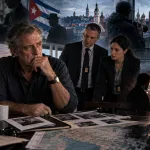
Think of it as Yoga for the brain, we are going to stretch a bit.
The Bar at the End of the Empire
Jack Calloway found the bar by accident, which was the only honest way to find a decent bar anymore.
It sat between a shuttered travel agency and a luxury watch store that never seemed to sell anything. No sign worth remembering. No music loud enough to chase away thought. Just a brass lamp over the door, a bartender who knew when not to talk, and a back wall lined with bottles older than some democracies.
Jack chose the corner booth out of habit.
Back to the wall. View of the door. Reflection of the room in the smoked mirror behind the bar. Old habits did not die. They simply got arthritis.
He ordered bourbon. Two fingers. No ice.
The bartender placed it down without ceremony.
“Waiting for someone?” she asked.
“No,” Jack said.
That was when the door opened.
The man who walked in was younger than Jack by twenty-five years, but older than he had any right to look. Tall, lean, gray at the temples, with the careful posture of someone who had spent too many years pretending not to be watching everything.
Jack knew him before the man saw him.
Evan Mercer.
Once upon a time, Evan had been a kid from Ohio with clean shoes, clean hands, and the ridiculous belief that the world could be made safer by smart people with classified badges. Jack had trained him during one of those strange interludes when the CIA still pretended it knew the difference between intelligence and war.
Evan spotted him.
For a moment, neither man moved.
Then Evan smiled.
Not a happy smile. Not quite. More the smile of a man who had found an old photograph in a burned house.
“Jack Calloway,” Evan said.
“Evan Mercer,” Jack replied. “Either you’re following me, or this country has run out of bars.”
Evan slid into the booth across from him.
“Maybe both.”
Jack lifted his glass.
“To institutional decline.”
Evan laughed once.
“I see prison didn’t soften you.”
“No,” Jack said. “But it did improve my opinion of silence.”
The bartender appeared.
“Same as him,” Evan said.
When she left, Evan leaned back and looked around the room.
“You still sit where you can see the exits.”
“You still notice.”
“You taught me.”
“I taught you a lot of things. Some of them were probably wrong.”
Evan studied him. “You really believe that?”
Jack looked into his glass.
“I believe every generation thinks it has learned the final lesson. Then the next generation arrives with new machines and makes old mistakes faster.”
The bartender brought Evan’s bourbon.
He raised it.
“To old mistakes.”
They drank.
For a while, they said nothing.
Outside, rain began tapping against the front window. The streetlights blurred into yellow ghosts. A delivery truck hissed by on wet pavement.
Finally, Evan said, “I heard you were writing.”
“I heard you were promoted.”
“That sounded like an accusation.”
“It was.”
Evan smiled faintly. “Deputy director for emerging threats.”
Jack let out a low whistle.
“Emerging threats. That sounds expensive.”
“It is.”
“And meaningless.”
“Mostly.”
Jack leaned back.
“So what are they afraid of now?”
Evan’s face changed. Not much, but enough. The bar disappeared from his eyes and somewhere else took its place. A room without windows. Screens on walls. Lawyers at the edges. People in expensive suits inventing language to hide fear.
“Everything,” Evan said.
Jack nodded.
“That’s usually when empires start making bad decisions.”
Evan turned his glass slowly between both hands.
“The old model is dead, Jack.”
“The old model was always dying. That was its charm.”
“No. I mean really dead. The passport games. The aliases. The business covers. The safe meetings. The surveillance detection routes. All of it. You can’t move through a modern city anymore without leaving fingerprints in the air.”
Jack said nothing.
Evan continued.
“Facial recognition at airports. Gait analysis in train stations. Payment trails. Cell tower handoffs. Hotel cameras. Doorbell cameras. Cars that report their own location. Every idiot tourist uploads street video in real time. Half the world is building a surveillance state by accident, and the other half is building one on purpose.”
Jack smiled.
“When I started, we worried about a man in a parked car reading a newspaper.”
“Now the newspaper reads you.”
Jack liked that line and hated that he liked it.
“So what’s the answer?” Jack asked. “More machines?”
“That’s what they think.”
“They?”
“The children who run strategy now.”
Jack looked amused. “Children always run strategy. Adults are too busy cleaning up.”
Evan took a drink.
“They want AI officers. Not analysts using AI. Not case officers assisted by systems. I mean synthetic operational personas. Digital ghosts. Online identities that can live for years, speak twelve languages, build trust, move money, recruit, manipulate, persuade, and never sleep.”
Jack’s expression hardened.
“That isn’t espionage.”
“It may be the future of espionage.”
“No,” Jack said. “That’s mass manipulation wearing a trench coat.”
Evan looked at him carefully.
“You sound like the Senate report.”
“I sound like a man who has seen what happens when agencies fall in love with tools and forget people.”
Evan sighed.
“Human sources are harder now.”
“They were always hard.”
“They’re nearly impossible in some places.”
“Good,” Jack said.
“Good?”
“Difficulty is a moral filter. If something is hard, expensive, slow, and dangerous, adults have to think before doing it. When something becomes easy, cheap, invisible, and automated, everybody becomes brave.”
Evan sat with that.
The rain thickened.
At the bar, a man in a navy suit laughed too loudly into his phone. Jack glanced once at the mirror, filed him away, then returned to Evan.
“You remember what I told you at the Farm?” Jack asked.
“You told me a lot of things.”
“I told you intelligence is not stealing secrets.”
Evan nodded slowly.
“You said intelligence is understanding human beings before they do something stupid.”
“Exactly.”
“You also said most bureaucracies prefer secrets because understanding people is harder.”
Jack smiled.
“I was smarter then.”
“No,” Evan said. “You were angrier.”
“I had better knees.”
Evan looked down into his bourbon.
“We’re drowning in information now. More than any service in history. Signals, images, intercepts, financial flows, social networks, biometric data, satellite persistence, machine translation. We can watch a man leave a house in one country and predict where he’ll be in another by dinner.”
“And yet?”
“And yet we understand less.”
Jack nodded once.
“That’s because information is not judgment.”
“No,” Evan said. “It’s not.”
“And machines do not have judgment. They have appetite.”
Evan looked up.
“That’s a good line.”
“It cost me thirty months.”
The joke landed hard.
Evan’s face tightened. “I should have written.”
“You were inside.”
“That’s not an excuse.”
“No,” Jack said. “It’s a condition.”
Evan looked away.
“I believed them at first.”
“Everyone does.”
“I thought you had crossed a line.”
“I had.”
Evan looked back at him.
“I crossed the right one.”
There it was. The old Jack Calloway. Not loud. Not theatrical. Just a stone dropped into deep water.
Evan swallowed.
“They teach your case now.”
Jack laughed.
“That’s unfortunate.”
“Not officially. Not by name. But they teach it. The whistleblower problem. The media exposure problem. The internal dissent problem.”
“Of course they do. They learned the wrong lesson.”
“What was the right lesson?”
“That torture corrupts the torturer before it breaks the prisoner. That secrecy without law becomes monarchy. That every agency eventually confuses protecting the country with protecting itself.”
Evan did not answer.
Jack leaned forward.
“Tell me something, Evan. In your emerging threats kingdom, do they still talk about law?”
“Constantly.”
“That’s bad.”
“Why?”
“When honest men obey the law, they don’t have to chant about it.”
Evan gave a small, tired smile.
“You haven’t changed.”
“Yes, I have. I used to think reform was possible.”
“And now?”
“Now I think reform is possible for people. Not institutions.”
“That’s bleak.”
“That’s history.”
Evan looked toward the rain-streaked window.
“The CIA is changing whether we like it or not.”
“The CIA has always changed. OSS cowboys became Cold War chess players. Cold War chess players became counterterrorism hunters. Counterterrorism hunters became drone managers. Now you’re becoming data priests.”
“Data priests?”
“You sit before glowing screens, interpret signs no ordinary citizen can see, and demand trust.”
Evan chuckled despite himself.
“That’s not entirely unfair.”
“It’s entirely fair. That’s why it hurts.”
Evan finished his bourbon and signaled for another.
Jack watched him.
“What are you really doing here?”
Evan’s hand stopped halfway back to the table.
“You always did that.”
“What?”
“Cut through the room.”
“I’m old. I don’t have time to wander through hallways.”
The second drink came. Evan waited until the bartender walked away.
“They asked me to build a unit,” he said.
“What kind?”
“One that combines human operations with artificial intelligence systems. Recruitment targeting. Risk scoring. Deep cover support. Counter-surveillance modeling. Foreign influence mapping.”
“Sounds like a machine built to remove conscience from the chain.”
“That’s what worries me.”
“Then don’t build it.”
“It will be built.”
“Then don’t be the man who gives it manners.”
Evan looked sharply at him.
“That’s easy for you to say.”
“No,” Jack said. “It is not.”
For the first time, the old pain moved visibly across Jack’s face. Not self-pity. Something harder. The memory of concrete walls, steel doors, lawyers, headlines, friends who vanished, men who lied under oath and slept well.
“I know exactly what things cost,” Jack said. “That’s why I’m careful when I tell a man not to sell his soul in installments.”
Evan rubbed his forehead.
“The argument is that if we don’t build it, someone worse will.”
“That argument has justified every wicked invention since the rock.”
“It’s also sometimes true.”
“Yes,” Jack said. “That’s what makes it dangerous.”
Evan leaned back.
“So what would you do?”
Jack looked toward the bottles behind the bar.
“I’d begin by admitting what the machine cannot know.”
“Which is?”
“Shame. Mercy. Doubt. The look in a man’s eyes when he wants to go home. The tremor in his voice when he talks about his children. The difference between a fanatic and a frightened boy repeating slogans because he has nowhere else to sleep.”
Evan was silent.
Jack continued.
“The future of espionage is not AI replacing human intelligence. That’s fantasy. The future is whether human beings can remain human while surrounded by systems that reward inhuman conclusions.”
Evan whispered, “That’s what I’m afraid of.”
“Good. Fear is useful. Panic is not.”
“You think there’s a way to do it right?”
Jack exhaled.
“Yes. But no bureaucracy will like it.”
“Tell me anyway.”
Jack counted on his fingers.
“First, AI never makes the final call on life, death, detention, recruitment, or designation. Never. Not once. Not in emergencies. Not under pressure. Not because some assistant deputy undersecretary needs a clean slide for a meeting.”
Evan nodded.
“Second, every model used in intelligence needs an adversarial review by people whose careers do not depend on approving it.”
“That will be difficult.”
“Then it might work.”
Evan almost smiled.
“Third, separate collection from interpretation. Machines are good at finding patterns. They are terrible at knowing which patterns matter.”
“That’s true.”
“Fourth, stop expanding the word terrorist until it means everyone you dislike. Once you do that, the machinery built for foreign enemies turns inward. It always does.”
Evan stared at him.
“You know that fight is already happening.”
“I assumed. Governments are predictable. They build cannons for dragons and eventually aim them at peasants.”
The man in the navy suit at the bar laughed again. Jack ignored him this time.
“Fifth,” Jack said, “remember that sources are people, not assets.”
Evan looked down.
“You never liked that word.”
“No. Asset is what accountants call furniture.”
“That word is not going away.”
“Neither is stupidity.”
Evan shook his head, smiling faintly.
“You really haven’t changed.”
Jack took the last sip of his bourbon.
“Sixth, teach officers history. Not PowerPoint history. Real history. Coups. Blowback. Lies that became policy. Operations that succeeded tactically and failed morally. Make them read the files nobody wants opened.”
“That would destroy morale.”
“No,” Jack said. “It would destroy vanity. People confuse the two.”
The rain softened.
For a moment, the bar seemed suspended outside time. Two men in a booth. Two glasses. One country outside the window, still powerful, still afraid, still telling itself stories about necessity.
Evan said, “You know what scares me most?”
“That you may be good at it.”
Evan looked up.
Jack’s face was calm.
“That’s always the trap,” Jack said. “Bad men are easy to refuse. Bad ideas wearing good intentions are harder. But the hardest thing in the world is being useful to a system you no longer trust.”
Evan’s voice was low.
“I joined because of you.”
“No, you didn’t.”
“I did.”
“No,” Jack said. “You joined because you wanted the world to make sense. I was just standing near the door.”
Evan laughed softly, then stopped.
“They want me to bring in outside advisors,” he said. “Ethics people. Technical people. Former officers.”
Jack saw where it was going.
“No.”
“I haven’t asked.”
“You were about to.”
“We need someone who knows both sides.”
“You need a priest with a criminal record.”
“We need someone who understands what happens when the CIA loses its soul.”
Jack looked at him for a long time.
Then he said, “The CIA does not have a soul. People do.”
“That’s why I’m asking you.”
Jack turned his glass in a slow circle on the table.
Years ago, he had walked into rooms where men were chained to tables. He had seen fear dressed as patriotism. He had watched lawyers make language kneel. He had learned that democracies do not usually fall in one glorious explosion. They rot by memo.
And yet across from him sat Evan Mercer, once a kid with clean shoes, now a tired man with power and doubt.
Doubt mattered.
Doubt was the last guardrail before the cliff.
“I won’t work for them,” Jack said.
Evan’s face fell.
“But I’ll talk to you.”
Evan looked up.
“Privately?”
“Publicly, if necessary.”
“That may make things harder.”
“Good.”
“You keep saying that.”
“Because easy is how they get you.”
Evan sat back and breathed out, as if he had been carrying something heavy and had not known where to set it down.
The bartender came by.
“Another round?”
Evan looked at Jack.
Jack shook his head.
“No,” Jack said. “We should leave before this starts feeling like nostalgia.”
They stood.
At the door, Evan paused.
“Jack.”
Calloway turned.
“Do you think the CIA can survive the future?”
Jack looked out at the wet street, at the cameras above the traffic lights, at the phones glowing in passing cars, at the great invisible net humming over everything.
“No,” he said.
Evan frowned.
Jack opened the door.
“But it may deserve to become something smaller, quieter, and more honest.”
“That sounds impossible.”
Jack stepped into the rain.
“So did catching terrorists without becoming one.”
Evan followed him outside.
For a moment they stood beneath the brass lamp, two shadows from different wars.
Then Jack put on his hat and walked away, not quickly, not dramatically, just steadily, like a man who had spent his life leaving places before the trap closed.
Behind him, Evan Mercer watched.
The future of espionage would arrive with satellites, algorithms, drones, synthetic voices, and machines that could remember everything except why restraint mattered.
But for one night, at least, one man inside the system had remembered enough to ask the right question.
And Jack Calloway, against his better judgment, had answered.