Think of it as Yoga for the brain, we are going to stretch a bit.
Has the Deep-State Just Been Given Its Two-Week Notice?
The Supreme Court did not abolish the Deep State with one swing of the gavel. Washington is too talented at surviving for that. But it did something almost as dangerous to the permanent bureaucracy: it reminded them that the executive branch has an elected CEO boss. -- YNOT!
There is a special kind of employee who believes the company cannot fire him because the furniture has grown used to him.
Washington, D.C. has been full of that fellow for a long time.
He does not run for office. He does not knock on doors. He does not ask the American people for permission.
He simply stays.
Presidents come in with big plans, bold speeches, and fresh pens ready to sign things. Then they discover that half the government is run by people who treat the elected president like a temporary substitute teacher.
“Nice speech, Mr. President. Leave the paperwork on the desk. We’ll get to it sometime between never and after lunch.”
That, right there, is what folks call the Deep State.
Not a shadowy villain petting a cat in a basement. Nothing that dramatic. It is worse than that. It is boring people with job protection. Bureaucrats with badges. Agencies with attitudes. A permanent government that looks at elections the way a cat looks at a screen door — mildly annoyed, but not especially threatened.
But now the Supreme Court may have handed the whole crowd a pink slip written in constitutional ink.
The argument is simple enough that Washington had to spend ninety years making it complicated: the executive branch belongs to the President. Not to a committee. Not to a commission. Not to some agency head who thinks Article II is a suggestion box.
If the President is responsible for executing the law, then the President has to be able to remove the people executing it badly, slowly, dishonestly, or with a face that says, “I survived three administrations and I’ll survive you too.”
That is not tyranny. That is management. Every plumber knows it. Every restaurant owner knows it. Every man who ever hired his cousin to help pour concrete and regretted it by noon knows it. If you cannot fire the person ruining the job, then you are not in charge of the job.
You are just standing nearby while the disaster wears your name tag.
For decades, Washington built itself a fourth branch of government. It was not elected, not accountable, and not especially humble. It hid behind “independence,” which is a fine word when it belongs to a judge and a suspicious word when it belongs to somebody spending your tax money while ignoring your vote.
And now the old arrangement may be cracking.
Naturally, the professional screamers are screaming. That is how you know someone found the light switch. The people who spent years telling us democracy was sacred are suddenly worried that elected presidents might control the executive branch.
That is a funny thing about power. Everybody loves checks and balances until the check bounces on their office lease.
Now, let’s not be children. Power in one man’s hands is always dangerous. But power in nobody’s hands is worse, because then nobody can be blamed, nobody can be fired, and nobody ever has to answer the phone when the house catches fire.
Accountability is not perfect. It just beats the alternative. So maybe the Deep State did not get fired today. Maybe it just got called into HR. Maybe the meeting is short. Maybe the coffee is cold. Maybe someone finally says, “We appreciate your years of service, but the voters have decided to go in another direction.”
And somewhere in Washington, a man with a government pension just felt a chill run down his laminated badge.
Because the scariest words in D.C. are not “democracy dies in darkness.”
They are: “Your supervisor would like to see you.”
What the Supreme Court actually ruled
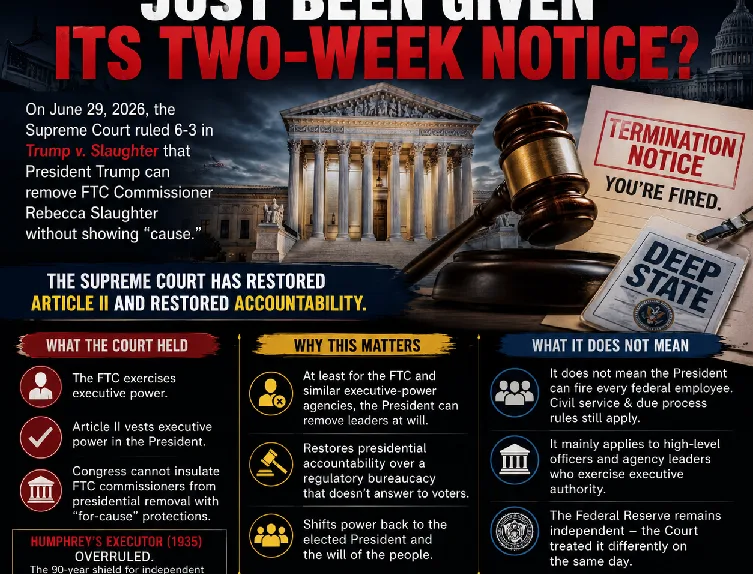
On June 29, 2026, the Supreme Court ruled 6–3 in Trump v. Slaughter that President Trump could lawfully remove FTC Commissioner Rebecca Slaughter without needing to show “cause.” The Court held that the FTC exercises executive power, and because Article II vests executive power in the President, Congress cannot insulate FTC commissioners from presidential removal through “for-cause” protections. (Reuters)
That means the Court effectively overruled Humphrey’s Executor v. United States, the 1935 case that had protected FTC commissioners from being fired except for “inefficiency, neglect of duty, or malfeasance in office.” Humphrey’s had been one of the legal pillars supporting independent agencies for about ninety years. (Reuters)
Why Humphrey’s Executor mattered
In Humphrey’s Executor, the Court said the FTC was not purely executive. It described the FTC as partly “quasi-legislative” and “quasi-judicial,” meaning Congress could design it to be independent from direct presidential control. That old logic allowed agencies like the FTC to say, in effect: “Mr. President, you appointed us, but you cannot fire us just because you dislike our politics.” (Wikipedia)
The new ruling rejects that framework for the modern FTC. Chief Justice Roberts, writing for the majority according to reports, treated the FTC’s enforcement role as executive power. Once the agency is exercising executive power, the official exercising it must answer to the President. (Reuters)
What changed in plain English
Before this ruling, Congress could protect certain independent-agency leaders from at-will presidential removal. After this ruling, at least for the FTC and similar executive-power agencies, the President can remove those officials more freely.
So the ruling is not just about one commissioner. It changes the balance between the elected President and the permanent regulatory bureaucracy. That is why supporters call it a restoration of presidential accountability, while critics call it a dangerous concentration of power. (The Guardian)
What it does not necessarily mean
It does not mean the President can fire every federal employee overnight. Civil-service laws, union rules, due-process protections, and statutory procedures may still apply to rank-and-file employees. The ruling is mainly about high-level officers and agency leaders who exercise executive authority. The transcript’s claim that this covers “90% of the federal government’s payroll” is political exaggeration, not the precise legal holding.
It also does not clearly destroy the independence of the Federal Reserve. On the same day, the Court reportedly treated the Fed differently and allowed Fed Governor Lisa Cook to remain in place while litigation continued, signaling that monetary-policy independence may still be treated as a special category. (AP News)
The constitutional issue
The central constitutional fight is over Article II, which says: “The executive Power shall be vested in a President of the United States of America.”
The majority’s view is basically this: if someone is wielding executive power, the President must be able to supervise and remove that person. Otherwise, you have executive power being exercised by people who do not answer to the elected executive. (New York Post)
The dissent’s view is the opposite worry: if the President can fire independent regulators at will, agencies meant to act with technical judgment and some independence may become political instruments of whoever occupies the White House. Justice Sotomayor, joined by Justices Kagan and Jackson, warned that the decision weakens checks and balances and threatens the independence of regulatory agencies. (Reuters)