Think of it as Yoga for the brain, we are going to stretch a bit.
My thoughts on this 250th July Fourth
I have always admired the Fourth of July. It is the one day in the year when Americans agree to look in the same direction, even if it is only upward, and even if the thing they are admiring is exploding. My dad shooting his rifle into the air. (yeah nuts)
There is poetry in that.
A firework is a perfect American sermon. It begins with a fuse, makes a great deal of noise, rises higher than good sense would recommend, bursts into glory, frightens the livestock, delights the children, and leaves behind a smell of smoke and debt. It is brief, beautiful, dangerous, and expensive — which is to say, it resembles most of our national undertakings.
But I do not come to bury the Fourth of July. I come to dust it off.
The trouble with great anniversaries is that men treat them like old family portraits. They hang them high, admire the frame, praise the ancestor’s chin, and never ask whether the old gentleman would approve of what has become of the house.
On July 4, 1776, a group of Englishmen did something marvelous. They stopped being Englishmen by committee. They gathered in Philadelphia, sweated through their waistcoats, sharpened their arguments, and announced to the mightiest empire on Earth that mankind had rights not loaned by kings, not rented from parliaments, and not granted by bureaucrats with ink-stained fingers and a talent for making chains look like paperwork.
They said that all men are created equal.
This was a noble sentence, and like many noble sentences, it embarrassed the men who wrote it.
For a truth may be born before its owners are ready to live with it. The Declaration was not the nation as it was. It was the nation caught in the act of promising what it ought to become.
That is why it has survived. A lie requires defense. A truth requires only time and a few brave fools willing to insist upon it.
The Declaration was not merely a complaint against King George. A complaint against a king is ordinary. Men have complained against kings since the first king discovered taxes and the first subject discovered muttering.
No, the Declaration was more dangerous than complaint.
It was an argument against all masters.
It declared that government is not the parent of liberty, but its hired servant. It declared that the people are not cattle to be counted, milked, branded, and occasionally flattered before an election. It declared that a man is not born with a saddle on his back, nor another man booted and spurred to ride him.
That sentence alone was enough to get a continent into trouble. And it did.
The American experiment began with ink, but it had to be paid for in frostbite, hunger, powder, blood, widowhood, bankruptcy, and the stubbornness of men who had no business defeating an empire except that they neglected to quit.
That is the part we are fond of remembering.
The part we are less fond of remembering is that the experiment did not end at Yorktown.
That was only the first installment.
Every generation since has received the same bill, with interest.
The Founders declared liberty. Their children had to organize it. Their grandchildren had to expand it. Lincoln’s generation had to bleed for it. Others had to march for it, vote for it, work for it, fight for it, defend it in courtrooms, classrooms, churches, factories, newspapers, battlefields, and sometimes at kitchen tables where the bravest thing a person can say is, “That is not right.”
America has always been two nations wrestling in one skin.
One is the America of speeches — shining, generous, brave, equal, humane, free.
The other is the America of habits — fearful, greedy, proud, foolish, tribal, and frequently convinced that God Himself has endorsed its inconvenience.
The miracle is not that America has avoided hypocrisy. It has not. The miracle is that America wrote down a standard high enough to condemn its own hypocrisy, and then preserved enough liberty for its citizens to use the document as evidence against the crime.
That is no small thing. A tyrant writes laws to protect himself from the people.
A republic writes principles that allow the people to protect themselves from the government, and occasionally from themselves, which is the harder rescue.
I have heard men say America is finished. They have been saying it for a long time.
America was finished at Valley Forge. Finished at the Articles of Confederation. Finished in 1812. Finished at Fort Sumter. Finished at Gettysburg. Finished in the Depression. Finished at Pearl Harbor. Finished in Vietnam. Finished during riots, scandals, assassinations, recessions, bad presidents, worse congresses, foolish wars, crooked bargains, and every election in which the losing side discovered that civilization had ended on schedule.
And yet, here she is. Older. Louder. Bruised. Contradictory. Still arguing.Still correcting.
Still sinning. Still repenting. Still building. Still free enough for fools to condemn her in public and wise men to be grateful they can.
That is the secret of the American experiment: it does not require Americans to be angels. If it did, it would have failed before breakfast.
It requires only that enough of them remain citizens. A citizen is not a spectator with a flag.
A citizen is not a customer demanding government provide him liberty already assembled and delivered by noon.
A citizen is not a professional outrage machine with shoes.
A citizen is a steward. He inherits a house he did not build, finds some beams rotten, some rooms magnificent, some windows broken, some foundations sound, and then must decide whether to repair it or burn it down to prove he noticed the defects.
There are always men eager to burn it down.
They call it justice, progress, order, purity, destiny, revolution, safety, equality, security, or patriotism, depending on the costume required. But under the costume is the same old appetite: the desire to rule what ought to be free.
The enemies of the American experiment are not new. They are older than America.
They are envy, fear, pride, greed, hatred, resentment, cowardice, and the ancient itch of one man to put a collar on another and call it civilization.
Sometimes they come from foreign capitals.
Sometimes they come from domestic platforms.
Sometimes they wear uniforms.
Sometimes they wear smiles.
Sometimes they quote the Founders while betraying every principle the Founders risked their necks to defend.
Sometimes they whisper that your neighbor is your enemy.
Sometimes they are on Facebook and Youtube.
Sometimes they are in congress, military, or local government,
That is the oldest trick in politics and the cheapest.
A republic can survive disagreement. It was built for disagreement. It cannot survive a people trained to despise one another more than they love their liberty.
Once Americans cease to see one another as countrymen, no invading army is necessary. The gates are open. The enemy may enter carrying a microphone.
Success is a sly danger.
Failure keeps a man alert. Hunger keeps him honest at least about bread. Cold reminds him that shelter matters. But success is a warm room, a soft chair, a full plate, and a flattering voice saying, “You earned all this yourself, and it will continue forever without effort.”
That voice has ruined more nations than cannon.
With success comes complacency. With complacency comes forgetfulness.
With forgetfulness comes division. And with division come the old wolves, licking their chops and praising our sophistication.
America remains, for all her faults, a light among dark skies.
Not because she is perfect. Perfect nations exist only in speeches, textbooks, and the advertisements of dictators.
America is a light because she permits correction. Because she allows argument. Because she makes room for the dissenter, the inventor, the preacher, the pamphleteer, the immigrant, the reformer, the fool, the genius, and the ordinary man who wants only to raise his children without asking permission from a throne.
That is why so many have wanted her to fail. A free nation is an insult to tyrants.
A prosperous free nation is an unbearable insult.
It suggests that people may live without masters. It suggests that citizens may be trusted with speech, worship, enterprise, arms, conscience, and the dangerous privilege of voting their rulers out before the rulers grow too comfortable.
No tyrant can forgive that. No petty tyrant can either.
So on this Fourth of July, let us not merely celebrate independence as a historical event, as if liberty were a museum piece behind glass.
Let us treat it as a current assignment.
Let us read the Declaration not as a relic, but as a summons.
Let us remember that fireworks are not the light itself. They are only reminders.
The real light is quieter. It is a free man speaking.
A free woman worshiping. A free press accusing.
A free citizen voting. A free people arguing without killing.
A free child believing tomorrow may be larger than yesterday.
That light must be tended.
It must be guarded from the storm, from the thief, from the fool, and especially from the lazy heir who assumes the lamp burns by magic.
So raise the flag, if you have one. Raise a glass, if you are inclined.
Raise a prayer, if you remember how. But afterward, raise a citizen.
For the Republic does not need more spectators cheering the fireworks.
It needs men and women willing to keep the flame after the smoke clears.
And if we can manage that — if we can remember that we are one house, however noisy the rooms; one people, however quarrelsome the table; one experiment, however unfinished the work — then perhaps the old Declaration will still have some thunder left in it.
Not the thunder of cannon. Not the thunder of politicians. Not the thunder of mobs.
But the thunder of a free people remembering, just in time, that liberty is not inherited like furniture.
It is inherited like a duty. And duties, unlike fireworks, are not meant to vanish after they shine.
This could serve as the narration under the image, or the opening monologue before the bar scene.
A Personal Fourth of July Note
On a personal note, when I was about twelve years old, my school principal had an unusual punishment for misbehaving students. Depending on how much trouble we were in, we had to write out the Declaration of Independence, the preamble, or parts of the Constitution.
I am not recommending this as a parenting method, but I will say this: after writing those words so many times, I memorized much of them. And over the years — really over the last twenty years — I have come to understand them in a much deeper way.
The men who wrote these documents were brilliant. Many were farmers, printers, lawyers, soldiers, inventors, and ordinary citizens by title, but extraordinary minds by ability. Franklin, Jefferson, Washington, Lincoln, and others understood something very important: government belongs to the people, not the other way around.
That is the core of the American system. The people own the government. The government does not own the people.
I hope you have enjoyed some of my writings today. Below, you will find the full text of the Declaration of Independence. It is well worth reading. There is much more in it than most people realize, and unless you read the whole thing, you may never know what you are missing.
Happy Fourth of July.
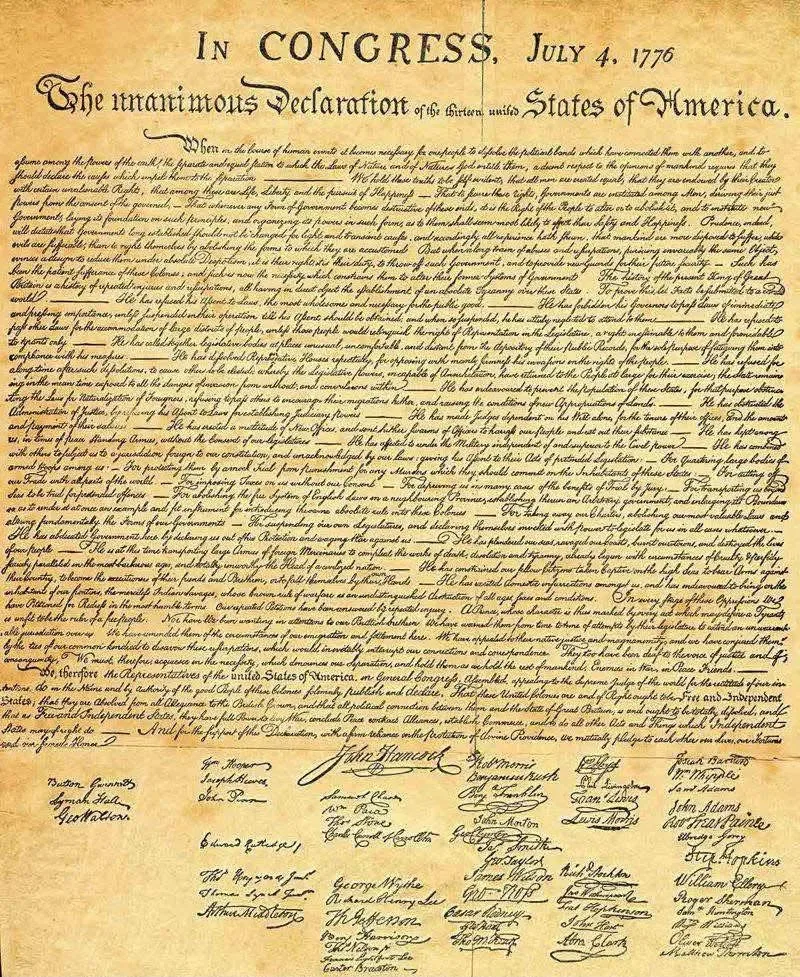
FULL TEXT : The unanimous Declaration of the thirteen united States of America
When in the Course of human events, it becomes necessary for one people to dissolve the political bands which have connected them with another, and to assume among the Powers of the earth, the separate and equal station to which the Laws of Nature and of Nature’s God entitle them, a decent respect to the opinions of mankind requires that they should declare the causes which impel them to the separation.
We hold these truths to be self-evident, that all men are created equal, that they are endowed by their Creator with certain unalienable Rights; that among these are Life, Liberty and the pursuit of Happiness. That to secure these rights, Governments are instituted among Men, deriving their just powers from the consent of the governed; That whenever any Form of Government becomes destructive of these ends, it is the Right of the People to alter or abolish it, and to institute new Government, laying its foundation on such principles, and organizing its powers in such form, as to them shall seem most likely to effect their Safety and Happiness.
Prudence, indeed, will dictate that Governments long established should not be changed for light and transient causes; and accordingly all experience hath shewn, that mankind are more disposed to suffer, while evils are sufferable, than to right themselves by abolishing the forms to which they are accustomed.
But when a long train of abuses and usurpations, pursuing invariably the same Object, evinces a design to reduce them under absolute Despotism, it is their right, it is their duty, to throw off such Government and to provide new Guards for their future security.
Such has been the patient sufferance of these Colonies; and such is now the necessity which constrains them to alter their former Systems of Government.
The history of the present King of Great Britain is a history of repeated injuries and usurpations, all having in direct object the establishment of an absolute Tyranny over these States.
To prove this, let Facts be submitted to a candid world.
He has refused his Assent to Laws, the most wholesome and necessary for the public good.
He has forbidden his Governors to pass Laws of immediate and pressing importance, unless suspended in their operation till his Assent should be obtained; and when so suspended, he has utterly neglected to attend to them.
He has refused to pass other Laws for the accommodation of large districts of people, unless those people would relinquish the right of Representation in the Legislature — a right inestimable to them and formidable to tyrants only.
He has called together legislative bodies at places unusual, uncomfortable, and distant from the depository of their Public Records, for the sole purpose of fatiguing them into compliance with his measures.
He has dissolved Representative Houses repeatedly, for opposing with manly firmness his invasions on the rights of the people.
He has refused for a long time, after such dissolutions, to cause others to be elected; whereby the Legislative Powers, incapable of Annihilation, have returned to the People at large for their exercise; the State remaining in the meantime exposed to all the dangers of invasion from without, and convulsions within.
He has endeavoured to prevent the population of these States; for that purpose obstructing the Laws of Naturalization of Foreigners, refusing to pass others to encourage their migrations hither, and raising the conditions of new Appropriations of Lands.
He has obstructed the Administration of Justice, by refusing his Assent to Laws for establishing Judiciary Powers.
He has made Judges dependent on his Will alone for the tenure of their offices and the amount and payment of their salaries.
He has erected a multitude of New Offices, and sent hither swarms of Officers to harass our People and eat out their substance.
He has kept among us, in times of peace, Standing Armies without the Consent of our legislatures.
He has affected to render the Military independent of and superior to the Civil Power.
He has combined with others to subject us to a jurisdiction foreign to our constitution and unacknowledged by our laws, giving his Assent to their Acts of pretended Legislation:
For quartering large bodies of armed troops among us;
For protecting them, by a mock Trial, from punishment for any Murders which they should commit on the Inhabitants of these States;
For cutting off our Trade with all parts of the world;
For imposing Taxes on us without our Consent;
For depriving us, in many cases, of the benefits of Trial by Jury;
For transporting us beyond Seas to be tried for pretended offences;
For abolishing the free System of English Laws in a neighbouring Province, establishing therein an Arbitrary government and enlarging its Boundaries, so as to render it at once an example and fit instrument for introducing the same absolute rule into these Colonies;
For taking away our Charters, abolishing our most valuable Laws and altering fundamentally the Forms of our Governments;
For suspending our own Legislatures, and declaring themselves invested with power to legislate for us in all cases whatsoever.
He has abdicated Government here, by declaring us out of his Protection and waging War against us.
He has plundered our seas, ravaged our Coasts, burnt our towns and destroyed the lives of our people.
He is at this time transporting large Armies of foreign Mercenaries to complete the works of death, desolation, and tyranny already begun with circumstances of Cruelty & Perfidy scarcely paralleled in the most barbarous ages, and totally unworthy the Head of a civilized nation.
He has constrained our fellow Citizens taken Captive on the high Seas to bear Arms against their Country, to become the executioners of their friends and Brethren, or to fall themselves by their Hands.
He has excited domestic insurrections amongst us, and has endeavoured to bring on the inhabitants of our frontiers the merciless Indian Savages, whose known rule of warfare is an undistinguished destruction of all ages, sexes and conditions.
In every stage of these Oppressions We have Petitioned for Redress in the most humble terms.
Our repeated Petitions have been answered only by repeated injury.
A Prince, whose character is thus marked by every act which may define a Tyrant, is unfit to be the ruler of a free People.
Nor have We been wanting in attentions to our British brethren.
We have warned them from time to time of attempts by their legislature to extend an unwarrantable jurisdiction over us.
We have reminded them of the circumstances of our emigration and settlement here.
We have appealed to their native justice and magnanimity, and we have conjured them by the ties of our common kindred to disavow these usurpations, which would inevitably interrupt our connections and correspondence.
They too have been deaf to the voice of justice and of consanguinity.
We must, therefore, acquiesce in the necessity which denounces our Separation, and hold them, as we hold the rest of mankind: Enemies in War, in Peace Friends.
We, therefore, the Representatives of the united States of America, in General Congress, Assembled, appealing to the Supreme Judge of the world for the rectitude of our intentions, do, in the Name and by Authority of the good People of these Colonies, solemnly publish and declare:
That these United Colonies are, and of Right ought to be Free and Independent States;
that they are Absolved from all Allegiance to the British Crown;
and that all political connection between them and the State of Great Britain is and ought to be totally dissolved;
and that as Free and Independent States, they have full Power to levy War, conclude Peace, contract Alliances, establish Commerce and do all other Acts and Things which Independent States may of right do.
And for the support of this Declaration, with a firm reliance on the protection of divine Providence, we mutually pledge to each other our Lives, our Fortunes and our sacred Honor.