Think of it as Yoga for the brain, we are going to stretch a bit.
Cuba’s Long Road to Freedom – The First Time
The Revolution Before the Revolution
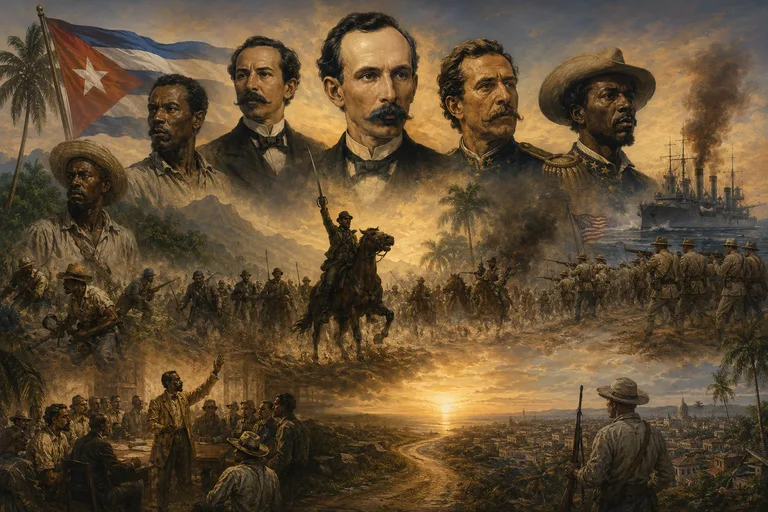
Before Cuba became a republic, before Castro, before Batista, before the slogans and speeches of the twentieth century, there was another revolution.
The original Cuban revolution was not one man standing at a podium. It was not one army marching into Havana. It was not one single battle, one single date, or one clean victory wrapped in a flag.
It was a long, painful, unfinished struggle that stretched across generations.
It began with conspiracies, slave rebellions, exile movements, failed expeditions, and men who dreamed of breaking Cuba away from Spain long before the island was ready to rise. It passed through the sugar fields, the mountains, the prison camps, the exile clubs of New York and Florida, and the blood-soaked roads of Oriente.
Cuba’s first revolution was not born in 1959.
It was born in the nineteenth century, when Cubans began asking whether they were subjects of an empire or citizens of a nation not yet born.
The Early Sparks
Long before the great wars of independence, Cuba already had men willing to risk everything for freedom.
In 1812, José Antonio Aponte led one of the most important anti-slavery conspiracies in Cuban history. It failed, and he paid with his life, but the idea did not die. Cuba was still a Spanish colony, still tied to slavery, still chained to an empire that treated the island as property.
Later came the early independence plots and the expeditions of Narciso López. These movements did not free Cuba, but they helped shape the symbols, arguments, and dreams that would later define the independence struggle.
Every failed attempt left behind something useful.
A lesson.
A martyr.
A flag.
A warning.
The Cry of Yara
Then came October 10, 1868.
Carlos Manuel de Céspedes, a sugar planter from eastern Cuba, freed his slaves and declared Cuba independent from Spain. This moment became known as the Grito de Yara, the Cry of Yara.
That cry started the Ten Years’ War.
For ten years, Cubans fought Spain with courage, hunger, machetes, horses, and impossible hope. They created a government in arms. They wrote constitutions. They argued about leadership. They fought on battlefields and in the forests. They learned that building a nation is harder than starting a rebellion.
The Ten Years’ War gave Cuba some of its greatest patriots.
Carlos Manuel de Céspedes.
Ignacio Agramonte.
Máximo Gómez.
Antonio Maceo.
These were not perfect men. No great history is made by perfect men. But they carried the dream of Cuba when the dream was still dangerous.
The Peace That Was Not Freedom
In 1878, after ten years of sacrifice, the war ended with the Pact of Zanjón.
Spain offered reforms.
But not independence.
Not full freedom.
Not the complete abolition of slavery at that moment.
Some accepted the pact because Cuba was exhausted. The war had drained the island. Families were ruined. Armies were tired. Hope itself had become expensive.
But Antonio Maceo refused.
At the Protest of Baraguá, Maceo rejected the peace because it did not give Cuba what the war had demanded. He understood something very simple: a peace that leaves the central injustice alive is not peace. It is just a pause.
Baraguá became one of the most honorable moments in Cuban history.
Not because it won the war.
But because it refused to lie about defeat.
The Little War and the Long Exile
After the Ten Years’ War came the Little War of 1879–1880.
It failed.
The rebels lacked enough weapons, unity, money, and support. Cuba had not recovered from the first great struggle. But even failure has a place in history when it keeps the cause alive.
Then came the years of exile and rebuilding.
In New York, Tampa, Key West, and other places, Cuban patriots met, wrote, argued, organized, raised money, printed newspapers, and prepared for the next war.
This is where José Martí became the great architect of the final revolution.
Martí understood that Cuba needed more than courage. It needed organization. It needed purpose. It needed a political soul. He did not want Cuba simply to escape Spain and fall into the hands of another empire. He wanted a republic with dignity.
In 1892, Martí founded the Cuban Revolutionary Party.
The final war was coming.
The Final War of Independence
On February 24, 1895, the final war began with the Grito de Baire.
Martí returned to Cuba. Máximo Gómez returned. Antonio Maceo returned. The old warriors and the new generation took up the cause again.
But freedom demanded blood quickly.
On May 19, 1895, José Martí was killed at Dos Ríos.
He did not live to see the republic he helped call into being. Like Moses, he saw the promised land from a distance, but did not enter it.
Still, the war continued.
Máximo Gómez and Antonio Maceo carried the revolution across the island from east to west. This was not a local uprising anymore. This was a national war.
Spain answered with brutality. General Valeriano Weyler imposed reconcentration policies, forcing rural Cubans into controlled zones and causing enormous suffering. Spain tried to separate the people from the rebels by punishing the people.
Then, in 1896, Antonio Maceo was killed.
The Bronze Titan fell, but the cause remained standing.
The United States Enters
In 1898, the USS Maine exploded in Havana Harbor.
Soon after, the United States entered the war against Spain.
This is where the story becomes complicated.
Cubans had been fighting Spain for decades. Cuban blood had already soaked the island. Cuban patriots had already built the independence movement. But when the United States entered, the final defeat of Spain came quickly.
Spain lost Cuba.
But Cuba did not immediately receive full freedom.
In December 1898, the Treaty of Paris ended Spanish rule, but Cuba passed into a period of U.S. military occupation. The Spanish empire was gone, but the Cuban republic was not yet fully born.
That is the tragedy of many revolutions.
You can defeat the old master and still not be completely free.
The Republic Is Born
On May 20, 1902, the Republic of Cuba was established.
The Cuban flag rose.
The Spanish empire was gone.
But the victory was incomplete.
The Platt Amendment gave the United States the right to intervene in Cuban affairs and helped establish the conditions for Guantánamo Bay. Cuba had won independence from Spain, but its sovereignty was limited from the beginning.
So the original Cuban revolution ended with a republic — but not the republic Martí had fully dreamed of.
It was a beginning.
It was also a warning.
The Chronology of the Original Cuban Revolution
The road to Cuban independence can be remembered like this:
1812 — Aponte Rebellion
An early anti-slavery conspiracy showed that the desire for freedom existed long before the independence wars.
1850–1851 — Narciso López Expeditions
Failed attempts to liberate or annex Cuba helped shape revolutionary symbols, including the lone-star flag.
October 10, 1868 — Grito de Yara
Carlos Manuel de Céspedes declared Cuban independence and began the Ten Years’ War.
1868–1878 — Ten Years’ War
Cuba’s first great independence war against Spain.
1869 — Assembly of Guáimaro
The revolutionaries created a republican government in arms.
1873 — Death of Ignacio Agramonte
One of Cuba’s great independence leaders was killed.
1874 — Death of Carlos Manuel de Céspedes
The Father of the Homeland died after helping launch the independence struggle.
1878 — Pact of Zanjón
The Ten Years’ War ended without Cuban independence.
1878 — Protest of Baraguá
Antonio Maceo refused to accept peace without independence and abolition.
1879–1880 — Little War
Another uprising failed, but the independence cause survived.
1886 — Abolition of Slavery in Cuba
Slavery finally ended, but racial inequality remained.
1892 — Cuban Revolutionary Party Founded
José Martí organized the political engine of the final war.
February 24, 1895 — Grito de Baire
The final Cuban War of Independence began.
May 19, 1895 — Death of José Martí
Martí was killed at Dos Ríos and became Cuba’s national martyr.
1895–1896 — Invasion from East to West
Gómez and Maceo carried the war across Cuba.
1896 — Weyler’s Reconcentration Policy
Spain used brutal measures against civilians to weaken the rebellion.
December 7, 1896 — Death of Antonio Maceo
The Bronze Titan was killed, dealing a terrible blow to the revolution.
February 15, 1898 — Explosion of the USS Maine
The disaster helped push the United States into war with Spain.
April 1898 — Spanish-American War Begins
The United States entered the conflict.
December 10, 1898 — Treaty of Paris
Spain lost Cuba, but Cuba entered U.S. military occupation.
1901 — Platt Amendment
The United States imposed limits on Cuba’s sovereignty.
May 20, 1902 — Republic of Cuba Established
Cuba became a republic, but under heavy U.S. influence.
Why This History Matters
This chronology matters because Cuba’s story has too often been reduced to one revolution, one dictator, one ideology, or one political argument.
But Cuba’s real history is older and deeper than that.
Before 1959, there was 1895.
Before 1895, there was 1868.
Before 1868, there were men and women already dreaming of freedom in a colony built on sugar, slavery, empire, and fear.
In future posts, I will explore each of these events one by one.
We will look at the men, the battles, the betrayals, the mistakes, the victories, and the unfinished promises. We will talk about Céspedes, Martí, Maceo, Gómez, Agramonte, Aponte, Baraguá, Yara, Baire, Weyler, the Maine, the Platt Amendment, and the birth of the Cuban republic.
Because Cuba cannot be understood by starting in the middle of the story.
You have to go back to the beginning.
And the beginning tells us something powerful:
Cuba was not handed freedom.
Cuba bled for it.
And even after all that blood, the dream was still not complete.