Think of it as Yoga for the brain, we are going to stretch a bit.
The Manacas–Iznaga Massacre — July 13th, 1963
The Prisoners Who Survived the War—Only to Be Killed After It
History often remembers the men who die in battle.
It is less comfortable remembering the men who survive the battle, surrender, spend years in prison, and are then taken into the darkness to be machine-gunned by the government holding them.
That is the story of the Manacas–Iznaga massacre of 1963.
It is a story buried beneath disputed dates, incomplete records, exile testimony, revolutionary propaganda, and the silence of a government that controlled the courts, the press, the prisons, and the place where the bodies fell.
The central facts, however, are difficult to dismiss.
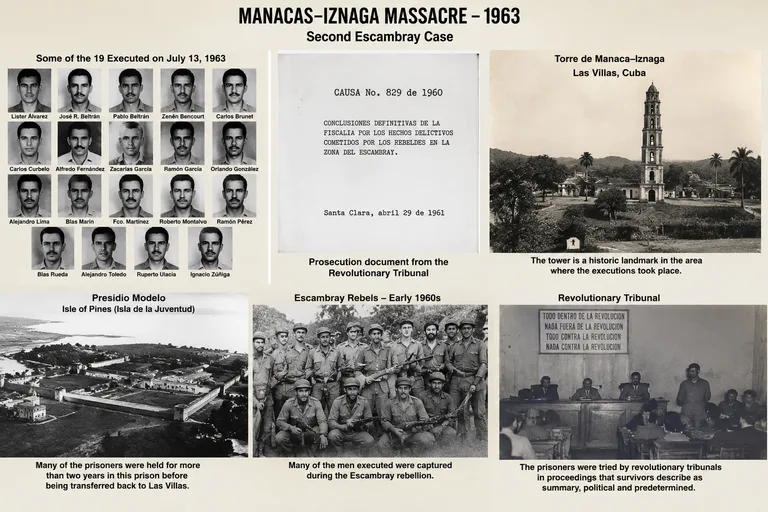
A group of captured rebels from the Escambray Mountains had already spent more than two years in prison. They were under complete government control. They were transported back to Las Villas, brought before a revolutionary tribunal, and sentenced in proceedings survivors later described as predetermined.
Nineteen men were reportedly taken near Manacas–Iznaga and killed together.
Two related prisoners had allegedly been killed the day before.
That brings the broader death toll connected to the case to 21.
The exact date remains disputed. Survivor testimony places the principal execution in the early morning of July 13, 1963. Other historical lists give August 13, 1963. The Inter-American Commission on Human Rights later recorded the killings only as occurring during July or August 1963.
The date may remain contested. The dead do not.
The War in the Escambray
The men later killed at Manacas–Iznaga were connected to the armed resistance in Cuba’s Escambray Mountains, a rugged region in central Cuba that became the center of one of the most important and least honestly discussed conflicts of the early Revolution.
Official Cuban history called the rebels bandidos—bandits.
The reality was more complicated.
The Escambray resistance included farmers, former revolutionaries, anti-communists, former members of the movement that had fought against Fulgencio Batista, and men who believed Fidel Castro had betrayed the promises of the Revolution.
Some had supported Castro before turning against him.
Some opposed the rapid communist transformation of Cuba.
Some resisted land seizures, political executions, forced collectivization, and the elimination of independent political organizations.
Others received weapons, supplies, encouragement, or assistance connected to Cuban exile groups and the United States.
This was not merely a collection of innocent civilians discussing politics around a kitchen table. Many of the men involved had participated in an armed insurgency. Some were commanders. Some had fought government forces. Revolutionary prosecutors accused members of the group of killings, attacks, collaboration with armed bands, and offenses against the state.
That must be acknowledged.
But it does not excuse what happened next. A prisoner is no longer a battlefield target.
A captured man is no longer an armed threat.
Once the government has disarmed him, imprisoned him, and placed him under guard, the government assumes responsibility for his life.
Even a man accused of serious crimes is entitled to a real trial.
He is not supposed to be taken to a bend in the road and shot down with the others.
More Than Two Years in Prison
Many of the prisoners associated with the Manacas–Iznaga case had reportedly been captured during the Escambray operations of 1960 and 1961.
They were transferred to the Presidio Modelo on the Isle of Pines, known today as the Isle of Youth.
There they remained for more than two years. This detail is important.
These were not men seized during an active battle and killed in the confusion of combat.
They were prisoners. They had been disarmed.
They had been transported through the prison system.
The government knew who they were. The government knew where they were.
The government had years to investigate the accusations against them.
Yet according to surviving testimony, they were eventually removed from the Presidio Modelo and taken back to Las Villas for what became known as the Second Escambray Case, or the Segunda Causa del Escambray.
The legal case itself appears to have existed for some time. A surviving prosecution document connected to Revolutionary Tribunal Case No. 829 of 1960 was reportedly prepared in Santa Clara on April 29, 1961.
That means the accusations had been assembled more than two years before the final executions.
The state had time.
What the prisoners did not have was meaningful justice.
The Transfer to Manacas–Iznaga
According to the testimony of political prisoner Aldo Chaviano Rodríguez, 23 prisoners were transferred from the Isle of Pines to the Manacas–Iznaga area on July 12, 1963.
They were taken near the old tower and the sugar-producing region associated with the Torre de Iznaga, close to Trinidad in the former province of Las Villas.
The Torre de Iznaga is today remembered as a picturesque colonial landmark—a tall tower rising over the Valley of the Sugar Mills.
But in this story, it was not a tourist attraction.
It was the landscape surrounding a revolutionary tribunal and an alleged mass execution.
Chaviano later described the proceeding as rushed, arbitrary, and decided before it began.
The tribunal was reportedly presided over by Captain Andrés Abeledo Mejías, known as El Pinto.
Chaviano identified Luis Felipe Denis as the accusing officer and Dr. Humberto Jorge as the prosecutor.
The prisoners faced accusations involving armed rebellion, crimes against state power, participation in insurgent organizations, and responsibility for acts committed during the Escambray conflict.
The government presented the men as dangerous counterrevolutionaries.
But a court is supposed to determine guilt through evidence.
It is not supposed to exist merely to give a formal appearance to a sentence already chosen.
A Trial That Survivors Said Was Already Decided
According to Chaviano’s testimony, the accusations were often based on aliases, assumptions, questionable identifications, and broad claims about the actions of insurgent groups.
The proceedings were not described as a careful examination of individual guilt.
They were described as revolutionary justice.
That phrase has been used many times in history.
It usually means the government has already decided what justice requires.
At the end of the proceeding:
Nineteen prisoners were sentenced to death.
Two prisoners received sentences of 30 years.
Two other men connected to the same case had reportedly already been killed the previous day.
The appeals process, according to the survivor account, lasted only minutes.
The death sentences were confirmed.
There was no long judicial review.
There was no independent appellate court.
There was no public examination of the evidence.
There was no outside authority capable of stopping the execution.
The government that accused the men controlled the tribunal that judged them and the soldiers who would kill them.
The Two Men Killed Before the Main Execution
According to Chaviano, two prisoners connected to the same case—Macario Quintana and a man identified in different sources as Aquilino Zerquera or Aquilino Serquera—had already been killed at a place called Las Tinajitas in the Escambray.
Their bodies were allegedly displayed near the place where the remaining prisoners were tried.
The purpose, according to the testimony, was obvious.
The prisoners were meant to see what awaited them.
This detail helps explain why different sources give different totals.
Some accounts refer to 19 men executed at Manacas–Iznaga.
Others speak of 21 victims connected to the Second Escambray Case.
The two numbers are not necessarily contradictory.
Nineteen were reportedly killed in the principal mass execution.
Two related prisoners had allegedly been killed the previous day.
Together, they form a total of 21.
The Inter-American Commission on Human Rights later reported that 21 prisoners died under machine-gun fire in the Torre de Iznaga area, although its summary did not fully explain the sequence.
The Road Into Darkness
After the sentences were confirmed, the condemned prisoners were reportedly loaded into military vehicles.
It was late at night.
According to the survivor account, they were driven to a bend in the road near Manacas–Iznaga.
The hour was approximately 1:00 in the morning.
The vehicles stopped.
Their headlights were used to illuminate the execution site.
There would be no public witness.
No family members.
No independent reporters.
No clergy standing beside the condemned.
Only prisoners, soldiers, officials, darkness, and the glare of headlights.
Three men were reportedly called first:
Alejandro “Nando” Lima
Zacarías García
Roberto Montalvo
They were allegedly machine-gunned separately.
The remaining prisoners understood what was happening.
According to Chaviano, they began shouting against communism and calling out for God and liberty.
Then the shooting widened.
Soldiers and members of the tribunal allegedly opened fire on the group with machine guns, rifles, pistols, and revolvers.
The men were not executed one at a time before a formal firing squad.
They were reportedly shot together.
The wounded were then allegedly finished at close range.
Carlos Brunet
One of the most vivid details in the survivor account concerns Carlos Brunet Álvarez.
According to Chaviano, Brunet remained standing after the first burst of gunfire.
Whether through courage, shock, injury, or sheer refusal to fall, he remained on his feet.
Then multiple armed men fired at him.
He went down beneath the combined gunfire.
Stories like this are difficult to prove decades later, especially when the government responsible never released complete records and never allowed an independent forensic investigation.
But that is precisely why survivor testimony matters.
When a state seals the files, controls the burial site, and eliminates outside scrutiny, the surviving witness becomes the archive.
Chaviano also alleged that militia members removed shoes from the bodies and later wore them.
That detail is especially grotesque.
It suggests not merely execution, but humiliation.
The dead were stripped not only of life, but of dignity.
This allegation remains dependent on survivor testimony and should be described as such.
But it belongs in the historical record because silence does not make testimony disappear.
The Reported Victims
Commemorative lists preserved in exile sources identify the 19 men reportedly killed together as:
Líster Álvarez López
José R. Beltrán Hernández
Pablo Beltrán Mendoza
Zenén Bencourt Rodríguez
Carlos Brunet Álvarez
Carlos Curbelo Pérez
Alfredo “Nené” Fernández García
Zacarías García López
Ramón García Ramos
Orlando González López
Alejandro “Nando” Lima Barzaga
Blas Marín Navarro
Francisco “Franco” Martínez Zúñiga
Roberto Montalvo Cabrera
Ramón “Monguito” Pérez Ramírez
Blas Enrique Rueda Muñoz
Alejandro Toledo Toledo
Ruperto Ulacia Montelier
Ignacio Zúñiga González
Spellings vary among sources.
That is common in records created under repression and later reconstructed from memory, prison testimony, family documents, and exile archives.
Some surnames appear in slightly different forms. Aliases are also recorded differently.
This does not mean the victims did not exist.
It means the government never provided the kind of transparent public record that would have resolved every uncertainty.
The Men Who Survived
Aldo Chaviano stated that he and an older prisoner identified as Romayor were the two men among the transferred group who did not receive death sentences.
A tribunal document reportedly includes a prisoner named Eladio Romayor Díaz, although the surviving documents and later testimony do not always align perfectly.
Chaviano went on to spend approximately 26 years and four months in prison, based on cumulative sentences that exceeded 30 years.
He eventually left Cuba and lived in New Jersey.
His testimony became one of the principal surviving accounts of what happened.
This creates a difficult historical situation.
The Cuban government did not open its records.
There was no independent investigation at the scene.
There was no forensic review available to the public.
The names, sequence, and details therefore depend heavily on witnesses and exile documentation.
That does not make the account worthless.
It means it must be handled honestly.
The details should be attributed where they come from.
The institutional findings should be separated from the survivor’s memories.
And where uncertainty exists, it should be admitted rather than concealed.
The Inter-American Commission’s Account
The strongest institutional confirmation comes from the Inter-American Commission on Human Rights.
In its reporting on political prisoners in Cuba, the Commission described captured Escambray rebels who had been imprisoned on the Isle of Pines without trial.
After more than two years, a group was reportedly returned to the mainland and taken to the Torre de Iznaga, in the Condado area of Las Villas.
The Commission stated that they were machine-gunned while getting out of trucks.
It reported that 21 prisoners died under machine-gun fire.
That account supports several essential parts of the survivor testimony:
The victims were already prisoners.
They had been held for years.
They were transferred from the Isle of Pines.
They were taken to the Torre de Iznaga area.
They were killed by machine-gun fire.
Approximately 21 men died.
The Commission did not provide every detail preserved in Chaviano’s account.
It did not settle the exact date.
It did not reproduce a complete list of names.
It did not describe every stage of the tribunal.
But it confirmed the central allegation:
Prisoners under government control were taken to the Manacas–Iznaga area and machine-gunned.
July 13 or August 13?
The precise date remains one of the most persistent uncertainties.
Aldo Chaviano’s detailed testimony places the principal execution shortly after midnight on July 13, 1963.
According to that chronology:
The prisoners were transferred on July 12.
The tribunal took place that day.
The executions occurred at approximately 1:00 a.m. on July 13.
Other memorial lists give the date as August 13, 1963.
The Inter-American Commission avoided choosing between them and recorded the killings only as occurring in July or August 1963.
There are several possible explanations:
A date may have been copied incorrectly.
The month may have been confused in later records.
Different parts of the case may have occurred on different dates.
Government secrecy may have prevented families from receiving reliable information.
Prison testimony recorded years later may have introduced discrepancies.
The responsible approach is not to pretend the uncertainty does not exist.
The safest historical title is:
The Manacas–Iznaga Massacre of 1963
Within the account, it should be explained that survivor testimony places the execution on July 13, while other lists record August 13.
A disputed date does not erase the crime.
Were the Prisoners Guilty?
This question must be addressed honestly.
The men were associated with an armed rebellion.
Some had fought the government.
Some had held leadership roles.
Some were accused of participating in killings, attacks, and cooperation with counterrevolutionary groups.
The prosecution linked them to actions committed during the Escambray conflict and to efforts supported in part by exile organizations and the United States.
It would therefore be inaccurate to portray every man simply as a peaceful civilian arrested for expressing an opinion.
But guilt is not established merely because the government says so.
And even guilt does not eliminate the right to due process.
A lawful government may arrest a rebel.
It may charge him.
It may present evidence.
It may allow a defense.
It may hold a genuine trial.
It may punish crimes proven beyond a reasonable standard.
What it may not do is create a tribunal whose result is predetermined and then machine-gun prisoners together in the darkness.
The moral question is not whether these men had ever carried weapons.
The moral question is what the Cuban government did after it had taken those weapons away.
Revolutionary Justice
Revolutions often begin by promising justice.
They then create a special kind of justice for their enemies.
The accused are called traitors before trial. The government controls the evidence.
The defense exists only as ceremony. Appeals are measured in minutes.
Sentences are carried out before questions can be asked. Then the state writes the history.
This is how execution becomes “justice.” This is how political murder becomes “defense of the Revolution.”
This is how men disappear beneath official labels.
Bandit. Counterrevolutionary. Mercenary. Enemy of the people.
Once the label is attached, the state expects the public to stop seeing the human being beneath it.
The Manacas–Iznaga massacre matters because it forces us to look beneath the label.
These men may have been rebels. They may have committed crimes. They may have fought the government. But at the time they were killed, they were prisoners.
That changes everything.
Why So Few People Know the Story
The massacre remains obscure outside Cuban exile circles and human-rights documentation.
There are several reasons.
It occurred during a hidden internal war in a rural region.
The Cuban government controlled the press.
The courts were revolutionary institutions rather than independent bodies.
Foreign investigators had no access to the scene.
The bodies were not subjected to public forensic examination.
Survivors remained imprisoned for decades.
Families had little ability to gather documents or speak publicly.
Exile sources preserved the story, but their records sometimes conflict over dates, spellings, and numbers.
Official Cuban histories portrayed the Escambray conflict as a campaign against foreign-backed bandits and rarely acknowledged crimes committed against captured rebels.
The government therefore possessed the power not only to kill, but to define the dead.
That is one of the greatest powers an authoritarian state can hold.
It decides who is remembered as a victim and who is remembered only as an enemy.
The Meaning of Manacas–Iznaga
The Manacas–Iznaga massacre is not important because every detail has been perfectly preserved.
It is important because the central pattern is clear.
Men were captured. They spent years in prison.
They were brought before a revolutionary tribunal.
Most were condemned to death.They were taken away at night.
They were machine-gunned.
No independent court reviewed the event.
No transparent investigation followed.
No government official was held accountable.
The state controlled the prisoners, the weapons, the tribunal, the records, and the story.
That is not justice. It is power without accountability.
The 21
The broader case is often remembered through the number 21.
Nineteen men reportedly died in the principal execution near Manacas–Iznaga.
Two related prisoners had allegedly been killed the previous day.
The Inter-American Commission also reported 21 deaths under machine-gun fire.
The exact reconciliation of these accounts remains imperfect.
But the figure represents more than a count.
It represents 21 lives placed in the hands of a state that had already defeated and imprisoned them.
They had survived the mountains. They had survived capture.
They had survived more than two years in prison.
They did not survive revolutionary justice.
Final Thought
There are moments when a government reveals its true nature not through speeches, constitutions, or banners, but through what it does to a defeated enemy.
The men of Manacas–Iznaga were no longer fighting in the mountains.
They were not advancing with rifles.They were not hiding in the forest.
They were prisoners standing beneath military headlights.
The government had already won. It killed them anyway.
That is why this story must be remembered.
Not because every victim was necessarily innocent of every accusation.
Not because war is simple. Not because the Escambray rebellion lacked violence or foreign involvement.
But because civilization is measured by what a state does after its enemy has surrendered.
At Manacas–Iznaga, the Cuban Revolution did not merely punish its opponents.
It placed prisoners before machine guns and called the result justice.