Think of it as Yoga for the brain, we are going to stretch a bit.
1959 – Cuba Before Castro
To understand the Cuban Revolution, we must first stop lying about the Cuba that existed before it.
On the eve of Fidel Castro’s victory in January 1959, Cuba was not the tropical paradise sometimes remembered by nostalgic exiles. But neither was it the miserable, backward “brothel of the Western Hemisphere” portrayed by defenders of the Revolution.
Both versions distort the truth.
Pre-Castro Cuba was one of the most modern, prosperous, and socially advanced countries in Latin America. It was also a nation divided by corruption, racial discrimination, rural poverty, political violence, and enormous differences between Havana and the countryside. Not unlike the Untied States just 90 miles away. We must not compare it to the Untied States of today,
It was neither a Paradise nor Hell. It was still a developing country, remembering this is essential.
Cuba did not need to be destroyed and rebuilt as a communist dictatorship. It needed honest government, political stability, rural development, and stronger democratic institutions.
Instead, it got Fidel Castro.
Success by the Numbers
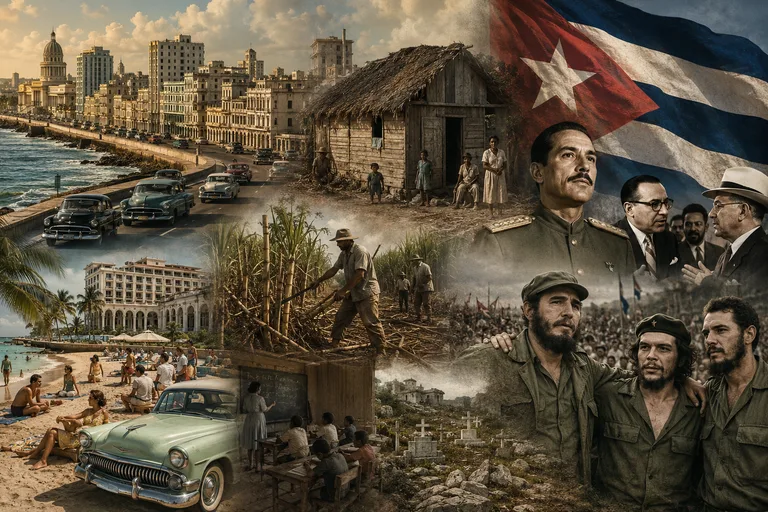
Havana was one of the most dynamic cities in the Western Hemisphere.
Its hotels, theaters, department stores, restaurants, universities, newspapers, radio stations, hospitals, nightclubs, and businesses made it a major commercial and cultural center.
Cuba’s economy had grown rapidly during the first half of the twentieth century, driven largely by sugar exports and close trade with the United States.
By several commonly cited measures, Cuba ranked among the most advanced nations in Latin America:
Fifth in the Western Hemisphere in per-capita income
Third in Latin America in life expectancy
Second in per-capita ownership of automobiles and telephones
First in television sets per inhabitant
Fourth in Latin American literacy, with a rate of approximately 76 percent
Eleventh in the world in doctors per capita
Cuba had modern hospitals, private clinics, universities, professional associations, labor unions, newspapers, radio networks, and a growing middle class.
Many private hospitals and charitable institutions provided services to people who could not afford medical care. Cuban doctors were respected throughout the region. The country’s income distribution, while unequal, compared favorably with that of many other Latin American nations.
For thousands of Cuban families, education and professional employment offered a genuine path toward social advancement.
This was not a failed country.
It was a successful country with serious failures.
Havana Was Not All of Cuba
The greatest mistake anyone can make is to judge pre-1959 Cuba entirely by Havana.
Urban Cuba and rural Cuba often seemed like two different nations.
Havana could resemble a Southern European capital. Some residents enjoyed living standards comparable to those in Spain, Portugal, Greece, and even parts of France.
But in the countryside, especially in isolated sugar-producing regions, many Cubans lived in severe poverty.
Sugar production was seasonal. Cane cutters—the macheteros—might work intensely for only four months of the year. During the remaining months, many had little or no reliable income.
They lived in debt, survived on inconsistent wages, and frequently lacked adequate food, housing, education, sanitation, and medical care.
Some rural children attended school for only a year or two. Others never attended at all. Illiteracy remained common in the most isolated regions.
Hospitals and clinics were concentrated in the cities. Rural families sometimes traveled great distances to obtain medical treatment. Along roads near the Sierra Maestra, small graveyards marked communities where people had died before reaching proper care.
The tragedy was not that Cuba lacked doctors, hospitals, schools, or wealth.
The tragedy was that these resources did not reach everyone.
The Cuba of Two Worlds
Pre-revolutionary Cuba was a nation of striking contrasts.
It had television sets, modern highways, luxury hotels, advanced medical care, and one of Latin America’s strongest middle classes.
It also had dirt-floor homes, malnourished children, seasonal unemployment, and rural families living beyond the reach of basic government services.
Havana was like Miami, while rural Cuba reflected the conditions of say Mississippi
Both realities existed at the same time.
The luxury of Havana did not erase rural poverty.
But rural poverty did not erase Cuba’s national achievements.
Racism and Segregation
Race was another unresolved wound.
Although Cuba had a large Black and mixed-race population, private clubs, neighborhoods, hotels, and beaches were often segregated in practice.
Black Cubans faced discrimination in employment, housing, education, and social life. Even Fulgencio Batista, who was of mixed racial ancestry and became president of Cuba, was reportedly denied membership in one of Havana’s most exclusive clubs.
The Cuban Republic officially celebrated racial equality, particularly because Black and white Cubans had fought together during the wars of independence.
But legal ideals and social reality were not always the same.
The Revolution would later claim that it had completely eliminated racism. That claim was also false. The government suppressed open discussion of racial discrimination by declaring the problem solved.
Pre-Castro Cuba had racial injustice, but again I remember it in the US as well at the time.
A Republic Weakened from Birth
Cuba entered independence carrying the wounds of war.
The long struggle against Spain devastated the countryside, destroyed property, disrupted agriculture, and killed many of the nation’s most capable independence leaders.
José Martí—the intellectual and moral architect of Cuban independence—was killed in battle in 1895. Other leaders of the independence movement were also killed, marginalized, or divided.
When the Republic of Cuba was formally established on May 20, 1902, it lacked a unifying national figure capable of controlling the ambitions unleashed by independence.
The United States also maintained extraordinary influence through the Platt Amendment, which gave Washington the right to intervene militarily under certain circumstances.
The amendment weakened the legitimacy of the Cuban government because it placed a foreign power at the center of Cuban political life.
The United States occupied Cuba from 1906 to 1909 and intervened again during later periods of instability.
The Platt Amendment was abolished in 1934, twenty-five years before Castro took power. It therefore cannot explain or excuse everything that happened after 1959.
But during the early Republic, it contributed to a political culture in which Cuban sovereignty appeared incomplete.
Corruption Became a National Disease
Cuba’s greatest problem was not a lack of potential.
It was bad government.
Election fraud, favoritism, patronage, political violence, and theft repeatedly weakened public confidence in the Republic.
Government positions became opportunities for personal enrichment. Public contracts rewarded political allies. Presidents promised reform and then tolerated corruption within their own administrations.
By the late 1920s, President Gerardo Machado had transformed an elected government into an increasingly repressive dictatorship.
Opposition came from university students, labor unions, political activists, and dissatisfied military officers. In 1933, Machado was finally driven from power.
The fall of Machado created hope—but also chaos.
The Rise of Batista
After Machado’s departure, university professor Ramón Grau San Martín briefly led a nationalist government under the slogan “Cuba for all Cubans.”
But the United States refused to recognize Grau’s government.
Meanwhile, a young army sergeant named Fulgencio Batista emerged as the dominant figure inside the Cuban military.
Batista helped remove Grau and became Cuba’s political strongman, controlling successive governments from behind the scenes.
Yet Batista’s history is more complicated than the cartoon version commonly presented.
In 1940, he was elected president in a legitimate election. His government supported one of the most progressive constitutions in Latin America. Labor rights expanded, the Communist Party participated legally in politics, and Batista completed his term.
When his term ended in 1944, Batista stepped aside and allowed his opponent, Ramón Grau San Martín, to assume the presidency.
For the next eight years, Cuba continued to hold competitive elections.
But democracy was weakened by corruption, patronage, organized political gangs, and violence in the streets and at the University of Havana.
Cuba had democratic institutions.
It simply failed to protect them.
Batista Destroys the Republic
On March 10, 1952, Batista returned to power through a military coup.
The coup canceled elections and destroyed the constitutional order that Batista himself had once helped establish.
This was the decisive rupture.
Batista did not create every problem in Cuba, but his coup convinced many Cubans that elections, courts, laws, and constitutional government could no longer protect them.
Writer Carlos Alberto Montaner described Batista’s coup as the opening of a political Pandora’s box.
Institutions no longer appeared to matter.
Audacity mattered. Violence mattered.
The person willing to break the rules could defeat those still trying to follow them.
That person would be Fidel Castro.
What Cubans Were Fighting For
Between 1952 and 1958, Cubans from nearly every social class opposed Batista.
Students, business owners, workers, professionals, mothers, journalists, politicians, religious leaders, and members of the middle class joined the resistance.
Their public demands were not communism, Marxism, collectivization, one-party rule, or alliance with the Soviet Union.
They spoke about:
Restoring the 1940 Constitution
Holding free elections
Ending corruption
Protecting human rights
Reestablishing the rule of law
Removing Batista
Returning Cuba to representative government
Many Cubans believed they were participating in a democratic revolution.
That belief explains why Fidel Castro received such broad support.
Castro’s Great Deception
Fidel Castro did not initially present himself to most Cubans as a communist dictator.
He spoke the language of democracy.
He promised constitutional government, social justice, honest leadership, and free elections.
At one point, Castro declared:
“Not Communism or Marxism is our idea. Our political philosophy is representative democracy and social justice in a well-planned economy.”
Those words mattered.
Business owners heard democracy.
Students heard freedom.
Workers heard social justice.
Professionals heard honest government.
Farmers heard land reform.
Political leaders heard a restoration of the constitutional Republic.
Almost no one was publicly being asked to approve a permanent dictatorship, the elimination of private property, political prisons, firing squads, censorship, mass exile, Soviet military dependence, or sixty-seven years of one-family rule.
That was not the revolution most Cubans believed they were supporting.
The Hope of January 1959
When Batista fled Cuba on January 1, 1959, the country celebrated.
Many wealthy and middle-class Cubans welcomed Castro’s victory. Business owners donated money to the revolutionary movement. Professionals offered their expertise. Families voluntarily paid overdue taxes because they believed an honest government had finally arrived.
Professor Marifeli Pérez-Stable recalled that members of her family went out and paid their back taxes because they believed Cuba would finally have a government that would use the money honestly.
That detail tells us something important.
The Cuban people were not demanding the destruction of their country.
They wanted their country repaired.
They did not believe they were surrendering their rights.
They believed their rights were being restored.
They did not believe they were welcoming a communist dictatorship.
They believed they were welcoming a democratic revolution.
The Truth About Pre-Castro Cuba
The truth does not fit comfortably inside propaganda.
Cuba before Castro was not paradise.
It had poverty, racism, inequality, corruption, political violence, organized crime, and a government that failed millions of rural citizens.
But it was not a hopeless or backward nation.
It had a highly educated professional class, modern infrastructure, strong cultural institutions, an energetic private economy, a prosperous middle class, and some of the best social indicators in Latin America.
Its central problem was not capitalism.
Its problem was the failure of political institutions to distribute opportunity, restrain corruption, and defend constitutional democracy.
Cuba needed reform. Cuba needed rural investment.
Cuba needed honest elections. Cuba needed accountable government.
Cuba needed the rule of law.
What Cuba did not need was a dictatorship that would abolish elections, confiscate private property, silence the press, imprison political opponents, drive millions into exile, and blame every failure on a foreign enemy.
The Revolution That Was Stolen
The Cuban Revolution succeeded because it promised to restore the Republic.
Fidel Castro remained in power because he destroyed it.
That is the great tragedy of modern Cuban history.
The people rose against one dictator and received another—more ideological, more ruthless, and far more permanent.
Batista betrayed Cuban democracy with a military coup.
Castro buried it under a revolution.
Pre-1959 Cuba should not be romanticized. Its injustices were real, and its poorest citizens had legitimate reasons to demand change.
But those injustices cannot be used to justify everything that followed.
A country can be imperfect without needing to be destroyed.
A democracy can be corrupt without needing to be replaced by totalitarianism.
And a revolution can begin with the language of freedom while ending with an entire nation in chains.
Cuba needed change. Fidel Castro used that need to take everything.