I stopped by my uncle’s house one afternoon to borrow his hammer drill.
That was the entire plan.
Walk in, borrow the drill, promise to bring it back, and leave before he found a reason to turn a five-minute visit into a two-hour lecture about life, money, politics, plumbing, or why no one builds a decent refrigerator anymore.
But when my uncle opened the door, he smiled and waved me inside.
“Come into the kitchen,” he said. “I have cake.”
That was how he trapped you.
My uncle believed cake could solve almost any problem. If it could not solve the problem, it could at least make you sit still long enough to hear his opinion about it.
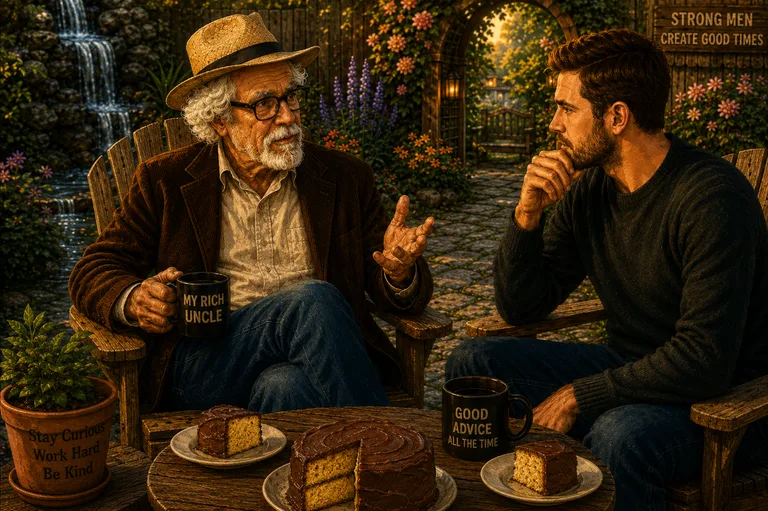
A pot of coffee was already brewing. On the kitchen table sat a yellow cake with chocolate frosting, missing two generous slices.
As I entered, I noticed my uncle holding an old photograph. It showed a group of young men standing outside what appeared to be a high school. They had long hair, wide collars, and the confident expressions of people who had no idea how strange their clothes would look fifty years later.
I pointed to one of the boys.
“Did you go to school with him?”
My uncle studied the photograph for another moment.
“Yes,” he said. “We were good friends.”
He placed the picture on the table.
“But he’s gone now.”
“I’m sorry,” I said.
My uncle looked at me.
“Oh, he didn’t die. Not exactly.”
“What happened?”
“He became a socialist and stopped talking to me.”
I laughed, but my uncle did not.
“He decided that anyone who disagreed with him was either stupid, evil, or both. Apparently, I qualified.”
He cut me a piece of cake and poured two cups of coffee.
“You know,” he continued, “I have lost a lot of friends during the last ten years.”
I sat across from him.
“When I turned thirty, more than a hundred people came to my birthday party. We filled the house, the yard, and half the street. When I turned thirty-five, maybe thirty people came. I don’t remember the exact number.”
“What happened to everyone?”
“Life happened. People married, moved away, had children, changed jobs. That is normal. But something else has happened since then.”
He pushed the cake plate toward me.
“The world has more people than ever, but those people seem to have fewer and fewer friends.”
He tapped the cake with the side of his fork.
“I call it the Cake Theory.”
“The Cake Theory?”
“Imagine your circle of friends as a birthday cake.”
He drew an invisible circle around the cake with his finger.
“Think about the people you knew around 2012. They had different opinions, different religions, different lifestyles, different backgrounds. Some were Republicans, some were Democrats, and most did not talk about politics every five minutes.”
“So the cake was whole?”
“More or less. It was not perfect, but everyone could sit at the same table.”
He took the knife and made a straight cut through the center of the cake.
“Then came the 2016 election. Trump against Clinton. That was the first major cut.”
“Left against right.”
“Exactly. Society had been divided politically for a long time, but social media made that division personal. People were no longer merely disagreeing. They were unfriending each other.”
He separated the two halves slightly.
“One side believed the other side was destroying the country. The other side believed exactly the same thing. Both were convinced they were defending civilization.”
“What was different about that election?”
“Politics became identity. An opinion was no longer something you had. It became who you were. If someone criticized your candidate, it felt as though they were attacking you personally.”
He made another cut through one section of the cake.
“Then came men against women. Hillary Clinton’s campaign made gender part of the political battle. Suddenly, you were not just divided by ideology. You could also be divided by sex.”
“So if you were a conservative man, your section became smaller again.”
“Correct. First, the cake was divided between left and right. Then each section was divided along another line.”
He cut the cake once more.
“That is when the people running the social-media machines discovered something important. One division was not enough.”
“They wanted everyone fighting everyone?”
“They learned that outrage creates attention. Attention creates engagement. Engagement creates money and influence.”
He pointed the knife toward me.
“A peaceful person closes the application and goes outside. An angry person keeps scrolling.”
Then he made a jagged cut through another part of the cake.
“Next came COVID.”
“Lockdowns, masks, mandates, and vaccines.”
“COVID cut directly through families, friendships, workplaces, churches, and political parties. It even divided conservatives.”
He moved two pieces apart.
“One side believed strong rules were necessary for public health. They valued order, safety, hygiene, and collective responsibility. The other side questioned the mandates and the official explanations. They valued freedom, transparency, bodily autonomy, and the right to challenge authority.”
“And both sides thought the other was dangerous.”
“Exactly. One side thought the skeptics were reckless. The other thought the obedient were surrendering their freedom.”
He leaned back.
“People lost friends. Some stopped speaking to brothers, sisters, parents, and children. Families fought over Thanksgiving dinner. Co-workers reported each other. Neighbors treated one another like enemies.”
He looked at the pieces of cake.
“Another hard cut.”
He turned the plate slightly and sliced from a different angle.
“Then, in 2022, Russia invaded Ukraine.”
“Another division.”
“But notice something important,” he said. “It was not the same division. It did not perfectly follow the old left-versus-right line.”
He separated another piece.
“Some people demanded punishment, weapons, sanctions, and total support for Ukraine. Others wanted negotiations, restraint, and an end to the fighting before it expanded.”
“Peace versus punishment.”
“Or diplomacy versus strength, depending on how you framed it. That is part of the trick. Every side gets a noble label for itself and an ugly label for the other.”
He raised his cup.
“If you wanted negotiations, they called you weak or pro-Russian. If you wanted military support, they called you a warmonger. Very simple. Very emotional. Very effective.”
He made another cut.
“Then came Israel and Palestine.”
“New lines again.”
“Completely new lines. Not simply left against right. Not men against women. Not freedom against mandates. Friends who had agreed on every previous issue suddenly discovered they were enemies over Gaza.”
He placed the knife beside the plate.
“That is what makes the model so dangerous. Old-fashioned divide and conquer divided people once and then reinforced the division. This new system divides people, then divides each division, then divides the divisions again.”
“Divide, divide, divide—and conquer.”
“Exactly.”
We looked at the cake. What had been one round cake was now a collection of irregular pieces scattered across the plate.
“Every controversy cuts from a different angle,” my uncle said. “Each time, a different group of your friends is removed from your life.”
“And eventually?”
He slid one small piece toward me.
“You are left with a very sad birthday cake. Just enough for one person.”
I took a bite.
“So what happens after everyone is isolated?”
“That is when loneliness becomes useful.”
“Useful to whom?”
“To anyone who wants to influence you.”
He leaned forward.
“A person with strong family ties, loyal friends, a healthy community, and people they trust is difficult to manipulate. That person has somewhere to go. They can ask questions. They can compare experiences. They can laugh at propaganda.”
“And a lonely person?”
“A lonely person turns to the screen for companionship, information, approval, anger, entertainment, and identity.”
He tapped his phone.
“The same machine that helped isolate the person now offers to become the person’s friend.”
“That is dark.”
“It is also profitable.”
He picked up the knife and held it above the remaining cake.
“If I were the devil and wanted to control the world, I would not begin by putting everyone in chains.”
“What would you do?”
“First, I would cut the cake.”
He lowered the knife.
“Then I would let the people starve for companionship. After that, it would be easy to nudge them wherever I wanted them to go.”
For a moment, neither of us spoke.
The coffee maker clicked as it finished brewing.
“So what do we do?” I asked.
My uncle put the knife down.
“We stop cutting.”
“That sounds easier than it is.”
“It is easier than people think, but it requires discipline.”
He held up one finger.
“First, focus on what connects you to people, not what divides you.”
“What if we strongly disagree?”
“Then talk about something else. You are not required to discuss every political controversy with every person you know.”
He pointed toward the window.
“You can talk about work, children, food, travel, cars, music, gardens, old stories, business ideas, home repairs, or the neighbor who somehow manages to run a leaf blower every Sunday morning.”
I smiled.
“You can share a meal with someone without first conducting an ideological background check.”
He raised a second finger.
“Second, keep difficult conversations offline.”
“Why?”
“Because online, you are not merely talking to another person. You are performing in front of an audience while an algorithm watches, measures, sorts, and amplifies everything.”
He gestured toward the chair beside him.
“Face to face, you see a human being. You hear the hesitation in their voice. You notice when they are hurt. You can clarify what you meant. You can laugh. You can apologize.”
“Soul to soul.”
“Exactly. Never try to repair an important relationship inside a comment thread.”
He raised a third finger.
“Third, stay loyal to people, not positions.”
“You mean friendship should be more important than politics?”
“Most of the time, yes. Political positions change. People learn. Circumstances change. New information appears.”
He pointed at the old photograph.
“Your brother will not always be right. But your brother will always be your brother.”
“That does not mean accepting everything someone does.”
“No. Loyalty does not mean surrendering your judgment. Some relationships are abusive or dangerous, and distance may be necessary. But ending a thirty-year friendship because someone voted differently is usually foolish.”
He looked again at the photograph.
“We have started treating disagreement as betrayal.”
I glanced at the picture of his former friend.
“Could you reconnect with him?”
My uncle considered the question.
“Perhaps.”
“Even after all this time?”
“That brings us to the most powerful part of the Cake Theory.”
He began moving the pieces back toward one another.
“The people dividing society keep introducing new issues. They assume every new division will make us weaker.”
He joined two pieces.
“But every new issue also gives us an opportunity to reconnect.”
“How?”
“Suppose you stopped talking to a friend because of his position during COVID. Years later, you discover that both of you see the war in Gaza the same way.”
“So you have common ground again.”
“Exactly. Use it.”
He joined another piece.
“Do not reopen the old argument. Do not demand an apology. Do not send him a twenty-page explanation of why he was wrong.”
“What do you say?”
“You say, ‘I was thinking about you. It has been too long. Let’s have coffee.’”
“That simple?”
“That simple.”
He continued rebuilding the cake.
“Perhaps your left-wing friend and your right-wing friend were divided over Trump. But now both are concerned about what Mamdani represents in New York. Fine. There is common ground again.”
“So they start talking.”
“They start talking—and then, with any luck, they eventually stop talking about politics.”
He smiled.
“That is where the real friendship begins again.”
The cake could not be made whole. The cuts were still visible. Some frosting had stuck to the knife. A few crumbs remained scattered across the plate.
But the pieces were together.
“People are slowly realizing that this game is not merely political,” my uncle said. “It is psychological.”
“Because human connection is resistance.”
He nodded.
“We have all been played by narratives, campaigns, headlines, influencers, and algorithms. Every side thinks only the other side was manipulated.”
“But all of us were.”
“All of us.”
He pushed the reassembled cake toward the middle of the table.
“We are sitting at home alone, each guarding a tiny piece of cake, convinced everyone else is the enemy.”
“What should people do?”
“Write to an old friend.”
“What if the friend does not answer?”
“Write to another one.”
“What if the conversation becomes political?”
“Change the subject.”
“What if they insist?”
“Tell them the friendship matters more than winning the argument.”
He poured more coffee into my cup.
“Most of those old friends are sitting at home with their own tiny pieces of cake. They may be wondering whether you still hate them.”
“So invite them back.”
“Yes. Invite them over. Drink coffee. Share food. Tell old stories. Help each other. Learn from one another. Travel to see each other while you still can.”
He cut two fresh slices and placed one on my plate.
“There is hope. We simply have to get the cake back.”
I picked up my fork.
“Stop slicing.”
“Stop cutting.”
We ate quietly for another minute.
Then my uncle looked at me.
“By the way, why did you come here?”
I had almost forgotten.
“I need to borrow your hammer drill.”
“Oh.”
He stood and walked toward the garage.
“It is over here. Bring it back by next week. I want to change the door near the laundry room.”
I followed him.
“I can come by Saturday and help you.”
He stopped, turned around, and smiled.
“I will have more cake.”
© 2026 insearchofyourpassions.com - Some Rights Reserve - This website and its content are the property of YNOT. This work is licensed under a Creative Commons Attribution 4.0 International License. You are free to share and adapt the material for any purpose, even commercially, as long as you give appropriate credit, provide a link to the license, and indicate if changes were made.