Think of it as Yoga for the brain, we are going to stretch a bit.
Dear Diary: Dr. Fauci and the Strange Habit of Powerful Men Writing Their Own Alibis
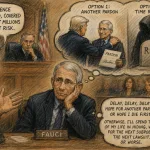
Fauci versus Fauci: The prosecution’s most damaging eyewitness may be Fauci himself. -YNOT!
If you are ever planning to do something illegal, moderately illegal, questionably ethical, or merely embarrassing enough to require a congressional hearing, my first piece of advice is simple:
Do not keep a diary. Do not write yourself little reminders.
Do not email yourself a private history of the event.
Do not record what you knew, when you knew it, whom you spoke with, which reporters you trusted, which politicians you despised, or how clever you believed yourself to be.
Most importantly, do not write the diary under the assumption that nobody else will ever read it.
That assumption has ruined many a distinguished career.
Yet powerful men seem unable to resist the temptation. Dictators, generals, presidents, revolutionaries, spies, bureaucrats and assorted saviors of humanity often feel compelled to explain themselves to posterity. You know who I mean.
Ordinary criminals hide the evidence. Historic personalities organize it into chapters.
They do not believe they are writing a confession. They believe they are preparing the authorized biography.
And now we have the Fauci diaries.
The Gospel According to Anthony Fauci
Senator Rand Paul has released more than a thousand pages of journal entries attributed to Dr. Anthony Fauci. The entries reportedly stretch from December 2019 through December 2022 and arrive just before Fauci is scheduled to testify before a Senate committee on Wednesday, July 29, 2026. (CBS News)
Fauci was not merely another government doctor during COVID. He was one of the most visible members of the federal response, participating in a growing conflict inside the Trump White House over the Wuhan laboratory, lockdowns, masking and other pandemic measures.
For several years, the public saw Fauci through television interviews, congressional testimony and carefully prepared statements.
The diaries offer something different. They show Fauci writing about Fauci, for Fauci.
That is an important distinction.
A public statement is designed to persuade the public. A congressional answer is designed to survive Congress. A memoir is designed to flatter the author without making the flattery too obvious.
A private diary is where a man sometimes forgets that history has subpoena power.
What a Diary Can—and Cannot—Prove
Let us be careful. A diary entry is not a criminal conviction.
It is not proof that every memory recorded in it is accurate. People misunderstand events, exaggerate their influence, remember conversations selectively and arrange the past in ways that make themselves appear wiser than they were.
A diary can even be self-deception written in real time.
But it can reveal what the writer believed, what he feared, what he considered important and how he wished to remember himself.
That is why these records matter.
They do not automatically prove that Fauci committed a crime, lied under oath or deliberately caused any particular policy.
They may, however, help investigators compare three different versions of events:
What Fauci said privately. What Fauci said publicly.
What the documentary record shows actually happened.
Where those three agree, the diary may help clear up confusion.
Where they conflict, Congress has work to do.
The Dangerous Difference Between Uncertainty and Certainty
One of the central questions concerns the origin of COVID-19.
Public discussion of the lab-leak possibility was often treated during the early pandemic as disinformation, conspiracy theory or partisan speculation. Yet Fauci’s diary reportedly records substantial private uncertainty.
According to CBS News, a January 2020 entry said the Wuhan market was not the original source but an “amplifier.” Another entry referred to a conference call during which several prominent scientists questioned whether the virus had originated naturally. Fauci later wrote that he continued to believe natural emergence was highly likely while acknowledging that nobody, including himself, could be completely certain. (CBS News)
That does not prove the virus came from a laboratory. It does raise a legitimate question:
Was the uncertainty expressed privately greater than the uncertainty communicated publicly?
Science is allowed to be uncertain. In fact, science is supposed to be uncertain when the evidence is incomplete.
The difficulty begins when uncertainty is permitted inside the conference room but forbidden outside it.
If officials privately considered several possibilities while publicly treating one of those possibilities as absurd, the issue is no longer merely scientific. It becomes a question of public trust.
The public did not require Fauci to know the unknowable in January 2020.
It required him to be honest about what was known, what was suspected and what remained uncertain.
There is a vast moral difference between saying, “The available evidence currently favors natural emergence,” and saying, “Only a fool or a dangerous conspiracy theorist would ask whether a laboratory was involved.”
The first is science. The second is public relations wearing a laboratory coat.
The Gain-of-Function Question
The most serious part of this controversy involves research involving potentially dangerous pathogens. Here precision matters.
The Obama administration did not simply make all gain-of-function research “illegal.” In October 2014, it instituted a federal funding pause covering certain experiments involving influenza, SARS and MERS viruses that could reasonably be expected to enhance pathogenicity or respiratory transmissibility in mammals. The policy also contained exceptions and handled some ongoing projects individually.
That distinction is important because Washington survives through definitions.
The ordinary citizen hears the phrase “gain of function” and imagines scientists making a virus more dangerous.
The bureaucrat hears it and asks which definition, which framework, which funding category, which agency interpretation and which paragraph of which guidance document applies.
Thus, two men can argue before Congress about whether research was “gain of function,” while each uses a different definition and both leave claiming victory.
The question for investigators should not stop with terminology.
Why the heck were we researching game of function at all and in China?
They must ask what the experiments actually did.
Did they enhance viral characteristics? What risks were recognized?
Who funded the work? Which exemptions or interpretations were used?
What did Fauci know about those decisions?
What did he tell the Obama, Trump and Biden administrations?
What did he tell Congress?
The accusation that Fauci lied to three administrations is serious. At this stage, it should be treated as an allegation to be tested against documents and testimony—not as a verdict announced before the hearing begins.
But neither should the allegation be dismissed simply because Fauci was once introduced on television as “America’s doctor.”
A title is not evidence. A television reputation is not immunity.
And “trust the science” cannot mean “never question the scientist.”
The Man Who Became the Message
The diaries reportedly contain repeated references to Fauci’s sudden celebrity: favorable press coverage, celebrity contacts, public applause, television appearances and the extraordinary attention surrounding him.
In one entry, Fauci described himself as perhaps the most famous and talked-about person in the country. Other entries tracked favorable portrayals, popular tributes and the unusual culture of admiration that grew around him. Some entries expressed embarrassment or discomfort with the attention, so the record is not entirely one-dimensional.
Still, there is something institutionally dangerous about transforming a government adviser into a national saint.
Scientists should be respected for their work. They should not be turned into mascots.
The moment a scientific official becomes a cultural hero, criticism of the official begins to look like opposition to science itself.
That is how a person becomes inseparable from an institution.
Question Fauci, and you are accused of questioning medicine.
Question pandemic policy, and you are accused of wanting people to die.
Question the laboratory hypothesis, and you are accused of spreading dangerous misinformation.
The argument stops being about evidence and becomes a loyalty test.
This is particularly dangerous because scientists are human beings. They possess ambition, vanity, friendships, grudges, blind spots and political instincts, just like plumbers, politicians and newspaper columnists.
A medical degree does not vaccinate a man against pride.
The Lockdown Contradiction
The diaries also appear to complicate Fauci’s later descriptions of his role in shutdowns and school closures.
Fauci did not possess direct legal authority to close every school or business in America. Those decisions were generally made by presidents, governors, mayors, health departments and school officials.
But influence is not the same thing as formal authority.
A diary entry reportedly describes Fauci as having convinced New York City Mayor Bill de Blasio to close the city’s schools. Another records a similar conversation involving California officials.
That does not mean Fauci single-handedly locked down America.
It does suggest that statements minimizing his influence deserve scrutiny.
During the emergency, officials naturally wanted credit for actions they believed would save lives.
After the consequences became visible—learning loss, business failures, social isolation, delayed medical treatment and deep public anger—the supply of volunteers willing to accept responsibility became remarkably limited.
Success has a thousand fathers. A failed policy is left at the fire station in a basket.
The proper question is not whether Fauci personally possessed a giant red lever marked CLOSE AMERICA.
The question is whether his recommendations materially influenced decisions and whether he later described that influence accurately.
Science, Politics and the Court of Celebrity
The pandemic created a peculiar alliance between government experts, political officials, media personalities and celebrities.
Some of that cooperation was inevitable. The government needed to communicate quickly, and news organizations needed access to experts.
But access can turn into friendship, friendship into protection and protection into mythology.
When journalists begin treating a source as a friend, they may stop treating him as a subject.
When television hosts repeatedly praise an official rather than interrogate him, journalism becomes public relations.
When celebrities turn a bureaucrat into a cultural icon, disagreement becomes heresy.
A healthy republic should never have an official who is above aggressive questioning—not the president, not a general, not an intelligence director and certainly not a public-health adviser.
The more power an official possesses, the less admiration journalists should bring into the interview.
A reporter’s job is not to kneel before authority and thank it for its service.
The job is to ask what authority did.
Fauci Versus Fauci
The most important witness at the hearing may not be Rand Paul.
It may not even be Anthony Fauci. It may be Anthony Fauci’s earlier self.
The Fauci who wrote privately will be compared with the Fauci who spoke publicly.
The Fauci of January 2020 will be compared with the Fauci of 2021.
The Fauci who discussed laboratory possibilities will be compared with the Fauci who described those possibilities before Congress.
The Fauci who recorded his influence over restrictions will be compared with the Fauci who later minimized responsibility for them.
The Fauci who praised his own performance will be compared with the documents, emails, funding records and testimony of everyone else in the room.
Perhaps the differences will have innocent explanations.
Perhaps memory changed. Perhaps statements are being removed from context.
Perhaps the diary will ultimately vindicate him on some issues and damage him on others.
That is why an investigation is necessary.
We should not declare Fauci guilty because we distrust him.
We should not declare him innocent because television once told us to trust him.
Let the Documents Speak
The pandemic was not a movie. Millions of people died, families were separated, businesses collapsed, children lost irreplaceable years of education and governments exercised powers that would have been unthinkable months earlier.
The decisions made during that period deserve more than slogans.
They deserve records. They deserve sworn testimony.
They deserve adversarial questioning.
They deserve investigators willing to distinguish between an honest mistake, bureaucratic self-protection, political manipulation and deliberate deception.
I have reached no final verdict.
The diary has only recently become public. More research must be done. Entries must be authenticated, placed in context and compared with emails, grant documents, scientific discussions and previous testimony.
But the preliminary picture is troubling enough to demand serious examination.
It suggests a government official who may have privately entertained possibilities that were publicly discouraged, who possessed enormous influence while sometimes minimizing that influence, and who became so closely associated with “the science” that questioning the man was treated as questioning reality itself.
Perhaps Fauci will explain it all. Perhaps Congress will expose exaggerations by his critics.
Perhaps the diary will prove less sinister than it appears.
Or perhaps we are watching the opening scene of one of those Washington conspiracy films in which the government assures everybody that there is nothing to investigate—right up until somebody finds the diary.
Either way, the American public deserves the complete record.
Because when a man writes his own history, he should not be surprised when history asks to cross-examine him.
This is an extraordinarily serious matter, and I have tried to approach it with respect for the memories of every family that suffered a loss. Someday, someone will undoubtedly make the movie Fauci. I will not be going to see it.