Think of it as Yoga for the brain, we are going to stretch a bit.
Fauci pleads the Fifth … Never saw that coming… kidding of course
Fauci’s Biden pardon is not blanket lifetime immunity. The official warrant covers federal offenses he may have committed or participated in from January 1, 2014, through January 19, 2025, provided they arose from or related to his specified government service. It does not cover later conduct, unrelated offenses, or state crimes.
Can he plead the Fifth?
Yes—but the legal basis must be potential exposure to an unpardonable or unpardoned offense, such as:
Perjury, obstruction, false statements, or contempt occurring after January 19, 2025.
Participation in criminal conduct continuing after that date.
Conduct outside the pardon’s subject-matter scope.
Possible state-law exposure.
However, where a truthful answer could expose him only to federal offenses completely covered by the pardon, his Fifth Amendment claim becomes much weaker. Supreme Court precedent holds that when immunity removes the realistic danger of prosecution, the privilege against self-incrimination no longer justifies refusing to answer. Whether Fauci’s pardon eliminates the danger presented by each particular question would ultimately be a legal question, not something resolved simply by invoking the Fifth repeatedly.
A pardon removes the Fifth Amendment privilege concerning matters for which the pardon leaves no realistic criminal exposure—but it does not remove the privilege concerning separate, unpardoned criminal exposure.
His invocation today is not itself evidence of guilt, nor is it perjury, because he did not provide a false answer. He invoked the Fifth rather than answering.
Is the diary evidence?
Potentially, yes. In a criminal proceeding, prosecutors would have to authenticate it as genuine. Fauci’s own authenticated statements could generally be introduced against him as statements of an opposing party. The diary could establish knowledge, intent, chronology, inconsistencies, or leads to other evidence. But a diary entry is evidence—not automatic proof of a crime or conspiracy. (Legal Information Institute)
A pardon also does not erase historical facts or create a legal fiction that the underlying conduct never happened. Therefore, pardoned conduct and documents relating to it may potentially be used as background evidence when proving a separate, unpardoned post-pardon offense. (Congress.gov)
The major correction: covering something up does not automatically extend a conspiracy
To prosecute Fauci for a conspiracy continuing beyond January 19, 2025, prosecutors would need evidence that:
There was an actual criminal agreement involving at least two people.
Its criminal objective continued beyond the pardon date.
Fauci knowingly remained involved after that date.
An overt act after that date occurred, where the applicable conspiracy statute requires one.
The general federal conspiracy statute requires an agreement and an act intended to advance its objective.
The Supreme Court has specifically rejected the idea that ordinary attempts to conceal a completed crime automatically keep the original conspiracy alive forever. Under Grunewald v. United States, later concealment counts as part of the conspiracy only when concealment was itself part of the original criminal objective or was necessary to accomplish the principal objective. Merely denying wrongdoing or covering one’s tracks after the underlying scheme ended ordinarily does not extend the conspiracy.
A deliberate lie after the pardon could nevertheless constitute a new crime, such as perjury if made materially under oath, or obstruction if made corruptly to impede a congressional investigation. Those offenses would be dated after the pardon and therefore outside it.
Bottom line
The Biden pardon cannot protect Fauci from crimes committed after January 19, 2025, including post-pardon perjury, obstruction, or proven participation in a continuing conspiracy.
But this part goes too far: “He is still lying and covering it up, therefore the conspiracy is ongoing and the pardon is useless.”
Continued lying would have to be proven, and it might constitute a new offense. It does not, by itself, prove that an earlier conspiracy legally continued. The pardon remains extremely valuable against prosecution for covered pre-January 19, 2025 federal conduct; it is simply ineffective against genuinely new post-pardon crimes.
Fauci’s pardon covers federal offenses related to his government service only through January 19, 2025. It does not protect him from post-pardon perjury, obstruction, false statements, or continued participation in a criminal conspiracy. His diary could provide admissible evidence if authenticated, but prosecutors would still have to prove that a conspiracy actually continued beyond the pardon date and that Fauci knowingly participated in it after that date. Mere denial or concealment of a completed offense does not automatically keep the original conspiracy alive.
State criminal charges and private civil lawsuits are outside the normal protection of Fauci’s presidential pardon. In those areas, the pardon is much less useful—but other immunity doctrines could still protect him.
1. State criminal charges
Biden’s pardon covers “offenses against the United States” related to Fauci’s government service through January 19, 2025. It does not pardon violations of Maryland, New York, Florida, California, or another state’s criminal laws. Presidential pardon authority does not extend to state offenses or civil wrongs.
Therefore, a state would not need to prove that Fauci committed a new crime after the pardon date. A state could theoretically prosecute a pre-pardon state offense, because that offense was never covered by Biden’s pardon in the first place.
The Supreme Court’s dual-sovereignty doctrine permits state and federal governments to prosecute offenses arising from the same conduct because each sovereign is enforcing its own law. A federal pardon therefore does not ordinarily prevent a state prosecution.
But a state would still need:
A genuine violation of that state’s law.
Territorial jurisdiction or another legally sufficient connection to the state.
Evidence proving every element beyond a reasonable doubt.
A prosecution filed within the applicable limitations period.
A theory that is not preempted by federal law.
A lie to Congress, for example, is principally a federal matter. It does not automatically become state perjury merely because a state resident was affected. Prosecutors would need a separate state-law offense and jurisdictional basis.
Federal-officer immunity remains a major defense
Even without the pardon, a former federal official can argue Supremacy Clause immunity from state prosecution when the conduct was authorized by federal law and the official did no more than was “necessary and proper” in carrying out federal duties. That protection would not necessarily cover conduct outside federal authority or conduct that was not necessary and proper.
So the state’s theory would matter enormously:
“Fauci made a controversial federal policy decision” would face strong immunity and preemption defenses.
“Fauci personally falsified records, destroyed evidence, committed fraud, or joined an unlawful agreement outside his lawful authority” would present a materially different question—assuming the evidence and state jurisdiction existed.
One additional wrinkle: Washington, D.C., is not treated exactly like a state for pardon purposes. DOJ states that presidential clemency can reach certain D.C. offenses prosecuted by the U.S. Attorney in the name of the United States. Maryland or Virginia offenses would remain ordinary state offenses.
2. Private lawsuits for damages
The pardon itself does not erase private civil liability. A person could file a lawsuit based on pardoned conduct, and authenticated diary entries could potentially be used as evidence. But filing a case is much easier than surviving dismissal.
A plaintiff would have to prove:
A legally recognized cause of action.
A concrete personal injury—not merely disagreement with public policy.
A sufficiently direct causal link between Fauci’s conduct and the injury.
Measurable damages.
Timeliness under the relevant statute of limitations.
For claims involving illness, vaccination, business closures, employment losses, or death, proving that Fauci personally and legally caused the particular plaintiff’s damages would usually be a central obstacle.
The Westfall Act
For ordinary tort claims based on conduct within Fauci’s federal employment, the government could certify that he was acting within the scope of employment. Under the Westfall Act, the United States would then generally replace Fauci as the defendant, converting the case into a Federal Tort Claims Act proceeding.
That is significant because the FTCA contains major exceptions, including claims based on discretionary policy functions and claims arising from misrepresentation, deceit, libel, or slander. Many lawsuits framed as “Fauci lied and caused damages” could encounter those exceptions.
Public Health Service protection
Federal law also makes the FTCA remedy exclusive for personal injury or death resulting from medical or related functions performed by Public Health Service officers or employees within their employment. The Supreme Court has interpreted that provision as granting personal immunity for covered conduct. Whether it applied to a particular Fauci claim would depend on his status, the function involved, and the precise allegations.
PREP Act immunity
A lawsuit involving COVID vaccines, treatments, testing, distribution, administration, or other covered countermeasures could also run into the PREP Act. It provides broad liability protection to covered persons, potentially including “program planners” who supplied policy guidance or scientific advice, subject to a narrow statutory exception for willful misconduct.
This means a conventional negligence or failure-to-warn lawsuit involving a covered COVID countermeasure could be barred even though the presidential pardon itself provides no civil immunity.
Constitutional lawsuits
Trying to sue Fauci personally for constitutional violations would also be difficult. The Supreme Court has sharply restricted new implied damages actions against federal officers under Bivens, especially where high-level government policy and national public-health decisions are involved.
His Fifth Amendment position in a civil case
Because the pardon does not eliminate possible state exposure, Fauci could potentially invoke the Fifth Amendment during civil discovery or testimony when an answer might incriminate him under state law or for an unpardoned federal offense.
However, civil litigation differs from a criminal trial. A court or jury may sometimes draw an adverse inference from a party’s invocation of the Fifth when other probative evidence supports the claim. The invocation alone would not automatically establish liability.
Bottom line
Biden’s pardon does not protect Fauci from state crimes at all—even crimes allegedly committed before January 19, 2025.
And regarding civil litigation: The pardon does not extinguish private claims for damages, but plaintiffs would still have to overcome causation, standing, limitation periods, federal-officer protections, the Westfall Act, FTCA exceptions, Public Health Service immunity, and potentially the PREP Act.
The diary could help establish knowledge, intent, contradictions, or investigative leads. But it would not, by itself, overcome those jurisdictional and immunity barriers or prove that Fauci personally caused a particular plaintiff’s damages.
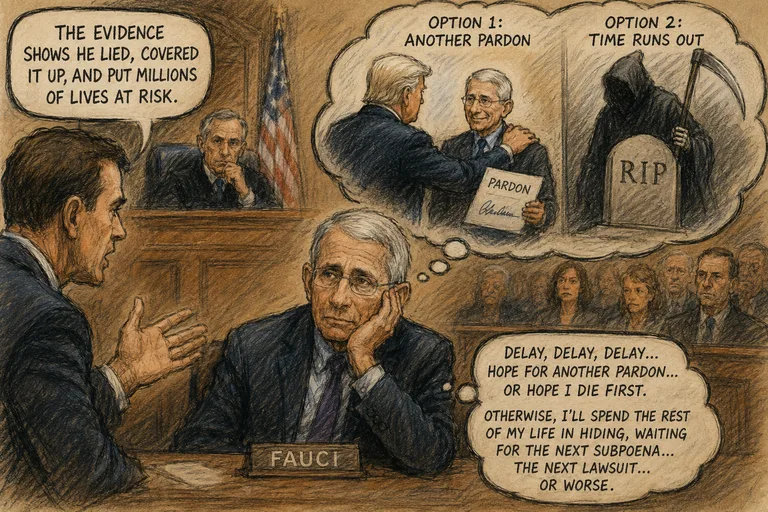
Fauci’s best defense will simply be delay: drag the process out long enough to hope that the next president grants him another pardon—or that time overtakes the case altogether. Either way he could spend the rest of his life looking over his shoulder, never knowing when another subpoena, lawsuit, investigation, or criminal charge may arrive at his door.