Think of it as Yoga for the brain, we are going to stretch a bit.
AI IS HERE — Transforming Innovation and the Nature of Work
For years, people talked about artificial intelligence as though it were tomorrow’s problem.
Something coming. Something we should prepare for.
Something that might someday change the way we work.
Well, someday showed up. AI is here.
And I don’t think we have fully grasped what that means yet.
This isn’t simply another piece of software.
It isn’t Microsoft Word replacing the typewriter.
It isn’t Excel replacing the adding machine.
It isn’t even the Internet replacing the filing cabinet.
Those technologies helped people do the same work faster.
AI is beginning to change the nature of the work itself.
That is a much bigger deal.
We Are Moving Beyond Automation
The first stage of computerization was simple.
Give the machine a repetitive job. Calculate this. Sort that.
Move this information from one system to another.
Send this email. Generate this report.
Automation followed instructions.
AI is beginning to do something different.
You can increasingly give it a goal.
Research this market. Find the problem. Compare the alternatives. Develop a solution.
Write the software. Test it. Find what broke. Fix it. Document it.
Then tell me what you think we should do next.
That is an entirely different relationship between man and machine.
We are moving from software that waits for instructions to systems capable of reasoning, planning, coordinating tools and executing multi-step work toward an objective.
That is where agentic AI becomes important.
One AI agent may research. Another may analyze. Another may write code. Another may test it. Another may monitor production. Another may interact with the customer.
And increasingly, these agents will communicate and coordinate with each other.
The human does not disappear. But the human’s job changes.
Instead of personally performing every step, the human increasingly becomes the person who decides:
What are we trying to accomplish? What constraints matter? What does good look like?
When should the machine stop and ask me?
Is the result actually right?
That is management.
Except now you may be managing people, software, machines, and artificial intelligence at the same time.
Innovation Is About to Get Much Faster
There has always been a tremendous distance between an idea and its execution.
You could have a great idea for a business, but you needed programmers.
Designers. Researchers. Writers. Accountants. Marketing people. Data analysts. Infrastructure.
And, perhaps most importantly, money and time.
Every one of those requirements created friction between: “I have an idea.” and “I built it.” AI is rapidly compressing that distance.
A person can now describe an idea and begin researching it within minutes.
Build a prototype in hours. Test assumptions. Generate designs. Write documentation. Analyze competitors. Create databases. Develop software. Find errors. Rewrite the software. And do it again tomorrow.
That does not mean every idea becomes a good idea.
AI doesn’t eliminate bad judgment.
If anything, it can allow bad judgment to move faster too.
But for somebody who understands the problem they are trying to solve, the leverage can be extraordinary.
Expertise Doesn’t Disappear. It Becomes More Valuable.
There is another misconception about AI.
People sometimes imagine that because AI knows many things, expertise will no longer matter.
I think the opposite may happen.
Consider two people using the same powerful AI. One knows nothing about construction. The other has spent thirty years building buildings.
Ask both of them to design a system for managing construction projects.
They are not going to produce the same result. Why?
Because the experienced person knows what questions to ask.
He knows which problems actually matter.
He knows which answer sounds good but won’t survive Tuesday morning on a construction site.
AI provides enormous capability. Experience provides direction.
The competitive advantage won’t simply belong to whoever has the biggest language model.
Most companies will eventually have access to excellent models.
The real advantage will come from combining AI with things competitors cannot easily download: Institutional knowledge. Historical data. Customer relationships. Industry experience. Proprietary processes.
And people who understand the business.
AI multiplied by domain knowledge is far more valuable than AI by itself.
The Digital Worker Has Arrived
We are also beginning to see something I believe will become commonplace: digital workers. Not simply chatbots.
Not an assistant sitting in the corner waiting for someone to type a question.
Digital workers with responsibilities.
One might monitor customer accounts. Another watches servers. Another reconciles transactions. Another performs research. Another monitors inventory. Another analyzes sales opportunities. Another writes and tests software.
They don’t necessarily replace a person one-for-one.
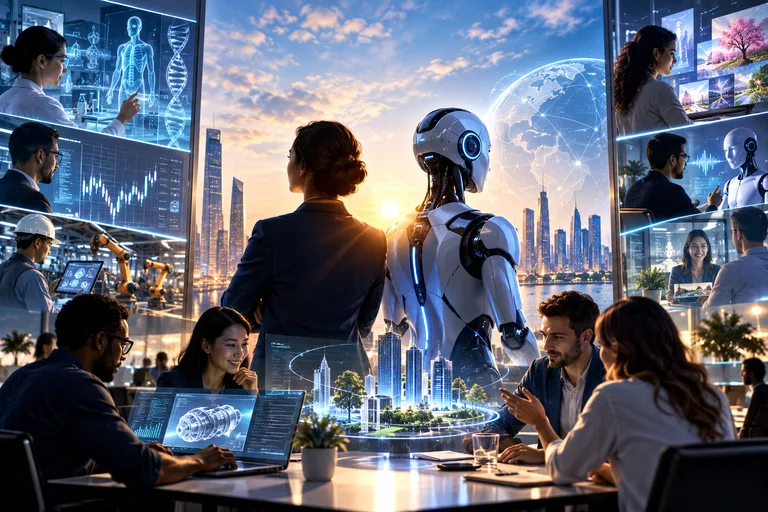
Instead, businesses begin reorganizing themselves around a combination of human and digital labor.
The interesting question will no longer be: “How many employees does this company have?”
It may become: “How much productive capability does this company control?”
A ten-person company with hundreds of specialized AI processes may someday possess capabilities that once required hundreds of employees.
That changes entrepreneurship. It changes the economics of small business.
And it changes who gets to innovate.
AI Is Becoming Multimodal
There is another important change underway.
AI isn’t limited to words anymore. It increasingly understands:
Eventually the distinction between “using the computer” and “talking to the AI” may largely disappear.
You won’t necessarily open five programs, export three files, build a spreadsheet and prepare a report.
You may simply say: “Figure out why production was down yesterday.”
The system can retrieve the numbers, examine operational data, compare historical performance, inspect reports, communicate with specialized agents and return with an explanation.
Then you might say: “Fix what you can, prepare recommendations for what you can’t, and tell me before you make anything irreversible.”
That is where this becomes transformational.
Even the Data Center Changes
AI will not merely run inside businesses.
It will increasingly help operate the infrastructure underneath them.
The ability to know when something simply doesn’t make sense.
AI can generate a thousand ideas.
Someone still has to recognize the one worth pursuing.
AI can produce an answer. Someone still has to decide whether it is correct.
AI can execute a plan. Someone still has to decide whether it is the right plan.
That distinction matters.
This Is Not Tomorrow
There will undoubtedly be mistakes. There will be enormous amounts of hype.
Billions of dollars will be wasted chasing AI simply because somebody put the letters A and I on a PowerPoint presentation.
Some projects will fail spectacularly. Some companies will discover they automated processes that never should have existed in the first place.
There will be security problems, legal problems, privacy problems and ethical problems.
Every transformative technology arrives carrying both opportunity and trouble.
But don’t mistake the problems for evidence that the transformation isn’t happening.
It is.
The important conversation inside organizations has already started changing.
A few years ago the question was: “Should we experiment with AI?”
Then it became:“Where can we use AI?”
Now it is becoming: “How should this company operate in a world where intelligent machines are part of the workforce?”
That is a very different question.
And I suspect that before this decade is over, we may look back and realize that the arrival of artificial intelligence was not simply another chapter in the history of computing.
It changed what an organization could be. It changed what an individual could accomplish. It changed the distance between imagination and execution.
And ultimately, it changed the nature of work itself.
The future isn’t waiting outside the door anymore.