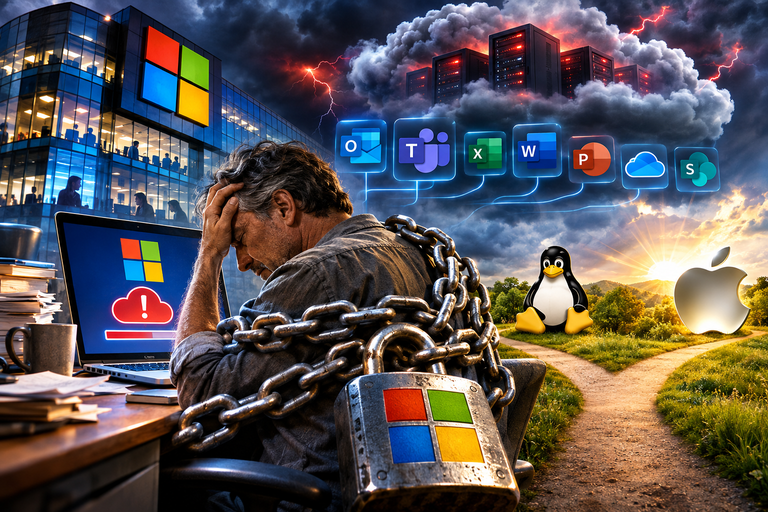
Think of it as Yoga for the brain, we are going to stretch a bit.
WHY ARE YOU STILL USING MICROSOFT? SERIOUSLY.
There's a peculiar genius in selling a man a problem, charging him monthly for the solution, and then convincing him that leaving would be too complicated. -- YNOT!
There comes a point in every man’s life when he must ask himself a difficult question.
Am I paying for a service, or am I financing my own suffering?
And if you’re still running your business on Microsoft, that question is long overdue.
Yesterday, November 12, Microsoft once again demonstrated the remarkable engineering achievement of charging millions of customers for a service that suddenly becomes unavailable.
Outlook, Exchange Online, Teams-related functions, and other Microsoft 365 services experienced widespread disruptions.
And somewhere in Microsoft’s enormous corporate headquarters, I imagine someone was preparing a carefully worded announcement explaining that they were investigating an issue, working diligently toward a resolution, and thanking everyone for their patience.
Patience?
After decades of this nonsense, patience should qualify as a tax-deductible business expense.
THE PROBLEM ISN’T JUST THE OUTAGE. IT’S THE ENTIRE PHILOSOPHY.
I am still amazed that people continue putting up with Microsoft’s software.
Menus buried inside menus. Settings scattered across three different interfaces. Features that move around for no apparent reason. Software that often looks and behaves like something designed in 1999, except now you need an internet connection, a Microsoft account, and occasionally divine intervention to make it work.
Every few years Microsoft announces another great reinvention.
A new interface. A new name. A new licensing model. Another subscription.
And somehow the simplest tasks become more complicated.
What once required two mouse clicks now requires six, an administrator’s permission, and a helpful invitation to try Copilot.
Congratulations! Progress has arrived, and it wants your credit card.
I SPEAK FROM EXPERIENCE.
Around the year 2000, I was a Microsoft Platinum Service Provider.
I’ve been working with computers, networks, servers, operating systems, and business technology for decades.
I’ve watched the industry evolve from machines sitting under desks to virtualized infrastructure, cloud computing, and artificial intelligence.
I remember when Microsoft actually had to convince people to buy its products.
Today, Microsoft seems more interested in convincing people they cannot survive without them.
And that is a very different business model.
The fundamentals haven’t improved nearly as much as they should have.
Instead, Microsoft has spent decades adding new layers to old foundations.
A patch on a patch, followed by another patch, eventually requiring a completely new patch because the previous patch broke something that had been working since Windows XP.
At some point, software stops resembling engineering and begins resembling an archaeological excavation.
Nobody knows exactly what’s underneath, but everyone is afraid to dig too deeply.
AND NOW ENTER ARTIFICIAL INTELLIGENCE.
For years, cybersecurity professionals and hackers have searched for vulnerabilities in operating systems, applications, and networks.
Artificial intelligence is making that process faster.
AI can help researchers analyze code, identify weaknesses, and uncover dangerous interactions between components.
That creates opportunities for defenders, but it also gives attackers increasingly powerful tools.
And when you’ve spent decades accumulating complexity, legacy compatibility requirements, and dependencies, you create an enormous amount of software that must be understood and secured.
To be fair, Linux and Apple have vulnerabilities too. Nobody gets a free pass in cybersecurity.
But Microsoft’s enormous installed base, deeply integrated software ecosystem, and complicated legacy architecture create a particularly attractive target.
I don’t know whether Microsoft’s problems come from poor engineering, excessive complexity, misplaced priorities, or simply the difficulty of managing an enormous platform.
What I do know is that customers are the ones who pay when things go wrong.
THE CLOUD WAS SUPPOSED TO SOLVE EVERYTHING.
I actually like the concept of cloud computing.
Why maintain complicated infrastructure yourself when someone else can handle the equipment, updates, security, backups, and maintenance?
In principle, it’s wonderful.
In practice, you have simply moved the responsibility to someone else.
And when that someone else fails, you discover something important.
You don’t control the equipment. You don’t control the software. You don’t control the updates. You don’t control the maintenance schedule.
And when the service stops working, you don’t control when it comes back.
You control only one thing.
The monthly payment.
And Microsoft is remarkably good at collecting that.
Yesterday’s outage illustrates the problem beautifully.
Companies that believed they had eliminated their technology headaches by moving everything into Microsoft’s cloud discovered that they had merely outsourced those headaches to a company they couldn’t call into the conference room and hold accountable.
When your own server fails, you can investigate it, repair it, replace it, or restore it.
When Microsoft’s cloud fails, you open a status page and hope somebody in Redmond knows what they’re doing.
THE REAL TRAP IS DEPENDENCY.
Microsoft doesn’t merely sell software anymore.
It sells an ecosystem.
Your email lives in Exchange Online.
Your files live in OneDrive.
Your documents live in SharePoint.
Your employees communicate through Teams.
Your identities depend on Microsoft Entra.
Your computers are managed through Microsoft’s administrative tools.
And every year, another business function gets absorbed into the same ecosystem.
At first, integration seems convenient.
Everything works together.
One vendor. One subscription. One familiar environment.
But eventually, leaving becomes so complicated and expensive that management stops considering alternatives.
That’s when convenience becomes captivity.
The more you use Microsoft, the more difficult it becomes to escape.
And the deeper they have you by your private parts.
Not because Microsoft physically prevents you from leaving, but because your own business has become dependent on its technology.
That is the danger of vendor lock-in.
YOU DO HAVE ALTERNATIVES.
I walked away from Windows after the Windows 8 fiasco.
That was enough for me.
I wasn’t interested in spending the rest of my professional life fighting an operating system that increasingly seemed determined to tell me how I should use my own computer.
I moved to Linux. And no, Linux isn’t perfect.
Sometimes it requires technical knowledge. Sometimes hardware compatibility takes work. Sometimes you need to understand what you’re doing.
But I would rather spend an hour learning how my computer works than spend a lifetime asking permission to use it.
For businesses and individuals who want a supported desktop environment with less technical administration, Apple is another reasonable alternative.
For those who want control, flexibility, transparency, and independence, Linux deserves serious consideration.
Linux servers, open-source applications, independent email providers, alternative office suites, and self-hosted services can reduce dependence on any single corporation.
You don’t necessarily have to replace everything tomorrow.
But you should have an exit strategy.
And more importantly, you should know whether you can actually execute it.
Because a backup you cannot restore is not a backup.
And an exit strategy you have never tested is merely a comforting bedtime story.
BUT MICROSOFT IS THE INDUSTRY STANDARD!
Ah, yes. The industry standard. My favorite argument.
For centuries, people defended terrible ideas by pointing out that everyone else was doing the same thing.
Everyone uses it! Everyone accepts it! Everyone pays for it!
Well, everyone once thought smoking was perfectly healthy, too.
Popularity does not prove quality.
Market dominance does not establish engineering excellence.
And familiarity is not the same thing as reliability.
Microsoft has some excellent technology, and talented engineers undoubtedly work there.
But that doesn’t mean customers should accept unnecessary complexity, recurring disruptions, or an increasingly expensive dependency on one vendor.
A company should have to earn your business continuously.
Not inherit it permanently because switching would be inconvenient.
SO HERE IS MY ADVICE.
If you’re a business owner, stop asking whether Microsoft is the standard.
Start asking whether Microsoft is the best solution for YOUR business.
What happens if Microsoft 365 is unavailable for an entire day?
Can your employees communicate?
Can they access essential files?
Can they continue operating?
Can you recover your information without Microsoft’s assistance?
Do you have independent backups?
Could you move to another provider if you wanted to?
And perhaps most importantly, do you actually own and control the technology your business depends on?
If you don’t know the answers, then yesterday’s outage should serve as a very expensive reminder.
THE BOTTOM LINE.
I don’t expect technology to be perfect. I’ve spent enough decades working with computers to know better.
Hardware fails. Software breaks. People make mistakes.
But I do expect technology companies to make their products more reliable, more secure, and easier to use as the years go by.
Not simply more complicated, more expensive, and more difficult to escape.
Microsoft has had decades to improve the fundamentals.
Instead, too often, customers get another interface redesign, another licensing change, another subscription increase, and another explanation about service disruptions.
There is an old business principle that says the customer is always right.
Microsoft seems to have invented a new one. The customer is always subscribed.
And as long as the payments keep coming, perhaps that is good enough.
But it shouldn’t be good enough for you.
Because the purpose of technology is to serve the people who use it. Not the other way around.
And if you’ve reached the point where you are afraid to leave a software company because your entire business depends on it, then perhaps you aren’t really its customer anymore.
Perhaps you’re its prisoner. And the most remarkable part?
You’re paying for the privilege.
YOU DON’T HAVE TO USE MICROSOFT.
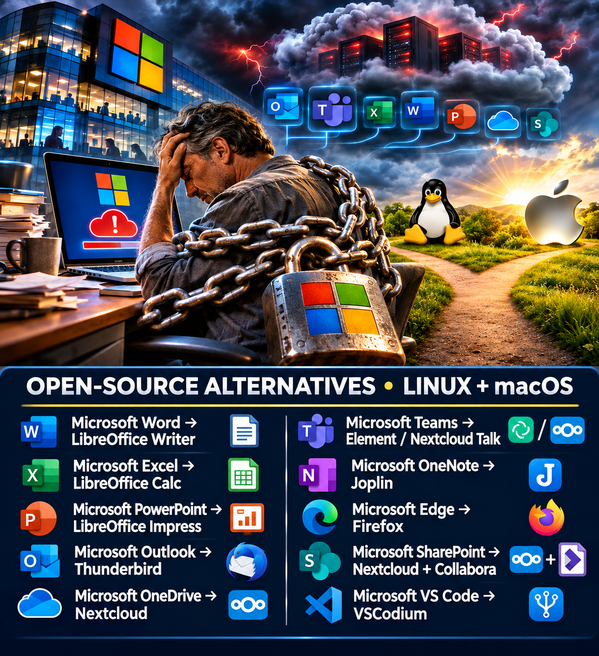
Here are free, open-source alternatives that work on BOTH Linux and Apple macOS.
Microsoft Word → LibreOffice Writer
Microsoft Excel → LibreOffice Calc
Microsoft PowerPoint → LibreOffice Impress
Microsoft Access → LibreOffice Base
Microsoft Outlook → Mozilla Thunderbird
Microsoft OneDrive → Nextcloud
Microsoft Teams → Element or Nextcloud Talk
Microsoft OneNote → Joplin
Microsoft Edge → Mozilla Firefox
Microsoft Paint → Krita or GIMP
Microsoft SharePoint → Nextcloud + Collabora Online
Microsoft Project → OpenProject
Microsoft Remote Desktop → RustDesk
Microsoft VS Code → VSCodium
Some are desktop applications; others are browser-based or require a server. Not every alternative offers identical features, but these tools can replace much of a typical Microsoft software environment.
You don’t have to replace everything overnight. Start with one application, learn what works, and gradually take control of your technology.
Free software doesn’t mean freedom from responsibility. It means having the freedom to choose.