Think of it as Yoga for the brain, we are going to stretch a bit.
Haiti: The War Against the Gangs — El Salvador’s Troops, American Contractors, Helicopters and Drones
When criminals become the government, citizens become hostages. Haiti is discovering that it takes military power to reclaim a country, but it takes honest institutions, justice, and economic opportunity to keep it. Defeating the gangs may win the battle; restoring civilization is how you win the war. — YNOT
As of November 23, 2026, Haiti is experiencing what increasingly resembles an international military intervention against organized criminal armies rather than a conventional police operation.
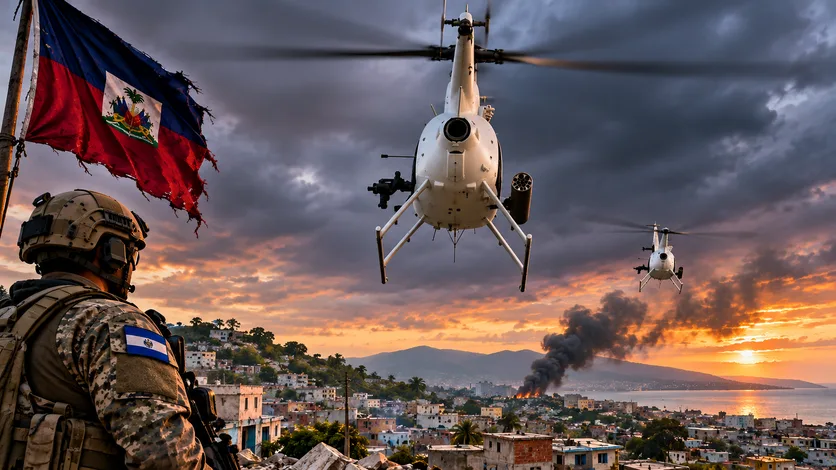
President Nayib Bukele of El Salvador has deployed approximately 2,500 troops to Haiti, operating alongside Haitian security forces, a United Nations-authorized multinational force and American private military contractors.
Military helicopters, explosive drones, armored vehicles, special forces and even robotic dogs are being deployed in and around Port-au-Prince.
What makes this situation particularly interesting is that the United States is substantially involved in supporting the intervention without publicly assuming a direct combat role.
The transcript you provided is broadly consistent with recent independent reporting, although some of its operational claims, casualty figures and conclusions remain unverified. Pasted text(4) The Wall Street Journal
How bad is the situation in Haiti?
Since the assassination of Haitian President Jovenel Moïse on July 7, 2021, Haiti has suffered a progressive collapse of governmental authority.
Criminal gangs have evolved from neighborhood criminal organizations into heavily armed groups capable of challenging the Haitian government itself.
As of November 2026:
More than 21,000 people have been killed in gang-related violence since January 2022 through June 2026.
Approximately 1.5 million people have been displaced.
Approximately 5.8 million Haitians face acute food insecurity.
Gangs control much of Port-au-Prince.
Hospitals, schools and businesses have been forced to close.
Kidnapping, extortion, murder and sexual violence have become widespread.
Haiti has not held national elections since 2016.
The gangs have effectively created miniature criminal states within Haiti, collecting money, controlling movement and imposing their own authority on communities. The New Humanitarian
Why did El Salvador enter Haiti?
El Salvador was already participating in the international security mission when four Salvadoran aviation technicians disappeared following a gang ambush on October 18, 2026.
Bukele responded by initially sending special forces personnel to locate the missing men.
That rescue mission quickly expanded into something considerably larger.
Following discussions with Haitian Prime Minister Alix Didier Fils-Aimé and U.S. President Donald Trump, Bukele authorized a substantial military deployment.
Trump reportedly told Bukele to do what he needed to do.
El Salvador now has approximately 2,500 additional troops in Haiti, operating separately from the formal UN-authorized force.
Bukele has effectively taken his domestic anti-gang strategy and applied it to an international security crisis.
The fate of the four missing Salvadorans remains unresolved in the latest reporting. AP News
Who is actually fighting in Haiti?
There are effectively five separate security organizations conducting operations against Haitian gangs.
Organization
Role
Personnel
Haitian National Police
Domestic law enforcement and anti-gang operations
Thousands nationwide
Haitian Armed Forces
Military operations and infrastructure protection
Approximately 1,000
Gang Suppression Force (GSF)
UN-authorized multinational security force
1,563 as of October 12
El Salvador’s independent deployment
Special forces, aviation and military operations
Approximately 2,500
Vectus Global
Private military contractors and drone operations
Undisclosed
The UN-authorized Gang Suppression Force has an approved ceiling of 5,500 uniformed personnel. Its October 2026 composition included:
Country
Personnel
Chad
740
Sri Lanka
349
Guatemala
149
Mongolia
125
El Salvador
124
Jamaica
20
Force headquarters
56
Total
1,563
El Salvador’s additional 2,500 soldiers are separate from these numbers. This makes El Salvador the largest foreign military presence in Haiti.
The problem is that these organizations do not all operate under a unified chain of command. UNSOH
Who are the gangs?
Haiti’s gangs have developed into sophisticated criminal organizations with political connections, financial networks and territorial control.
Among the most significant are:
Gang or coalition
Known leadership
Viv Ansanm
Coalition associated with Jimmy “Barbecue” Chérizier
400 Mawozo
Wilson Joseph, known as Lanmò San Jou
Gran Grif
Luckson Elan
Boston Gang
Associated with Mathias Saintil, reportedly killed during recent operations
Brooklyn Gang
Associated with Gabriel Jean-Pierre, known as Ti Gabriel
Chen Mechan
Armed gang operating around the capital
Their sources of revenue include kidnapping for ransom, extortion, illegal road tolls, trafficking, business protection payments and connections with corrupt political and commercial interests.
The United States has designated Viv Ansanm and Gran Grif as foreign terrorist organizations.
The helicopters and military technology
The Salvadoran deployment is particularly significant because it brings military aviation capabilities into an environment where police operations previously struggled to maintain control.
The equipment reportedly being used includes:
Equipment
Purpose
UH-1 Huey helicopters
Transport and military support
MD-500 helicopters
Reconnaissance and armed support
Surveillance drones
Aerial observation
Explosive drones
Offensive operations against armed groups
Armored personnel vehicles
Protected transportation
Robotic quadrupeds
Remote reconnaissance and security operations
Night-vision equipment
Operations in low-light conditions
Military cargo aircraft
Transportation and logistical support
The footage released by Bukele shows helicopters, armored vehicles and robotic dogs. Independent reporting corroborates the general deployment, although the precise equipment inventories and some claimed combat results have not been independently established.
The transcript’s account of the recovery of Haiti’s national football stadium has also been corroborated by news reporting. Delaware Public Media
Erik Prince and Vectus Global
Perhaps the least understood participant in Haiti’s conflict is Erik Prince, the American founder of Blackwater and a former U.S. Navy SEAL.
His current private military company, Vectus Global, has been contracted by the Haitian government.
The company’s activities reportedly include aerial surveillance, drone operations, security training and support for Haitian forces.
In August 2025, Prince told Reuters that his company had reached a 10-year agreement with Haiti.
The arrangement reportedly extends beyond military security. Once order is restored, the company would become involved in designing and implementing a system to collect taxes on imported goods crossing Haiti’s border with the Dominican Republic.
This raises significant questions about the privatization of traditional government functions.
The financial terms of the agreement have not been publicly disclosed. In 2025, the U.S. government denied that it was funding or overseeing Prince’s operation. Reuters
Who is paying for all of this?
This is where the situation becomes particularly complicated. There is no single financing mechanism covering the entire intervention.
The United Nations
The UN-authorized Gang Suppression Force receives funding through voluntary international contributions and a separately financed United Nations logistical support operation.
Published financial figures include:
Funding category
Amount
International trust fund pledges as of July 31, 2026
$223.9 million
Contributions received
$184.2 million
Trust fund money disbursed by July 31
$70.4 million
Proposed UN logistical support budget, July 2026–June 2027
$403.6 million
The UN support budget covers such expenses as fuel, food, transportation, accommodation, medical facilities, aviation and administrative support.
These are separate funding categories and should not automatically be added together as an amount already spent. HaitiDocs
El Salvador
Bukele’s government is providing the military personnel and substantial quantities of equipment for its independent deployment.
However, the complete cost of the Salvadoran operation and who ultimately pays for it remain undisclosed.
Independent analysts have questioned whether El Salvador, a relatively small economy, could sustain such a large overseas deployment entirely on its own.
Using estimated UN logistical costs of $200–$250 per person per day as a rough comparison gives an indication of the potential expense.
Period
Estimated logistical cost for 2,500 personnel
Daily
$500,000–$625,000
Monthly (30 days)
$15–$18.75 million
Annually
$182.5–$228.1 million
These are illustrative estimates, not confirmed Salvadoran expenditures. They exclude military salaries and may differ substantially from the actual costs. The New Humanitarian
Haiti
The Haitian government is the contracting party behind Vectus Global’s private military operation.
How much Haiti is paying, where all the money originates and whether future customs revenues will be involved in compensating Vectus remain unanswered questions.
Prince’s stated involvement in future tax collection makes this arrangement particularly unusual.
Bukele and members of his government have claimed that El Salvador is financing 90% of its rescue mission. However, it remains unclear whether this includes the long-term costs of maintaining 2,500 troops overseas. The New Humanitarian
United States
The United States is involved at several levels:
Military transportation and logistical assistance.
Previous military equipment transfers to regional partners.
Diplomatic coordination.
Support for the multinational Gang Suppression Force.
Training and assistance for Haitian security institutions.
Intelligence and regional security cooperation.
Washington and Panama sponsored the UN resolution establishing the Gang Suppression Force.
However, there is no publicly documented evidence establishing that Washington is secretly paying the entire bill for Bukele’s independent military intervention.
Canada
Canada is another major financial contributor.
According to Global Affairs Canada, as of September 2026:
Category
Canadian dollars
International assistance to Haiti since 2022
More than C$570 million
Support for the multinational security mission
C$126 million
Additional security, governance and community funding announced in September 2026
C$25.4 million
These categories may overlap and should not be treated as entirely separate expenditures. Canada
Dominican Republic
The Dominican Republic is providing logistical and intelligence support, transportation assistance and medical support.
Its government has a particularly strong interest in preventing Haiti’s instability from spreading across their shared border.
President Luis Abinader has publicly confirmed his government’s cooperation with Bukele, without committing Dominican combat troops to the intervention. AP News
Colombia
Colombia has provided transportation assistance for Salvadoran personnel and military equipment.
Its involvement represents a broader regional effort against organized crime.
Are the gangs surrendering?
There are indications that the military pressure is affecting gang leadership.
Wilson Joseph, the leader of 400 Mawozo, has sought United Nations mediation. Other gang representatives have reportedly expressed an interest in negotiations.
Bukele has also used social media extensively to publicize military operations, challenge gang leaders and communicate directly with Haitians in Haitian Creole.
There have been reports of gang leaders abandoning strongholds, but abandoning a building does not necessarily mean abandoning a criminal organization.
There is currently insufficient evidence to conclude that Haiti’s major gangs have been defeated.
What do Haitians think?
Thousands of Haitians demonstrated on November 17 in support of Bukele’s intervention.
For people who have endured years of kidnapping, extortion, murder and displacement, the arrival of a foreign military force capable of challenging the gangs represents hope.
However, other Haitians and human rights organizations are concerned about civilian casualties, foreign military authority and the absence of clear accountability.
According to UN figures cited by the Council on Foreign Relations, drone operations resulted in the deaths of 87 civilians, including 21 children, between July 2025 and September 2026.
The challenge is restoring public security without treating the civilian population as expendable. Reuters
The latest developments
As of November 23, 2026:
November 17: Thousands of Haitians demonstrated in support of Bukele’s intervention.
November 20: Haiti announced an agreement with El Salvador to construct three new prisons.
November 23: Bukele confirmed the deaths of three Salvadoran soldiers and announced compensation of $200,000 for each of their families, plus monthly financial assistance.
The four missing Salvadoran technicians have not been publicly confirmed as rescued.
The UN Gang Suppression Force mandate extends through March 31, 2027.
Haitian elections are anticipated in 2027. AP News
Why the United States has a strategic interest
Haiti is not some distant conflict on the other side of the planet. It is located approximately 700 miles southeast of Miami.
The United States has several reasons to support stabilization:
Preventing uncontrolled maritime migration.
Disrupting weapons and narcotics trafficking.
Protecting Caribbean shipping and commerce.
Preventing the destabilization of the Dominican Republic.
Reducing the influence of transnational criminal organizations.
Avoiding another large-scale American military intervention.
From Washington’s perspective, a regional coalition capable of restoring stability without deploying large numbers of American combat troops could be an attractive alternative.
Can Bukele repeat his El Salvador success in Haiti?
That is the billion-dollar question.
El Salvador
Haiti
Functioning central government
Severely weakened government
Established military and police
Fragmented security institutions
Government-controlled judicial system
Severely impaired judicial system
Centralized political leadership
Fragmented political authority
Established prison infrastructure
Severe prison capacity problems
Unified domestic security strategy
Multiple independent security forces
Bukele had the advantage of controlling the institutions of his own country. In Haiti, he does not.
Military force can recover territory, but someone must subsequently police it, administer it, restore electricity and water, reopen schools, prosecute criminals and establish a functioning economy.
Otherwise, the gangs may simply return when the foreign soldiers leave.
My assessment
What is emerging in Haiti could become a new model for regional security intervention:
American diplomatic and logistical support, Latin American military personnel, international financing, private military contractors and modern drone technology.
El Salvador supplies the soldiers. American contractors supply specialized capabilities. International donors provide substantial financial assistance. Neighboring countries provide logistical support. Haiti supplies the legal authority through its government.
The missing ingredient is a transparent, unified command structure and a credible long-term reconstruction strategy.
It is entirely possible that Bukele will succeed in substantially weakening Haiti’s gangs. But defeating criminal organizations and rebuilding a functioning country are two very different accomplishments.
Haiti needs both.
And as for who is paying for it, the available evidence points to a combination of Salvadoran, Haitian, American, Canadian and broader international resources, with significant portions of the financial arrangements still undisclosed.
The military operation is increasingly visible. Its accounting books are considerably less so.