Think of it as Yoga for the brain, we are going to stretch a bit.
Taken Too Soon — The Kitten Who Never Learned Manners
A kitten taken from his mother too soon has not missed a meal. He has missed his education. He will still grow up — he will just grow up fluent in kitten and innocent of manners, and somebody has to teach him the difference between a playmate and a chew toy. -- YNOT!
The case that started this chapter arrived as a confession. A woman had taken in a kitten at about three weeks old — far too young to leave his mother, through whatever accident of circumstance — and hand-raised him to ten weeks. He slept on her chest. He nursed on her shirt. He was, by her own proud account, entirely convinced she was his mother. He was also a holy terror. He mugged her two-year-old cat for sport. He treated her arms as climbing equipment and her hands as prey. He ran at one speed, which was full, until he fell asleep wherever the battery died.
Her question was how to teach him to be more gentle. It is the right question with a wrong assumption hiding in it. The assumption is that gentleness is a trait some kittens have and this one lacks. It isn’t. Gentleness is a curriculum. In a normal litter it is taught, daily and rigorously, by the two strictest teachers in the animal world: a mother cat, and a pack of siblings with no mercy in them at all. This kitten’s teachers left when he was three weeks old. Everything he is doing wrong is a lesson he never got.
MANNERS ARE TAUGHT, AND THE TEACHERS ARE CATS
A kitten’s schooling runs on a schedule. Between roughly two and nine weeks of age — the socialization window — a kitten is wired to learn what the world is and how hard he is allowed to use it. This is why responsible shelters and breeders hold kittens to at least eight weeks, and why many now say ten to twelve is better. It is not about the milk. It is about the classes still in session.
The core course is bite inhibition, and it cannot be lectured. It can only be sparred into a kitten. Watch a litter at play and you are watching a feedback machine. One kitten bites too hard, and the victim does the two most instructive things in the world: he squeaks, and he quits. The game stops. The fun leaves. Do that forty times a day for six weeks and a kitten builds a volume knob — the lifelong knowledge of exactly how much tooth a playmate can stand. Mother teaches the advanced seminar. A kitten who climbs her like a tree or bites her in earnest gets pinned, washed with great ceremony, or simply walked away from, and a mother cat walking away from you is a silence no kitten argues with.
Now take a kitten out of that school at three weeks. He keeps the weapons and skips the training. He has a full set of needles, a wrestler’s enthusiasm, and no knob. When he shreds your arm, he is not being aggressive and he is not being bad. He is playing at the only volume he knows, which is all of it, because no squeaking sibling ever taught him there were other volumes.
LEAVING EARLY LEAVES MARKS — THE RESEARCH SAYS SO
This is not just shelter folklore. In 2017, researchers in Finland published a study of nearly six thousand cats (Ahola and colleagues, in Scientific Reports) and found that cats weaned before eight weeks were significantly more likely to show aggression toward people and to develop repetitive comfort behaviors like wool-sucking — nursing on fabric — than cats who stayed with their mothers longer. Read that again and notice what it means: the two complaints in our case, the terror and the shirt-nursing, are the two signatures of the same missing semester. They arrive together because they have the same cause.
That is genuinely good news, even though it doesn’t sound like it. A cause is something you can work on. A kitten who is “just bad” is a life sentence. A kitten who missed school is a student, and students can be taught — by whoever is standing in front of the class. Which, if you are reading this chapter with scratches on your arms, is you.
YOU ARE THE LITTERMATE NOW
Your job is to reproduce, in human form, the exact feedback a sibling would give. It has three moves, and they only work as a set.
Squeak. When the teeth cross the line, make the sound a kitten makes: a short, high, sharp “ow!” — louder and more startled than feels dignified. You are not scolding. You are squeaking. It has to land in the moment, in the same three seconds the book keeps coming back to, because that is the only window a cat learns in.
Freeze. Every instinct says yank your hand away. Don’t. A hand that jerks and flutters is a wounded bird, and wounded birds are the entire point of the exercise as far as the kitten is concerned. Go limp. A boring hand, attached to a boring human, is a game that has stopped being fun.
Withdraw. Then stand up and leave — thirty seconds, a minute, no ceremony. This is the sibling quitting the game and the mother walking off, in one gesture. Play ends when teeth begin. Every time, from every human in the house, because a kitten taught by three people with three different rules is a kitten taught nothing.
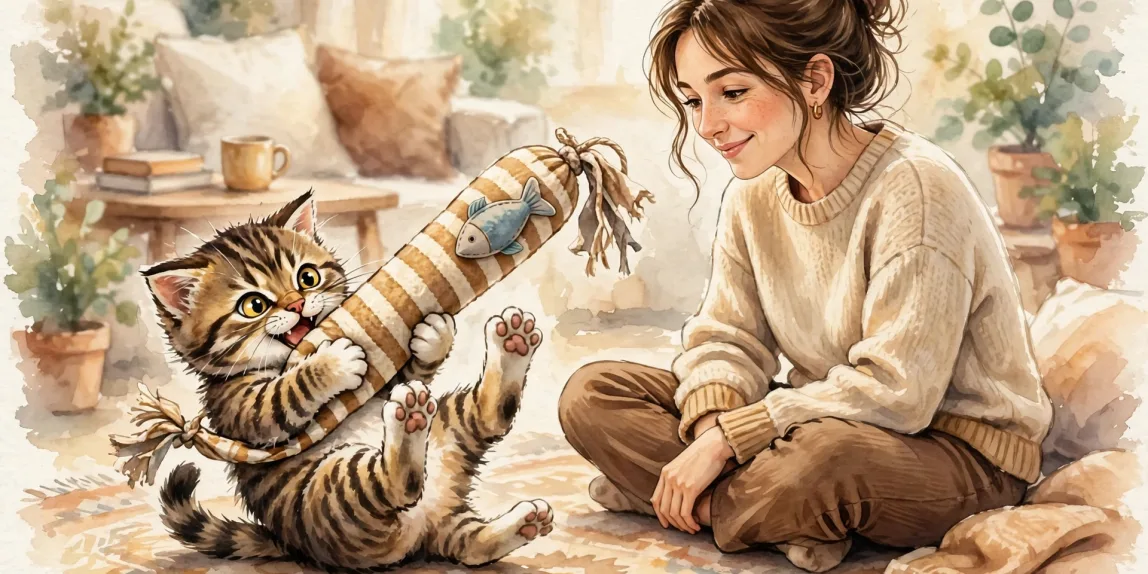
And keep a substitute within arm’s reach. A kicker toy — one of those long stuffed tubes a kitten can hug and rabbit-kick — slid between your arm and the kitten mid-attack teaches the second half of the lesson: biting is fine, and here is what it’s for. Hands are never toys, not even in the cute weeks. Especially not in the cute weeks.
A WORD ABOUT THE SPRAY BOTTLE, SINCE SOMEONE ALWAYS SUGGESTS IT
Ask the internet how to gentle a wild kitten and the first answer you will get is a spray bottle. There is a whole chapter earlier in this book about why scaring a cat straight doesn’t work, and it applies to kittens with interest: the spray teaches the kitten that you are dangerous, and it teaches him precisely nothing about teeth, because a squirt carries no information about what he did — only about who did it to him. The littermate method works better for a simple reason. It is not punishment. It is translation. You are telling him, in his own native language, the one thing his siblings never got to say: too hard, and the game is over.
PROTECT THE OLDER CAT — SHE DID NOT VOLUNTEER AS FACULTY
The second victim in these cases is the resident cat, and she needs defending on principle. A two-year-old cat being used as a sparring dummy by an uneducated kitten is not a teaching assistant; some older cats discipline a kitten beautifully, but the ones who won’t — the patient, the timid, the simply outnumbered — just endure it, and a kitten whose bullying works is a kitten learning that bullying works. Intervene the way you would between children: break it up calmly, remove the kitten, give the elder her territory back. Separate them when nobody is home to referee, and make sure she has rooms, perches, and a litter box the kitten cannot ambush her in. Her dignity is part of the curriculum too — a kitten who learns the old cat is off-limits has learned the most transferable lesson in the book: some creatures are not for wrestling.
DRAIN THE TANK BEFORE HE SPENDS IT ON YOU
Half of kitten terror is just fuel with nowhere to go. A kitten is built to hunt in bursts, and a house offers him exactly two moving targets: the other cat, and you. So schedule the hunting. Two or three real play sessions a day with a wand toy — the kind that makes him stalk, chase, and finally catch — and end each one the way a hunt ends in nature: with a small meal. Hunt, catch, eat, groom, sleep is the oldest sequence in a cat’s wiring, and a kitten played out on that rhythm before bed will sleep like a stone instead of practicing parkour on your chest at 3 a.m. You cannot scold energy out of a kitten. You can only spend it first.
THE SHIRT-NURSING, AND TWO SMALL MERCY JOBS
Expect the suckling. A kitten who nurses on your shirt, your earlobe, or a blanket is running the comfort program of a baby taken from the source too early, and it usually fades as he grows. Offer him a soft blanket of his own to transfer it to, and don’t make a project of stopping him — with one exception. If he is not just nursing fabric but swallowing it, that is pica, and pica is a veterinarian conversation, because cloth in a kitten’s gut is a surgical story nobody wants.
While he is young and forgiving, trim the points off his claws — just the needle tips, well clear of the pink quick — a few at a time, calmly, with treats. A kitten who learns at ten weeks that claw trims are boring will be a cat you can trim for twenty years. And when your vet says he is old enough, neutering is worth doing for all the usual reasons — but know what it will and won’t do. It settles roaming, spraying, and some male bluster. It does not teach manners. Manners are the squeak, the freeze, and the walking away, repeated with love until the knob is built.
Will he calm down? Yes — the thread of every one of these stories bends the same way. The wild kitten of ten weeks becomes the intense young cat of one year and the merely opinionated cat of three. Age does the slow work. But age alone gives you a bigger cat with the same education, and the humans who do the littermate’s job for a few months get there faster and with fewer scars. Teach him gently. He is taking notes with his whole heart.
He isn’t a bad kitten. He’s a kitten whose teachers left early — so the school is you, and the school is small, and the only student adores the teacher. — YNOT!