Think of it as Yoga for the brain, we are going to stretch a bit.
THE FIRST COMMUNE IN THE NEW WORLD — AND WHY IT FAILED A THANKSGIVING STORY THEY DON’T OFTEN TELL YOU
The Pilgrims discovered 400 years ago what politicians are still arguing about today: You can share the harvest, but somebody still has to plant the corn. And when the man doing the planting gets no more than the man doing the watching, sooner or later, everybody goes hungry. -- YNOT!
Every Thanksgiving, Americans gather around a table piled high with turkey, stuffing, mashed potatoes, and pumpkin pie to celebrate a little event that took place more than 400 years ago.
We were taught the familiar story.
The Pilgrims arrived in America, nearly starved, received help from the Indians, and eventually celebrated their survival with a great feast.
All true, more or less.
But there’s another fascinating chapter to this story, one involving a failed communal economic experiment, human nature, and a lesson about incentives that Americans are still debating four centuries later.
And the remarkable thing is that the Pilgrims discovered it long before Karl Marx was even born.
THE PILGRIMS’ GRAND COMMUNAL EXPERIMENT
When the Mayflower arrived in 1620, the Pilgrims weren’t establishing a capitalist paradise where every man owned his own farm.
Quite the opposite.
Their settlement operated under a financial agreement with investors back in England.
Much of the labor, production, and supplies belonged to a common enterprise.
People worked for the community, and provisions were distributed from a common supply.
It wasn’t communism in the modern Marxist sense. That political theory wouldn’t exist for another two centuries. Nor was Plymouth the first settlement in America to experiment with communal labor.
Nevertheless, the economic arrangement had something familiar about it.
The strong worked alongside the weak. The industrious shared the results of their labor with those who produced less.
And everyone was expected to contribute to the common good. It sounded wonderful on paper.
Of course, so do most economic theories before somebody has to get up at sunrise and start digging.
THE PROBLEM WITH SHARING EVERYTHING
Governor William Bradford later described what happened in his history, Of Plymouth Plantation.
The young and physically capable men began complaining.
They were doing much of the hardest work, yet their share of food and other provisions wasn’t necessarily any greater than that of people contributing considerably less.
Married men resented having their wives assigned labor for other households.
And some people became less enthusiastic about working when their additional effort brought little direct benefit to their own families.
Imagine a young farmer spending ten hours cultivating corn while another spends four.
At harvest time, both receive provisions from the same common store.
Now, imagine explaining to the fellow working ten hours why he ought to be delighted about the arrangement.
Bradford discovered that people have an annoying habit of keeping track of who is doing the work.
And when the connection between work and reward becomes too weak, resentment tends to grow.
THE INDIANS ALREADY KNEW HOW TO FEED THEMSELVES
Meanwhile, the Wampanoag people had been living, farming, hunting, fishing, and trading in the region for generations.
They understood the climate, the soil, and the crops.
They knew how to cultivate corn, beans, and squash, preserve food, and survive New England winters.
They also practiced something the English newcomers desperately needed: cooperation.
The Wampanoag helped teach the Pilgrims how to grow unfamiliar crops and provided important assistance during their early struggles.
And yes, the Native Americans traded food and other goods with Europeans.
But here’s an interesting distinction.
Wampanoag communities combined family farming, shared land, trade, and assistance to people who needed help.
They weren’t modern capitalists or communists.
They had developed practical ways to balance family responsibility with community obligations.
Apparently, nobody needed a European economist to explain that people could work for themselves and still help their neighbors.
THE FIRST THANKSGIVING — 1621
By the autumn of 1621, after surviving a devastating first winter, the Pilgrims had managed a successful harvest.
They celebrated with a feast lasting three days.
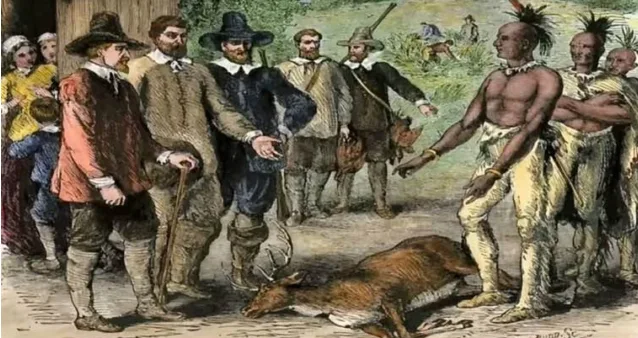
The Wampanoag leader Massasoit, also known as Ousamequin, arrived with approximately 90 men.
The Wampanoag contributed five deer, while the colonists supplied wildfowl and other food.
It was a celebration of survival, harvest, and an uneasy but important alliance between two peoples.
And it happened while Plymouth was still operating under its communal economic arrangement.
That detail matters.
The famous 1621 feast did not celebrate the abandonment of communal farming. That change was still two years away.
But the colony continued struggling with food shortages, uncertain supplies, difficult weather, and the challenges of growing food in an unfamiliar environment.
The Pilgrims had survived.
They had not yet solved all their economic problems.
THEN CAME 1623 — AND EVERYTHING CHANGED
By 1623, Bradford and the colony’s leadership had become increasingly concerned about agricultural production.
The common labor arrangement wasn’t producing the results they needed.
So Bradford tried something different.
Instead of organizing corn cultivation primarily as a communal effort, he assigned individual families particular plots of land to farm for their own benefit.
These were initially rights to use the land, not permanent private ownership.
Nevertheless, the change gave families a much more direct connection between their labor and their harvest.
And according to Bradford, the results were remarkable.
More corn was planted.
People became more industrious.
Families worked their fields with greater enthusiasm.
Bradford even observed that women who had previously resisted certain agricultural duties willingly went into the fields with their children.
Imagine that!
Give people a more direct reward for their efforts, and suddenly they discover enthusiasm for getting up in the morning.
Bradford wasn’t conducting a modern scientific experiment, and Plymouth still faced a serious drought in 1623.
But his observations were clear enough.
Changing the incentives improved the colony’s willingness to cultivate corn.
The Pilgrims had discovered something that every businessman, farmer, and employee understands.
People generally work harder when they have a meaningful stake in the results.
WHY DID THE COMMUNAL SYSTEM FAIL?
The important issue wasn’t that the Pilgrims hated one another or refused to help their neighbors.
Quite the opposite. These were deeply religious people who believed in cooperation, charity, duty, and mutual assistance.
But Bradford believed their system had created several economic problems.
First, productive workers resented receiving little additional reward for their greater efforts.
Second, the arrangement weakened individual incentives to increase production.
Third, disputes arose over how work and provisions were distributed.
And finally, the colony’s leaders found themselves trying to manage everyone’s labor instead of allowing families greater responsibility for their own production.
Sound familiar?
Bradford concluded that communal arrangements could create dissatisfaction even among people committed to religious duty and cooperation.
In other words, good intentions didn’t automatically produce good economic results.
THE IMPORTANT DISTINCTION BETWEEN SHARING AND COMMUNAL PRODUCTION
Now, this doesn’t mean the Pilgrims abandoned cooperation.
They continued working together in many areas, including defense and other community activities.
And the Wampanoag demonstrated that shared resources and assistance to neighbors could coexist with family responsibility.
The lesson wasn’t that charity was bad.
The lesson was that organizing all production around a common system could create problems when effort and reward became disconnected.
There’s a difference between helping your neighbor because he needs help and designing an economic system that gives your neighbor no additional reason to produce.
One is generosity.
The other can become an incentive problem.
AND WHAT DOES THIS HAVE TO DO WITH SOCIALISM TODAY?
Quite a bit, although we should be careful about pretending that a seventeenth-century farming arrangement was identical to a modern socialist economy.
Different economic systems have different rules governing ownership, wages, incentives, and distribution.
But the underlying question remains remarkably familiar.
How do you encourage people to produce while ensuring that those who genuinely need assistance are not abandoned?
How much should individuals retain from their own work?
How much should be shared?
And who gets to decide?
These questions didn’t begin with Marx, Lenin, or modern American politics.
They were already being debated in a struggling English settlement in Massachusetts four centuries ago.
THANKSGIVING — THE LESSON WE SHOULD REMEMBER
Every Thanksgiving, we celebrate the Pilgrims’ survival and the harvest they shared with the Wampanoag.
We should also remember what happened afterward.
The colony experimented with communal agricultural labor, encountered serious problems, and changed its approach.
The Wampanoag had already developed systems combining family production, communal resources, and trade.
And both histories remind us that cooperation and individual responsibility need not be enemies.
Perhaps there’s a lesson worth remembering when Americans argue about capitalism and socialism over Thanksgiving dinner.
A society needs people willing to help their neighbors. But it also needs people willing to plant the corn. And if you want more corn next year, you had better give the fellow doing the planting a good reason to keep planting.
Because no matter how beautifully you explain your economic theory, when winter arrives, nobody can eat a political promise.