Think of it as Yoga for the brain, we are going to stretch a bit.
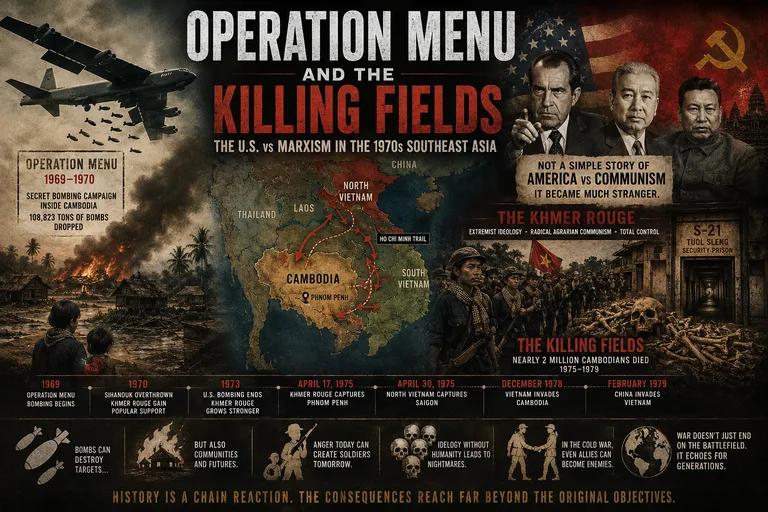
Operation Menu and the Killing Fields
The U.S. vs. Marxism in 1970s Southeast Asia
History is rarely as simple as the slogans used to fight it. -- YNOT!
In the 1960s and 1970s, American foreign policy in Southeast Asia was built around one overriding fear:
Communism was spreading. China had fallen to Mao in 1949. North Vietnam was communist. Communist insurgencies existed throughout Southeast Asia.
The Soviet Union and Communist China were supplying revolutionary movements with weapons, money, training and political support.
Washington feared that if South Vietnam fell, Cambodia, Laos, Thailand and perhaps other countries would eventually follow.
This became known as the Domino Theory.
And for more than a decade, the United States poured troops, aircraft, money and firepower into Southeast Asia attempting to stop those dominoes from falling.
But Cambodia demonstrates how complicated—and dangerous—that strategy became.
What started as an American effort to destroy Vietnamese communist sanctuaries inside Cambodia contributed to the destabilization of an already fragile country.
That instability helped create conditions in which one of the most radical communist movements in history could grow.
That movement became the Khmer Rouge. Its victory produced the Killing Fields.
Then, in one of the great geopolitical ironies of the Cold War, the Khmer Rouge was eventually destroyed not by the United States— but by another communist country.
Vietnam.
And Communist China responded by invading Communist Vietnam.
By the end, the struggle was no longer simply:
Capitalism vs. Communism. It had become:
America vs. North Vietnam.
China vs. the Soviet Union.
Cambodia vs. Vietnam.
Communist vs. Communist.
Nationalism vs. ideology.
And millions of ordinary people were caught in the middle.
Cambodia Was Supposed to Be Neutral
During much of the Vietnam War, Cambodia officially attempted to remain neutral.
Its ruler, Prince Norodom Sihanouk, tried to navigate between the United States, China, North Vietnam and South Vietnam without allowing Cambodia to become another battlefield.
But neutrality on paper did not mean neutrality on the ground.
North Vietnamese Army and Viet Cong forces established bases, supply depots and sanctuary areas inside eastern Cambodia.
They could cross from South Vietnam into Cambodia, regroup, obtain supplies and then return to fight American and South Vietnamese forces.
The famous Ho Chi Minh Trail was not simply one road through Vietnam. It was a vast logistical network extending through Laos and portions of Cambodia.
From the American military perspective, this created a serious problem.
U.S. soldiers were fighting an enemy that could cross an international border into territory American forces were officially reluctant to attack.
President Richard Nixon decided that had to change.
Operation Menu
On March 18, 1969, American B-52 bombers attacked North Vietnamese and Viet Cong base areas inside Cambodia.
The operation was secret.
Its name was Operation Menu.
Even the individual target areas received food-related code names:
Breakfast
Lunch
Snack
Dinner
Dessert
Supper
It sounded almost humorous.
There was nothing humorous about what the names represented.
Strategic B-52 bombers were dropping enormous quantities of explosives on communist sanctuary areas inside another country.
Operation Menu continued until May 26, 1970.
According to the official U.S. Department of Defense historical record, B-52s flew 3,875 Menu sorties and dropped 108,823 tons of ordnance on the six Cambodian base areas. (Defense Historical Office)
And the secrecy went remarkably far. The Pentagon used a dual reporting system.
Missions could officially appear to have targeted locations in South Vietnam while the aircraft actually bombed Cambodia. Separate highly restricted records documented the real targets.
Secretary of Defense Melvin Laird later said that he supported attacking the communist sanctuaries but disagreed with Nixon and Henry Kissinger about keeping the campaign secret because he believed the administration should defend the decision publicly before Congress and the American people. (Defense Historical Office)
This is an important distinction. The military justification was not imaginary.
North Vietnamese and Viet Cong forces really were operating inside Cambodia.
The controversy was over whether the United States had the legal and political authority to secretly expand the war into Cambodian territory—and what consequences would follow.
Then Cambodia Exploded Politically
In March 1970, while Prince Sihanouk was outside the country, Cambodia’s National Assembly removed him from power.
General Lon Nol emerged as the dominant figure of the new Cambodian government.
This changed everything.
Sihanouk had previously fought Cambodia’s communists.
Now, furious over his removal, he allied himself with them.
From exile, the enormously popular former ruler encouraged Cambodians to resist Lon Nol.
For the Cambodian communists, this was an extraordinary political gift.
A rural Cambodian peasant might not know much about Marx, Lenin or Mao.
But he knew who Prince Sihanouk was.
Now Sihanouk was telling Cambodians to join the resistance.
The small Cambodian communist movement suddenly had the prestige of the former king behind it.
At the same time, North Vietnamese forces fought Lon Nol’s army and helped expand communist-controlled territory.
Cambodia descended into civil war.
The Khmer Rouge
The Cambodian communist movement eventually became universally known as the Khmer Rouge—“Red Khmer.”
At its center was a secretive revolutionary named Saloth Sar.
The world would know him as: Pol Pot.
Pol Pot and his inner circle had developed an extraordinarily radical interpretation of communism.
They were influenced by: Marxism-Leninism. Maoism, peasant revolution, Cambodian nationalism, anti-colonialism, and intense suspicion of Vietnam and foreign influence.
Their objective was not simply to nationalize some industries or redistribute wealth.
They wanted to reconstruct Cambodian society from the ground up.
Cities, capitalism, markets, private property, religion, class distinctions and much of traditional social life would eventually be eliminated.
Cambodia would become an enormous self-sufficient agricultural collective.
But in the early 1970s, most Cambodians did not yet know what the Khmer Rouge would become.
They knew that there was a civil war.
They knew Lon Nol’s government was struggling.
They knew foreign armies were fighting on Cambodian soil.
And they knew American bombers were overhead.
The Bombing Gets Much Bigger
Operation Menu ended in May 1970.
The bombing of Cambodia did not.
After Menu came a much broader American air campaign, including operations associated with Freedom Deal.
By 1973, American airpower was increasingly being used not merely against North Vietnamese sanctuary areas but to support the Cambodian government against the advancing Khmer Rouge.
Exactly how much ordnance was dropped over Cambodia throughout the entire war has produced considerable historical debate because different military databases and methodologies have produced different totals.
What is not seriously disputed is the scale.
Hundreds of thousands of tons of American bombs fell on Cambodia.
The countryside suffered enormous destruction.
Villages were damaged or destroyed.
Civilians died.
Families fled toward cities.
Agricultural production was disrupted.
And the Cambodian countryside became increasingly radicalized.
Did American Bombing Create the Khmer Rouge?
This question deserves a careful answer.
No.
The United States did not invent the Khmer Rouge.
Cambodian communism existed before Operation Menu.
Pol Pot was already a communist revolutionary.
North Vietnam provided enormous early military assistance.
China later became the Khmer Rouge’s principal arms supplier.
Sihanouk’s overthrow and subsequent alliance with the insurgency was enormously important.
Lon Nol’s government suffered from corruption, political weakness and military problems.
Cambodia had become a battlefield in the larger Vietnam War.
There were many causes.
But there is substantial evidence that American bombing became an extraordinarily useful recruiting tool for the Khmer Rouge.
A U.S. intelligence report from 1973 described Khmer Rouge cadres using destruction caused by B-52 strikes as a central propaganda theme while recruiting young Cambodians.
They told villagers:
Look at your destroyed homes.
Look at the bomb craters.
Look at the people who died.
Lon Nol brought the Americans here.
Join us and stop the destruction.
Contemporary intelligence found that the message was effective. (Encyclopedia.com)
This is one of the cruel paradoxes of counterinsurgency.
You can destroy an enemy military position—
and simultaneously create another enemy.
A farmer who had never read Marx could become a revolutionary because his village had just been bombed.
That does not mean the bombing alone caused the Khmer Rouge victory.
It means warfare can produce political consequences very different from the military objective.
By 1973, the Khmer Rouge Had Become a Serious Army
In 1970, Cambodian communist forces were still heavily dependent upon North Vietnam.
That changed quickly.
The Khmer Rouge grew in numbers, territory and military capability.
By the end of 1972, most North Vietnamese combat forces had withdrawn from Cambodia, while China increasingly became the Khmer Rouge’s principal supplier of weapons. (United States Holocaust Memorial Museum)
This is important because the Cambodian revolution was becoming increasingly independent of Vietnam.
And increasingly hostile toward it.
The communist world itself was dividing.
The Soviet Union and China were bitter rivals.
Vietnam was moving increasingly toward Moscow.
The Khmer Rouge moved increasingly toward Beijing.
Behind what Americans casually called “Communism” were movements that sometimes hated one another almost as much as they hated the United States.
1975 — The Dominoes Fall
Then came one of the most extraordinary months in Cold War history.
On April 17, 1975, the Khmer Rouge captured Phnom Penh, Cambodia’s capital.
Thirteen days later—
on April 30, 1975—
North Vietnamese forces captured Saigon.
South Vietnam ceased to exist.
Later that year, the communist Pathet Lao completed its takeover of Laos.
Within months, the political map of Indochina had changed dramatically.
For Americans who had spent twenty years hearing about the Domino Theory, it appeared that the dominoes had finally fallen.
South Vietnam — Communist.
Cambodia — Communist.
Laos — Communist.
But what happened next proved how misleading that simple picture was.
April 17, 1975 — Phnom Penh Celebrates
When Khmer Rouge soldiers entered Phnom Penh, many residents initially celebrated.
The civil war was finally over.
No more artillery.
No more bombing.
No more fighting.
Peace had arrived.
Except it hadn’t.
Within hours, Khmer Rouge troops ordered the evacuation of the city.
Not some neighborhoods.
Not military areas.
The entire city.
Phnom Penh had swollen to perhaps two million people because refugees had poured into the capital during the war.
Now virtually all of them were ordered into the countryside.
Hospitals were emptied.
Patients were taken from beds.
The elderly walked alongside children.
Families carried whatever possessions they could.
Some were told the Americans were going to bomb Phnom Penh and they would return in a few days.
They never returned.
The evacuation was not temporary.
It was the beginning of a revolutionary experiment.
The Khmer Rouge intended to erase the old Cambodia and build another one.
The Revolution Begins
The country was renamed:
Democratic Kampuchea.
Money disappeared.
Banks ceased functioning.
Markets were abolished.
Private businesses disappeared.
Private property was largely eliminated.
Schools closed.
Religion was suppressed.
Buddhist monks were persecuted and monasteries closed or repurposed.
People were organized into agricultural collectives.
Urban residents were sent into rural labor brigades.
Families were frequently separated.
Food was controlled by the revolutionary organization.
Individual life became subordinate to what the Khmer Rouge called Angkar—“the Organization.”
The objective was an agrarian communist society purified of capitalism, foreign influence and the social structure of the old Cambodia.
The consequences were catastrophic.
The Enemy Was Everywhere
Revolutionary governments frequently begin by identifying enemies.
The Khmer Rouge eventually discovered enemies everywhere.
Former Lon Nol soldiers.
Former government officials.
Police officers.
Teachers.
Doctors.
Business owners.
Intellectuals.
Buddhist monks.
Ethnic Vietnamese.
Cham Muslims.
People who spoke foreign languages.
People who had traveled abroad.
People suspected of having connections with the CIA.
People suspected of connections with Vietnam.
Then something even more frightening happened.
The Khmer Rouge began purging themselves.
Regional party leaders were accused of treason.
Military commanders disappeared.
Cadres were accused of being Vietnamese agents.
Confessions produced new names.
Those people were arrested.
Their confessions produced still more names.
The revolution began consuming its own revolutionaries.
S-21
The most infamous symbol of this system was Security Prison 21—S-21.
It operated inside a former school in Phnom Penh.
Today it is the Tuol Sleng Genocide Museum.
Prisoners were photographed when they arrived.
They were interrogated.
They were tortured.
They were forced to confess to elaborate conspiracies that frequently did not exist.
A prisoner might eventually confess that he had worked for:
the CIA
the KGB
Vietnam
or some imaginary network of spies.
The objective was not necessarily to discover the truth.
The system assumed guilt.
The interrogation created the story required to justify it.
Prisoners were eventually transported to execution sites such as Choeung Ek, one of the places that became known collectively as:
The Killing Fields.
The Killing Fields
The name can create the impression that most Khmer Rouge victims were marched into fields and executed.
Many were.
But the true horror was broader.
Cambodians died from:
execution
starvation
disease
exhaustion
forced labor
malnutrition
torture
and the deliberate destruction of normal social and medical systems.
People worked extraordinary hours while receiving inadequate food.
Agricultural quotas were often unrealistic.
Food could be produced in an area while the workers producing it starved.
Modern medicine was distrusted.
People weakened by hunger became vulnerable to diseases that would otherwise have been survivable.
The United States Holocaust Memorial Museum estimates that nearly two million people died during the three years, eight months and twenty days of Khmer Rouge rule—at least about one-quarter of Cambodia’s population. (United States Holocaust Memorial Museum)
Imagine that.
Not one person in a thousand.
Not one in a hundred.
Approximately:
One out of every four Cambodians.
Dead.
Was It Genocide?
The term Cambodian Genocide is commonly and appropriately used, but there is an important legal distinction.
Much of the Khmer Rouge’s killing was directed against political or social categories:
former government officials, alleged class enemies, intellectuals, suspected traitors and other supposedly undesirable people.
Those acts constituted enormous crimes against humanity, including murder, extermination, enslavement, torture, persecution and forced population transfer.
The Khmer Rouge also deliberately targeted ethnic and religious groups.
Later internationalized Cambodian tribunals found Khmer Rouge leaders responsible for genocide against ethnic Vietnamese and, in relevant proceedings, the Cham Muslim population, along with extensive crimes against humanity. (ECCC)
So the precise historical description is:
The Khmer Rouge committed genocide, crimes against humanity, war crimes and mass political killing.
Then the Communists Went to War With Each Other
This is the point where the simplistic Cold War narrative completely collapses.
The Khmer Rouge was communist.
Vietnam was communist.
They should have been allies.
They weren’t.
The Khmer Rouge leadership was fiercely nationalist and increasingly hostile toward Vietnam.
Cambodian and Vietnamese communists had long-standing political disagreements.
There were also centuries of historical tension between Cambodia and Vietnam.
And now the international communist world had split into competing camps:
China backed Cambodia.
The Soviet Union backed Vietnam.
The Khmer Rouge launched increasingly violent attacks across the Vietnamese border.
Vietnam eventually decided Pol Pot’s government had to be removed.
In December 1978, the Vietnamese army invaded Cambodia.
The Khmer Rouge military collapsed with astonishing speed.
On January 7, 1979, Vietnamese forces entered Phnom Penh.
The regime responsible for the Killing Fields had been overthrown.
But the Cold War produced another extraordinary twist.
China Invades Vietnam
China was Pol Pot’s most important international supporter.
Vietnam had become closely aligned with the Soviet Union.
So when Vietnam invaded Cambodia and removed China’s ally—
China retaliated.
On February 17, 1979, Chinese forces crossed the Vietnamese border.
Now consider what had happened.
Only a few years earlier, Americans had been told that Southeast Asia was a struggle between:
The Free World and Communism.
By 1979:
Communist Vietnam had invaded Communist Cambodia.
Then:
Communist China invaded Communist Vietnam.
Meanwhile:
the Communist Soviet Union supported Vietnam.
The ideological map had become almost meaningless without understanding nationalism and great-power politics.
Even the Carter administration’s internal documents described the situation as simultaneously involving the Vietnamese invasion of Cambodia and the Chinese invasion of Vietnam, while Washington sought withdrawal of both forces. (Office of the Historian)
That tells you something fundamental about the Cold War:
Marxism did not erase nationalism.
Cambodia was still Cambodia.
Vietnam was still Vietnam.
China was still China.
The Soviet Union was still pursuing Soviet interests.
Ideology mattered.
But power mattered too.
And Pol Pot Survived
Vietnam destroyed the Khmer Rouge government.
It did not immediately destroy the Khmer Rouge movement.
Pol Pot and surviving forces retreated toward the Thai border and continued guerrilla warfare.
And now another extraordinary geopolitical reversal occurred.
Because Vietnam was aligned with the Soviet Union, China and several Western and regional governments opposed Vietnam’s occupation of Cambodia.
The diplomatic struggle over Cambodia therefore continued for years.
This produced one of the ugliest ironies of Cold War politics:
the regime that had actually stopped the Killing Fields was Vietnam—the country the United States had spent years fighting.
Meanwhile the international struggle over who legitimately represented Cambodia continued long after Pol Pot’s government had collapsed.
The Cold War did not produce clean heroes and villains organized neatly by ideology.
It produced alliances based upon:
“The enemy of my enemy may temporarily be useful.”
Pol Pot Never Faced an International Trial
Pol Pot survived for almost another twenty years.
He died in 1998 while still in former Khmer Rouge territory.
He never stood before an international court for the destruction of Cambodia.
Justice came slowly.
The Extraordinary Chambers in the Courts of Cambodia, created with Cambodian and United Nations involvement, eventually prosecuted surviving senior Khmer Rouge figures.
Among them:
Kaing Guek Eav — “Duch”
Commander of S-21.
Nuon Chea — “Brother Number Two”
One of Pol Pot’s most important deputies.
Khieu Samphan
Head of state of Democratic Kampuchea.
Senior leaders were eventually convicted of crimes including crimes against humanity, grave breaches of the Geneva Conventions and genocide. (ECCC)
But decades had passed.
Many perpetrators and victims were already dead.
So Did America Cause the Killing Fields?
This question is often turned into a political slogan.
One side says:
“Nixon and Kissinger created the Khmer Rouge.”
The other says:
“America had nothing to do with what happened.”
Neither explanation is adequate.
The Khmer Rouge was responsible for the Khmer Rouge’s crimes.
Pol Pot and his leadership deliberately created the political system that produced mass starvation, forced labor, executions and genocide.
North Vietnam played an important role in the Cambodian civil war.
China armed and supported the Khmer Rouge.
Sihanouk’s alliance with the insurgency helped legitimize it.
The overthrow of Sihanouk destabilized the political system.
Lon Nol’s government had enormous weaknesses.
Cambodia’s own communist movement already existed.
All of that matters.
But it is equally difficult to argue that dropping enormous quantities of explosives on a rural society undergoing civil war had no political consequences.
American bombing killed civilians, displaced populations and created anger that Khmer Rouge recruiters deliberately exploited.
The historical lesson is therefore more complicated:
America did not create Pol Pot.
But American intervention became part of the environment in which Pol Pot was able to rise.
Those are two very different statements.
Both can be true.
The Bigger Lesson — Wars Create Things Nobody Planned
Richard Nixon did not order Operation Menu because he wanted the Khmer Rouge to rule Cambodia.
The objective was almost exactly the opposite.
He wanted to weaken communist forces.
The B-52 crews were not flying missions intending to create a genocidal government.
They were attempting to destroy North Vietnamese and Viet Cong bases that were being used in a real war against American forces.
Yet military actions exist inside political systems.
Destroying a military base can make tactical sense.
Destroying the village beside it can create twenty new recruits.
Removing one government can empower another faction.
Supporting today’s ally can produce tomorrow’s enemy.
And ideological labels can hide national interests that eventually tear alliances apart.
The Great Irony of Southeast Asia
America spent enormous resources attempting to prevent communist domination of Southeast Asia.
Then America withdrew.
South Vietnam fell.
Cambodia fell.
Laos fell.
For a moment, it appeared that the communist world had won.
But only four years later:
Cambodian communists were killing Vietnamese.
Vietnamese communists invaded Cambodia.
Chinese communists invaded Vietnam.
Soviet communists backed Vietnam against China.
The supposedly monolithic communist threat was tearing itself apart.
The Cold War had never really been one war.
It was dozens of wars layered on top of one another:
colonial wars
civil wars
national liberation wars
ethnic conflicts
communist revolutions
superpower proxy wars
ancient territorial rivalries
and struggles for political power.
The United States viewed much of this through the lens of stopping Marxism.
China viewed it through Chinese strategic interests.
The Soviet Union viewed it through Soviet strategic interests.
Vietnam pursued Vietnamese interests.
Pol Pot pursued his own revolutionary vision of Cambodia.
And ordinary Cambodian villagers had almost no control over any of it.
From Operation Menu to the Killing Fields
Operation Menu began with a military question:
How do you attack an enemy that hides across a border?
The answer seemed simple.
Bomb the sanctuaries.
But Cambodia reminds us that there are rarely simple answers once a great power enters another country’s civil conflict.
The bombs became part of the political story.
The political crisis became a civil war.
The civil war strengthened extremists.
The extremists won.
The revolution became a nightmare.
Nearly two million Cambodians died.
Then the communist neighbors who were supposedly part of the same global movement went to war with one another.
That is what makes Cambodia more than a story about Nixon, Kissinger, Pol Pot or even the Vietnam War.
It is a warning about the limits of military power.
You can know where a bomb will land.
You cannot always know where history will go after it explodes.
MMT Final Thought
The lesson of Cambodia is not that America was solely responsible for the Killing Fields.
It wasn’t.
Nor is the lesson that American actions were irrelevant.
They weren’t.
The real lesson is more uncomfortable:
History is a chain reaction.
A decision made in Washington affects a village in Cambodia.
The destruction of that village affects whom a young farmer chooses to support.
That farmer becomes a soldier. That army changes a government.
That government attacks another country.
That country invades. Another superpower responds.
And ten years after the original decision, the world may bear almost no resemblance to what the people who made that decision expected.
Operation Menu was intended to contain a war. Instead, Cambodia became another battlefield. And when the smoke finally cleared, the conflict had traveled from secret B-52 strikes— to civil war— to communist revolution— to the Killing Fields— to genocide— to Vietnam’s invasion of Cambodia— and finally to China’s invasion of Vietnam.
That was Southeast Asia in the 1970s. Not simply America versus Marxism.
But a demonstration of what happens when ideology, nationalism, civil war and superpower politics collide.
What Is a Proxy War?
A proxy war occurs when major powers compete indirectly by financing, arming, training, advising or otherwise supporting opposing governments, armies or insurgent movements rather than formally declaring war on each other. During the Cold War, this allowed nuclear powers such as the United States, Soviet Union and Communist China to fight for influence without necessarily risking a direct great-power war. The local participants were not simply puppets—they had their own governments, ideologies, ethnic conflicts and national ambitions—but outside weapons, money and political support could dramatically increase the size and duration of their wars. Southeast Asia became one of the clearest examples. Beginning around 1950, the United States and the newly established People’s Republic of China repeatedly found themselves supporting opposing sides across Indochina. In some cases, such as Korea and Vietnam, the confrontation went beyond a traditional proxy war because American or Chinese forces became directly involved.
U.S.–China Proxy-War Timeline
1950–1954 — First Indochina War
U.S. → France and the anti-communist Associated States China → Ho Chi Minh and the Viet Minh
This may actually be the earliest major U.S.–Communist China proxy confrontation. By 1950, Communist China was providing the Viet Minh with matériel, training and technical assistance, while the United States began supplying military assistance to French and allied forces fighting them. Washington increasingly saw the conflict not simply as a colonial war but as an effort to prevent Communist China’s influence from spreading southward into Southeast Asia.
Result: The French were defeated at Dien Bien Phu in 1954, Vietnam was temporarily divided, and the conflict evolved into the Vietnam War.
1950–1953 — Korean War
U.S. / United Nations → South Korea China + Soviet assistance → North Korea
Korea initially had characteristics of a proxy conflict, but it quickly became something much more dangerous. After U.S.-led forces advanced toward the Chinese border, hundreds of thousands of Chinese troops entered Korea and fought American forces directly. For that reason, Korea cannot accurately be described as a pure proxy war—it became an actual U.S.–China shooting war conducted without a formal declaration of war between Washington and Beijing. U.S. Army history describes China and the Soviet Union as North Korea’s Cold War supporters and the United States and its UN allies as the opposing coalition.
Result: Armistice in 1953; Korea remained divided.
1955–1975 — Vietnam War
U.S. → South Vietnam China + Soviet Union → North Vietnam
This became the largest indirect confrontation between the United States and Communist China after Korea. China supplied North Vietnam with weapons, food, machinery, construction material and other assistance while the United States increasingly supplied—and eventually directly defended—South Vietnam. By 1972, American records show that Chinese military aid to Hanoi had become comparable in value to Soviet military assistance during some periods.
But there was an important difference from Korea: China deliberately avoided sending its main combat forces against American forces in Vietnam, partly because Beijing did not want another direct U.S.–China war. Zhou Enlai told the Nixon administration that China would continue assisting Hanoi but would not enter the war directly unless China itself was attacked.
Result: Saigon fell on April 30, 1975, and Vietnam was unified under Communist control.
1960s–1975 — The Secret War in Laos
U.S. / CIA → Royal Lao Government and Hmong forces North Vietnam / Pathet Lao → supported by China and the Soviet bloc
Laos was perhaps an even more literal example of proxy warfare. The CIA secretly trained and armed indigenous forces while North Vietnamese forces and the Pathet Lao operated on the opposing side. American intelligence documents actually described the struggle in Laos as “the contest in Laos has been by proxy.” China and the Soviet Union supported the communist side, although North Vietnam was the dominant outside military actor.
Result: The Pathet Lao took control of Laos in 1975.
1970–1975 — Cambodian Civil War
U.S. → Lon Nol government China → Khmer Rouge North Vietnam → initially major military support for Cambodian communists
Cambodia became another U.S.–China proxy battleground. Washington supplied Lon Nol’s anti-communist government with weapons, money and air support. The Khmer Rouge initially depended heavily upon North Vietnamese forces, but by the end of 1972 most North Vietnamese combat troops had withdrawn and China became the Khmer Rouge’s principal source of weapons. The United States ultimately provided about $1.6 billion in civilian and military assistance to Lon Nol’s government.
This is where Operation Menu and the later American bombing campaign fit into the larger U.S.–China struggle for influence in Southeast Asia.
Result: The Khmer Rouge captured Phnom Penh on April 17, 1975. The Killing Fields followed.
1978–1979 — The Alliances Turn Upside Down
Then something remarkable happened.
The U.S.–China proxy rivalry in Southeast Asia largely reversed itself.
China → Khmer Rouge / anti-Vietnamese Cambodian forces
Soviet Union → Vietnam
Vietnam invaded Cambodia in December 1978 and overthrew the Chinese-backed Pol Pot regime. China retaliated by invading northern Vietnam in February 1979. American intelligence described Indochina as divided into two camps: China backing Cambodia and the Soviet Union backing Vietnam and Laos.
But now the United States increasingly shared China’s objective of containing Soviet-backed Vietnam.
The former adversaries were beginning to find themselves on the same side.
1979–1989 — Afghanistan: Former Enemies Become Partners
U.S. + China + Pakistan → Afghan Mujahideen Soviet Union → Communist Afghan government
By the time the Soviet Union invaded Afghanistan in December 1979, the transformation was extraordinary.
The United States and Communist China—the two countries that had fought each other in Korea and supported opposing sides across Indochina—were now cooperating against the Soviet Union.
Declassified State Department documents explicitly describe common U.S. and Chinese objectives in opposing Soviet actions in Afghanistan.
So within thirty years, the geopolitical alignment had gone from:
1950s 🇺🇸 United States VS. 🇨🇳 Communist China
to:
1980s 🇺🇸 United States + Communist China VS. ☭ Soviet Union
The Larger Pattern
Seen as a timeline, the wars of Southeast Asia tell a much bigger story than simply “America versus Communism.”
1950 — U.S. and China begin backing opposing sides in Indochina.
1950 — Chinese and American soldiers fight each other directly in Korea.
1960s — China supports North Vietnam while America supports South Vietnam.
1960s — Laos becomes a secret proxy battlefield.
1970 — America supports Lon Nol while China increasingly supports the Khmer Rouge.
1975 — South Vietnam, Cambodia and Laos all fall to communist movements.
1978 — Communist Vietnam invades Communist Cambodia.
1979 — Communist China invades Communist Vietnam.
1979–1980s — The United States and Communist China cooperate against the Soviet Union.
The lesson is that the Cold War was never simply capitalism versus Marxism.
It was also a struggle over national power, territory, regional influence and competing alliances.
The United States spent much of the 1950s and 1960s treating Communist China, the Soviet Union, North Vietnam and other communist movements as parts of a single worldwide threat.
By the end of the 1970s, those supposedly unified communist powers were fighting one another, while the United States was beginning to cooperate with the very Communist China it had spent decades trying to contain.
And now the switcheroo may happen again, but that is a story for another time.