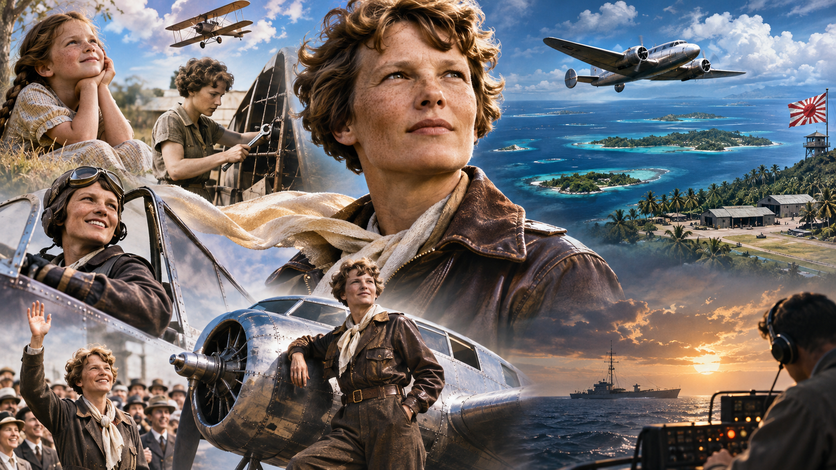
Think of it as Yoga for the brain, we are going to stretch a bit.
Amelia Earhart — The Girl Who Wanted to Fly – The American Dream
She had a dream to Fly -- She Conquered the Skies, and Disappeared Into One of History's Greatest Mysteries and one most people today never heard of -- YNOT!
There is something extraordinary about the American Dream.
Sometimes it begins with a young immigrant arriving in America with nothing but ambition. Sometimes it begins with a young entrepreneur working in a restaurant, dreaming about creating something that doesn’t yet exist.
And sometimes it begins with a little girl in Kansas who looks up at the sky and decides that someday she is going to fly.
Not ride in an airplane. Not sit in the back while someone else flies.
She wants to be the pilot back in the turn of the last centuary.Her name was Amelia Earhart.
Let’s put it in perspective – in 1920 she had her first flight as a passenger and solo at age 24 in 1921. There were only 8 women pilots and she was one of them.
She didn’t complain and about women’s rights, she did something about it.
And she would become one of the most extraordinary women of the twentieth century.
She would challenge nearly every convention of her time, break aviation records, become an international celebrity, and inspire millions of young women to pursue careers they had previously been told were not meant for them.
But her greatest ambition would also lead to her disappearance.
And nearly ninety years later, we are still trying to understand exactly what happened.
Because there is another side to Amelia Earhart’s story.
A mysterious side involving the United States government, President Franklin Roosevelt, Japanese-controlled islands, possible intelligence gathering, and an airplane that vanished over the Pacific Ocean.
But before we get to that mystery, we need to understand the little girl who started it all.
1897 — A Little Girl in Kansas Who Refused to Be Ordinary
Amelia Mary Earhart was born on July 24, 1897, in Atchison, Kansas.
America was a very different country.
Women couldn’t vote in national elections. Their professional opportunities were limited, and few were encouraged to pursue engineering, science, or the growing field of aviation.
In fact, when Amelia was born, the Wright brothers had not yet made their historic powered flight at Kitty Hawk.
That wouldn’t happen until 1903. Think about that.
Amelia Earhart was born into a world where powered airplanes had not yet become a reality.
Her family was relatively comfortable during her early childhood, but that stability wouldn’t last.
Her father, Edwin Earhart, worked in the railroad industry. His struggles with alcoholism and the family’s financial difficulties eventually disrupted their lives.
The family moved repeatedly, and Amelia attended several different schools.
She and her younger sister, Muriel, spent considerable time with their grandparents.
Amelia was not what people in those days would have called a proper little lady.
She climbed trees, explored the outdoors, played sports, and enjoyed mechanical contraptions.
She was fascinated by adventure. She even kept a scrapbook of newspaper articles about women accomplishing extraordinary things in fields normally dominated by men.
Engineers. Scientists. Doctors. Businesswomen.
Amelia was collecting examples of what women could accomplish long before she understood what she herself would become.
And here’s something interesting.
When she first saw an airplane at approximately ten years old, she wasn’t particularly impressed.
The early flying machines looked like collections of wooden sticks, wires, and fabric.
They were noisy, awkward, and frequently dangerous.
But something changed as she grew older.
And that change would determine the rest of her life.
1918–1920 — The Day She Discovered the Sky
During World War I, Amelia left school and went to Toronto, Canada, where she volunteered as a nurse’s aide at a military hospital.
She helped care for wounded and recovering soldiers.
It was there that she began seeing airplanes more frequently.
Military aviation was rapidly developing.
Aircraft that had been little more than experimental machines just a few years earlier were now being used for reconnaissance, combat, and transportation.
Amelia watched pilots perform at flying exhibitions.
She became fascinated. But fascination is one thing.
An obsession is something else.
On December 28, 1920, while living in California, Amelia took her first airplane ride with a pilot named Frank Hawks.
She was twenty-three years old. The flight lasted only a few minutes.
But those few minutes changed everything. She later recalled:
“As soon as I left the ground, I knew I myself had to fly.”
That was it. She had found her purpose.
Now came the problem. Flying was expensive.
Flight schools were uncommon. And the aviation industry was overwhelmingly male.
But Amelia didn’t have the money or the connections to make it easy.
So she did something that should sound familiar to anyone who has ever tried to build a business or follow an ambitious dream.
She went to work.
1921 — Working Ordinary Jobs to Finance an Extraordinary Dream
Amelia wasn’t handed an airplane. She had to earn her opportunity.
She worked as a telephone company clerk. She worked as a photographer.
She took whatever employment helped her save money for flying lessons.
Her first instructor was another remarkable woman, Anita “Neta” Snook, one of the relatively few female flight instructors in the country.
Imagine those early lessons. Primitive instruments.
Unreliable engines. Open cockpits.
No sophisticated navigation equipment.
No satellite weather forecasts. No GPS.
And aircraft that were far less forgiving than modern airplanes.
A pilot had to understand the machine, the weather, and the limits of both.
Amelia worked at it. She practiced. She learned. And she saved.
In 1921, with family assistance, she purchased her first airplane.
It was a secondhand Kinner Airster biplane painted bright yellow.
She called it The Canary.
And she loved that airplane.
In October 1922, she flew it to approximately 14,000 feet, setting an unofficial women’s altitude record.
In 1923, she received an international pilot’s license.
She was only twenty-five. The little girl from Kansas had become a licensed pilot.
But here is the part people often forget.
Success doesn’t mean that life suddenly becomes easy.
Amelia’s family was still dealing with financial problems.
Eventually, she had to sell her airplane. She moved east with her mother.
She continued working, including as a social worker helping immigrant families in Boston.
For a time, her aviation career slowed considerably.
She had worked for years to obtain an airplane, only to lose the ability to keep it.
That’s a familiar American Dream story, isn’t it?
You work. You save. You finally get somewhere.
And then life sends you backward. The question is what you do next.
Amelia kept flying whenever she could. And in 1928, an unexpected opportunity arrived.
1928 — Famous for Flying Across the Atlantic Without Flying the Airplane
Now comes one of the strangest chapters in Amelia’s career.
In 1927, Charles Lindbergh had become a worldwide celebrity by flying solo across the Atlantic.
Americans were fascinated by aviation.
Airplanes represented modern technology, courage, progress, and the possibility of making the world smaller.
The next question was obvious. Could a woman accomplish something similar?
A wealthy American woman named Amy Phipps Guest wanted to sponsor a transatlantic flight with a woman aboard.
The organizers eventually approached Amelia. She agreed.
On June 17, 1928, Amelia climbed into a Fokker trimotor airplane called Friendship.
The aircraft flew from Newfoundland to Wales.
The flight took approximately twenty hours and forty minutes.
Amelia became the first woman to cross the Atlantic Ocean by airplane.
Newspapers celebrated. Crowds cheered. She became famous almost overnight.
But there was one problem.
She hadn’t actually flown the airplane.
The two men accompanying her, Wilmer Stultz and Louis Gordon, handled the flying.
Amelia was primarily a passenger.
She later described herself as little more than a “sack of potatoes.”
Imagine that.
The entire world was celebrating her aviation achievement, and she knew she hadn’t yet accomplished what she really wanted.
But rather than accept the publicity as the pinnacle of her career, she set herself another goal.
She would fly across the Atlantic again. This time alone.
This was also when she met publisher George Palmer Putnam, who would eventually become her husband and help manage her public career.
Together, they developed her reputation as an aviation pioneer.
But the fame didn’t satisfy Amelia. She wanted something more.
She wanted to prove she could actually do it.
1932 — The Girl From Kansas Conquers the Atlantic
On May 20, 1932, Amelia climbed into a single-engine Lockheed Vega.
She departed from Newfoundland. Her destination was Europe. Alone.
No navigator. No copilot. Just Amelia, her airplane, and thousands of miles of ocean.
Today, we cross the Atlantic in large commercial jets with sophisticated avionics, multiple navigation systems, satellite communications, and carefully coordinated air traffic control.
In 1932, Amelia had none of those advantages.
She faced bad weather. Icing conditions. Mechanical problems. Navigational uncertainty.
And the constant knowledge that an engine failure over the Atlantic would leave her with very few options.
After nearly fifteen hours, she landed in Northern Ireland.
She had done it.
Amelia Earhart became the first woman to fly solo and nonstop across the Atlantic Ocean.
She was also only the second person to accomplish the feat, following Charles Lindbergh.
Now she wasn’t simply famous because she had crossed the Atlantic as a passenger.
She had crossed it herself. President Herbert Hoover honored her.
She received the Distinguished Flying Cross. She became an international celebrity.
But something much more important happened.
Millions of girls and young women suddenly had proof that professions traditionally reserved for men were not necessarily beyond their abilities.
Amelia became a symbol of opportunity.
Not because she demanded that the world call her extraordinary.
But because she had done something extraordinary. And she wasn’t finished.
1932–1936 — Building a Career, Breaking Records, and Opening Doors
Over the next several years, Amelia continued establishing aviation records.
She became the first woman to fly solo nonstop across the United States.
In January 1935, she became the first person to fly solo from Hawaii to the American mainland.
Think about that achievement. The Pacific Ocean had already defeated numerous aviators.
Amelia flew from Honolulu to Oakland, California. Alone.
She also completed pioneering flights involving Mexico.
Meanwhile, she was writing books, giving lectures, promoting commercial aviation, and encouraging women to pursue technical careers.
She helped establish the Ninety-Nines, an organization of women pilots, and served as its first president.
She even ventured into business, including developing a clothing line.
Not all her business ventures succeeded. But she continued trying.
In 1935, Purdue University invited her to join its faculty as an adviser in aeronautics and women’s careers.
She wanted women to study engineering and science.
She wanted young people to pursue opportunities that previous generations couldn’t imagine.
And Purdue helped make her next great ambition possible.
With support from the Purdue Research Foundation, she acquired a Lockheed Model 10-E Electra.
This was a modern twin-engine airplane. A serious aircraft.
She called it her Flying Laboratory.
The airplane could carry additional fuel and equipment for long-distance flights.
And Amelia had decided on the greatest challenge of her career.
She wanted to fly around the world. Others had already circumnavigated the globe by air.
But Amelia planned a longer route close to the equator, approximately 29,000 miles.
It would be one of the most ambitious flights attempted in aviation history.
And it would also be her last.
1937 — One Last Great Adventure
By 1937, Amelia was one of the most recognizable women in the world.
She had money, fame, professional accomplishments, and a secure place in aviation history.
She didn’t need to prove anything else. But that’s the thing about people who spend their lives pursuing impossible dreams.
They rarely stop simply because they’ve become successful.
Her first attempt to fly around the world began in March 1937.
It ended almost immediately.
While taking off from Hawaii, her Lockheed Electra suffered a serious accident.
The airplane was badly damaged. The expedition had to be abandoned.
It was an expensive setback. And it might have been a warning.
But Amelia wasn’t finished. The airplane was shipped back to California and repaired.
Her plans were reorganized. This time, she would fly in the opposite direction.
Her navigator would be Fred Noonan.
Noonan was an experienced aviation navigator who had helped establish long-distance Pacific routes for Pan American Airways.
He knew the Pacific. He understood celestial navigation.
And he was familiar with the extraordinary challenges of finding tiny islands surrounded by thousands of miles of open ocean.
On June 1, 1937, Amelia and Fred began the main eastbound portion of their second world-flight attempt from Miami.
Their route carried them through South America, across the Atlantic to Africa, through India and Southeast Asia, and finally toward the Pacific.
For weeks, they made steady progress.
By late June, they had covered approximately 22,000 miles.
Only about 7,000 miles remained. They were getting close.
Amelia was thirty-nine years old. Her fortieth birthday was only weeks away.
She had come a long way from the little girl climbing trees in Kansas.
And then came July 2, 1937.
July 2, 1937 — The Flight Into History
Amelia Earhart and Fred Noonan departed from Lae, New Guinea.
Their destination was Howland Island. That sounds simple until you look at a map.
Howland Island is a tiny piece of land in the middle of the Pacific Ocean.
Approximately two miles long and less than a mile wide.
It was roughly 2,556 miles from their departure point.
Imagine flying more than 2,500 miles over open water and trying to locate an island barely large enough to support a landing strip.
There was no GPS. No satellite navigation.
No computerized flight management system.
No modern long-range communications network.
Just the aircraft’s instruments, charts, radio equipment, and Fred Noonan’s navigation skills.
Waiting near Howland was the U.S. Coast Guard cutter Itasca.
The ship was supposed to help guide the aircraft toward the island.
But communications became increasingly problematic.
Amelia transmitted several radio messages. The ship could hear her.
But she apparently couldn’t establish reliable two-way communications with the ship.
At approximately 7:42 a.m., she reported that they believed they were near Howland but couldn’t see it.
Fuel was becoming a concern. At approximately 8:43 a.m., another transmission reported that they were flying along a navigational line, 157–337 degrees.
And then… Nothing. No confirmed landing.
No confirmed distress transmission explaining what happened.
No wreckage. No survivors. The airplane simply disappeared.
The United States launched an enormous search involving Coast Guard and Navy resources.
Ships and aircraft searched vast areas of the Pacific.
But they found nothing conclusive.
No trace of Amelia Earhart. No trace of Fred Noonan.
No confirmed wreckage of their Lockheed Electra.
The American government eventually ended its search.
Her husband continued looking. But the mystery remained.
For decades, the prevailing explanation has been straightforward.
The two aviators couldn’t locate Howland Island, ran out of fuel, and crashed into the ocean.
It’s a plausible explanation, consistent with much of the available evidence.
But it has never been conclusively proven by recovering the airplane.
And over the years, another theory developed.
One that adds an entirely different dimension to Amelia Earhart’s final adventure.
The Mystery — Was There Another Purpose to Her Final Flight?
Now we come to the part of the story that has fascinated historians, aviation researchers, and conspiracy theorists for generations.
What if Amelia Earhart’s final journey had a second purpose?
Not necessarily espionage. Not necessarily a secret mission planned by American intelligence.
But perhaps a small favor for the United States government.
To understand the theory, we have to understand what was happening in the Pacific in 1937.
Japan was expanding its influence throughout Asia and the Pacific.
It controlled numerous islands that had previously belonged to Germany.
These included the Marshall Islands, Caroline Islands, and Northern Mariana Islands.
Some of these territories would later become strategically important Japanese military bases during World War II.
American military planners were increasingly concerned about Japan’s ambitions.
They wanted to know what Japan was building.
Were harbors being expanded?
Were airfields under construction?
Were installations being prepared for military use?
These were legitimate intelligence questions.
And the Japanese-controlled islands were not particularly easy for American military aircraft to investigate.
Now consider Amelia Earhart.
She was flying around the world in a civilian aircraft.
She was internationally famous.
She was an American national hero.
And she had something few Americans possessed.
An airplane capable of traveling thousands of miles across the Pacific.
The Roosevelt Connection
Here is where the story becomes particularly interesting.
Amelia was personally acquainted with President Franklin D. Roosevelt.
She was also a friend of First Lady Eleanor Roosevelt.
She had visited the White House and corresponded with the president.
And the Roosevelt administration had provided genuine assistance with her world flight.
In January 1937, the White House confirmed that federal funds had been allocated to help construct an airfield on Howland Island.
The Coast Guard and Navy also provided logistical assistance for her journey.
We know this because the correspondence survives in the National Archives.
These weren’t imaginary connections.
They were real.
The question is whether that cooperation went beyond helping a famous American aviator accomplish an extraordinary goal.
The Truk Island Theory
One of the most intriguing theories concerns Truk, now called Chuuk, in the Caroline Islands.
During the 1930s, Japan was developing infrastructure throughout its Pacific possessions.
Truk had a large natural lagoon that would later become an important Japanese naval anchorage.
The United States had understandable reasons to be interested in the region.
In 1966, journalist Fred Goerner published a book called The Search for Amelia Earhart.
After years of investigation and interviews, Goerner developed a theory that Earhart and Noonan had made an unofficial reconnaissance flight over Truk.
According to his reconstruction, they were supposed to observe Japanese-controlled territory before continuing toward Howland Island.
And here is the distinction I find particularly interesting.
She would not necessarily have been a spy.
Think about it.
Suppose someone in the American government had said something like:
“Amelia, you’re going to be flying through the Pacific anyway. If your route permits, could you take a look at what the Japanese are building on those islands?”
No elaborate espionage operation.
No secret-agent training.
Just an experienced American aviator making observations that might be useful to her government.
It is an interesting possibility.
But we have to be careful.
There is no authenticated document proving that anyone gave Amelia or Fred Noonan such instructions.
The Truk theory also has serious practical problems.
Flying via Truk would have added hundreds of miles to an already demanding journey.
Fuel would have become an enormous concern.
And the surviving radio transmissions suggest that Amelia was attempting to locate Howland Island when communications were lost.
Goerner’s theory was supported primarily by interviews and his interpretation of circumstantial evidence, rather than by a documented government assignment.
The Reports of Capture
Another mystery involves accounts from the Marshall Islands and Saipan.
Over the years, several people claimed to have seen an American woman and man being held by Japanese authorities.
Some accounts suggested that an airplane landed or crashed near Mili Atoll.
Others described the possibility that the aviators were transported through Japanese-controlled islands and eventually taken to Saipan.
Goerner believed Earhart and Noonan had been captured by Japanese authorities.
But these reports have a major weakness.
Most were collected years after the disappearance.
Some were secondhand.
Others contradicted one another.
And none has established beyond reasonable doubt that the people being described were Amelia Earhart and Fred Noonan.
There are also alternative theories.
Some researchers believe the aircraft crashed near Howland Island after exhausting its fuel.
Others have investigated the possibility that Amelia landed on Nikumaroro, a remote Pacific island, and survived temporarily as a castaway.
But despite years of investigations, searches, documentaries, and new technology, no theory has produced universally accepted physical proof of exactly what happened.
What About the Recently Released Government Files?
There has been renewed interest in the mystery because the National Archives began releasing additional Amelia Earhart government records in November 2025, with further releases through January 2026.
These records include historical correspondence, military reports, search information, and intelligence-related material.
But the documents released so far have not established that Earhart was instructed to observe Japanese installations.
Earlier government investigations also failed to substantiate claims that she had been on an American espionage mission.
That doesn’t prove an informal request was impossible.
It simply means we have no reliable evidence that it occurred.
So the mystery remains.
The American Dream — A Life Much Bigger Than Its Ending
There is something unfortunate about the way history remembers Amelia Earhart.
Ask most people about her today, and they’ll tell you about the airplane that disappeared.
The mysterious Pacific flight.
The possible Japanese connection.
The theories about secret missions.
And certainly, those are fascinating.
But I think the greater story is what happened during the forty years she almost lived.
Here was a girl born before the Wright brothers flew.
A girl who grew up in a society where women couldn’t vote.
A girl whose family experienced financial problems and instability.
A young woman who worked ordinary jobs to pay for flying lessons.
A pilot who had to sell her first airplane because she couldn’t afford to keep it.
A woman who became famous for crossing the Atlantic as a passenger, then went back and crossed it again alone.
A pioneer who crossed both the Atlantic and Pacific Oceans.
A professional who encouraged women to become scientists and engineers.
And finally, an aviator who attempted to fly approximately 29,000 miles around the world because she believed she could do it.
Think about what she accomplished.
She didn’t inherit an aviation company.
She didn’t have a government career waiting for her.
She didn’t grow up knowing she would become a national hero.
She started with curiosity.
She developed a dream.
She worked.
She failed.
She tried again.
And again.
And again.
Until she accomplished things that most people in her generation couldn’t imagine.
That is the American Dream.
Not the guarantee that you will become rich.
Not the promise that everything you attempt will succeed.
And certainly not the promise that life will always end happily.
The American Dream is the opportunity to attempt something greater than the circumstances into which you were born.
Amelia Earhart demonstrated that opportunity.
She also demonstrated its risks.
Because ambition sometimes takes people beyond the boundaries of what is safe, familiar, or even possible.
Final Thought
Amelia Earhart was only thirty-nine years old when she disappeared.
She was just three weeks away from her fortieth birthday.
She had spent nearly half her life pursuing the extraordinary dream she discovered during one short airplane ride in California.
And in her final hours, she was attempting to complete an achievement that would have placed her among the great aviation pioneers of history.
Did she simply run out of fuel while searching for Howland Island?
Did she land somewhere else?
Was she captured by the Japanese?
Or had someone in the American government asked her and Fred Noonan to observe something along their journey?
We don’t know.
And until convincing physical or documentary evidence emerges, we may never know.
But here’s something worth remembering.
For nearly ninety years, people have been trying to discover where Amelia Earhart’s last flight ended.
Perhaps we should spend a little more time remembering where her remarkable journey began.
It began with a little girl in Kansas.
A girl who didn’t want to be told what she could or couldn’t do.
A girl who dreamed of flying when airplanes themselves were still a relatively new invention.
She grew up.
She worked.
She learned to fly.
She broke records.
And she changed what millions of women believed was possible.
Her final flight remains one of the greatest mysteries in aviation history.
But her life shouldn’t be remembered merely as a mystery.
It should be remembered as an extraordinary achievement.
Because Amelia Earhart didn’t become famous because she disappeared.
She became famous because she dared to fly.
And somewhere along the way, she helped change the world.
The American Dream doesn't promise that you'll reach your destination. It gives you the freedom to choose a destination nobody before you believed you could reach. -- YNOT!
DEEP DIVE: Was Amelia Earhart Secretly Asked to Investigate Japanese Military Activity in the Pacific?
The theory that she wasn’t a spy, but was carrying out a small favor for the U.S. government.
There is a fascinating historical theory about Amelia Earhart’s disappearance on July 2, 1937, that goes beyond the familiar claim that she was an American spy.
The theory is that Earhart and her navigator, Fred Noonan, were making a legitimate around-the-world flight, but someone in the American government may have asked them to make a small detour to observe Japanese-controlled islands in the Pacific.
Not necessarily to photograph secret military installations. Not necessarily to undertake a formal espionage mission. Perhaps simply to report what they could see.
This is a meaningful distinction.
The theory has existed for decades, and there are some legitimate historical circumstances that help explain why it developed. But there is also an important limitation: no authenticated government instruction directing Earhart or Noonan to conduct such reconnaissance has been found.
I examined historical research and U.S. government records, including documents released by the National Archives in 2025 and January 2026.
Here’s what makes the theory interesting, where it originated, and where the evidence becomes problematic.
1. The islands America wanted to know about
In 1937, the United States and Japan were already suspicious of each other’s military intentions in the Pacific.
Japan controlled three important groups of islands under a League of Nations mandate:
The Marshall Islands: Including Jaluit, Mili, and Kwajalein.
The Caroline Islands: Including Truk (now Chuuk), which would later become an important Japanese naval stronghold.
The Mariana Islands: Including Saipan and Tinian.
Japan was developing harbors, airfields, and other infrastructure throughout these territories.
Some facilities had potential military applications, although the extent of Japanese fortification in 1937 was much more limited than it would become during World War II.
American intelligence was interested in what Japan was doing there.
That much is documented history.
Historian Thomas F. King, examining the Japanese mandates and Earhart’s disappearance, acknowledges that American intelligence had good reasons to want information about the islands. He also notes that a reconnaissance overflight would not necessarily have revealed much of military value at that time. tighar.org
That creates the first piece of circumstantial evidence: the United States had a genuine intelligence interest in these islands.
It does not establish that Earhart was recruited to investigate them.
2. The island at the center of the story: Truk
The most specific version of the reconnaissance theory involves Truk Lagoon, now called Chuuk, in the Caroline Islands.
In the 1960s, journalist Fred Goerner investigated Earhart’s disappearance and interviewed people in the Pacific who claimed knowledge of her fate.
His 1966 book, The Search for Amelia Earhart, advanced a theory that Earhart had secretly been instructed to observe Japanese activity at Truk while making her world flight.
According to Goerner’s theory, Earhart and Noonan departed from their intended route, passed over Truk, and then continued toward Howland Island.
The idea was that an internationally famous civilian pilot could make observations without attracting the same attention as an American military reconnaissance aircraft.
Goerner also believed the pair eventually came down in the Marshall Islands, were captured by the Japanese, and transported to Saipan.
This is probably the specific story you’re remembering: an otherwise legitimate flight carrying an additional, unofficial assignment to look at Japanese installations.
The important qualification is that Goerner’s reconstruction relied heavily on testimony and later interpretations rather than a documented mission order. tighar.org
3. The Roosevelt connection is real
This is one of the more intriguing parts of the story.
Amelia Earhart was personally acquainted with President Franklin D. Roosevelt and was a close friend of First Lady Eleanor Roosevelt.
She visited the White House, corresponded with the president, and requested government assistance with her world flight.
And we have the letters to prove it.
On January 11, 1937, the White House confirmed that Roosevelt had approved federal funding to construct a landing field on Howland Island so Earhart could refuel there.
The U.S. government also provided logistical support, including Coast Guard and Navy assistance.
This was substantial support for a civilian aviation project, although the government also regarded the new airfield as useful for future aviation.
The surviving correspondence documents her need for a refueling stop and the government’s willingness to help. It does not document a secret assignment. National Archives
The interesting question is whether someone might have asked Earhart for information in return for that assistance.
That is possible as a hypothetical scenario. But it remains speculation, not an established historical event.
4. There were reports of Americans being held by the Japanese
This is another reason the story persisted.
After Earhart disappeared, accounts emerged suggesting that a white woman and man had been seen in Japanese-controlled territory.
Some stories placed them in the Marshall Islands. Others suggested they had been transported to Saipan.
The reports included recollections from island residents, secondhand accounts passed to American servicemen, and claims from military personnel who served in the Pacific during World War II.
One account, investigated by Goerner, involved a Japanese fisherman who reportedly knew of a female aviator being recovered near the Marshall Islands.
The alleged chain of events was that Earhart and Noonan landed near Mili Atoll, were taken to Jaluit, transferred through Kwajalein, and eventually transported to Saipan.
Several people later claimed to have seen Earhart, her aircraft, or evidence of her imprisonment.
These accounts deserve to be recognized as part of the historical record. However, their reliability varies considerably. Some were recorded years after the disappearance, some were secondhand, and others contradicted one another. None has been independently established as an identification of Earhart and Noonan. tighar.org
The photograph that appeared to prove everything
In 2017, a History Channel documentary presented a photograph from Jaluit Atoll that supposedly showed Earhart and Noonan after their capture.
Unfortunately, researchers discovered that the photograph had appeared in a Japanese publication dated October 10, 1935.
That was almost two years before they disappeared.
So that particular piece of supposed evidence cannot document their capture in 1937. tighar.org
5. Another fascinating clue: The Navy itself was accused of reconnaissance
Here is something less widely discussed.
In October 1937, just a few months after Earhart disappeared, an Australian publication called Smith’s Weekly reported allegations that the American Navy had taken advantage of the search to investigate Japanese-controlled islands.
Notice the distinction.
This allegation concerned American naval aircraft conducting reconnaissance during the search, rather than Earhart conducting reconnaissance during her flight.
On January 17, 1938, U.S. Senator Gerald P. Nye wrote to Secretary of State Cordell Hull asking whether the story was authentic.
He wanted to know whether American naval pilots had discovered anything significant and whether information had been shared with the British Navy.
Hull responded on January 20, 1938, stating that the allegations were unfounded. According to the State Department, the search area was considerably removed from the Japanese-controlled islands.
The correspondence is preserved in the National Archives. National Archives
This is particularly interesting because it demonstrates that suspicions about Earhart’s disappearance and American reconnaissance activities existed almost immediately.
They were not entirely invented decades later.
But the existence of an early allegation is different from evidence that the allegation was true.
6. The biggest problem with the Truk theory: Distance
The geography creates a serious difficulty.
Earhart’s intended route from Lae, New Guinea, to Howland Island was approximately 2,556 statute miles.
Flying via Truk would have increased the distance to approximately 3,170 miles.
That adds more than 600 miles to an already difficult flight.
Her Lockheed Electra was carrying approximately 1,100 gallons of fuel, and the original flight plan already required careful fuel management.
An analysis of the proposed Truk detour suggests that, under reasonably favorable assumptions, Earhart might have reached Howland with only about an hour of fuel remaining.
That leaves almost no allowance for searching for an island, navigational mistakes, unexpected headwinds, or other complications.
Goerner suggested that the aircraft had been fitted with more powerful engines, but researchers found no tangible evidence that its original engines had been replaced. tighar.org
There is another practical problem: much of a Truk observation mission would likely have occurred in darkness, limiting what the crew could see.
A brief reconnaissance assignment might sound simple, but flying over Truk would not have been a minor detour.
A different theory involving observation of islands closer to the intended flight path would have fewer geographic problems, but no documented reconnaissance instruction for such a route has been established either.
7. What do the actual radio transmissions tell us?
This is where the evidence becomes especially important.
On July 2, 1937, Earhart and Noonan were approaching Howland Island.
The Coast Guard cutter Itasca received several radio transmissions.
At approximately 7:42 a.m., Howland local time, Earhart reported that she believed they should be near the ship but could not see it. She also reported low fuel.
At approximately 8:43 a.m., she reported that they were following a navigational line designated 157–337.
The transmissions grew stronger as the aircraft apparently approached Howland.
That pattern is consistent with an aircraft trying to locate its destination, not one that was still hundreds of miles away conducting reconnaissance over Japanese territory.
It also makes some versions of the theory—that they flew directly to distant Saipan instead of Howland—difficult to reconcile with the recorded communications. tighar.org
Importantly, the radio evidence does not by itself establish whether an earlier diversion occurred. It does, however, impose significant constraints on any proposed alternative route.
8. What did the recently released government files reveal?
This is an important development.
Beginning in November 2025, the National Archives released thousands of pages of government records concerning Earhart’s disappearance. Additional records appeared in December 2025 and January 2026.
The releases included historical correspondence, military records, intelligence-related material, and reports concerning competing disappearance theories. National Archives
Among the documents was a Department of Defense fact sheet originally prepared in 1986.
It stated that investigations had uncovered no substantive, accurate evidence indicating Earhart had conducted espionage or reconnaissance for the United States.
The records also included an intelligence-community historical assessment examining the allegations.
That assessment reported that searches of CIA records, including records inherited from the Office of Strategic Services, had not identified documentation assigning Earhart an intelligence mission.
The assessment specifically considered the possibility that Roosevelt might have personally authorized such an assignment but found no supporting documentation. National Archives
The records released through January 2026 do not establish that Earhart and Noonan were instructed to investigate Japanese installations.
That does not logically prove that no informal conversation could ever have occurred. It does mean that the proposed assignment remains unverified.
9. So, could Earhart have been asked to simply observe something?
I would separate the underlying idea from the larger conspiracy theory.
There is nothing inherently implausible about government officials asking a civilian pilot for observations during an international flight.
In the 1930s, aviation was opening regions of the world that were still poorly documented from the air.
The American government was interested in Japanese military development.
Earhart had contacts at the highest levels of government.
And she had a capable navigator who had worked on trans-Pacific aviation routes.
All those things are true.
But several additional steps would be required to turn that into a credible explanation of her disappearance.
We would need evidence that Earhart or Noonan received instructions to observe a particular island, that their route took them near it, and that their disappearance was connected to that activity.
At present, the documentary evidence supports the circumstances that made such a request conceivable, but not the request itself.
My conclusion
I think your distinction between being a spy and being asked to look at something is useful.
It avoids assuming that Earhart was a trained intelligence operative or that the entire world flight was a cover story.
Nevertheless, it remains an unverified hypothesis.
The strongest documented facts are that the U.S. government wanted intelligence about Japanese-controlled Pacific islands, that Roosevelt supported Earhart’s flight, and that rumors involving Japanese territory circulated soon after her disappearance.
The weakest part is the missing link: there is no authenticated evidence identifying a government official who instructed Earhart or Noonan to observe Truk or another Japanese-controlled island.
And the flight’s geography, fuel requirements, and radio transmissions present substantial obstacles to the proposed Truk detour.
The conventional explanation remains that Earhart and Noonan failed to locate Howland Island and ultimately exhausted their fuel. The aircraft has not been conclusively recovered, so their exact fate remains unresolved.
There is another question worth investigating: Whether Earhart’s flight was connected in any way to America’s broader effort to establish a strategic foothold on Howland and other Pacific islands before World War II. That possibility involves documented American territorial and aviation interests, and it is distinct from the unproven claim that she was sent to photograph Japanese bases.