Think of it as Yoga for the brain, we are going to stretch a bit.
July 26: The Day Cuba’s Destruction Began
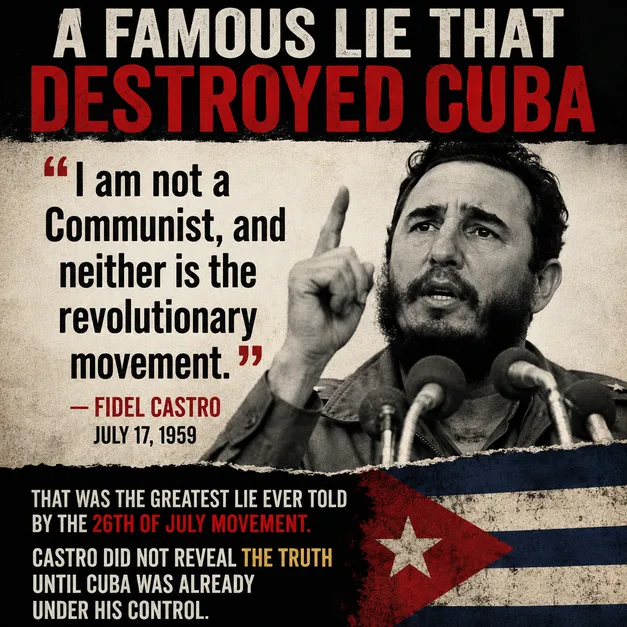
“I am not a Communist, and neither is the evolutionary movement.” —Fidel Castro, July 17, 1959

That was perhaps the greatest lie ever told by the 26th of July Movement. Castro did not reveal the truth until Cuba was already under his control.
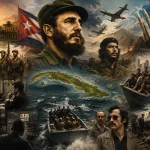
The Cuban dictatorship celebrates July 26 as the beginning of its revolution.
It should be remembered as the beginning of Cuba’s catastrophe.
On July 26, 1953, an armed group led by Fidel Castro attacked the Moncada Barracks in Santiago de Cuba and the Carlos Manuel de Céspedes Barracks in Bayamo. The assault failed militarily, but it created the mythology that Castro later used to seize power, destroy the Cuban republic, and imprison an entire nation.
The regime calls July 26 a heroic date. It was not heroic.
It was the birth of a movement that would replace an unconstitutional government with a permanent totalitarian state.
Batista’s Coup Was Illegal. Castro’s Dictatorship Was Worse.
Fulgencio Batista’s coup on March 10, 1952, was illegal, unconstitutional, and damaging to Cuba’s democratic institutions.
But the dishonest history written by the Castro regime pretends that Cuba before 1959 was already a totalitarian prison.
It was not.
Under Batista, Cubans still had freedoms that disappeared completely after Castro took power.
Journalists criticized the government. Opposition politicians spoke publicly.
Magazines published attacks against Batista. Television programs questioned officials and debated national policy.
Political organizations operated. Civic institutions existed outside government control.
Batista could be criticized in public, opposed in print, and condemned on television.
Under Castro, criticism became a crime.
That is the difference between an authoritarian government and a totalitarian state.
Batista violated the constitutional order. Castro destroyed it.
Batista interrupted democracy.
Castro abolished it.
Batista ruled for years. Castroism enslaved generations.
The 26th of July Movement Did Not Restore Cuba
The 26th of July Movement claimed to fight for democracy, constitutional government, and national dignity.
Those promises were a fraud. The movement did not restore the republic.
It buried it. It did not return power to the people.
It concentrated power in one man.
It did not liberate Cuba. It converted Cuba into a police state.
The movement carried out bombings and violent actions in public places, exposing civilians to danger in cinemas, restaurants, shops, cafés, parks, and other spaces where ordinary people gathered.
This was not simply resistance against a military government.
It was a campaign to create fear, disorder, and political power.
Other anti-Batista groups directly confronted the government and military leadership. The Revolutionary Directorate of March 13 attacked the Presidential Palace and placed its own members at risk in an attempt to remove Batista.
Castro’s movement built a political mythology around violence and then used that mythology to justify absolute power.
Fidel Castro Lied His Way Into Power
Fidel Castro repeatedly denied being a communist.
He claimed to support democracy.
He promised elections. He invoked the Constitution.
He presented himself as a nationalist reformer.
These were not misunderstandings. They were lies.
He told the Cuban people what they needed to hear until he no longer needed their consent.
Once in power, he eliminated elections, destroyed political parties, confiscated private property, closed independent newspapers, silenced unions, imprisoned opponents, executed enemies, and forced hundreds of thousands of Cubans into exile.
Only after consolidating control did he openly declare himself a Marxist-Leninist.
The deception was complete.
He did not reveal his true project until Cuba had already been captured.
Then the Soviet Union gave him the money, weapons, intelligence, and political support needed to preserve the dictatorship.
What began as a promise of national renewal became a foreign-supported system of repression.
Castro did not free Cuba from dependency.
He made Cuba dependent on the Soviet empire.
Later, the regime survived on Venezuelan oil, foreign subsidies, remittances, tourism, and the exploitation of Cuban labor.
The dictatorship has always survived by consuming resources created by others.
The Revolution Created a New Aristocracy
The revolution claimed to destroy privilege.
Instead, it changed who was privileged.
The old elite was replaced by a political, military, and security caste that lived above the population and outside the rules imposed on everyone else.
The ruling class gained access to superior homes, imported food, private medical care, restricted resorts, foreign travel, government vehicles, special stores, and economic opportunities denied to ordinary Cubans.
They lived in Miramar, Atabey, Siboney, Cubanacán, Kohly, Nuevo Vedado, and other protected enclaves while ordinary families struggled for food, electricity, medicine, transportation, and basic dignity.
This was never a dictatorship of the proletariat.
It was a dictatorship over the proletariat. The workers did not gain power.
The workers lost the right to organize.
The farmers did not gain land. The state took control of production.
The poor did not become prosperous. They became permanently dependent.
The revolution did not eliminate inequality. It replaced economic inequality with political apartheid.
Those loyal to the system received access. Those who resisted were punished.
The Police Do Not Protect the People
The regime calls its force the National Revolutionary Police.
The name exposes the truth. A national police force serves the nation.
A revolutionary police force serves the regime.
Cuba’s police, Ministry of the Interior, and State Security do not primarily exist to defend citizens.
They exist to defend the dictatorship from the citizens. They monitor neighborhoods.
They interrogate dissidents. They harass families. They infiltrate opposition groups.
They threaten artists. They silence journalists. They beat protesters.
They imprison political opponents. They criminalize speech.
They punish independent thought They enforce fear.
They are not guardians of law. They are guardians of power. Their purpose is not justice.
Their purpose is obedience.
July 26 Led Directly to National Ruin
The consequences of July 26 are visible everywhere.
Political executions. Prisons filled with dissidents.
Confiscated homes and businesses.
Censored newspapers. Destroyed institutions.
Broken families. Millions in exile. Thousands lost at sea.
A nation divided between those trapped inside and those forced to rebuild their lives abroad.
Cuba became a country where leaving was often the only path to freedom.
A country where the government controlled employment, education, food, housing, travel, information, and speech.
A country where survival depended on silence. A country rich in talent but trapped in poverty.
A country that once attracted immigrants and became a country people risked death to escape.
This is the legacy of July 26.
Not dignity. Not sovereignty. Not equality. Ruin.
The Regime Celebrates Because July 26 Gave It Power
The dictatorship celebrates July 26 because it marks the origin of its authority.
The Cuban people should remember it as the origin of their captivity.
The attack on the barracks was not the liberation of Cuba.
It was the opening chapter of a political project that would destroy the republic and replace it with a hereditary ruling system protected by soldiers, police, propaganda, prisons, and fear.
Batista’s coup created a crisis. Castro turned that crisis into national destruction.
Cuba needed constitutional restoration. Castro delivered communist dictatorship.
Cuba needed elections. Castro delivered one-party rule.
Cuba needed law. Castro delivered political terror.
Cuba needed reform. Castro delivered exile, poverty, censorship, and death.
The Saddest Day in Cuban History
July 26 should never be celebrated by anyone who values liberty.
It should be remembered as a warning about how nations are lost.
They are lost when violence is romanticized.
They are lost when political lies are mistaken for hope.
They are lost when a charismatic leader demands trust without limits.
They are lost when people excuse crimes because they despise the government being attacked.
They are lost when the promise of justice becomes an excuse for absolute power.
The Cuban tragedy did not begin on January 1, 1959.
By then, the machinery was already in motion.
It began on July 26, 1953, when a failed attack became a revolutionary myth, and that myth became the weapon used to conquer a nation.
For the regime, July 26 is a holiday. For Cuba, it is a funeral date.
It marks the beginning of executions, prisons, confiscation, exile, separation, hunger, censorship, fear, and sixty-seven years of national humiliation.
There is nothing heroic about it. There is nothing glorious about it. There is nothing to celebrate.
July 26 was not the day Cuba began to rise. It was the day Cuba began to fall.
May God free the Cuban people, reunite the Cuban nation, punish those responsible for its destruction, and bring this long nightmare to an end.