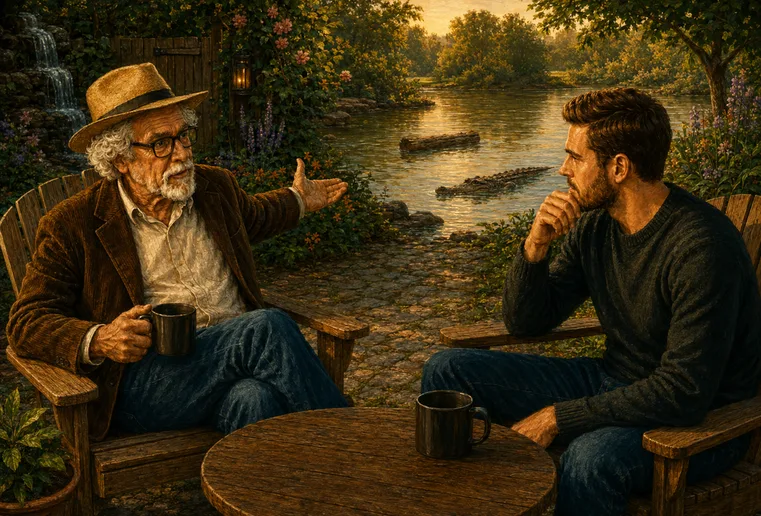
Think of it as Yoga for the brain, we are going to stretch a bit.
No Matter How Long the Log Stays in the Water, It Never Becomes a Crocodile
“Uncle Bob, I don’t understand it,” I said. “I’m doing everything successful people tell me to do. I go to their conferences. I listen to their podcasts. I read their books. I even dress more professionally. But I don’t feel any closer to becoming successful.”
Uncle Bob leaned back in his chair and studied me for a moment.
“Son, have you ever heard the African proverb, ‘No matter how long the log stays in the water, it never becomes a crocodile’?”
“No.”
“Well, think about it. A log can float beside a crocodile every day. It can live in the same river, feel the same current and bake under the same sun. From a distance, someone might even mistake that log for a crocodile. But it is still a log.”
“What does that have to do with me?”
“You’re floating in the right water,” he said. “But you’re expecting the water to transform you.”
I must have looked confused, because he continued.
“There’s nothing wrong with attending conferences, reading books or surrounding yourself with successful people. The right environment matters. It can expose you to opportunities, ideas and people you would never encounter otherwise. But simply standing next to successful people does not make you successful.”
“Then what does?”
“Doing the work they did to become successful.”
Uncle Bob leaned forward. “People imitate the visible parts of success. They buy the clothes, the automobile and the expensive watch. They copy the language. They talk about investments, leadership and entrepreneurship. They post photographs from conferences and restaurants. But those are the scales on the crocodile. They are not what makes the crocodile dangerous.”
“So what makes it dangerous?”
“What is underneath the water—the strength, patience, instinct and ability to act when the opportunity arrives.”
He took another drink of coffee. “You see a successful businessman driving a beautiful automobile, but you don’t see the twenty years he spent learning his industry. You see the company he owns, but you don’t see the failed companies that taught him how to operate it. You see the money, but you don’t see the risks, sleepless nights, difficult decisions and years of discipline behind it.”
“So I shouldn’t try to copy successful people?”
“That isn’t what I said. Copy their principles, not their appearance. Study how they think. Study how they make decisions. Study how they deal with failure, protect their money and recognize opportunity. Then adapt those lessons to your own abilities and circumstances.”
“But what if I want to become someone different?”
“You can change. Of course you can change. But real change comes from the inside and works its way outward. Most people try to change the outside and hope it eventually works its way inward.”
He pointed at the lake. “A log cannot become a crocodile, but a skilled craftsman can turn that log into a table, a chair, a boat or a beautiful sculpture. The log can become extremely valuable, but it must become valuable according to its own nature.”
“So I should accept myself exactly as I am?”
“No. That’s another excuse people use to avoid improving. You accept your starting point, not your limitations. You identify the material you have been given, and then you decide what to build from it.”
He picked up a napkin and drew three circles. “In the first circle, write what you’re naturally good at. In the second, write what people will pay you to do. In the third, write what you are willing to practice for years. Where those three circles overlap, you may find your real opportunity.”
“What if I’m not naturally good at anything?”
“That usually means you haven’t done enough things yet. Ability often remains hidden until responsibility forces it to come out. Work in different businesses. Sell something. Manage a small project. Help a struggling company. Try, fail, adjust and try again. Action will teach you more about your nature than endless self-examination.”
I looked down at the three circles. “So being around successful people is still helpful?”
“Very helpful—if you participate instead of merely watching. Don’t just go to the business conference. Introduce yourself to people. Ask intelligent questions. Follow up. Apply one lesson when you get home. Don’t simply admire the factory; learn how the factory operates.”
“And what about pretending until I become successful?”
“There is a difference between practicing a new identity and living a lie. You can begin behaving more responsibly before you feel responsible. You can practice speaking confidently before you feel confident. But pretending to possess experience, money or knowledge that you do not have will eventually expose you.”
“Like the log being mistaken for a crocodile?”
“Exactly. From far away, it may fool people. But sooner or later, someone gets close enough to see that it has no teeth.”
I laughed.
Uncle Bob didn’t.
“Son, that is how people get into serious trouble. They borrow money to appear wealthy. They take positions they are not prepared to handle. They repeat advice they do not understand. They become more concerned with looking successful than becoming capable.”
“So what should I do now?”
“Choose one useful ability and develop some teeth.”
“What do you mean?”
“Learn to sell. Learn to negotiate. Learn to read financial statements. Learn to manage people. Learn to build something customers need. Pick a real ability that creates value, and work on it until you are undeniably competent.”
“How long will that take?”
“Longer than buying an expensive suit and less time than repairing the damage caused by pretending.”
He folded the napkin and pushed it toward me. “Remember this: proximity is not progress. Sitting in an office does not make you a businessman. Owning stock does not make you an investor. Starting a company does not make you an entrepreneur. Those titles must be earned through understanding, discipline and repeated action.”
I slipped the napkin into my pocket. “So the lesson is to stay true to who I am?”
“Partly. The deeper lesson is to build from who you are. Don’t waste your life trying to become a poor imitation of somebody else. Learn from other people, but construct something that fits your own strengths, experiences and purpose.”
He smiled. “The river can give you opportunity. The crocodiles can show you what is possible. But neither can decide what you will become. That part is your responsibility.”
I stood up to leave, but Uncle Bob stopped me. “One more thing.”
“What?”
“If you ever see a log floating in a river, don’t assume it isn’t a crocodile.”
I stared at him.
He laughed. “A good businessman stays authentic—but he also stays careful.”