Think of it as Yoga for the brain, we are going to stretch a bit.
CUBA Exports the Revolution
For decades, Cuba exported revolution while the Soviet Union picked up the tab. Cuban blood, Soviet money, and foreign countries paid the price.
Cuba’s Military Campaigns, Proxy Wars, and Intelligence Operations Abroad
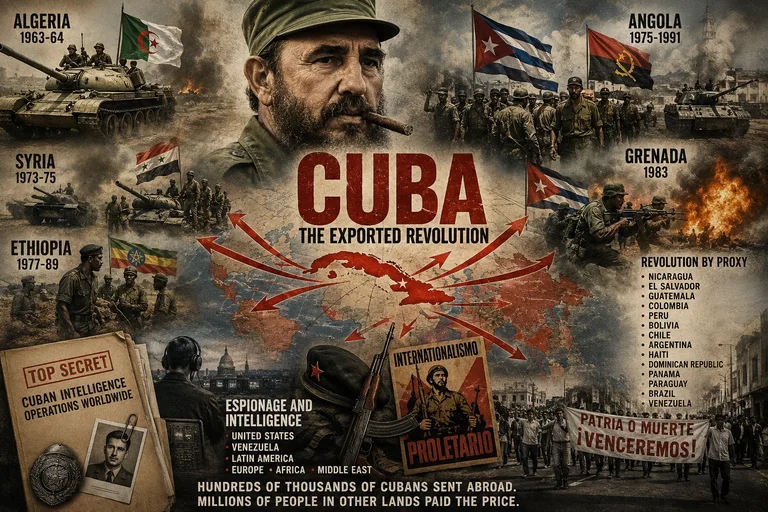
After 1959, Cuba was not merely a poor island claiming to defend itself against the United States. Under Fidel Castro, Cuba became an exporter of armed revolution. The regime sent soldiers, tanks, pilots, doctors, advisers, intelligence officers, trainers, weapons, propaganda, and political operatives across Africa, the Middle East, Latin America, and the United States. Havana called it “internationalism.” Its enemies called it subversion. In reality, it was both: a small Caribbean dictatorship, financed and armed by the Soviet bloc, projecting itself into other nations’ wars.
One research review of Cuban military internationalism identifies the major direct Cuban armed interventions as Algeria, Syria, Angola, and Ethiopia, while Cuban records and other histories also include Congo/Zaire and Grenada as important combat or military-security episodes. Cuba’s official press claims that 385,908 Cuban combatants served in African missions, and recent reporting has described more than 400,000 Cuban military and support personnel serving across Africa during the Cold War. Those numbers show the scale of Castro’s ambition: Cuba was economically broken at home, but militarily active abroad. (Seguridad Internacional)
Before going campaign by campaign, one warning is necessary: casualty figures are messy. In Angola, Ethiopia, and Grenada, we can give reasonable estimates of Cuban dead and battlefield deaths. In Latin America, where Cuba usually acted through training, weapons, intelligence, safe haven, and political support, there is usually no honest way to say “Cuba caused exactly this many deaths.” The correct approach is to distinguish direct Cuban combat deaths, enemy/allied combat deaths, and total conflict deaths.
Summary casualty ledger
Campaign / country
Cuban role
Approx. Cuban personnel
Approx. killed / casualty picture
Algeria / Sand War, 1963–64
Cuban armor, advisers, troops supporting Algeria against Morocco
Cuban official source says 865 troops; other accounts cite about 686 men
Cuban deaths unclear or possibly none publicly confirmed. Algerian deaths often estimated 60–300; Moroccan deaths disputed, often listed from dozens to low hundreds. (Granma)
Congo/Zaire, 1965
Che Guevara and Cuban guerrilla mission supporting Congolese rebels
Roughly 100–200 Cubans, depending source/account
Cuban-specific deaths unclear. Wider Congo Crisis often estimated around 100,000 dead, but that cannot be attributed to Cuba alone. (Cambridge University Press)
Syria / Golan front, 1973–75
Cuban tank troops/advisers supporting Syria after Yom Kippur War
Cuban official source says 746 troops; other estimates range higher
Reported Cuban losses around 180 killed and 250 wounded. Israeli official records list 2,297–2,689 Israeli dead in the Yom Kippur War as a whole, not all against Cubans. (Granma)
Angola, 1975–91
Major Cuban expeditionary war backing MPLA against FNLA, UNITA, Zaire, and South Africa
Raúl Castro claimed 370,000+ soldiers and 50,000 civilians over the war
Cuban dead commonly given as about 2,077 in Angola. Angola’s civil war killed at least 500,000, with some estimates higher. (OpenEdition Books)
Ethiopia / Ogaden War, 1977–89
Cuban combat forces backing Ethiopia against Somalia
Often cited around 16,000 Cuban troops
Cuban dead estimates vary, often 160–400. Ogaden War deaths estimated around 60,000 total: about 15,000 Ethiopian soldiers, 20,000 Somali/WSLF fighters, and 25,000 civilians. (Wikipedia)
Grenada, 1983
Cuban military advisers, armed construction/security personnel resisted U.S.-led invasion
U.S. sources found 784 Cubans on island; 638 captured
U.S.: 19 killed, about 115 wounded. Cuba: 25 killed, 59 wounded, 638 captured. Grenada: 45 military dead, 358 wounded, plus civilian deaths. (Line of Departure)
Nicaragua, 1978–90
Training, arms, intelligence, logistics for Sandinistas; later security/adviser role
No single clean troop number; mostly advisers/trainers
Anti-Somoza fighting left up to 50,000 dead; Contra war later killed about 30,000–35,000. Cuban-specific battlefield deaths not clearly documented. (Office of the Historian)
El Salvador, 1980–92
Support networks for leftist guerrillas; regional revolutionary training and liaison
Not a Cuban combat deployment
Civil war killed about 75,000. UN-linked findings attributed the overwhelming majority of civilian killings to government/security forces, with a smaller share to the FMLN. Cuban-specific deaths not applicable. (Loyola Special Collections)
Guatemala, 1960–96
Support/inspiration/training networks for guerrilla movements
Not a Cuban combat deployment
Up to 200,000 dead and over 40,000 disappeared; CEH attributed 93% of violations to the state and 3% to guerrillas. (ICMP)
Colombia, 1960s–present conflict
Ideological support, safe haven, training allegations, later peace-host role; ELN/FARC links
Not a formal Cuban expedition
Colombian conflict deaths documented at 262,197 by CNMH through 2018; Truth Commission estimates around 450,000 homicides from 1985–2018. Cuba-specific death toll cannot be separated. (Centro de Memoria Histórica)
Bolivia, 1966–67
Che Guevara’s Cuban-led guerrilla foco
Small guerrilla column
Final battle: Bolivian Rangers captured Che; U.S. records say orders were given to kill him. Total campaign deaths were small compared with Angola or Central America, but politically enormous. (Office of the Historian)
1. Algeria: Cuba’s first African military test
Cuba’s first major foreign military mission came only a few years after Castro took power. In 1963, newly independent Algeria fought Morocco in the Sand War, a border conflict over disputed Saharan territory. Algeria had just emerged from its brutal war against France and was weak, disorganized, and heavily politicized. To Castro, Algeria was a natural revolutionary ally: anti-colonial, socialist-leaning, and useful as Cuba’s first stage in Africa.
Cuba sent a military contingent to support Algeria. Cuba’s own official press says 865 Cuban troops and their equipment arrived between October 21 and October 29, 1963. Other accounts describe a smaller force of around 686 men under Efigenio Ameijeiras, including tanks and armored support. The mission was not only symbolic. Castro authorized Cuban personnel for combat if necessary, though the war ended quickly and Cuba’s direct battlefield role appears to have been limited. (Granma)
The casualties in the Sand War are disputed. French sources reported 60 Algerian dead and 250 wounded, while later works give around 300 Algerian dead. Moroccan losses are less clearly sourced and vary from dozens to low hundreds. For Cuba, there is no solid public casualty count; the best phrasing is that Cuban losses were unclear and probably limited, because the war was short and the Cuban force arrived near the end. (Wikipedia)
Algeria mattered because it proved the pattern: Castro would use Cuban soldiers not just to defend Cuba, but to insert Havana into foreign wars. A country that could not feed its own people reliably was already exporting tanks and ideology.
2. Congo/Zaire: Che Guevara’s failed African revolution
The Congo mission was one of Castro’s most romantic and foolish adventures. In 1965, Che Guevara secretly entered what is today the Democratic Republic of Congo to support leftist rebels connected to the National Council of Liberation. The Congolese crisis had already drawn in the United States, the Soviet bloc, Belgium, mercenaries, neighboring African states, and United Nations forces. Cuba saw Congo as the next Sierra Maestra — a jungle war where a disciplined guerrilla vanguard could ignite revolution.
It failed badly. Che discovered that the Congolese rebels were not the disciplined revolutionary army he imagined. They were divided, poorly organized, suspicious of outsiders, and often more interested in local power struggles than Marxist theory. A Cambridge history summary describes Congo as an early test bed for Cuba’s projection into Africa and notes that the disorganization of the Congolese rebels and poor assessment of the local balance of power doomed the guerrilla effort. (Cambridge University Press)
The Cuban force was small, usually described in the range of 100 to 200 personnel depending on the account. This was not Angola. It was a guerrilla expedition, not a conventional army. Cuban-specific casualties are not reliably documented in a clean public count. The wider Congo Crisis, however, is often estimated at around 100,000 dead, but those deaths came from a broad civil and international crisis, not from Cuba alone. (Cambridge University Press)
Congo is important for the book because it shows the arrogance of revolutionary export. Castro and Che believed the Cuban model could be transplanted into another country like a machine part. Congo proved otherwise. Revolution was not a product Havana could simply ship by boat.
3. Syria and the Golan: Cuban tanks against Israel
Cuba’s intervention in Syria is less known than Angola, but it is one of the most revealing. After the 1973 Yom Kippur War, Syria requested help from Cuba. Cuba sent tank troops and advisers to reinforce Syria on the Golan front. Cuba’s official press says 746 Cuban troops were sent; other accounts estimate a larger deployment, sometimes between 800 and 3,000. (Granma)
This placed Cuban personnel into the Arab-Israeli conflict. Cuban tank crews and advisers served on the Syrian side during the post-Yom Kippur War fighting and the war of attrition that followed. Israeli official records say the Yom Kippur War began with Egyptian and Syrian surprise attacks and list Israeli losses at 2,297 soldiers killed and 7,250 wounded in one official chronology; another Israeli archive page gives 2,689 dead and 7,251 wounded. Those figures are for the war as a whole, not specifically for fighting against Cubans. (Israeli Military Archives)
Cuban losses were significant for a faraway war most Cubans had no personal stake in. A review of Cuban military internationalism reports approximately 180 Cuban killed and 250 wounded on the Golan front. That is a heavy price for a small island fighting on behalf of Syria, in a conflict thousands of miles from Havana. (Seguridad Internacional)
This campaign also reveals Castro’s ideological alignment. Cuba did not merely oppose the United States in the Caribbean. It joined Soviet-aligned fronts globally: against South Africa in Angola, against Somalia in Ethiopia, against Israel in Syria, and against U.S.-aligned governments or movements in Latin America.
4. Angola: Cuba’s biggest foreign war
Angola was Cuba’s great overseas war. It was the campaign that transformed Cuba from a loud revolutionary state into a real expeditionary military actor. After Portugal’s dictatorship collapsed in 1974, Angola moved toward independence, but the country was divided among three main movements: MPLA, FNLA, and UNITA. The MPLA had Soviet and Cuban ties. FNLA received support from Zaire and U.S.-aligned networks. UNITA, led by Jonas Savimbi, later became the main anti-MPLA force backed by South Africa and the United States. U.S. State Department history describes Angola as a Cold War battleground where the superpowers and their allies supplied competing clients. (Office of the Historian)
Cuba launched Operation Carlota in November 1975. The immediate goal was to save the MPLA from being overrun by rival Angolan factions, Zairian-backed forces, and South African intervention. U.S. documents estimated Cuban troop levels reached 10,000–12,000 by early 1976. A later academic chapter cites Raúl Castro’s claim that more than 370,000 Cuban soldiers and 50,000 Cuban civilians served in Angola over the course of the war, with 2,077 Cuban combat deaths. (Office of the Historian)
The early Cuban intervention helped the MPLA survive. The MPLA declared itself the government of independent Angola on November 11, 1975. South African forces withdrew in spring 1976, and the MPLA remained the official government. That was the first Cuban victory: Castro had helped decide who would rule Angola. (Office of the Historian)
But Angola did not become peaceful. The civil war continued for decades. Cuba stayed to defend the MPLA government. UNITA fought on. South Africa continued to intervene from Namibia, then called South West Africa. The United States, South Africa, Zaire, the Soviet Union, and Cuba all turned Angola into a proxy battlefield. The Angolan people paid the price.
The war’s death toll is staggering. Conservative summaries commonly say more than 500,000 people died in the Angolan Civil War. Some estimates go higher. These were not all soldiers. Civilians died from combat, bombing, mines, displacement, hunger, disease, and the destruction of infrastructure. The South African Truth and Reconciliation Commission described mass displacement and civilian suffering from South African operations in Angola, and cited one major Operation Hooper engagement near Cuito Cuanavale in which 324 Angolan/Cuban troops and 21 South Africans were killed, according to SADF figures. (Truth Commission)
The late decisive chapter came around Cuito Cuanavale in 1987–88. Both sides claimed victory. South Africa and UNITA argued they stopped an MPLA offensive. Cuba and Angola argued they prevented Cuito from falling and shifted the strategic balance. Politically, the battle helped push negotiations that led to Cuban withdrawal and Namibia’s independence. The 1988 agreements between Angola, Cuba, and South Africa created the framework for foreign troop withdrawal. (Seguridad Internacional)
Angola is the central exhibit in the case against Castro’s myth. The regime claimed moral purity and anti-imperialism while operating an expeditionary army abroad for fifteen years. Cuba was not simply a victim of great-power politics. In Angola, Cuba became one of the armed instruments of great-power politics.
5. Ethiopia and the Ogaden War: Cuba chooses Ethiopia over Somalia
The Ogaden War exposed the hypocrisy and cold calculation inside communist “solidarity.” Somalia and Ethiopia had both claimed revolutionary credentials at different moments. But when Somalia invaded Ethiopia’s Ogaden region in 1977, the Soviet Union shifted support toward Ethiopia’s Marxist Derg regime. Cuba followed Moscow.
Cuban troops were flown into Ethiopia to help repel Somalia. Many accounts cite around 16,000 Cuban troops involved, along with Soviet support and advisers. The war turned once Cuban, Soviet, and allied support strengthened Ethiopia’s counteroffensive. Somali forces were pushed back, and Ethiopia regained control of most of the Ogaden. (Wikipedia)
Casualty estimates vary. A useful estimate gives around 60,000 total deaths in the Ogaden War: approximately 15,000 Ethiopian soldiers, 20,000 Somali soldiers and WSLF fighters, and 25,000 civilians. Cuban deaths are usually estimated between 160 and 400, depending on the source. (The Guardian)
The aftermath was brutal. A Guardian archive report from 1980 described refugee accounts of Ethiopian and Cuban soldiers destroying herds, burning fields, destroying farms, and forcing population movements in the Ogaden. It reported an official refugee figure of 1.4 million. These accounts should be described as refugee reports, but they show the human cost of the war after the battlefield victory. (The Guardian)
The Ogaden War shows that Castro’s “internationalism” was not about freedom. It was about alignment. When the Soviet line changed, Cuba changed. The people of the Ogaden became pieces on a Cold War board.
6. Grenada: Cuban and American forces collide
Grenada was the rare case where Cuban and American forces directly fought each other. In 1983, after the murder of Grenadian Prime Minister Maurice Bishop and the collapse of order inside the island’s Marxist government, the United States launched Operation Urgent Fury. The U.S. said it acted to protect American medical students, restore order, and remove Cuban/Soviet influence. (U.S. Naval Institute)
Cuba had hundreds of personnel on Grenada, many working on the Point Salines airport project. U.S. sources found 784 Cubans on the island and identified Cuban military advisers among them. The Cuban line was that many were construction workers; U.S. accounts emphasized that many were armed and that Cuban and Grenadian forces were not fully organized for island-wide defense when the invasion came. (Line of Departure)
The casualty figures are among the clearest of all Cuban foreign operations. U.S. Army history lists 19 U.S. dead and 115 wounded; Cuban forces lost 25 killed, 59 wounded, and 638 captured; Grenadian forces lost 45 killed and 358 wounded. (Line of Departure)
Grenada mattered because it shattered the illusion that Cuban “internationalism” was harmless construction work and medical solidarity. When the fighting started, Cuban personnel fought. Some died. Others were captured. The island became a miniature version of the Cold War: Cuba, the United States, Marxist revolution, Soviet weapons, Caribbean politics, and dead young men on all sides.
7. Nicaragua: Cuba’s successful revolution in Central America
Nicaragua was one of Havana’s greatest political victories in Latin America. Cuba supported the Sandinista National Liberation Front, or FSLN, in the struggle against Anastasio Somoza. U.S. documents from 1979 described Cuba providing logistics, safe haven, and training to the Sandinistas. Another U.S. document said Cuba accelerated training, urged Sandinista factions to unify, sent guerrillas back into Nicaragua, and supplied arms including anti-aircraft guns, heavy mortars, and recoilless rifles. (Office of the Historian)
The anti-Somoza revolution was extremely costly. A country-study summary estimates that by the Sandinista victory, 50,000 Nicaraguans were dead, 120,000 were exiles, and 600,000 were homeless. The later Contra War, fought between the Sandinista government and U.S.-backed Contra rebels, killed about 30,000 to 35,000 people. (Country Studies)
Cuba did not send an Angola-sized army to Nicaragua. It did not need to. This was the Latin American model: train the cadres, arm the movement, provide intelligence, shape the ideology, and help the guerrilla organization survive long enough to win. Once the Sandinistas took power, Nicaragua became a major Cuban ally in the hemisphere.
For Castro, Nicaragua proved that the Cuban model could still win in Latin America. For Nicaraguans, the victory came with revolution, dictatorship, civil war, exile, economic destruction, and a new authoritarian dynasty under Daniel Ortega.
8. El Salvador: revolution by proxy
El Salvador was one of the bloodiest Cold War battlefields in the Americas. The leftist FMLN fought the U.S.-backed Salvadoran government in a civil war from 1980 to 1992. Cuba’s role was not a conventional military invasion; it was part of the broader revolutionary network of training, political support, safe haven, coordination, and ideological warfare.
The war killed about 75,000 people and left thousands missing. A summary of the UN Truth Commission’s findings says the overwhelming majority of deaths were attributed to government security forces and death squads, with a smaller share attributed to the FMLN. Reuters also summarizes the war as a conflict between leftist guerrillas and the U.S.-backed Salvadoran army that left 75,000 dead and 8,000 missing. (Loyola Special Collections)
For this chapter, the key is accuracy: Cuba helped revolutionary forces, but the Salvadoran state and allied death squads committed the majority of killings. That does not absolve Cuba of exporting armed struggle. It means the killing field was produced by both revolution and counterrevolution, with civilians crushed between them.
9. Guatemala: a war of terror, guerrillas, and state violence
Guatemala’s civil war lasted from 1960 to 1996 and became one of the worst conflicts in Latin America. Cuban support operated through ideological influence, revolutionary training networks, and ties to guerrilla movements, not through a public Cuban army. The war’s casualty numbers dwarf Cuba’s direct military campaigns.
The UN-sponsored Historical Clarification Commission estimated up to 200,000 dead and more than 40,000 disappeared. It attributed 93% of human-rights violations to the state and 3% to guerrillas. (ICMP)
That ratio matters. A serious anti-communist history should not pretend every death in Guatemala was caused by Cuban-backed guerrillas. The Guatemalan state and associated forces carried out the overwhelming share of atrocities. But Cuba still belongs in the story because Havana helped build the revolutionary imagination and regional infrastructure that encouraged armed struggle as the path to power.
10. Colombia: Cuba, guerrillas, safe haven, and the long war
Colombia is different because the conflict lasted for generations and still has armed remnants today. Cuba’s role included ideological influence, relations with guerrilla groups, safe haven allegations, and later hosting peace negotiations. The U.S. State Department has repeatedly described Cuba’s long history of providing advice, safe haven, communications, training, and financial support to guerrilla groups and individual terrorists. It also noted Cuba’s refusal to extradite ELN leaders after the 2019 Bogotá police academy bombing that killed 22 people and injured 87. (ecoi.net)
Colombia’s casualty numbers are enormous. Colombia’s National Center for Historical Memory documented 262,197 dead in the armed conflict from 1958 to July 2018. Colombia’s Truth Commission later estimated around 450,000 conflict-related homicides between 1985 and 2018. (Centro de Memoria Histórica)
But here again the attribution must be careful. Colombia’s deaths were caused by guerrillas, paramilitaries, state forces, criminal groups, narcotrafficking networks, and local power struggles. Cuba was part of the revolutionary ecosystem, but it was not the sole engine of Colombia’s war. The clean historical charge is not “Cuba killed 450,000 Colombians.” The clean charge is this: Cuba helped legitimize, shelter, train, and politically sustain armed revolutionary movements that became part of one of the longest and bloodiest conflicts in the hemisphere.
11. Bolivia: Che’s last disaster
Bolivia was Castroism reduced to its purest form: a small revolutionary foco trying to ignite a country that did not ask for it. Che Guevara entered Bolivia to create a guerrilla war that would spread across South America. The plan failed because Che misread Bolivia, failed to win broad peasant support, lacked sufficient local communist backing, and was hunted down by the Bolivian army with U.S. assistance.
U.S. records state that after Che’s capture, orders were given from Bolivian Army Headquarters to kill him. TIME’s original reporting described Bolivian Rangers tracking a small guerrilla group, capturing Che, and the political danger that a public trial would have posed. (Office of the Historian)
The death toll in Bolivia was tiny compared with Angola, Ethiopia, Nicaragua, or Guatemala. But the political meaning was enormous. Che’s death proved that the Cuban revolutionary model was not magic. It could fail. It could be rejected. It could be hunted down and destroyed.
12. Peru, Argentina, Brazil, Chile, Panama, Dominican Republic, Haiti, and others
Cuba’s influence extended across Latin America beyond the headline wars. In many countries, the Cuban role was not a formal expedition but a mixture of inspiration, training, funding, propaganda, intelligence liaison, and guerrilla networking. This included revolutionary movements or contacts in Argentina, Brazil, Chile, Panama, Peru, the Dominican Republic, Haiti, Paraguay, and others.
For some countries, like Peru, later violence took on its own internal logic. Peru’s internal armed conflict from 1980 to 2000 is estimated by one modern statistical study at between 58,234 and 65,958 fatal victims, and the study found that Shining Path killed more people than the Peruvian armed forces. But Shining Path was Maoist, not simply a Cuban proxy, so it would be inaccurate to make Cuba responsible for Peru’s full death toll. (arXiv)
The broader point is that Cuba exported the method: guerrilla romanticism, clandestine organization, political violence, revolutionary propaganda, and one-party ideology. Some movements succeeded. Most failed. But across the continent, young men died chasing Havana’s fantasy.
13. Espionage: Cuba’s most successful weapon
Cuba’s most effective foreign weapon was not the tank. It was the spy.
The United States is the clearest target. Ana Belén Montes, a senior Defense Intelligence Agency analyst, pleaded guilty to spying for Cuba and admitted revealing the identities of four U.S. undercover intelligence officers working in Cuba. Marta Velázquez was charged with helping introduce Montes to Cuban intelligence and accompanying her to Cuba for spycraft training. Víctor Manuel Rocha, a former U.S. ambassador and National Security Council official, pleaded guilty in 2024 to secretly acting for decades as an agent of the Cuban government, with DOJ saying his work began in 1973 and continued until his arrest. (FBI)
Cuba also embedded itself deeply into Venezuela’s security state. Reuters reported that Cuban intelligence agents were embedded throughout the Venezuelan military and the DGCIM counterintelligence structure under deep security agreements beginning in the late 2000s. This was not battlefield combat in the old sense. It was regime protection: surveillance, repression, loyalty control, and intelligence management. (Reuters)
Espionage does not produce casualty numbers the way artillery does. Its damage is quieter: betrayed sources, compromised operations, broken opposition networks, imprisoned dissidents, manipulated institutions, and regimes kept alive longer than they should have survived. In many ways, Cuban intelligence achieved what Cuban armies could not. It penetrated enemies, protected allies, and made Havana more dangerous than its economy or geography should have allowed.
Conclusion: the bill paid by other people
The Castro regime sold its foreign wars as moral duty. Algeria was anti-colonial solidarity. Syria was anti-Israel solidarity. Angola was anti-apartheid solidarity. Ethiopia was socialist solidarity. Nicaragua was revolutionary solidarity. Venezuela was Bolivarian solidarity.
But behind every slogan was the same structure: Cuban men sent abroad, Soviet weapons and subsidies, foreign civilians trapped in proxy wars, and Havana gaining influence while other countries burned.
Cuba paid in blood, but not only Cuban blood. Angolans, Ethiopians, Somalis, Grenadians, Nicaraguans, Salvadorans, Guatemalans, Colombians, Bolivians, Israelis, Syrians, South Africans, Moroccans, Algerians, and many others paid too.
That is the real history of Castro’s “internationalism.” It was not charity. It was not peace. It was the export of revolution by rifle, tank, radio, safe house, embassy, and spy network.
Cuba was a small island, but Castro turned it into a matchbox thrown into other people’s gasoline.