Think of it as Yoga for the brain, we are going to stretch a bit.
The Canoe, and the Five-Percent Plan for Building Wealth
By the time Dylan and Dorian returned Uncle Bob’s canoe, the sun was beginning to disappear behind the trees.
The two young men carried the canoe upside down between them, with Dylan walking backward and Dorian struggling under the heavier end.
“Slow down,” Dylan said. “You’re going to hit the truck.”
“I’m not going to hit the truck.”
“You said that about the mailbox.”
“The mailbox moved.”
Uncle Bob stood beside his convertible with a glass of iced tea in one hand. He watched them weave across the driveway like two men carrying a telephone pole through a furniture store.
“Put it on the rack,” Bob said. “Preferably without damaging the canoe, the truck, the house, or yourselves.”
They finally lowered it onto the wooden rack beside the garage.
Dorian stretched his back and looked toward Bob’s house. The property sat on several acres, shaded by old trees and separated from the road by a long private driveway. Bob’s convertible was parked near the garage. His truck was farther back, beside a workshop filled with tools, machinery, and half-finished projects.
Dorian looked around and shook his head.
“You know what I don’t understand?” he said.
Bob took a drink of tea. “That list could keep us here until winter.”
“How somebody gets all this.”
Bob glanced toward Dylan. “Did your friend hit his head while you were out there?”
“No,” Dylan said. “Not that I saw.”
Dorian ignored them.
“I’m serious. A house, land, cars, a workshop, investments. Some people have everything, and other people work their whole lives and end up with nothing.”
“That happens,” Bob said.
“And you don’t think that’s unfair?”
“Life is unfair. That observation and five dollars might buy you a cup of coffee.”
Dorian leaned against the canoe rack.
“That’s why people support socialism. They think wealth should be distributed more equally.”
Bob lowered his glass.
“Do you know why socialists are so stupid?”
Dylan closed his eyes.
“Here we go.”
Dorian straightened. “Why?”
“Because they spend all their time studying how to divide the harvest and almost no time learning how to plant the field.”
Dorian started to answer, but Bob raised a hand.
“I didn’t say poor people are stupid. I didn’t say struggling people are lazy. Plenty of hardworking people get sick, lose jobs, make mistakes, get cheated, or get hit by circumstances they could not control. Sometimes people need help. That isn’t what I’m talking about.”
“Then what are you talking about?”
“I’m talking about the belief that somebody else’s success caused your failure. I’m talking about people who would rather count what you have than examine what they do every day.”
Bob pointed toward the canoe.
“You two just spent the afternoon paddling down the river. Suppose Dylan paddled while you sat in the canoe complaining that he was getting farther ahead. Would the solution be to take away his paddle?”
“No.”
“Would it be fair to demand half the distance he traveled?”
“That doesn’t make sense.”
“Most things sound different when you remove the political slogans.”
Dorian folded his arms. “Not everyone starts with the same opportunities.”
“No, they don’t,” Bob said. “Some people begin ten miles ahead. Some begin ten miles behind. Some begin with a good family, good health, and a paid education. Others begin with debt, bad advice, and nobody willing to help them.”
“Exactly.”
“But standing still because somebody else got a head start does not improve your position.”
Bob motioned toward the porch.“Come sit down.”
The three of them walked to the back porch. Bob sat in an old wooden chair, while Dylan and Dorian took the bench opposite him.
“Let me give you a system,” Bob said. “It isn’t exciting. Nobody will make a revolutionary poster about it. It won’t get you applause from a crowd. But it works.”
Dorian leaned forward.
“Every time you make money, take five percent before you spend anything.”
“Five percent isn’t much.”
“That is the point. It is small enough that you can usually survive without it.”
“What do I do with it?”
“Save it. Invest it. Put it somewhere you cannot casually spend it. A retirement account, an index fund, a business account, or another legitimate investment. When possible, do it in a tax-advantaged account so the government takes less of the growth.”
Dorian looked skeptical. “You think five percent is going to make somebody rich?”
“No. I think the habit will.”
Bob placed his glass on the table. “The first five percent buys assets. Over time, those assets begin producing money. At first, the amount is so small you will laugh at it. Then one day, the money your investments earn will be larger than your original contributions. Eventually your money will be working every day, including days when you do not.”
“That still takes forever.”
“So does being broke.”
Dylan laughed.
Bob continued.
“Then take another five percent and invest it in yourself.”
“More savings?”
“No. Education. Skills. Tools. Books. Classes. Certifications. Software. Equipment. Anything that makes you more capable and more valuable.”
“What kind of skill?”
“That depends on who you are and where you want to go. Learn accounting. Learn sales. Learn programming. Learn how to repair air conditioners. Learn how to operate heavy equipment. Learn how to negotiate contracts. Learn a second language. Learn how to manage employees. Learn something that solves a problem people will pay to have solved.”
“What if I don’t have an extra ten percent?”
“Then cut expenses.”
Dorian frowned. “That’s easy to say when you’re rich.”
“No,” Bob said. “It is easier to say when you remember what it was like not to be rich.”
Bob nodded toward the convertible. “You see a car. You don’t see the years when I drove old cars, repaired them myself, and kept them long after other people thought I should replace them. You see the house. You don’t see the smaller house before it. You see the investments. You don’t see the first hundred dollars I was afraid to lose.”
He pointed toward Dorian’s phone. “How much does that cost every month?”
“My phone?”
“The phone, the plan, the subscriptions attached to it, the music service, the movie services, the food deliveries, the small purchases you barely remember making.”
Dorian looked at the screen. “I don’t know.”
“That is usually the answer.” Bob leaned back. “Most people do not decide to stay poor. They simply spend their future a few dollars at a time.”
Dorian remained quiet.
Bob continued. “You do not have to live like a monk. You do not have to stop enjoying life. But you should know the difference between an expense that improves your life and one that merely distracts you from it.”
“How do you tell the difference?”
“Wait three days before buying something you do not need. If you still want it, decide whether it is worth trading part of your future for it.”
“That sounds dramatic.”
“It is dramatic. Money is stored labor. When you spend money, you are spending hours of your life.”
Dylan looked at Dorian. “He told me that when I wanted to finance a motorcycle.”
“And did you listen?” Dorian asked.
“No.”
“What happened?”
“I sold it eight months later and still owed money.”
Bob nodded. “Education is expensive whether you receive it in a classroom or through stupidity.”
Dorian smiled. “All right. Five percent for investments. Five percent for skills. Then what?”
“Every day, do something positive.”
“That sounds like something printed on a coffee mug.”
“It would be, except most people would rather buy the mug than follow the advice.”
Bob held up one finger. “Read ten pages.”
A second finger. “Make one useful phone call.”
A third. “Practice one skill.”
A fourth “Exercise.”
A fifth. “Finish one task you have been avoiding.”
He lowered his hand. “The action does not have to be enormous. It only has to move you forward.”
“And that makes you rich?”
“Not by tomorrow.”
“Then how long?”
“Twenty years.”
Dorian laughed. “Twenty years?”
“Yes.”
“I’ll be old.”
Bob looked at Dylan. “How old is he?”
“Twenty-three.”
Bob turned back to Dorian. “At forty-three, you will think twenty-three was a child. The twenty years are going to pass whether you follow this plan or not.”
He picked up his tea again. “That is what young people never understand. They imagine that because something takes a long time, they have plenty of time to begin. It is exactly the opposite. The longer the process takes, the sooner you must begin.”
Dorian glanced at the workshop and the house beyond it. “You really think someone could become rich just doing those things?”
“I think after twenty years you would be richer than you can presently imagine. Not merely because of the money.”
“What else?”
“You would have twenty years of investment growth. Twenty years of accumulated knowledge. Twenty years of better judgment. Twenty years of professional relationships. Twenty years of completed projects. Twenty years of proving to yourself that you can keep promises.”
Bob tapped the table. “The investments compound. The skills compound. Your reputation compounds. Your confidence compounds. Good decisions make the next good decision easier.”
“And bad decisions compound too,” Dylan said.
Bob nodded. “Debt compounds. Laziness compounds. Excuses compound. Resentment compounds. Every path compounds eventually.”
Dorian looked out across the yard. “But what about people who are already rich? They can invest more than five percent of what I make.”
“Of course they can. Stop watching them.”
“That’s convenient.”
“It is practical. You cannot steer your canoe by staring at someone else’s boat.”
Bob pointed toward the river beyond the trees. “If a man passes you in a speedboat, you can spend the afternoon cursing him. You can demand that someone remove his engine. You can insist the river be redesigned so nobody travels faster than you. Or you can keep paddling toward your destination.”
Dorian considered that. “So your answer to inequality is just work harder?”
“No. That is a slogan too.”
Bob’s voice softened. “My answer is to control what you can control. Protect your income. Increase your ability. Lower unnecessary expenses. Avoid destructive debt. Build ownership. Make yourself useful. Help people when you are able. Do not wait for politicians, corporations, rich relatives, or revolutions to rescue you.”
Dylan grinned. “Especially rich relatives.”
“Especially rich relatives.”
Dorian looked at Bob’s house again.
“Did you always know this?” “No. I learned most of it by doing the opposite.”
“You lost money?”
“More than once.”
“Made bad investments?”
“Yes., work for 20 years, lost millions”
“Bought things you didn’t need?”
“Absolutely and “Trusted the wrong people”
Bob looked at him. “That was the most expensive lesson.”
“What changed?”
“I stopped treating mistakes as evidence that the world was against me. I began treating them as tuition.”
Dorian nodded slowly.
Bob stood and walked toward the canoe rack.
“Come here.”
They followed him.
Bob ran a hand along the side of the canoe. “When I bought this canoe, it was old. The paint was faded, one seat was cracked, and there was a small leak near the stern. I could afford a new one, but I did not need a new one. I repaired this one.”
“You could buy ten canoes,” Dorian said.
“Yes.”
“Then why keep this one?”
“Because wealth is not the ability to buy everything. Wealth is the ability to avoid needing everything.”
Bob pulled a folded twenty-dollar bill from his pocket and handed it to Dorian.
“What’s this for?”
“You helped return the canoe.”
“I don’t need to be paid.”
“Take it.”
Dorian accepted the bill.
“Now what are you going to do with it?”
“Save five percent?”
“That is one dollar.”
“And another dollar to learn something.”
Bob nodded. “What will you do with the other eighteen?”
Dorian thought for a moment.
“Probably spend it.”
“Good.”
Dorian blinked. “Good?”
“You are allowed to spend money. The lesson is not that spending is evil. The lesson is that your future should be paid before your appetite.”
Dorian folded the bill and placed it carefully in his wallet.
Bob looked toward Dylan.
“Did you charge him for the gas?” “No.”
“For the sandwiches?” “No.”
“For the bait?” “We didn’t go fishing.”
“Then what were the sandwiches for?”
“We got hungry.”
Bob shook his head. “Socialists.”
Dorian laughed. “You know, Uncle Bob, you might convince more people if you stopped calling them stupid.”
Bob picked up his iced tea. “I am not trying to convince everyone. I am trying to convince you.”
He started walking back toward the porch, then stopped. “One more thing.”
“What?”
“Do not tell people you are going to follow this plan.”
“Why not?”
“Because announcing your intentions gives you a little piece of the satisfaction before you have done any of the work. Keep quiet. Save the money. Learn the skill. Finish the project. Let the results introduce you.”
Bob continued toward the house.
Dorian remained beside the canoe for a moment, looking at the twenty-dollar bill through the open edge of his wallet.
“Do you think he’s right?” he asked.
Dylan shrugged. “He usually is.”
“That must be annoying.”
“You have no idea.”
They followed Bob toward the porch.
As they reached the steps, Dorian took out his phone.
“What are you doing?” Dylan asked.
“Canceling two subscriptions.”
From the porch, Bob raised his glass. “There may be hope for him yet.”
Remember the goal is to control what you can control. Protect your income. Increase your ability. Lower unnecessary expenses. Avoid destructive debt. Build ownership. Make yourself useful. Help people when you are able. Do not wait for politicians, corporations, rich relatives, or revolutions to rescue you.”
Bob leaned forward and pointed at Dorian. “You are fighting the wrong war. The real war is in your head, and you are losing it every day you blame someone else for your problems. Every minute you spend resenting people who have more than you is a minute you are not using to improve yourself.”
Dorian’s expression tightened. “So everything is my fault?”
“No. Not everything that happens to you is your fault. But what you do next is your responsibility. That is the difference between a victim of circumstance and someone who remains a victim for life.”
Bob watched Dorian put his phone back into his pocket.
“There may be hope for him yet.”
He started toward the house, then glanced back at them.
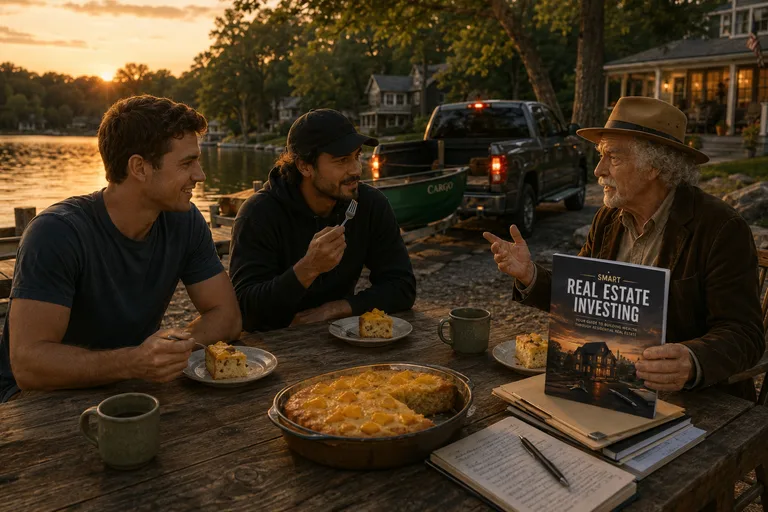
“You boys want some homemade banana-mango cake?”
Dorian looked at Dylan. “Is that a trick question?”
“No,” Bob said. “Come inside and get a slice before I reconsider.”
That was all the invitation they needed.
As they followed him through the back door, Bob stopped beside a small table near the kitchen and picked up a hardcover book.
“Dylan, I have something for your mother.”
Dylan looked at the book. “What is it?”
“My book.”
“You wrote another one?”
Bob handed it to him.
The title read: Smart Real Estate Investing
Dylan turned it over in his hands.
“What does Mom want with a real estate book?”
“Your parents have been talking about buying a house and renting it out.”
“They have?”
“They are looking into it. They asked me a few questions, so I marked the chapters they should read first.”
Dorian leaned over Dylan’s shoulder.
“Did you write a chapter called ‘Why Are Socialists So Stupid?’”
Bob opened the refrigerator and removed the cake.
“No. That book is about making money.”
He placed the cake on the counter and began cutting three large slices.
“The chapter about losing money is called ‘Taking Financial Advice from Your Friends.’”
Dorian laughed.
Dylan opened the book and noticed several pages marked with small yellow tabs.
“You really think they should buy a rental house?”
“I think they should study it before they buy anything,” Bob said. “A rental property can build wealth, but only when you buy the numbers—not the dream.”
“What does that mean?”
“It means the rent has to cover the mortgage, taxes, insurance, repairs, vacancies, and all the things people forget when they imagine themselves becoming landlords.”
Bob handed each of them a plate.
“A house is not automatically an investment just because somebody else sleeps in it.”
Dylan took a bite of cake. “This is good.”
“Of course it is.”
Dorian tasted his slice.
“Did you make this?”
Bob looked offended.
“You think wisdom is my only talent?”
Dylan tucked the book under his arm.
“I’ll give it to Mom.”
“Tell her to call me before they sign anything.”
“Why?”
“Because enthusiasm has purchased more bad real estate than ignorance ever did.”
Bob took his own slice and sat at the kitchen table.
Outside, the canoe rested quietly beside the garage. Inside, Dorian had already begun asking Bob questions about rental income, mortgages, and how much money someone should save before buying a property.