Think of it as Yoga for the brain, we are going to stretch a bit.
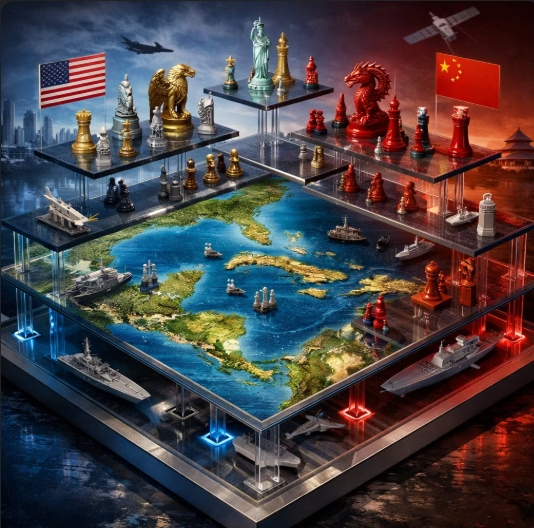
CHINA. CHINA. CHINA. And Why Venezuela is an important chess piece.
CHINA. CHINA. CHINA.
Say it three times, because that’s the real headline hiding behind the noise.
Yes, Venezuela just lost its dictator. Yes, Nicolás Maduro and Cilia Flores were captured during Operation Absolute Resolve, transferred into U.S. custody at sea, and are now expected to face charges in Manhattan federal court. Multiple outlets report they were moved via a U.S. amphibious assault ship before arrival in New York. That part is real, documented, and still unfolding.
But if you think this was just about cocaine, democracy, or even Venezuelan oil, you’re staring at the chessboard and arguing about the color of the squares.
This was a hemispheric security operation, and the pacing threat behind it wears a red flag with five stars.
Maduro wasn’t taken because Washington suddenly discovered its conscience. He was taken because Venezuela had become a strategic liability sitting uncomfortably close to America’s jugular. The U.S. Gulf Coast produces roughly 43% of U.S. crude oil and about 31% of refining capacity, most of it clustered along vulnerable coastal infrastructure. In any future high-end conflict—especially one involving China—that coastline matters more than slogans ever will.
From northern Venezuela to the Gulf Coast is roughly 2000 miles. To the Panama Canal, about 680 miles. All within missile range of a cargo ship. You don’t need imagination to see the problem—just a ruler and a range ring.
And this is where China quietly enters every paragraph.
China’s trade with Latin America and the Caribbean hit $551 billion in 2024, and Venezuela accounted for roughly 44% of all Chinese development finance in the region since 2005—before Beijing’s policy banks officially stopped lending in 2016. Oil-for-loans. Infrastructure-for-access. Satellites. Ports. Dual-use projects. Venezuela wasn’t a friend; it was a forward operating concept.
Which brings us to the Panama Canal—Phase One, not Phase Two.
Reuters reported that CK Hutchison, the Hong Kong-based firm operating key ports at Balboa (Pacific) and Cristóbal (Atlantic), agreed to sell most of its stake to a consortium including BlackRock. Those ports aren’t the canal itself—but anyone who understands chokepoints knows that controlling the doors matters almost as much as controlling the hallway. In a Taiwan contingency, you do not want a hostile power with leverage on both sides of the canal. A single scuttled vessel in the locks and suddenly U.S. naval logistics are taking the long way around the world.
Maduro’s arrest followed that move—not preceded it.
Now about the legality everyone on social media is screaming about.
Maduro has been under active U.S. indictment for nearly six years, accused of narco-terrorism conspiracy, cocaine importation, money laundering, and partnership with armed groups including FARC, ELN, and transnational criminal networks. The indictment does not treat him as a legitimate head of state. It describes him as an illegitimate ruler who retained power after disputed elections and used state machinery to run a criminal enterprise. From Washington’s perspective, that paperwork matters. It’s how you say, “This wasn’t an invasion. It was an arrest.”
Messy? Yes. Clean? No. But not accidental.
Now zoom out.
For BRICS, this is a stress fracture. The entire BRICS pitch relies on permanence—sanction-resistant regimes, discounted energy, alternative finance, and the comforting illusion that time is on their side. Venezuela and Iran weren’t side projects; they were load-bearing pillars.
If Iran follows—and the streets suggest it might—China loses cheap oil, Russia loses a sanctions partner, Hezbollah loses passports, and the yuan-settlement experiments quietly die of embarrassment.
And Russia? Moscow reads this with a calculator. Lower oil prices hurt. A destabilized Iran hurts. A chastened China makes a quieter partner. None of this ends wars overnight—but it tightens timelines and shrinks options.
Here’s the real change, the one that keeps people awake at night:
A precedent has been set.
Not regime change. Arrest.
That idea terrifies authoritarians more than aircraft carriers ever did. It turns every palace into a temporary lease and every “strategic partner” into a potential liability. Maduro didn’t fall because he lacked friends. He fell because his friends couldn’t protect him—and may have exposed him.
So yes, Venezuela matters.
Yes, Iran matters.
But China matters most.
Because when you plan for Taiwan, you don’t get to ignore the Caribbean. And if you plan for the Pacific while forgetting the Gulf Coast, you’re not planning—you’re hoping.
History has a habit of punishing hope when it pretends to be strategy.