Think of it as Yoga for the brain, we are going to stretch a bit.
The New Plaza Accord: The Deal Nobody Will Understand Until It Is Too Late
History’s biggest turns do not kick down the door. They slip in like a thief in the night, and by the time people notice, the world has already changed. -- YNOT!
Most of the time, history does not announce itself.
Big events happen quietly. The people living through them do not fully understand them. Sometimes even the people inside the room do not understand the full consequences of what they are doing.
One thing triggers another. Then another. Then another.
A currency deal becomes an industrial collapse. A war becomes a new world order.
A financial agreement becomes thirty years of economic pain.
A quiet meeting becomes the beginning of a new monetary system.
That is how history usually works.
You do not see the full meaning of an event when it happens. You see it years later. Sometimes decades later. By then, everyone acts like it was obvious.
It was not obvious.
That is why I want to lay out a theory. And honestly I don’t now if it is true, and if it was true if it is a positive thing or not. Not a certainty. Not a prediction carved in stone. A theory.
But one that may explain what is really happening behind the headlines.
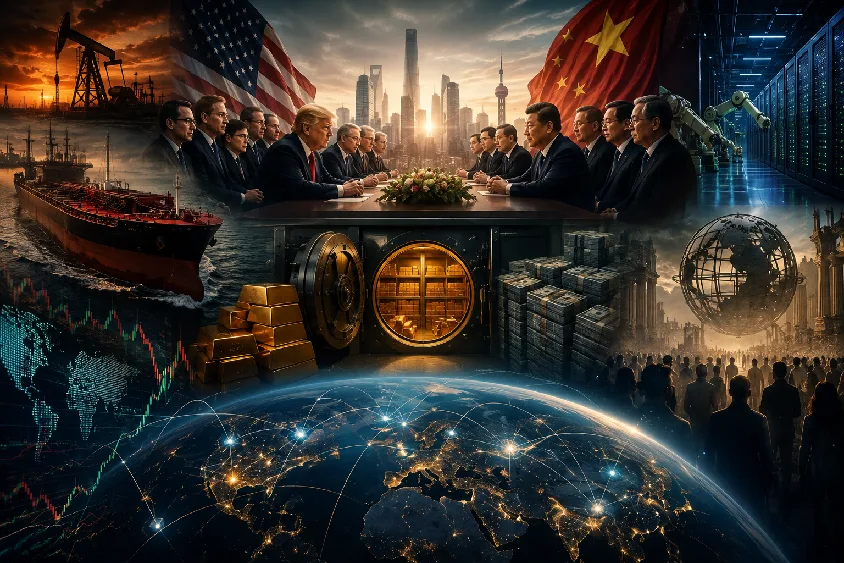
When Trump went to China and brought with him some of the most powerful CEOs in the world — Elon Musk, Tim Cook, Jensen Huang, Larry Fink, and others — that was not just a photo opportunity.
That was not just another diplomatic trip. That may have been one of the most important business and monetary meetings of our lifetime.
The official language was about cooperation, stability, humanity, trade, technology, and the future of relations between America and China.
But that is always how history talks in public.
The real question is this: Was this meeting about creating a new monetary order?
Because the old one is breaking.
The post-World War II order, largely built and imposed by the United States, is no longer functioning the way it used to. The dollar system is under pressure. The American industrial base has been hollowed out. China has become the factory of the world. Debt is exploding. Gold is moving. Supply chains are shifting. AI is about to destroy and remake whole categories of work.
The world is at a crossroads. And the country that helps write the next monetary order will help write the next century.
China knows this. America knows this.
The question is whether both sides are preparing a deal that most people will not understand until after it has already changed their lives.
The Ghost of the Plaza Accord
To understand what may be happening now, you have to go back forty years.
In 1985, the United States had a problem.
The dollar was too strong. The trade deficit was too large.
American manufacturers were getting crushed.
Foreign goods were cheaper. American exports were less competitive.
Sound familiar?
So the Reagan administration called a meeting at the Plaza Hotel in New York City. The United States brought in Japan, West Germany, France, and the United Kingdom.
Behind closed doors, they made a deal. That deal became known as the Plaza Accord.
The purpose was simple: weaken the U.S. dollar, especially against the Japanese yen.
The result was dramatic. The yen surged. Japanese exports became more expensive. American goods became more competitive. The U.S. trade deficit improved.
On paper, it looked like a win. But Japan paid the price.
Because when the yen rose that fast, Japan’s export-driven economy started to seize up. To compensate, Japan flooded its economy with cheap money. That cheap money created one of the biggest asset bubbles in modern history.
Stocks exploded. Real estate exploded. Debt exploded. Speculation exploded.
Then the bubble burst.Japan spent the next thirty years trying to recover from it.
History calls it the Lost Decades. So here is the lesson:
A currency deal can reshape the world. It can save one country and cripple another.
It can look like diplomacy while quietly rearranging the economic future of millions of people.
That is why a new Plaza Accord matters.
But China is not Japan. China watched what happened to Japan.
And China is not going to walk into the same trap.
China Will Not Let the Yuan Become the Yen
China’s hard line is simple: They will not allow a direct revaluation of the yuan against the dollar. They know what happened to Japan. They know that if their currency rises too fast, their export machine gets damaged. Factories suffer. Jobs suffer. Social stability suffers.
China’s entire political system depends on stability.
So if the world needs a monetary reset, China will not want the yuan to be the pressure valve. They need another asset to absorb the repricing.
That asset may be gold. Gold is the one asset both sides can use without saying the quiet part out loud.
America has gold. China has gold. Central banks have gold. Gold has no counterparty.
Gold is not printed by governments. Gold is not a campaign promise.
Gold is not a Treasury bill. Gold is not a central banker’s speech.
Gold is the old money hiding underneath the new money.
And if the dollar weakens against gold, both America and China can claim they did not directly destroy each other’s currency system.
That is the theory. Not a yuan revaluation. A gold-centered monetary reset.
A Plaza Accord 2.0, but this time the pressure valve is not Japan’s currency.
It is gold.
The Gold Escape Valve
The United States government holds more than 8,000 tons of gold.
But on the government’s books, that gold is still valued at around $42 an ounce, a relic from the old monetary system.
That accounting price has almost nothing to do with the real market price of gold.
So the United States is sitting on an asset that is massively understated on paper.
If America marked that gold closer to market value, the national balance sheet would suddenly look very different. It would not magically erase the debt, but it would change the optics and possibly the structure of the monetary system.
China also holds a huge amount of gold. Officially, they report one number. Unofficially, many believe they hold much more. And China has been accumulating gold for years.
So imagine the deal.
China does not revalue the yuan. America does not openly default.
The dollar weakens against gold. Gold rises dramatically.
America’s gold reserves become more valuable.
China’s gold reserves become more valuable.
The debt burden gets inflated away in real terms.
Both sides claim victory.
Then, in exchange, Chinese capital begins flowing into American manufacturing, factories, infrastructure, and industrial rebuilding.
Trump gets to say he brought factories back. China gets tariff relief, market access, and a seat at the table in the new monetary order.
Both sides get to look like they saved the world.
But the real story would be this: The dollar was devalued without calling it a devaluation.
Inflation Is Not the Accident. Inflation Is the Mechanism.
Most people misunderstand inflation.
They think inflation is a policy mistake.
Sometimes it is. But sometimes inflation is the plan.
Because inflation is how governments make unpayable debt payable again.
If you borrow a dollar today and pay it back years later with a dollar that is worth half as much, the debt shrinks in real terms.
The numbers stay the same. The burden changes.
That is the trick.
The government does not have to say it defaulted. It does not have to say it robbed savers.
It does not have to say it diluted the working class.
It just lets the value of money fall.
Normal people experience this as higher rent, higher groceries, higher insurance, higher taxes, higher car payments, and higher electric bills.
But asset owners experience it differently. If you own stocks, real estate, gold, Bitcoin, land, businesses, collectibles, productive tools, or scarce assets, inflation may actually make you richer in nominal terms. Your assets go up.
But if your wealth is sitting in cash, wages, or a savings account, inflation eats you alive.
That is the K-shaped economy. The top line goes up. The bottom line goes down.
The people with assets survive the monetary reset. The people without assets get reset.
AI Makes the Divide Worse
Now add AI on top of this. AI is not just another technology trend. It is a productivity earthquake.
It will make the top half of the economy more powerful, more efficient, and more profitable. But it will also destroy many of the jobs the bottom half depends on.
Customer service.
Data entry.
Basic office work.
Warehouse systems.
Trucking.
Manufacturing.
Accounting support.
Marketing support.
Administrative work.
Even parts of programming, design, and media.
This does not mean every job disappears overnight. But it does mean the labor market is going to be reorganized.
Some people will adapt. Some people will move up. Some people will use AI as leverage. Some people will be left behind.
That is not cruelty. That is math.
Every major transition leaves people behind.
The printing press did it. The industrial revolution did it. Electricity did it. The internet did it. Globalization did it. AI will do it faster.
So now you have inflation destroying savers, assets protecting the wealthy, and AI weakening the job base for millions of people.
That creates anger. That creates low trust. That creates political instability. That creates protests, resentment, conspiracy, and social breakdown. And the people managing the system know this.
That is why the digital control structure is being built at the same time.
Digital identity. Programmable money. Central bank digital currency. Algorithmic banking. Financial surveillance. Social scoring by another name.
Speech monitoring. De-banking. Access control. Permission-based money.
They will call it convenience. They will call it safety.
They will call it financial innovation.
But what it really means is this: When the class divide gets worse, the system will need tools to manage the anger. That is the digital control grid.
The Real Question
So is this theory guaranteed? No.
Maybe there is no deal. Maybe gold is not the pressure valve.
Maybe China and America cannot agree.
Maybe supply chains break before the system resets.
Maybe markets crash. Maybe oil explodes.
Maybe the whole theory is wrong.
But even if the details are wrong, the direction looks clear. The old order is breaking. The dollar is losing purchasing power. Debt is too high. Gold is rising.
China wants a bigger seat at the table. America wants to rebuild manufacturing.
AI is changing labor. Inflation is dividing society.
And people without assets are getting crushed.
So the question is not whether you like Trump, China, gold, Bitcoin, or central banks.
The question is simpler:Which side of the K-shaped economy are you on?
Are you on the side that owns assets? Or are you on the side that gets paid in dollars, saves in dollars, rents in dollars, and watches those dollars buy less every year?
Because if this is a monetary transition, the people who understand it early will prepare.
The people who understand it late will complain. And the people who never understand it will simply be poorer and never know why.
This is not investment advice. It is a warning.
Governments can print dollars. They can print promises. They can print statistics. They can print excuses.
But they cannot print gold. They cannot print land. They cannot print productive businesses. They cannot print real skill. They cannot print time.
Every major historical reset rewards the people who own scarce, useful, durable assets.
And it punishes the people who trusted paper too much.
Historical Events People Did Not Understand at the Time
Here are examples of events that looked like one thing when they happened, but only revealed their full importance years later:
The assassination of Archduke Franz Ferdinand in 1914 looked like a regional crisis. It became World War I.
The Treaty of Versailles looked like peace. It helped create the conditions for World War II.
The creation of the Federal Reserve in 1913 looked like banking reform. It changed the entire American monetary system.
Bretton Woods in 1944 looked like postwar planning. It made the dollar the center of the global financial system.
Nixon closing the gold window in 1971 looked like a temporary emergency measure. It ended the dollar’s direct link to gold.
The Plaza Accord in 1985 looked like currency coordination. It helped trigger Japan’s Lost Decades.
China joining the World Trade Organization in 2001 looked like free trade. It reshaped global manufacturing and hollowed out parts of America’s industrial base.
The 2008 financial crisis looked like a housing collapse. It became the beginning of permanent central bank intervention.
The COVID response looked like a public health emergency. It accelerated remote work, money printing, supply-chain instability, digital control, and distrust in institutions.
The rise of AI looks like a technology boom. It may become the largest labor reset in modern history.
History does not usually knock on the door and say, “I am here.” It walks in quietly.
Then years later, everyone asks why nobody saw it coming.