Think of it as Yoga for the brain, we are going to stretch a bit.
The Joy of Missing Out
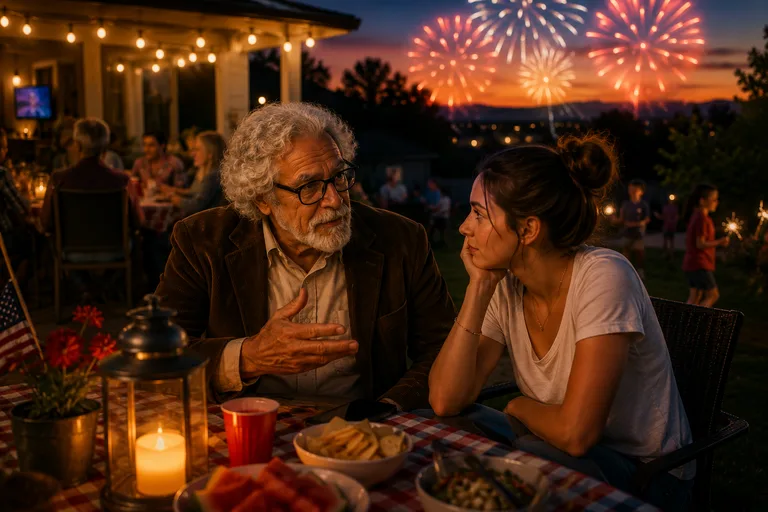
It was a typical Fourth of July at Uncle Bob’s house.
The grill was smoking, children were running through the yard with sparklers, and several generations of the family had gathered under the covered patio to eat too much food and argue about things nobody intended to resolve.
Music played softly from a speaker near the pool. Every few minutes, someone’s phone would chirp, buzz, or light up.
Across the patio, I noticed my cousin Karly sitting by herself.
She was staring down at her phone and sniffling.
At first, I thought the smoke from the grill had gotten to her. Then I noticed her wiping her eyes.
I walked over and sat beside her.
“Are you okay?” I asked.
That was all it took.
Boy, did I get an earful.
“No,” she said. “I’m not okay. Everybody else is doing something with their lives except me.”
I looked around the yard.
“You’re doing something right now,” I said. “You’re at a Fourth of July party.”
“That’s not what I mean.”
She turned her phone toward me.
The screen showed a photograph of one of her friends standing on a beach somewhere. The water was impossibly blue, the sand looked untouched, and the caption suggested that the woman had somehow discovered the meaning of life while drinking something from a coconut.
“She’s in Aruba,” Karly said.
“Looks nice.”
“She just got promoted, too.”
Karly swiped to another photograph.
Another friend was standing beside a new car with a large red bow tied around it.
“She bought that yesterday.”
Another swipe.
“This one just got engaged.”
Another swipe.
“They bought a house.”
Another.
“She started her own business.”
Another.
“They’re in Italy.”
I nodded carefully, trying to think of something useful to say.
Karly leaned back in her chair.
“I feel like everybody is moving forward and I’m standing still. I should be traveling. I should have a better job. I should be making more money. I should probably be married by now. I should be doing something exciting.”
I opened my mouth.
Thankfully, before I could say anything foolish, Uncle Bob began walking toward us.
He had apparently heard enough of the conversation to recognize danger.
I was not ready to be the wise uncle.
Uncle Bob was.
He pulled over another chair and sat across from Karly.
“What’s the problem?” he asked.
Karly gave him the abbreviated version, which still took almost ten minutes.
When she finished, Uncle Bob held out his hand.
“Give me your phone.”
She looked suspicious.
“Why?”
“I’m not going to throw it in the pool.”
“You promise?”
“No. But give it to me anyway.”
She handed it over.
Uncle Bob turned the phone facedown on the table.
“There,” he said. “Your life has already improved.”
Karly rolled her eyes.
“I’m serious, Uncle Bob.”
“So am I.”
He pointed toward the yard.
“Look around.”
She glanced toward the people eating, laughing, and preparing for the fireworks.
“What am I supposed to be looking at?”
“Your grandmother is sitting over there telling the same story she has told every Fourth of July for the past fifteen years.”
Karly smiled slightly.
“Your little cousins are chasing each other with water guns. Your father is pretending he knows how to cook ribs. Your mother has spent all afternoon feeding people who said they weren’t hungry. The sun is going down. The weather is good. The family is together.”
He tapped the phone.
“And you are sitting here comparing all of that to a photograph of somebody holding a coconut.”
Karly looked down.
“It’s not just the vacation.”
“I know,” Uncle Bob said. “It never is.”
He settled back in his chair.
“The problem is not that your friends are doing well. The problem is that every time somebody else announces something good, you use it as evidence that something is wrong with your life.”
Karly became quiet.
“That has a name now,” he continued. “FOMO. The fear of missing out.”
“I know what FOMO is.”
“Most people know the name. They don’t always recognize how much it controls them.”
He picked up her phone again but did not turn it over.
“FOMO makes you believe that life is happening somewhere else. At another party. In another city. At somebody else’s job. Inside somebody else’s marriage. In somebody else’s bank account.”
He handed the phone back to her.
“And because you are always looking at somebody else’s life, you stop noticing your own.”
Karly folded her arms.
“So I’m just supposed to stop wanting things?”
“No. Wanting more is not the problem. Letting other people decide what you should want is the problem.”
He pointed toward the phone.
“These little machines are comparison factories. Every day, they show you everybody else’s best meal, best vacation, best outfit, best relationship, and best business announcement.”
He paused.
“But they rarely show you the argument before the photograph, the credit-card bill after the vacation, the stress behind the promotion, the loneliness inside the marriage, or the fear behind the smiling face.”
Karly nodded slowly.
“So social media is fake?”
“Not always fake. Just incomplete.”
He leaned closer.
“A photograph can be true and still not tell the truth.”
That sentence quieted both of us.
Uncle Bob continued.
“Your friend may genuinely be happy in Aruba. Good for her. But her happiness does not create a deadline for yours.”
Karly looked toward the pool.
“I just feel behind.”
“Behind whom?”
“Everybody.”
“There is no everybody.”
She looked back at him.
“There are millions of people living millions of different lives on millions of different schedules. Some marry at twenty. Some marry at forty. Some start businesses at twenty-five. Others start them after retirement. Some people travel the world and wish they had a home. Some have beautiful homes and wish they had the freedom to leave.”
He shrugged.
“There is no single timetable.”
“But what if I really am wasting time?”
“That is possible,” Uncle Bob said.
Karly looked surprised.
I was surprised too.
Uncle Bob was not the kind of man who offered comfort by pretending every concern was imaginary.
“You may need to make changes,” he continued. “Maybe you need a better job. Maybe you should travel. Maybe there is something you have been postponing because you are afraid.”
He pointed toward her chest.
“But those decisions should come from here, not from panic caused by something you saw on a screen.”
He stood and walked over to the cooler.
“Do you want something to drink?”
“Water.”
He handed her a bottle, then sat down again.
“There is another word you should learn.”
“What?”
“JOMO.”
Karly laughed.
“That sounds made up.”
“So does FOMO.”
“What does it mean?”
“The joy of missing out.”
“That sounds like something boring people invented.”
“It was probably invented by someone who finally got tired of being exhausted.”
He twisted the cap from his own bottle.
“JOMO is being able to say, ‘That looks nice, but it is not for me.’ It is staying home without imagining that everybody else is having a better time. It is declining an invitation without writing a five-paragraph apology. It is watching a trend pass by without feeling obligated to chase it.”
Karly looked doubtful.
“That sounds like giving up.”
“No. Giving up is quitting something that matters. JOMO is refusing something that does not.”
He nodded toward the street, where cars had been arriving and leaving all afternoon.
“Most people spend their lives afraid to miss a party, an opportunity, a promotion, an investment, or a trend. They rush from one thing to another because stopping makes them nervous.”
He took a slow drink of water.
“They become so afraid of missing life that they miss the life they are actually living.”
That line stayed with me.
The sky had begun to darken, and the first distant fireworks were appearing above the rooftops.
Uncle Bob watched one burst into red sparks.
“When I was younger,” he said, “I thought every opportunity had to be taken. Every invitation had to be accepted. Every new idea had to be pursued. I thought staying busy meant I was important.”
“What changed?” I asked.
“I got tired.”
Karly laughed.
Uncle Bob smiled.
“I also realized that being busy and building a good life are not the same thing.”
He looked at both of us.
“A person can spend all day moving and still go nowhere.”
The music stopped briefly as someone changed the playlist. For a few seconds, the yard became noticeably quieter.
Uncle Bob noticed.
“That is what people are afraid of now,” he said.
“What?” Karly asked.
“Silence.”
He gestured toward the phones on the table.
“The minute there is no conversation, people reach for a screen. The minute they are alone, they look for noise. The minute they feel bored, they demand entertainment.”
He looked toward the sunset.
“But boredom is not always an emergency. Sometimes it is the doorway to thought.”
Karly turned her phone over but did not unlock it.
“So what am I supposed to do? Meditate in the woods?”
“If you want.”
“I don’t.”
“Then don’t.”
He laughed.
“People make slowing down more complicated than it needs to be. You do not have to move to a cabin or become a monk. Start small.”
“Like what?”
“Eat one meal without looking at your phone.”
“That’s it?”
“That would be a miracle for some people.”
He began counting on his fingers.
“Take a walk without headphones. Sit outside for ten minutes. Wake up early enough that your morning is not a fire drill. Turn off notifications that do not deserve access to your nervous system.”
Karly smiled.
“Notifications have access to my nervous system?”
“Apparently all of them do.”
He continued.
“Learn to say no. Not angrily. Not dramatically. Simply say, ‘That does not work for me.’ Protect your time before other people spend it for you.”
Karly thought about that.
“I’m bad at saying no.”
“Most people are. They think saying no makes them selfish.”
“Doesn’t it?”
“Sometimes. But saying yes to everything can also be selfish.”
“How?”
“Because eventually you become tired, resentful, and unpleasant to everybody you agreed to help.”
I laughed.
“I’ve met people like that.”
“So have I,” Uncle Bob said. “One of them used to be me.”
He leaned forward.
“Your time is a limited resource. Every yes is also a no to something else.”
Karly raised an eyebrow.
“What do you mean?”
“If you say yes to another night out, you may be saying no to sleep. If you say yes to another project, you may be saying no to your health. If you say yes to another hour online, you may be saying no to reading, thinking, exercising, or talking to someone you love.”
He picked up a paper plate from the table and brushed away a few crumbs.
“People pay attention to how they spend money, but many never examine how they spend their lives.”
By then, several family members had moved their chairs closer to us. They pretended to be waiting for fireworks, but I could tell they were listening.
Uncle Bob lowered his voice slightly.
“Living slowly does not mean living without ambition. It means acting with intention.”
He pointed toward Karly.
“You can work hard without rushing emotionally. You can build a business without chasing every trend. You can invest without buying whatever strangers are celebrating this week.”
“That sounds like something you would say about cryptocurrency,” I said.
“It applies to almost everything.”
He looked at Karly again.
“FOMO is expensive.”
“How?”
“In business, FOMO makes people abandon good plans because a competitor announced something new. They invest money in technology they do not understand, hire people they do not need, or launch products that do not fit their customers.”
He tapped the table.
“In investing, FOMO makes people buy after the price has already climbed because they are afraid everyone else will become rich without them. Then fear arrives, the price falls, and they sell at a loss.”
“So what does JOMO look like in investing?” Karly asked.
“It looks boring.”
“That doesn’t sound appealing.”
“Good investing often is boring. You make a plan. You understand what you own. You diversify. You wait. You ignore people who became experts yesterday.”
He smiled.
“The market has collected more money from impatient people than almost any casino.”
Karly looked again at the photograph of her friend’s vacation.
“Maybe I have been letting everybody else set my goals.”
“Most people do until they stop and decide what matters.”
“How do I decide?”
“You ask better questions.”
“Such as?”
“Instead of asking, ‘What is everyone else doing?’ ask, ‘What kind of life do I actually want?’”
He waited.
“Instead of asking, ‘How do I look successful?’ ask, ‘What would make my days feel meaningful?’”
He waited again.
“Instead of asking, ‘What am I missing?’ ask, ‘What am I failing to appreciate?’”
Karly stared toward the yard.
Her grandmother was laughing so hard at something that she had to wipe her eyes. Two of the younger children were lying on the grass looking at the sky. Someone had begun cutting watermelon near the kitchen door.
“I guess this isn’t a bad place to be,” Karly said.
“It is not.”
“But I still want to travel.”
“Then travel.”
“And I want a better job.”
“Then make a plan to find one.”
“And maybe start something of my own.”
“Then start small and learn.”
He pointed toward her phone again.
“But do not confuse inspiration with instruction. Somebody else’s life may give you ideas. It should not give you orders.”
The first large firework exploded above the neighborhood.
Everyone in the yard looked up.
For several seconds, there were no phones, no comparisons, no plans, and no worries. There was only the sound, the flash of color, and the faces of people illuminated beneath it.
Uncle Bob watched the sparks disappear.
“That,” he said, “is the deliciousness of life.”
Karly laughed.
“The what?”
“The deliciousness of life. Those moments you would miss if you were too busy looking for something better.”
He leaned back.
“A meal you actually taste. A conversation you do not rush. A quiet morning. A walk beneath trees. Sitting beside someone you love without needing to fill every second with words.”
Another firework opened above us, this one gold and white.
“The world is going to keep rushing,” he said. “Let it.”
He folded his hands over his stomach.
“You do not have to move at the speed of everybody else’s anxiety.”
Karly turned off her phone and placed it on the table.
“Do you really think I’m going to be okay?”
Uncle Bob looked at her.
“I think you will be better than okay when you stop treating your life like it is late.”
She rested her head against his shoulder.
For the next twenty minutes, we watched the fireworks.
Nobody said very much.
Nobody needed to.
Later that night, as I was leaving, Uncle Bob walked me toward my car.
“You were awfully quiet back there,” he said.
“I was going to give her advice.”
“That is what worried me.”
I laughed.
“I didn’t know what to say.”
“That is all right.”
He placed a hand on my shoulder.
“One day, you will be the uncle sitting in that chair.”
“I don’t think I’m ready.”
“Nobody is ready.”
He looked back toward the house, where Karly was helping her grandmother carry dishes into the kitchen.
“The first rule is to listen long enough to discover what the person is really afraid of.”
“And the second rule?”
“Do not give advice merely because there is silence.”
I nodded.
“And the third?”
“Tell them the truth, but leave them with hope.”
I opened my car door.
“That sounds difficult.”
“It is.”
He smiled.
“That is why people need rich uncles.”
As I drove home, I thought about Karly, her friends, their photographs, and the pressure we place on ourselves to keep up with lives we do not truly understand.
Perhaps the goal is not to withdraw from the world or stop wanting more.
Perhaps the goal is to stop rushing blindly through the life we already have.
To work hard, but rest without guilt.
To pursue opportunity, but reject panic.
To appreciate other people’s happiness without using it as evidence against our own.
FOMO tells us that something important is always happening somewhere else.
JOMO reminds us that we are allowed to choose where our lives happen.
And sometimes, the richest moment is not the promotion, the vacation, the purchase, or the announcement.
Sometimes it is a July evening at your uncle’s house, sitting beneath a dark sky, surrounded by family, while the whole world briefly becomes quiet enough to notice.
Rich Uncle’s Lesson
Do not measure your life against the carefully selected moments of other people’s lives.
Set goals, work hard, travel, build, invest, and dream—but make sure the life you are pursuing is genuinely yours.
Slowing down is not dropping out. It is paying attention.
Learn to enjoy missing what does not matter so you can be fully present for what does.
Life is not measured by how quickly you move through it.
It is measured by how deeply you experience the moments you were given.
You have a choice: live with FOMO, embrace JOMO, or savor the deliciousness of life.