Think of it as Yoga for the brain, we are going to stretch a bit.
I Survived Cuban Socialism
The Story of José Hernández
My name is José Hernández, and I survived Cuban socialism.
I do not use the word survived lightly.
I was not rescued from a battlefield. I was not pulled from the ruins of a collapsed building. I survived something slower—a political system that enters the classroom, the workplace, the neighborhood, the family, and eventually the private thoughts of every person living beneath it.
In Cuba, fear does not always announce itself.
It does not always arrive wearing a military uniform or carrying a rifle. Sometimes it lives in a conversation that suddenly becomes quiet when someone unfamiliar enters the room. Sometimes it is a mother warning her child never to repeat at school what was said at home.
Sometimes it is the realization that you do not know who genuinely supports the government, who secretly despises it, and who is merely pretending because pretending is safer than prison.
That is one of the most destructive things about dictatorship: it makes honesty dangerous.
People learn to hide themselves.
They praise what they hate. They repeat what they know is false. They applaud because everyone else is applauding. They become careful around coworkers, neighbors, teachers, relatives, and sometimes even friends.
You never know who might report you.
Some Cubans still defend the regime because they receive benefits from it. They may be rewarded with a better job, a motorcycle, a television, a house, a smartphone, or a mobile data plan. The rewards are sometimes small, but in a country where almost everyone has very little, even a small privilege can purchase loyalty.
Others defend the system because they have believed its propaganda for so long that admitting the truth would mean admitting that much of their lives was built upon a lie.
But I did not always understand these things.
I was raised inside the lie.
We Will Be Like Che
My political education began before I was old enough to understand politics.
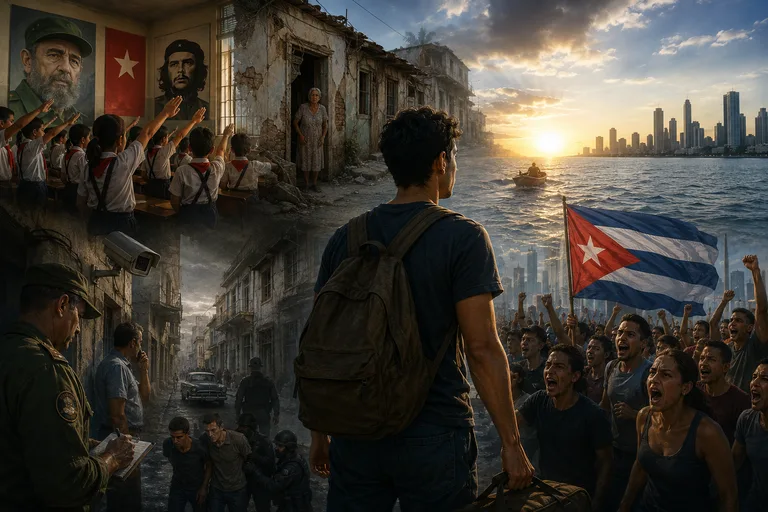
Every morning at school, we participated in ceremonies celebrating the Revolution. Fidel Castro was presented not simply as a political leader but almost as a sacred figure.
His image was everywhere.
It appeared in classrooms, hallways, offices, bulletin boards, textbooks, posters, and public buildings. We were surrounded by slogans, heroic stories, revolutionary symbols, and carefully selected versions of history.
We were taught that the Revolution had saved Cuba.
We were taught that communism represented justice.
We were taught that anyone who opposed the government was either ignorant, selfish, corrupt, dangerous, or working for a foreign enemy.
Then we were required to shout:
“Pioneers for Communism, we will be like Che!”
We were children.
We did not understand who Che Guevara really was. We did not understand communism, capitalism, dictatorship, democracy, political prisoners, independent journalism, or civil liberties.
We only understood that there was a correct answer and a dangerous answer.
The correct answer was the one the government had given us.
From the beginning, education was not merely about mathematics, science, language, or history. It was about manufacturing loyalty.
The purpose was not to teach children how to think.
It was to teach them what to think.
The Country of Permanent Propaganda
As I grew older, I began noticing how much money the government spent maintaining the appearance of public enthusiasm.
There were communist posters everywhere. There were banners, billboards, slogans, political celebrations, speeches, organized gatherings, and mandatory demonstrations.
Buses were used to transport workers and students to May Day marches and January 1 celebrations. Attendance was often presented as voluntary, but everyone understood that refusing to participate could create problems.
The government wanted enormous crowds because enormous crowds looked like public support.
Whether the people in those crowds genuinely supported the government was another question.
The spectacle mattered more than the truth.
One of the strangest examples was the national attention surrounding Elián González. His birthdays became political events. Cake, candy, and soft drinks were distributed to schools across the country.
In a nation where many families struggled to find food, medicine, soap, and basic necessities, the government could still find resources for propaganda.
There was always money for political theater.
There was rarely enough money for ordinary life.
Two Cubas Inside One Family
My family included people who supported the Revolution and people who opposed it.
I heard both sides.
The communists explained that Cuba’s hardships were caused by foreign enemies, the American embargo, sabotage, imperialism, and betrayal.
The critics spoke about repression, political prisoners, confiscated property, censorship, failed economic policies, corruption, and fear.
As a child, I could not judge between them.
As a teenager, I began to question.
As a university student, I finally began to understand.
I belonged to a generation that reached adulthood as limited internet access was slowly arriving in Cuba. For many years, the Cuban people had been denied meaningful access to the outside world.
Even when internet technology became available, most of us were not immediately given access to the open internet. We were confined largely to a government-controlled intranet.
The regime understood something important:
Information is dangerous to a government built upon isolation.
A dictatorship does not merely control what people can say. It tries to control what they can know.
Eventually, students discovered ways to bypass some of the restrictions. For the first time, I could see more of the world beyond official Cuban television, government newspapers, revolutionary textbooks, and carefully controlled political speeches.
I began reading foreign news.
I learned how other political systems functioned.
I saw open debates, competing political parties, independent organizations, protests, investigative journalism, criticism of presidents, public campaigns, and elections in which the outcome was not predetermined.
The internet did not tell me what to believe.
It showed me that I had been denied the information necessary to decide for myself.
That realization changed everything.
I decided I would not become another person who repeated propaganda merely because repeating it was easier than confronting it.
Never Repeat at School What You Hear at Home
Every Cuban child learns an unwritten rule:
What is said at home must remain at home.
A father might criticize the government at the dinner table and then warn his children never to repeat his words.
A mother might complain about food shortages but lower her voice when someone walked past the window.
A grandparent might remember life before the Revolution but speak only among trusted relatives.
Children were placed in an impossible position. The school encouraged loyalty to the Revolution, while families sometimes privately understood that the Revolution had failed them.
The system turned children into potential informants without their even realizing it.
A careless comment could cost a parent a job, an educational opportunity, a promotion, or worse.
People who left Cuba were insulted as gusanos—worms.
They were called counterrevolutionaries and traitors.
The neighbor across the street who emigrated was not treated as a person who had made a difficult choice. He became an enemy.
Why?
Because leaving Cuba challenged the government’s story.
If socialism had created paradise, why were so many people risking everything to escape it?
A Country Without Legal Opposition
Cuba did not allow people to create organizations that challenged the principles of the Revolution.
You could participate politically only within the boundaries established by the government.
You could not create a genuine opposition party.
You could not form an independent labor movement.
You could not organize freely against the ruling system.
You could not build a national political organization dedicated to replacing the government through ordinary democratic competition.
The system gave people a ballot but denied them meaningful political choice.
It created institutions and called them democratic, while ensuring that real opposition remained illegal, restricted, or dangerous.
By the time I finished university, I already knew I would never be comfortable living that way.
I am too rebellious to live as the obedient servant of a corrupt political elite.
Four Months of Revolutionary Employment
After graduation, I began the mandatory social service required of many Cuban graduates.
I lasted less than four months.
The salary was so low that it could not support a person for even a small portion of the month. The government spoke constantly about the dignity of labor, but it paid professionals wages that could not provide a dignified life.
You could work full time and still lack food.
You could possess a university degree and still be unable to buy basic necessities.
You could serve the State and remain dependent upon relatives, side jobs, informal trading, remittances, or favors.
Workers could not freely organize against these conditions because the labor unions were controlled by the State.
A union that answers to the employer is not an independent union.
A union that cannot challenge the government is not a meaningful defense of workers.
A worker could not freely organize a strike to demand better wages. He could not openly condemn the political system responsible for his poverty.
Even at work, criticism was dangerous.
The Revolution claimed to belong to the workers.
The workers were not allowed to oppose it.
The Eyes of the Neighborhood
Every neighborhood had people watching.
The system of local surveillance taught citizens to monitor one another. Informants paid attention to visitors, movements, conversations, political attitudes, and unusual activity.
Some people participated because they believed in the regime.
Some participated because they were afraid.
Some participated because informing brought rewards.
I saw people associated with the system receive motorcycles, cars, televisions, homes, and other benefits.
In a normal society, advancement is supposed to come through education, effort, creativity, service, or enterprise.
In a dictatorship, advancement often comes through loyalty.
The system created a market for obedience.
It encouraged people to exchange conscience for privilege.
Luxury Hotels and Collapsing Homes
I lived near Varadero, one of Cuba’s most important tourist areas.
I watched the government build new luxury hotels while ordinary Cuban buildings deteriorated.
Tourists slept in modern rooms, ate large meals, drank imported beverages, and relaxed beside carefully maintained swimming pools.
Meanwhile, elderly Cubans lived in houses that were literally collapsing around them.
Some had roofs that leaked.
Some lived behind cracked walls.
Some occupied structures that should have been condemned.
Some had no proper home at all.
The government always seemed capable of finding money for hotels that produced foreign currency.
It could find money for monuments, political events, propaganda, security organizations, and the machinery of control.
But when ordinary Cubans needed housing, medicine, plumbing, repairs, transportation, or food, there was never enough.
This is one of socialism’s great contradictions.
It promises equality while creating separate realities: one for the political elite, one for tourists, one for those connected to the system, and one for everyone else.
July 11, 2021
Then came July 11, 2021.
Across Cuba, people entered the streets.
They were frustrated by shortages, blackouts, repression, poverty, government failures, and the absence of a legal path to meaningful political change.
I saw what happened.
I knew university friends who were arrested.
They were decent people.
They were not criminals. They were not terrorists. They were not vandals. They were Cubans demanding the right to be heard.
Some received years in prison simply for participating in protests.
That moment destroyed any remaining illusion that Cuba permitted genuine political dissent.
A government confident in its legitimacy does not fear peaceful citizens in the street.
A government that claims to represent the people should listen when the people speak.
Instead, the regime answered dissent with arrests, prosecutions, intimidation, surveillance, and punishment.
The message was unmistakable:
You may suffer quietly.
You may leave.
But you may not challenge the system.
The Constitution That Could Be Changed When Convenient
I was also at university during the debate surrounding Cuba’s 2019 Constitution.
Citizens were encouraged to submit proposals and participate in discussions. It created the appearance that public opinion mattered.
Many proposals were heard.
Most were ignored.
One change that survived was an age limit of 60 for someone becoming president for the first time. Many hoped this would prevent the permanent recycling of elderly communist officials.
Then, in 2025, the rule was removed without a new popular referendum.
A provision that had been presented to the population as part of the constitutional settlement could be altered when it became inconvenient to those in power.
The document had already been structured to allow the ruling system to protect itself.
Then the government continued to describe Cuba as a democracy.
But democracy is more than voting on a document written within boundaries established by one political party.
Democracy requires genuine political competition.
It requires freedom of speech.
It requires independent journalism.
It requires freedom of association.
It requires citizens to organize against the government without being treated as enemies of the State.
It requires political leaders who can actually lose power.
Every Peaceful Road Was Closed
In Cuba, nearly every legal path to oppose the system was blocked.
You could not establish a competing national political party.
You could not freely organize mass protests against the government.
You could not create independent unions capable of confronting the State.
You could not build strong independent civic organizations outside revolutionary control.
For many years, even access to social media and the broader internet was severely restricted.
The system prohibited peaceful political replacement and then condemned anyone who demanded change.
It created a locked room and blamed the prisoners for wanting to escape.
Eventually, I understood that I had only one realistic choice.
I had to leave.
Leaving meant distance from my family.
It meant uncertainty.
It meant abandoning the country where I had been born.
It meant beginning again somewhere else.
But remaining meant surrendering my future to a system I could no longer pretend to believe in.
Kindness Does Not Cancel Dictatorship
I want to be honest.
I also witnessed acts of kindness in Cuba.
I saw people help neighbors.
I saw families share food when they had almost nothing.
I saw teachers care about their students.
I saw doctors and ordinary workers make sacrifices for others.
The Cuban people are not the Cuban government.
Human kindness can survive even inside a cruel political system.
But individual kindness does not erase dictatorship.
Good people living under oppression do not make the oppression good.
A government cannot excuse censorship, imprisonment, poverty, political control, and the denial of basic freedoms by pointing to moments when one Cuban helped another.
Those acts of kindness belong to the people.
The repression belongs to the State.
Why I Call Cuba a Dictatorship
I believe Cuba is a dictatorship because children are ideologically indoctrinated from an early age.
It is a dictatorship because its leaders are surrounded by a cult of personality.
It is a dictatorship because only one political party is legally permitted to dominate national political life.
It is a dictatorship because elections are not genuinely competitive.
It is a dictatorship because citizens cannot freely create an organized political opposition capable of removing the ruling system.
It is a dictatorship because opposition figures are harassed, monitored, intimidated, detained, and imprisoned.
It is a dictatorship because freedom of assembly and association is restricted.
It is a dictatorship because independent labor unions are not permitted to function freely.
It is a dictatorship because the judiciary does not operate independently from the political structure of the State.
It is a dictatorship because constitutional rules can be structured, interpreted, or changed to preserve the same ruling order.
Most importantly, it is a dictatorship because the Cuban people are not permitted to peacefully replace the entire political system through free and open competition.
The Great Lie
Socialism has appeared in many different forms and under many different names.
Its defenders will argue endlessly over definitions. They will insist that one historical regime was not truly socialist, another was not properly communist, another was corrupted, another was misunderstood, and the next attempt will finally succeed.
But for those who lived under the Cuban version, the debate is not academic.
We experienced the shortages.
We experienced the propaganda.
We experienced the surveillance.
We experienced the worthless salaries.
We experienced the inability to organize independently.
We experienced the fear of speaking freely.
We watched a ruling class demand sacrifice from the people while preserving power and privilege for itself.
The central lie was always the same:
The system claimed to act in the name of the people while denying the people the right to reject the system.
It claimed to liberate workers while preventing workers from organizing independently.
It claimed to provide equality while producing a privileged political caste.
It claimed to provide education while restricting information.
It claimed to represent the people while imprisoning people who protested.
It claimed to create dignity while forcing millions to survive through shortages, favors, remittances, black markets, and silence.
A system that must control speech, information, political organization, employment, education, and public assembly is not defending the people.
It is defending itself from the people.
Socialism does not fail only when the shelves become empty.
It fails when truth becomes dangerous.
It fails when children are taught loyalty before they are taught independent thought.
It fails when workers cannot challenge those who control their labor.
It fails when neighbors are trained to watch neighbors.
It fails when the government fears a protest more than it fears the suffering that caused it.
And it fails when leaving your homeland becomes the only peaceful vote against the system that you are still permitted to cast.
My name is José Hernández.
I was born inside the Revolution.
I was educated by it.
I worked under it.
I watched friends imprisoned by it.
And eventually, I escaped it.
I survived Cuban socialism.
Millions of Cubans are still trying to survive it.