Think of it as Yoga for the brain, we are going to stretch a bit.
The Platt Amendment: Cuba’s Independence Came With Fine Print
Throughout this series, I will try to approach Cuba’s history as honestly and fairly as possible. Some records are incomplete, and some events are still debated, so the goal is not to repeat propaganda from either side, but to look at the facts as clearly as we can.

The Platt Amendment is often presented as one of the reasons Fidel Castro and later Cuban revolutionaries became so hostile toward the United States. There is some truth to that argument, because the amendment became a symbol of American control over Cuba. But it is also important to remember that the Platt Amendment was repealed in 1934, long before the Cuban Revolution of the 1950s.

That does not make it irrelevant, but it does mean we should be careful not to blame every later Cuban problem on it. The Platt Amendment was part of its time: controversial, unequal, and deeply resented by many Cubans, but also defended by others as a stabilizing measure after years of war and political uncertainty.

In this series, we will look at the details, including U.S. intervention, the 1906 occupation, the events surrounding 1912, and the long shadow these moments cast over Cuban politics. The Platt Amendment happened. It shaped history. Whether it was necessary, harmful, or both is exactly the kind of question we will examine.
The Platt Amendment was one of those magnificent political inventions where one country tells another country it is free, then carefully explains all the ways it is not.
After the Spanish-American War, Cuba was supposed to become independent. That was the public story. Spain had been defeated. The old colonial master had been removed. The island that had fought, bled, rebelled, and buried its sons for freedom was finally going to become a republic.
At least that was the advertisement. But empires are very good at advertising freedom while keeping the receipt.
The United States had occupied Cuba after the war. The Teller Amendment had promised that the United States would not annex Cuba, which sounded noble enough. America would not swallow Cuba whole. It would not plant the flag and declare the island a permanent colony. It would not do what Spain had done.
Instead, Washington chose a more elegant method.
It would let Cuba become independent, but only after Cuba agreed to be independent under American supervision.
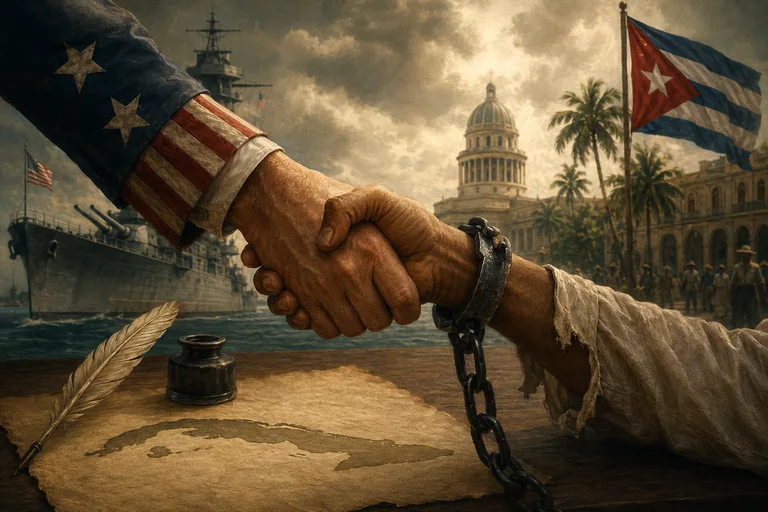
That was the genius of the Platt Amendment. It did not need to call Cuba a colony. It only needed to write rules that made Cuban sovereignty conditional. It was empire with better manners. A leash written in legal language.
The Platt Amendment was introduced in the United States Congress in 1901 as part of an Army appropriations bill. That alone tells you much of the story. Cuba’s future was not first decided in Havana by Cubans sitting freely among themselves. It was drafted in Washington, attached to American legislation, approved by American lawmakers, and then presented to Cuba as the price of ending American military occupation.
That is not quite the birth of a free republic.
That is a man being told he may leave the jail, provided he first signs over the right of the jailer to visit his house whenever he pleases.
The Cuban Constitutional Convention was then forced to review the amendment. Cuban delegates read it. They understood it. They resisted it. They tried to modify it. They tried to soften its language. They tried to protect what little dignity could be preserved inside a document designed to limit their independence before it even began.
But the United States had the stronger argument.
It had the army.
Washington made the matter plain: accept the Platt Amendment, or the occupation continues. Cuba had the same kind of choice a man has when a robber says, “Your money or your life.” Technically, there are two options. Practically, there is only one.
So the Cuban delegates debated. They objected. They divided. Some believed accepting the amendment was a bitter but necessary step toward getting the American troops out. Others saw it clearly for what it was: the replacement of Spanish colonial rule with American political supervision.
Eventually, Cuba accepted it reluctantly and by a divided vote.
The republic was born, but not cleanly.
It came into the world with a flag in one hand and a set of foreign restrictions in the other.
The Platt Amendment gave the United States the right to intervene militarily in Cuban affairs “for the preservation of Cuban independence” and for the maintenance of a government adequate to protect life, property, and individual liberty.
That language sounds almost beautiful if you do not read it too closely.
“Preservation of independence.”
“Protection of life.”
“Property.”
“Liberty.”
Those are the kinds of words empires use when they have dressed for church.
But the problem was not the poetry. The problem was the power behind it. The language was vague enough to justify almost anything Washington wanted to justify. If Cuba became politically unstable, the United States could intervene. If Cuba elected the wrong kind of leaders, the United States could intervene. If American investors became nervous, the United States could intervene. If Washington decided that Cuban independence was not behaving properly, then American troops could arrive to help Cuba remember how freedom was supposed to work.
In plain English, Cuba was independent unless the United States disagreed.
That is not independence.
That is probation.
The amendment also restricted Cuba’s ability to make treaties with foreign powers. It prevented Cuba from entering agreements that the United States believed might compromise Cuban independence. Again, the wording sounded protective. But it meant that Cuba’s foreign policy had to pass through the shadow of Washington’s approval.
Cuba was also limited in its ability to take on foreign debt. On paper, this was to prevent Cuba from becoming financially vulnerable to European powers. In practice, it gave the United States another handle on Cuban sovereignty. A country that cannot freely manage its diplomacy or finances is not fully sovereign. It may have a president, a congress, a flag, and a national anthem, but the real question remains: who has the final say?
Then came one of the most lasting provisions of all.
Cuba had to lease or sell land to the United States for naval bases.
That provision directly led to Guantánamo Bay.
Guantánamo is not some random accident of history. It is one of the surviving children of the Platt Amendment era. The United States acquired its base there through the unequal treaty framework created after occupation. After the Cuban Revolution of 1959, the new Cuban government rejected the legitimacy of the arrangement, but the United States continued to treat the lease as valid.
That is one of the remarkable things about empire. It is often very concerned with legality, especially when it wrote the law under pressure.
The Platt Amendment was later formalized in the 1903 Treaty of Relations between the United States and Cuba. By then, Cuba was officially independent. So now the arrangement could be dressed up as a treaty between two sovereign nations.
That sounded much better.
A treaty sounds civilized. A treaty sounds mutual. A treaty sounds like two gentlemen sitting across a polished table, signing papers after a fair negotiation.
But paper has a poor memory. It does not show the troops. It does not show the occupation. It does not show the pressure. It does not show one side saying, “Sign this, or we stay.”
A treaty between unequal powers can be perfectly legal and still morally crooked.
The Platt Amendment mattered because it made Cuban independence conditional from the beginning. Cuba was no longer a Spanish colony, but it was not fully free either. It had escaped one master only to find another standing at the door with paperwork.
And yes, the Platt Amendment was used.
It was not merely decorative. It was not a symbolic chain hung on the wall for legal scholars to admire. It was pulled.
The clearest example came in 1906. Cuban politics became unstable after a disputed election and armed revolt. President Tomás Estrada Palma, unable to control the crisis, requested American intervention. The United States stepped in, occupied Cuba again, and established a provisional government. William Howard Taft briefly served as provisional governor before Charles Magoon took over.
So much for Cuban self-government.
The United States had created a system in which Cuban instability became an invitation for American control. Washington could say it was protecting Cuban independence, but there is a peculiar kind of protection that looks very much like taking over.
That is the old imperial magic trick.
First, you declare that a smaller nation is not stable enough to govern itself. Then you intervene to stabilize it. Then your intervention proves that the smaller nation was not truly sovereign. Then you congratulate yourself for your responsibility.
It is like breaking a man’s legs and then charging him rent for the crutches.
The Platt Amendment also shaped American actions in 1912, during the uprising of the Partido Independiente de Color, the Independents of Color. This was a movement created by Afro-Cubans who had fought for independence and then found themselves excluded from the promises of the republic. When the uprising broke out, the Cuban government responded violently, and the United States landed forces, officially to protect American lives and property.
That phrase — “lives and property” — appears again and again in the history of intervention.
One should always pay close attention when property is placed beside life. In the vocabulary of empire, property often has a louder voice.
In 1917, during another political crisis known as the Sugar Intervention, American forces again became involved in Cuba. The name itself tells you what mattered. Sugar was not just a crop. It was money, land, power, export revenue, American investment, and foreign control. Cuba’s economy was deeply tied to sugar, and American capital held enormous influence.
The United States did not need to annex Cuba when it could dominate the island’s economy.
That is often the more efficient arrangement.
Annexation requires administration. Economic control only requires banks, plantations, contracts, railroads, ports, utilities, and the quiet understanding that American military power is never too far away.
The Platt Amendment gave American investors confidence. Sugar, mining, utilities, banking, and land ownership all became deeply connected to U.S. capital. American corporations could operate in Cuba knowing that behind the market stood the power of Washington.
A contract is one thing. A contract backed by a battleship is another.
This is why the Platt Amendment became such a central grievance in Cuban nationalist memory. It was not only about the right of intervention, although that was bad enough. It was about the entire structure of dependency it created. Cuba had formal sovereignty, but American power shaped its politics, its diplomacy, its finances, its military security, and its economy.
Cuba had presidents.Cuba had elections.Cuba had political parties.
Cuba had speeches, newspapers, flags, parades, and all the decorations of republican life.
But above all of it hovered one question:
What will Washington allow?
That was the real power of the Platt Amendment. It did not have to be invoked every morning. It did not need to send troops every week. It did not have to shout. It could whisper.
A loaded pistol on the table does not need to be fired every day to control the conversation.
Every Cuban president knew it was there. Every political faction knew it was there. Every investor knew it was there. Every nationalist knew it was there.
The Platt Amendment was not just a law. It was a warning label pasted onto Cuban sovereignty: Independent — unless otherwise instructed.
For roughly three decades, this arrangement defined the relationship between Cuba and the United States. It lasted from the early republic until 1934, when Franklin Roosevelt’s Good Neighbor Policy led to the repeal of most of the Platt framework. The United States formally gave up the old treaty-based right to intervene in Cuban domestic affairs.
That was a major change. But not a complete one.
The intervention clause was removed. The old language of supervision was retired. The United States could no longer openly point to the Platt Amendment and say, “There is our legal right to intervene.”
But Guantánamo Bay remained.
That is the part that makes the story feel less like a clean ending and more like a magician’s trick. The main document was buried, but one of its most important consequences survived. The United States kept the naval base. Cuba, especially after 1959, rejected the legitimacy of the lease. But Washington continued to treat it as valid.
So the Platt Amendment died, but one of its ghosts kept living on Cuban soil.
Could the Platt Amendment be used again today?
No, not legally. That particular permission slip expired in 1934. The United States cannot honestly say today, “We are intervening in Cuba under the Platt Amendment.” The treaty framework that gave Washington that right was abrogated. Any modern intervention would have to be justified under some other claimed authority: national security, self-defense, congressional authorization, international law, humanitarian crisis, or some new argument dressed in modern clothing.
But the spirit of the Platt Amendment is harder to bury.
The spirit of it is the belief that Cuban sovereignty is acceptable only when it does not offend American power.
That idea did not disappear in 1934.
It reappeared in other forms: sanctions, embargoes, covert operations, diplomatic pressure, exile politics, intelligence campaigns, economic isolation, and the permanent argument over Guantánamo.
Empires are very good at retiring old paperwork while keeping the habit that produced it.
That is why the Platt Amendment matters far beyond its legal life. It became part of the Cuban national story. It became evidence used by later revolutionaries to argue that the Cuban republic had been compromised from birth. Fidel Castro and others could point backward and say: look, this was never true independence. This was sovereignty under supervision. This was a republic built with foreign hands around its throat.
Now, one does not have to accept every later revolutionary argument to understand why the grievance had power.
The Platt Amendment gave Cuban nationalism a wound it could point to.
It said, in writing, that Cuba’s independence was conditional.
It said, in writing, that the United States could intervene.
It said, in writing, that Cuba could not freely conduct foreign policy.
It said, in writing, that the United States could acquire naval bases.
It said, in writing, that the Cuban republic was born under American approval.
That is the kind of insult nations remember.
People remember hunger. They remember occupation. They remember humiliation. They remember the day they were told they were free, then handed the rules of their freedom by a foreign power.
The process of reviewing the Platt Amendment only makes the insult clearer.
First, Washington drafted it. Then Congress approved it. Then Cuba was invited to review it.
That sounds fair until one remembers that Cuba was under American occupation at the time.
The Cuban delegates did not review the amendment as equals. They reviewed it as men sitting in a room while the occupying power held the keys. They could object. They could argue. They could protest. They could appeal to justice, dignity, and the principles of self-government.
But in the end, the United States controlled the exit door.
That is not free consent. That is consent under pressure.
The Cuban Constitutional Convention’s debate over the amendment was real, but the choice was not. Cuba could reject the terms and risk continued occupation, or accept them and begin its republic with limited sovereignty. That was the trap.
A trapped man may still choose which wall to lean against, but no one should mistake that for liberty.
The defenders of the Platt Amendment argued that it protected Cuba. They said it prevented European powers from gaining influence. They said it protected order. They said it prevented irresponsible debt. They said it guaranteed stability.
And perhaps some of them even believed it.
History is full of powerful men who mistake their interests for civilization.
But from the Cuban nationalist perspective, the amendment did not protect independence. It limited it. It did not defend sovereignty. It supervised it. It did not guarantee freedom. It placed freedom on probation.
That is the central contradiction.
The United States had promised not to annex Cuba. And technically, it did not.
But it reserved the power to intervene, restricted Cuba’s foreign relations, shaped its economic development, obtained Guantánamo Bay, and stood behind American corporate dominance on the island.
This is why the Platt Amendment is such an important document. It shows that domination does not always require annexation. A powerful country does not need to own another country outright if it can write the rules under which that country lives.
It can leave the flag alone.
It can leave the anthem alone.
It can let the local politicians give speeches.
It can let the people vote.
It can let the newspapers print patriotic editorials.
And still, behind all that, it can hold the power to intervene.
That is sovereignty with a collar.
The Platt Amendment was eventually repealed because even the United States understood that the old style of intervention had become politically costly. Roosevelt’s Good Neighbor Policy tried to improve relations with Latin America by stepping away from the more obvious forms of imperial control. The language changed. The diplomacy changed. The official posture changed.
But history does not vanish because a treaty is repealed.
The memory remains.
For Cuba, the Platt Amendment became proof that independence had been compromised at the founding. It became a symbol of the republic’s weakness, of American domination, and of the deep connection between political sovereignty and economic control.
For the United States, it was presented as a stabilizing measure.
For Cuban nationalists, it was a humiliation.
Both sides could read the same document and see different things.
Washington saw protection. Havana saw subordination.
And history, being less polite than diplomacy, tends to notice who had the army.
That is the lesson of the Platt Amendment.
It was not merely a clause. It was not merely a treaty.
It was not merely a constitutional condition.
It was the legal architecture of unequal independence.
It showed how a nation could be declared free while still being managed. It showed how an empire could avoid the ugly word “colony” while keeping many of the advantages of colonial power. It showed how legal language could turn domination into policy and policy into respectability.
The Platt Amendment was the fine print at the bottom of Cuba’s independence contract.
And the fine print said: You are free. But we will decide what freedom is allowed to mean.
SOME MORE DETAILS
The Platt Amendment was “Approved” in a very unequal process. It was not a normal Cuban constitutional debate where Cuba freely accepted or rejected terms. It went through American drafting first, then Cuban resistance, then U.S. pressure, then reluctant incorporation, then later treaty formalization, and finally repeal in 1934.
1. The U.S. wrote the terms first
After Spain lost Cuba in 1898, the United States occupied the island. The Teller Amendment had promised that the U.S. would not annex Cuba, but Washington still wanted legal control over Cuba’s foreign policy, debt, military stability, and naval access. The Platt Amendment was introduced in the U.S. Congress by Senator Orville H. Platt and became part of the Army Appropriations Act of 1901. The State Department describes it as the set of conditions Cuba had to accept before the U.S. would withdraw its troops and transfer sovereignty. So the first “review” happened in Washington, not Havana.
2. Congress approved it as U.S. law
The amendment passed through Congress in early 1901 as a rider attached to military appropriations. That meant it was not presented as a treaty negotiated equally with Cuba at first; it was passed as a U.S. legislative condition for ending occupation. The U.S. then told the Cuban constitutional convention that these provisions had to be incorporated into Cuba’s constitutional framework. FIU’s U.S.–Cuba chronology summarizes it directly: in March 1901, Congress approved the Platt Amendment and required the Cuban constituent assembly to incorporate it into the new constitution. That is important because Cuba was reviewing a demand already approved by the occupying power.
3. The Cuban Constitutional Convention debated it
Cuba’s constitutional convention had been formed to draft the new republic’s constitution. Cuban delegates objected strongly because the amendment reduced Cuban sovereignty before the republic had even fully begun. Cuban nationalists saw it as a contradiction: Cuba was being told it was independent, while also being told the U.S. could intervene, control key foreign-policy decisions, limit debt, and obtain naval bases.
The Cuban delegates tried to modify, soften, or reinterpret the amendment. But the United States would not accept major changes. Connecticut History notes that after several failed attempts to modify it, the Cuban Constitutional Convention eventually resigned itself to ratifying it in June 1901.
4. The U.S. made acceptance the price of withdrawal
This was the decisive pressure point. The American occupation would not end unless Cuba accepted the terms. So the convention’s review was not free review; it was review under occupation. The Cuban delegates could reject the amendment and risk continued U.S. military rule, or accept it and get a republic with limits. That is why I would describe the process as coerced constitutional review. Cuba debated it, but Washington controlled the exit door.
5. Cuba accepted it by a divided vote
The Cuban assembly eventually adopted the Platt Amendment in June 1901 by a vote of 16 to 11, with four abstentions, according to FIU’s chronology.
That vote tells the story. It was not unanimous enthusiasm. It was a divided acceptance under pressure. The pro-acceptance side understood that refusing might keep the U.S. occupation in place. The opposition side understood that accepting meant Cuba’s independence would begin with foreign supervision.
6. It was then formalized by treaty in 1903
After Cuba became formally independent in 1902, the Platt provisions were converted into a formal U.S.–Cuba treaty. The National Archives describes the Platt Amendment as being approved as a treaty between the U.S. and Cuba on May 22, 1903, permitting extensive U.S. involvement in Cuban domestic and international affairs. This is why you see two dates: 1901 for the amendment as U.S. legislation and Cuban constitutional incorporation, and 1903 for the treaty framework that made it a formal bilateral arrangement.
7. It was reviewed again in the 1930s and mostly repealed
The final major review came under Franklin Roosevelt’s Good Neighbor Policy. By then, the Platt Amendment had become a symbol of U.S. imperial control in Cuba and Latin America more broadly. The State Department’s history of the Good Neighbor Policy says that in 1934, at Roosevelt’s direction, the 1903 treaty with Cuba based on the Platt Amendment was abrogated.
But the repeal was incomplete in one major way: Guantánamo Bay remained. The intervention rights were removed, but the naval-base arrangement survived under separate treaty terms.
It was repealed/abrogated in 1934, so the United States no longer has that old treaty-based “right” to intervene in Cuba’s internal affairs. The National Archives says the Platt Amendment was repealed under Franklin Roosevelt’s Good Neighbor policy, and the 1934 Treaty of Relations explicitly states that the 1903 Treaty of Relations “shall cease to be in force” and was “abrogated.”
Can it be used today to invade Cuba or otherwise intefere
Intervention in Cuba: The U.S. could not legally say today, “We are invading Cuba under the Platt Amendment.” That authority is gone. Any modern U.S. military action would have to be justified under some other claimed authority: U.S. domestic law, self-defense, congressional authorization, international law, or a new crisis-based justification. That would be politically explosive and legally contested.
Guantánamo Bay: Guantánamo is different. The Platt Amendment was repealed, but the U.S. retained the Guantánamo lease. The National Archives notes that the lease remained after repeal, and the 1934 treaty preserved the naval-station arrangement unless both countries agreed to modify or end it.
SO the simple answer is no. The Platt Amendment cannot be used again because it no longer exists as active law. But the Guantánamo lease survived, and the U.S. still relies on that separate treaty framework to remain there.