Think of it as Yoga for the brain, we are going to stretch a bit.
GTA6 – How Low Can Society Go? Violence is Entertainment, Crime a Game, and We don’t Stop it
We've become extraordinarily good at building worlds in which anything is possible. Maybe it's time we spent a little more effort improving the world we actually live in. -- YNOT!
Today, one of the biggest entertainment events in history is taking place.
No, it isn’t the release of a new Star Wars movie. It isn’t a presidential inauguration, a Super Bowl, or even a major sporting event.
It’s the release of Grand Theft Auto VI. OR GTA 6.
A video game in which you can steal automobiles, rob businesses, distribute drugs, engage in violent criminal activity, and generally behave in ways that would get you arrested, imprisoned, or killed in the real world.
And people are celebrating. Not just a few teenagers sitting in their bedrooms playing video games.
We’re talking about millions of adults. People taking vacation days from work. Companies building enormous marketing campaigns. Professional sports teams participating in promotions. Local governments finding ways to capitalize on the excitement.
And the entertainment industry is calling it a masterpiece.
Now, before everyone gets upset, let me make something clear.
I’m not suggesting that playing GTA makes you a criminal. I’m not suggesting video games should be banned. And I’m certainly not against technology or entertainment.
Quite the opposite.
I find the technology behind GTA 6 fascinating. The artificial intelligence, graphics engines, detailed environments, and the enormous programming effort represent remarkable achievements.
But just because we CAN build something doesn’t necessarily mean we should celebrate everything we do with it.
And that brings me to a question.
How low can society go before we finally start asking whether we’re heading in the wrong direction?
THE YEAR WAS 1993 — AND AMERICA WAS SHOCKED
Let’s go back a little more than 30 years.
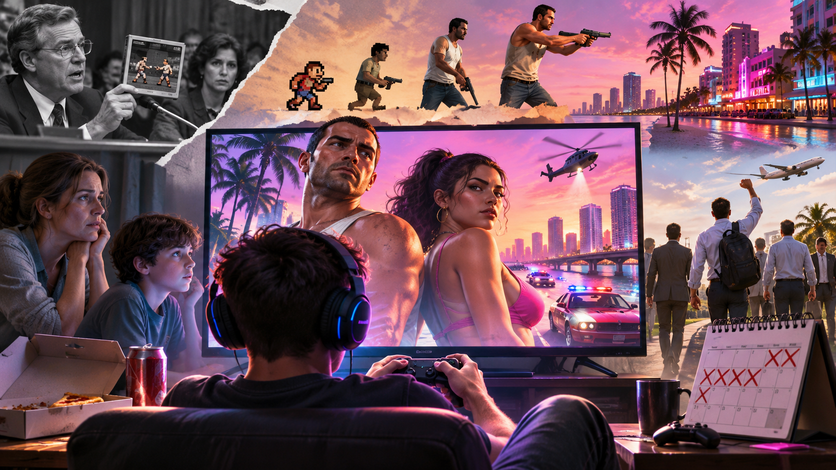
In 1993, the United States Congress held hearings about violent video games.
The games attracting attention included Mortal Kombat and Night Trap.
By today’s standards, their graphics were primitive. Characters looked like collections of pixels. The violence was cartoonish compared with what modern computers can produce.
Yet politicians from both political parties were concerned.
Democrats and Republicans actually agreed on something.
They worried about exposing children to excessive violence and sexual content.
Those hearings helped lead to the creation of the Entertainment Software Rating Board in 1994.
The ESRB rating system was designed to help parents understand what their children were playing.
A few years later, in 1997, the first Grand Theft Auto appeared.
Initially, it was a relatively simple game viewed from above.
You stole cars, committed crimes, and tried to escape the police.
But developers discovered something interesting.
People enjoyed being criminals when there were no real consequences.
And that discovery would eventually help create one of the most profitable entertainment franchises in history.
FROM CONTROVERSY TO BILLIONS
Fast-forward to 2013. Grand Theft Auto V arrived.
The graphics were considerably better. The violence was more realistic. Players could engage in increasingly elaborate criminal activities.
There were robberies, murders, drugs, prostitution, and practically every other form of criminal behavior imaginable.
And once again, there was controversy. Parents complained. Politicians complained.
Religious organizations complained. But something else happened.
GTA V generated approximately $1 billion in sales in just three days.
It became one of the fastest-selling entertainment products in history.
Now jump ahead another 13 years. GTA 6 has arrived.
Preorders alone were estimated at more than $1.5 billion before launch.
Millions of people have been counting the days. Some have taken vacation time specifically to play. Others have purchased new gaming consoles primarily for this one game.
Think about that.
We have people arranging their work schedules, family activities, and personal lives around the release of a video game.
And this isn’t some innocent little game about racing automobiles. It’s Grand Theft Auto.
A game built around the fantasy of criminal behavior.
Now, I understand that entertainment is supposed to be entertaining.
But somewhere along the way, we’ve moved from questioning this type of entertainment to treating it as a cultural achievement worthy of celebration.
What changed?
EVEN MIAMI IS CELEBRATING ITS OWN CRIMINAL FANTASY
Here’s something particularly interesting. GTA 6 takes place in Vice City, a fictional version of Miami, within a fictional state called Leonida.
Anyone familiar with South Florida will recognize the inspiration.
The beaches. The high-rises. The highways. The nightlife. The neighborhoods.
Rockstar Games has done an extraordinary job recreating the atmosphere of South Florida.
And Miami is embracing it. The Miami Heat participated in Vice City-themed promotions, complete with special jerseys and arena branding.
Miami-Dade County announced promotional and advertising arrangements valued at approximately $3.9 million.
To be clear, these were commercial arrangements intended to generate revenue and economic activity for the county—not simply $4 million in taxpayer spending.
From a business perspective, I understand the opportunity.
Millions of people will see a fictional version of Miami. That attention has marketing value.
But consider the irony. We spend millions of dollars operating police departments, fighting drug trafficking, prosecuting criminals, and trying to reduce violence.
Then we celebrate an entertainment product built around the fictional enjoyment of those same activities.
The behavior is unacceptable in our streets, but perfectly marketable on our screens.
And apparently, very profitable.
THE MORAL STANDARDS HAVEN’T DISAPPEARED — THEY’VE BECOME SELECTIVE
Something else about GTA 6 deserves attention.
The developers have reportedly placed certain limits on what players can do.
Some actions are restricted because they might resemble particularly sensitive real-world tragedies.
Other potentially offensive scenarios are treated differently.
That raises an interesting question. If simulated violence is harmless entertainment, why do we need restrictions on certain kinds of simulated violence?
The answer is fairly obvious. Because even the developers understand that some images, actions, and scenarios can offend people or carry disturbing associations.
In other words, we still have moral boundaries. We just keep moving them.
Consider what would have happened in 1993 if someone had demonstrated a video game with the realistic graphics and graphic content of GTA 6.
Congress would probably have called another hearing. Television networks would have discussed it for weeks. Parents would have demanded answers.
But in 2026? People are lining up to buy it.
The difference isn’t simply that technology has improved. It’s that our cultural tolerance has changed And that change deserves examination.
WHEN EVERYTHING BECOMES NORMAL, NOTHING IS SHOCKING
This is perhaps the most important part of the discussion.
Human beings adapt to their environment.
What initially shocks us eventually becomes familiar.
And what becomes familiar often stops attracting much attention.
We’ve seen this happen repeatedly throughout history. Consider television.
Decades ago, certain words couldn’t be spoken on television. Certain subjects couldn’t be discussed openly. Certain scenes were considered unacceptable.
Today, much of that material appears in ordinary entertainment.
The same thing happened with movies. And music. And social media.
Now video games have taken the process considerably further.
Because video games introduce another dimension.
You aren’t simply watching the behavior. You’re participating in a simulation of it.
You’re making decisions. You’re controlling the character.
You’re receiving rewards for completing certain actions. Sometimes those actions involve helping someone. Other times they involve committing crimes.
And the entire experience becomes increasingly realistic.
Does that mean you’re going to become violent? No.
But it’s reasonable to ask how repeated exposure to certain types of entertainment affects our attitudes.
What do we consider normal? What do we consider humorous?
What do we consider offensive?
And when does entertainment become so extreme that we stop recognizing the extremes?
DOES PLAYING VIOLENT VIDEO GAMES MAKE PEOPLE VIOLENT?
This is where we need to separate legitimate concerns from exaggerated claims.
There have been decades of research on violent video games.
Some studies have found associations between violent gaming and certain measures of aggressive thoughts or behavior.
Other studies have found little or no meaningful relationship.
And importantly, the American Psychological Association has warned that the scientific evidence does not establish that violent video games cause serious real-world violence.
So I’m not going to suggest that someone who spends the weekend playing GTA 6 will start stealing automobiles on Monday.
That would be ridiculous. Millions of perfectly normal, responsible people play video games. They have jobs, families, responsibilities, and ordinary lives.
But here’s what bothers me about the entire argument.
Why does the conversation always become whether a video game will turn someone into a murderer?
That’s setting the bar awfully low. Surely society should have higher standards than simply asking whether entertainment produces criminals.
Shouldn’t we also ask whether it encourages healthy habits?
Whether it’s appropriate for children?
Whether it helps or harms relationships?
Whether it’s replacing more productive activities?
Whether spending enormous amounts of time in a virtual world affects someone’s engagement with the real one?
Those are legitimate questions.
And they deserve answers beyond the usual response:
“It’s just a game.”
THE CHILDREN — WHO IS ACTUALLY PAYING ATTENTION?
GTA 6 carries an ESRB rating of Mature 17+.
The official rating identifies intense violence, blood and gore, nudity, strong sexual content, drug and alcohol use, and other mature material.
In other words, the gaming industry itself acknowledges that this isn’t appropriate entertainment for young children.
Yet we know younger people have historically played games from the Grand Theft Auto series.
And that raises another question. Where are the parents?
I remember when parents were concerned about what their children watched on television.
They worried about movies. They wanted to know who their children were spending time with.
Now we have extraordinarily realistic virtual worlds where children can potentially spend hours watching or participating in simulated criminal behavior.
And somehow, we’re supposed to believe that parental supervision is unnecessary because it’s digital.
That makes absolutely no sense. Children need boundaries. They need to understand the difference between appropriate and inappropriate behavior.
They need to develop judgment. And they need parents who actually know what they’re doing.
A rating system accomplishes very little if nobody pays attention to the rating.
I’m not suggesting government censorship. I’m suggesting parental responsibility.
There’s a difference.
WHEN ENTERTAINMENT BECOMES MORE IMPORTANT THAN REAL LIFE
Now let’s discuss something that concerns me even more than the violent content.
Escapism. There’s nothing inherently wrong with escaping reality for a few hours.
We all do it. Some people watch football.
Some watch movies. Some read novels.
Some play video games. And others spend hours on Facebook arguing with complete strangers.
But there is a point where recreation stops being recreation and becomes a replacement for ordinary life.
But some will emulate the game, and it lowers the bar of what is acceptable for everyone else.
The World Health Organization recognizes gaming disorder as a condition involving impaired control over gaming, the increasing priority given to gaming over other activities, and continued gaming despite significant negative consequences.
Importantly, the WHO also recognizes that this condition affects only a relatively small proportion of gamers.
Most people can enjoy games without developing a disorder. But the problem does exist.
And the technology is making virtual environments increasingly attractive.
GTA 6 is an extraordinary example. Its graphics approach photographic realism.
Its characters interact in increasingly sophisticated ways.
The environment is enormous. The world continues functioning around the player.
Now imagine what happens as artificial intelligence continues improving.
Characters who remember previous conversations. Entire cities populated by believable AI personalities. Virtual relationships. Artificial companions. Complex simulated economies.
Worlds that never end. The distinction between entertainment and an alternative life becomes increasingly blurred.
And that brings us to a much larger issue.
What happens when the virtual world becomes more attractive to someone than the real world?
Why struggle with a difficult relationship when a virtual character always responds the way you want?
Why work toward accomplishments that take years when a game can reward you every few minutes?
Why deal with failure when you can simply restart?
Why face responsibility when you can escape into a world where consequences are temporary?
These questions go far beyond GTA 6.
They concern the future of entertainment, artificial intelligence, virtual reality, and human behavior.
And I suspect we’re only beginning to understand the implications.
THE STRANGE CONTRADICTION OF MODERN MORALITY
Here’s another aspect that I find fascinating.
We live in a society that is extraordinarily sensitive about certain kinds of behavior.
People lose jobs over inappropriate jokes.
Companies issue apologies for advertisements that offend someone.
Universities debate whether particular words or images might make students uncomfortable.
Social media platforms regulate all kinds of expression.
Yet we simultaneously celebrate entertainment containing extraordinary levels of fictional violence, cruelty, sexual exploitation, and criminal behavior.
How do we reconcile those two things?
Apparently, our moral standards depend heavily on the circumstances.
A tasteless joke in the wrong setting can become a national controversy.
But simulated murder can be entertainment.
Now, I’m not arguing that these things are equivalent. They aren’t.
Fictional violence and real-world harassment are different categories of behavior.
But the contrast illustrates something important.
We have become extremely selective about what we consider offensive.
Sometimes we’re concerned about the smallest perceived insult.
Other times we dismiss extraordinarily graphic entertainment with a shrug.
And we rarely stop to examine why.
THE REVIEWERS ARE CELEBRATING IT
Here’s something that really caught my attention.
One of the major themes reviewers have praised in GTA 6 is the relationship between its two protagonists, Jason and Lucia.
The Guardian described the game as an unexpectedly compelling love story.
Reviewers have highlighted the emotional connections between the characters and the opportunities for small acts of kindness.
Apparently, players can strengthen the relationship through ordinary interactions.
And that sounds wonderful. A touching romance. Two people trying to build a life together.
Except that this same couple is involved in a world of robberies, violence, drugs, and organized crime.
Now, to be fair, writers have been exploring complicated criminals for centuries.
The Godfather was a brilliant movie. Breaking Bad was an extraordinary television series.
Neither required viewers to approve of the characters’ actions.
Good storytelling can absolutely involve immoral people.
But there’s a difference worth considering. In a movie, you’re watching the characters.
In a video game, you’re often controlling what happens.
And sometimes the rewards come directly from the choices you make.
That’s a fascinating storytelling technology.
It also creates moral questions that deserve more attention than simply calling the game a masterpiece.
A technically brilliant product can still raise legitimate questions about the behavior it celebrates or rewards.
Those two things aren’t mutually exclusive.
THE BUSINESS OF SELLING OUR WORST IMPULSES
Let’s talk about capitalism for a moment. Because there’s something important here.
Rockstar Games is a business. It produces entertainment that people want.
People voluntarily purchase that entertainment. And the company earns money.
From a business perspective, that’s perfectly understandable.
But businesses have always understood that certain human impulses are enormously profitable.
Sex sells. Violence sells. Controversy sells. Fear sells.
And forbidden behavior can be especially attractive.
The more controversial something becomes, the more attention it often attracts.
Grand Theft Auto has benefited from controversy throughout its history.
People complained. The media covered the complaints. More people learned about the games. And sales continued growing.
Now we’re at the point where controversy itself has become part of the product.
The outrageous behavior is no longer an unfortunate side effect.
It’s part of the attraction.
And if a company can make billions of dollars satisfying that demand, there will be tremendous financial incentives to continue.
That isn’t necessarily an argument for government intervention.
But it is a reminder of something I’ve said many times about business.
Just because customers are willing to buy something doesn’t automatically mean it benefits society.
Companies respond to consumer demand.
And sometimes the consumer needs to exercise better judgment.
TECHNOLOGY HAS MOVED FORWARD. HAVE WE?
As someone who has spent much of his life working with computers and technology, this is the part I find most interesting.
Consider how far we’ve advanced. In the 1990s, computers struggled to render a few moving objects on a screen.
Today, developers can create enormous virtual cities with realistic lighting, physics, traffic, artificial intelligence, and thousands of simulated interactions.
The technological accomplishment is staggering. GTA 6 represents years of engineering and creative work. And I can appreciate that achievement.
But technology itself doesn’t determine whether something is good or bad.
People make those decisions. We can use artificial intelligence to help discover new medicines. Or create increasingly sophisticated scams.
We can use virtual reality to train surgeons. Or create experiences that encourage people to withdraw from real-world relationships. We can use advanced graphics to teach history.
Or create more realistic depictions of violence.
The same underlying technologies can support very different purposes.
Technology gives us more power. It doesn’t automatically give us better judgment.
And that is something I think society is forgetting.
We’re so fascinated by what technology makes possible that we sometimes forget to ask what we actually want to accomplish.
SO WHERE DO WE DRAW THE LINE?
Let me be clear about something.
I don’t want the government deciding which video games adults can play.
I don’t want politicians determining which movies we’re allowed to watch.
And I certainly don’t want some bureaucratic committee deciding what qualifies as morally acceptable entertainment.
Freedom includes the freedom to make choices other people may dislike.
But freedom also comes with responsibility.
Parents have a responsibility to supervise their children.
Adults have a responsibility to manage their own time.
Businesses have a responsibility to consider more than the next quarterly earnings report.
And society has a responsibility to examine the cultural environment we’re creating.
That doesn’t require censorship. It requires judgment. It requires conversation.
And perhaps most importantly, it requires recognizing that entertainment isn’t automatically harmless simply because it isn’t real.
The effects of entertainment are complicated. Sometimes they’re positive.
Sometimes they’re negative. Sometimes they’re negligible.
But dismissing every concern by saying it’s just a game isn’t particularly thoughtful.
Neither is blaming every social problem on video games.
We should be capable of a more intelligent conversation than that.
GTA 6 ISN’T THE PROBLEM. IT’S A REFLECTION OF SOMETHING BIGGER.
And that brings me to my final point.
I don’t believe Grand Theft Auto 6 is going to destroy American civilization.
Civilizations don’t collapse because somebody releases a video game.
But cultural products tell us something about the people who create and consume them.
They reflect our interests. Our fears. Our fantasies. Our sense of humor. And sometimes our values.
In 1993, Congress was debating whether cartoonish video game violence was appropriate for children.
In 2026, millions of adults are celebrating one of the most graphically realistic criminal fantasy worlds ever created.
That’s a remarkable cultural transformation in just one generation.
Perhaps some of that transformation represents society becoming more sophisticated about the difference between fiction and reality.
But perhaps some of it also represents us becoming increasingly indifferent to things that once made us uncomfortable.
I suspect both are true. And the bigger concern isn’t that GTA 6 exists.
It’s that we’ve developed a culture in which almost everything can become entertainment.
Violence. Humiliation. Cruelty. Sexual exploitation. Human suffering.
As long as it’s sufficiently entertaining, somebody will package it, market it, and sell it.
And somebody else will buy it.
The question is whether we should occasionally stop and ask ourselves what we’re celebrating.
Because the next generation of entertainment technology will make today’s video games look primitive.
Artificial intelligence will create increasingly believable characters.
Virtual reality will make simulated experiences feel increasingly real.
And entire digital worlds may eventually become almost indistinguishable from physical reality.
When that happens, the question won’t simply be what technology allows us to do.
It will be what we choose to do with it. And whether we still recognize the difference between something being entertaining and something being worthwhile.
We’ve become extraordinarily good at building worlds in which anything is possible.
Maybe it’s time we spent a little more effort improving the world we actually live in.
And perhaps that’s the real question behind Grand Theft Auto 6.
Not whether a video game can make someone a bad person.
But whether a society that increasingly celebrates its worst fictional behavior should occasionally question the direction of its culture.
GTA 6 — How Low Can Society Go?
Or perhaps the more disturbing question is: How low can we go before we stop noticing?
May be many of us are already, go kill another Health Care CEO,
Research and fact-checking notes
I verified several important points rather than relying solely on one source.
Release and sales: GTA 6 officially launched November 19, 2026. Preorders were estimated at approximately $1.54 billion by November 17, but that was an industry estimate rather than an audited final sales figure. Rockstar Games
Miami-Dade’s $3.9 million deal: The county described the arrangements as revenue-generating commercial agreements, not a $4 million taxpayer expenditure. Miami-Dade County
Age rating: GTA 6 officially carries a Mature 17+ rating, with explicit content descriptors. ESRB Ratings
Scientific evidence: The American Psychological Association cautions that research does not establish a causal relationship between violent video games and serious real-world violence. https://www.apa.org
Gaming disorder: The World Health Organization recognizes excessive gaming as a potential clinical problem, but emphasizes that it affects only a small proportion of players.