Think of it as Yoga for the brain, we are going to stretch a bit.
Kids Need AI — and Pretending Otherwise Won’t Save Them
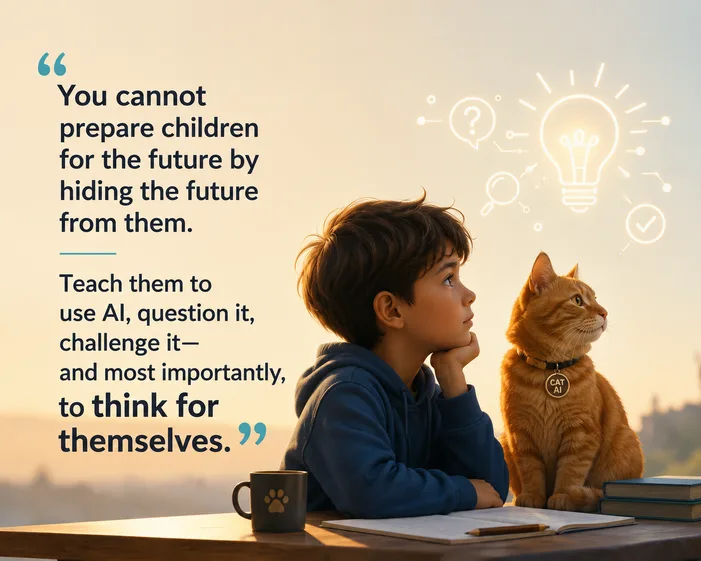
You cannot prepare children for the future by hiding the future from them. Teach them to use AI, question it, challenge it—and most importantly, to think for themselves. — YNOT!
There is an old habit among adults: when something new frightens us, we decide the children must be protected from it.
Sometimes this is wisdom. Sometimes it is simply fear wearing a necktie.
Artificial intelligence is not going away. We can ban ChatGPT from a classroom, block websites on the school Wi-Fi, confiscate phones, write policies, install filters, and make stern speeches about “doing your own work.”
Then the child goes home. AI is still there.
It is on the computer. It is on the phone. It is appearing inside search engines, word processors, cameras, games, cars, and probably the refrigerator before long.
So the question is no longer whether children will use artificial intelligence.
They will.
The question is whether we are going to teach them how.
That is an entirely different proposition.
We taught children to use the Internet. We must teach them to use AI.
When the Internet first arrived, plenty of people believed the solution was to keep children away from it.
That worked about as well as trying to keep teenagers away from music.
Eventually we understood that children needed something more useful than prohibition.
They needed to learn:
How to search.
How to recognize nonsense.
How to distinguish a reliable source from a lunatic with a webpage.
How to protect their privacy.
How to behave online.
How to recognize advertising.
How to question what they were being told.
AI requires the same kind of education — only more urgently.
Because AI doesn’t merely show children information.
It talks back.
It explains.
It advises.
It writes.
It creates pictures.
It solves problems.
And occasionally it says something completely wrong with the confidence of a man who has just been elected to office.
That makes AI literacy enormously important.
A child should learn very early that an AI can be useful without being infallible.
Ask it.
Question it.
Check it.
Challenge it.
Improve the answer.
Then decide what you think.
That is education.
The answer isn’t “No AI.”
There are certainly times when a child ought to do something without AI.
Learn your multiplication tables.
Write a paragraph yourself.
Read the book.
Work through the equation.
Think.
Struggle a little.
The human brain, like every other useful piece of machinery, improves considerably when somebody occasionally turns it on.
But there should also be times when AI is allowed to assist.
“Give me three ideas.”
“Explain this differently.”
“Why did I get this answer wrong?”
“Quiz me on the American Revolution.”
“Help me understand fractions.”
“Tell me what is weak about this paragraph.”
And eventually there should be assignments where AI is actually required.
Use AI.
Then verify what it told you.
Find an error.
Challenge its reasoning.
Improve its answer.
Explain what the AI got right and what it got wrong.
Now we are no longer teaching children merely to operate a machine.
We are teaching them to think alongside one without surrendering their own judgment to it.
That skill may be one of the most valuable things a school can teach over the next twenty years.
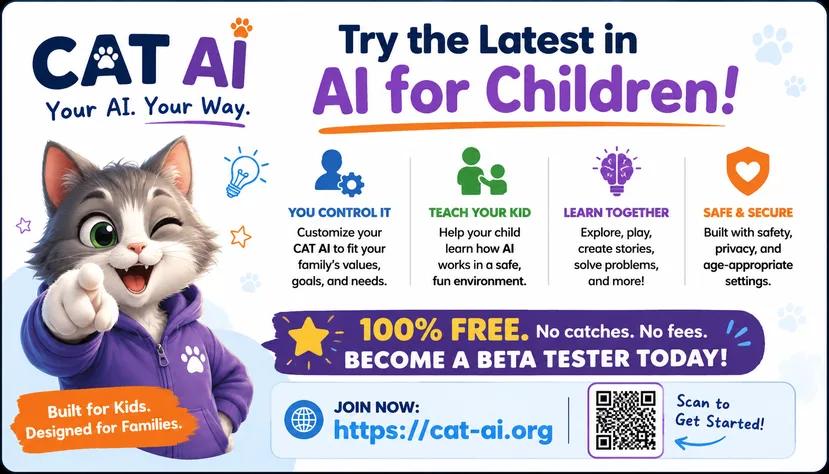
That is one reason we are developing CAT AI.
CAT AI is an experiment in creating a controlled AI environment specifically for children.
The idea is simple.
Give children somewhere they can use AI, play with AI, learn from AI, and learn about AI without simply throwing them into the commercial Internet.
No advertising.
No attempt to sell them shoes, video games, subscriptions, or breakfast cereal.
No algorithm trying to discover which button will keep them staring at the screen for another forty-seven minutes.
Instead, the child gets an AI companion inside an environment where parents, guardians, teachers, counselors, and institutions can provide appropriate oversight and guidance.
The goal isn’t surveillance.
The goal is support.
A parent should be able to say, “You can explore.”
A teacher should be able to say, “For this assignment, AI can help you research, but you must write the answer.”
And another teacher might say, “For this assignment, I want you to use AI and then show me where it was wrong.”
That is a much more interesting classroom than one with a sign taped to the wall saying:
NO CHATGPT.
Children should be allowed to play with AI.
This part is important.
Adults have a dreadful tendency to take every interesting technology and immediately turn it into homework.
Children learn enormously through play.
Let them talk to an AI cat.
Let them ask ridiculous questions.
Let them invent a planet.
Let them design a castle.
Let them ask why the sky is blue, why dinosaurs disappeared, whether a shark could beat an alligator, or how they might build a robot that waters the tomatoes.
Curiosity is not wasted time.
Curiosity is the engine.
And while the child thinks he is playing with an artificial cat, he may quietly be learning how to formulate questions, refine ideas, investigate claims, solve problems, and communicate with one of the most important technologies of his lifetime.
That is not a bad afternoon’s work.
AI should become an instructional tool.
The greatest educational opportunity may not be having AI do schoolwork.
It may be having AI teach.
Imagine a tutor that can explain fractions ten different ways without becoming irritated.
A reading companion that adjusts its vocabulary to the child.
A history tutor that lets a student ask fifty follow-up questions.
A science assistant that says:
“That’s an interesting theory. How could we test it?”
A writing coach that doesn’t simply rewrite a paragraph, but asks:
“What are you trying to say here?”
Good educational AI should not constantly provide answers.
Sometimes it should provide questions.
The objective isn’t to make thinking unnecessary.
It is to encourage more of it.
The dangerous child isn’t the one who uses AI.
The dangerous situation is the child who uses AI without understanding it.
A child who believes everything an AI says.
A child who cannot recognize manipulation.
A child who cannot distinguish his own ideas from machine-generated ones.
A child who has never been taught to verify information.
A child whose entire education about artificial intelligence came from TikTok, YouTube, and whatever commercial chatbot happened to be free that month.
We can do better than that.
Parents can be involved.
Teachers can be involved.
Schools can be involved.
Children can explore in environments designed for learning rather than selling.
And AI itself can help teach children how AI works.
There is a wonderfully circular quality to that.
We don’t need to protect children from the future.
We need to prepare them for it. There will undoubtedly be mistakes.
There always are when society meets a powerful new technology.
But hiding AI from children is not a serious long-term strategy.
The future has a remarkable habit of arriving whether adults approve of it or not.
So perhaps the better lesson is this:
Don’t let AI think for you. Learn how to think with it.
Use it. Question it. Verify it. Challenge it. Create with it.
And occasionally turn it off and prove that you can still think for yourself.
That is the balance projects like CAT AI are trying to create.
Not a childhood without artificial intelligence.
A childhood that teaches children how to live intelligently with it.