Think of it as Yoga for the brain, we are going to stretch a bit.
Grandma’s Final Gift
A few weeks after Grandma died, the family sold her house.
Once the mortgage, taxes, legal expenses, and everything else were paid, I received my percentage of the money. It was more money than I had ever received at one time, but not enough to retire on.
That created a problem I had never expected.
I was afraid to spend it, afraid to invest it, and afraid that doing nothing would be just as foolish.
Everyone had an opinion.
One person told me to put it all in the stock market. Another said I should pay off every debt I had. Someone else told me to buy a rental property. A friend even suggested cryptocurrency because, according to him, it was “about to explode.”
The more advice I received, the less certain I became.
Finally, I went to see Uncle Bob.
He was sitting on his back porch drinking coffee when I arrived.
“Uncle Bob, I need some advice.”
He looked over the top of his cup.
“That usually means you either have a problem or some money.”
“A little of both.”
“That can be the most dangerous combination.”
I sat down across from him.
“Grandma’s house was sold, and I received my share of the money. I don’t know what to do with it. I don’t want to waste it, but I also don’t want to invest it in the wrong thing and lose it.”
Uncle Bob nodded slowly.
“That money represents part of your grandmother’s lifetime of work. You should treat it with respect, but you shouldn’t be frightened of it. Money needs a purpose. Otherwise, it will either disappear or sit still until inflation slowly eats it.”
“So what should I do?”
“I’ll tell you about a very old and proven principle. The basic idea is even found in the Bible: divide what you have among different places because you don’t know what trouble may come.”
“So it’s a religious rule?”
“Not exactly a law requiring you to divide your money into precise percentages. But diversification is an ancient principle. Many financially sophisticated families, including generations of Jewish business families, have taught their children not to depend on one investment, one business, or one source of income.”
He leaned back in his chair.
“Most financial advisers will tell you to put sixty percent in stocks and forty percent in bonds. Others may suggest fifty percent in real estate and fifty percent in financial investments. Those plans may be appropriate for some people, but I look at wealth differently.”
“How?”
“I divide wealth into three large buckets.”
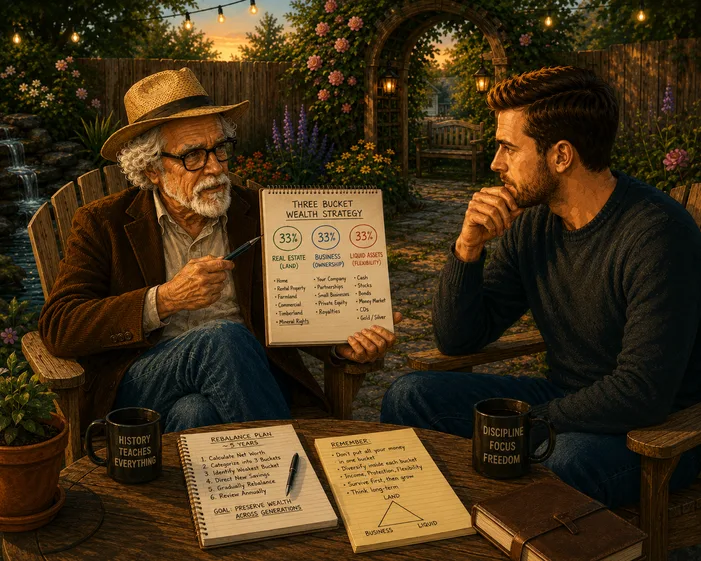
He picked up a notepad and wrote three numbers:
33 — 33 — 33
“Your long-term goal should be approximately one-third real estate, one-third operating businesses, and one-third liquid assets.”
I looked at the paper.
“That sounds simple.”
“The best principles usually do. Applying them is the difficult part.”
Bucket One: Real Estate
Uncle Bob circled the first number.
“The first thirty-three percent belongs in real estate or land.”
“What kind of real estate?”
“It could be your home, rental property, farmland, timberland, commercial property, mineral rights, or a small piece of land in the path of future development. The exact investment depends on your knowledge, location, and available capital.”
“Why real estate?”
“Because people will always need places to live, work, farm, store things, and operate businesses. Land is limited. Governments can print more money, companies can issue more stock, and new cryptocurrencies can be created every week. But nobody is manufacturing more land.”
“That means real estate can’t lose value?”
“Of course it can lose value,” he said. “Never confuse a strong asset with a guaranteed asset. Real estate can fall twenty, thirty, or even fifty percent in a bad market. A property can sit empty. A roof can fail. Taxes can rise. A neighborhood can decline.”
“Then why own it?”
“Because properly purchased real estate can preserve wealth, produce rental income, and protect you against inflation. Even when the market price temporarily falls, the property may continue producing income or providing you with a place to live.”
“So I should use Grandma’s money to buy a house?”
“Not necessarily. You’re trying to understand the destination, not make a reckless move tomorrow. You may not have enough money to buy the right property yet. You may need to save, find a partner, purchase a duplex, or use the money as part of a down payment.”
He tapped the first number.
“The important thing is to begin building this bucket intelligently.”
Bucket Two: Your Business
He circled the second number.
“The next thirty-three percent belongs in operating businesses.”
“You mean stocks?”
“No. Stocks belong primarily in the liquid bucket. I’m talking about direct ownership in a business that sells a product or service.”
“Like owning my own company?”
“That is usually the best place to begin because you have some control over it. You might also own part of another small business, become a silent partner, purchase an existing company, own royalty-producing intellectual property, or invest in a private enterprise you understand.”
“Why should a third of my wealth be in a business?”
“Because a good business produces cash flow. Real estate protects and stores wealth, but a business can actively create new wealth.”
He pointed toward the street.
“Suppose you own a pressure-cleaning company. Even if the stock market crashes, people may still need their roofs, driveways, and commercial buildings cleaned. If inflation raises your expenses, you may be able to raise your prices. If one service slows down, you can introduce another.”
“But businesses fail all the time.”
“They certainly do. That’s why I didn’t tell you to put one hundred percent of your money into a business. A business can fail because of competition, bad management, changing technology, regulation, theft, or simple bad luck.”
He paused.
“But unlike a stock certificate, your own business gives you some ability to respond. You can cut expenses, change suppliers, introduce new products, find new customers, or move into a different market.”
“So my business is supposed to produce the income?”
“Yes. Your business is the engine. Your real estate is the foundation. Your liquid assets are the reserve fuel.”
Bucket Three: Liquid Assets
He circled the final number.
“The last thirty-three percent should remain liquid.”
“What counts as liquid?”
“Cash, savings, money market funds, certificates of deposit, publicly traded stocks, bonds, and precious metals that can be sold quickly. Anything you can convert into usable money without spending months looking for a buyer.”
“Shouldn’t I keep all the inheritance liquid until I know what I’m doing?”
“For the moment, possibly. But not forever. Liquidity is important because it gives you flexibility. It allows you to survive emergencies, support your business during slow periods, and purchase assets when everyone else is desperate to sell.”
“What’s wrong with keeping most of my money in stocks?”
“Stocks can be excellent investments, but they can also fall fifty percent or more during a serious downturn. The fact that you own twenty different stocks does not necessarily mean you are truly diversified. If they all respond to the same financial crisis, they may all decline together.”
“What about stocks and bonds?”
“They are different investments, but they are both financial assets. Your retirement account, mutual funds, brokerage account, savings account, bonds, and publicly traded stocks may all belong in different accounts, but they still sit largely inside the same liquid bucket.”
“So someone can own many investments and still be concentrated?”
“Exactly. Owning thirty flavors of ice cream doesn’t mean you have thirty different food groups.”
I laughed.
“That sounds obvious when you say it that way.”
“Most important financial ideas are obvious after someone explains them.”
How the Three Buckets Protect You
Uncle Bob drew a triangle around the three numbers.
“Here is why the system works. At different times, different parts of the economy suffer.”
“If the stock market falls, you still have your real estate and business.”
“If property values decline, you can live on the income from your business.”
“If your business slows down, your liquid assets can help cover expenses until conditions improve.”
“If inflation damages the value of cash, your property and business may rise in value or produce higher income.”
“So one bucket supports the others?”
“That’s the idea. You don’t expect all three buckets to perform perfectly every year. You expect them to protect the whole family over many years.”
“What happens when one bucket does very well?”
“You rebalance.”
“How?”
“Suppose your business grows rapidly and eventually represents sixty percent of your net worth. You may take some of the profits and purchase real estate or build your liquid reserves. If the stock market rises dramatically and your financial assets become too large, you might move some profits into property or a private business.”
“Do I need to maintain exactly thirty-three percent in each one?”
“No. This isn’t chemistry. You’re creating balance, not chasing mathematical perfection. You may be at thirty percent, thirty-five percent, and thirty-five percent. That is close enough.”
He wrote another number on the paper.
Five years.
“Don’t try to rearrange your entire financial life in five weeks. Give yourself several years to build the three buckets properly.”
Diversify Inside Each Bucket
“I think I understand,” I said. “One property, one business, and one stock account.”
“No,” Uncle Bob replied. “That would be three buckets, but each bucket would still contain only one egg.”
He drew smaller circles inside each large number.
“You should eventually diversify inside the buckets.”
“In real estate, you might own your home, part of a rental property, and a piece of land.”
“In business, you might own your primary company, a minority interest in another business, and royalty income from intellectual property.”
“In liquid assets, you might hold emergency cash, short-term government securities, stocks, bonds, and a small amount of gold.”
“That sounds like it takes a lot of money.”
“It takes time more than anything. You don’t build a strong financial structure overnight. You build it one asset at a time.”
What Should I Do With Grandma’s Money?
I pushed the notepad back toward him.
“All right, but what should I do with the money I have right now?”
“First, don’t make any large moves while you’re grieving. Emotional periods are dangerous times to make permanent financial decisions.”
“That makes sense.”
“Second, place the money somewhere safe and liquid while you develop a plan. Don’t leave a large amount sitting in a regular checking account where it becomes too easy to spend.”
“Third, calculate your current net worth. Include your cash, retirement accounts, real estate equity, business ownership, and debts.”
“Then separate everything into the three buckets.”
“What if the buckets are uneven?”
“They probably will be. Most people discover that nearly everything they own is in one category.”
“And then?”
“Direct new money toward the weakest bucket. You don’t necessarily have to sell everything you already own. Gradual changes are usually less disruptive and may reduce taxes and transaction costs.”
I looked again at the three numbers.
“So Grandma’s money doesn’t have to go into one big investment?”
“That is exactly what it should not do.”
He folded his hands on the table.
“People receive an inheritance and immediately believe they must make one dramatic decision. They buy one property, invest in one company, or hand everything to one financial adviser.”
“Your grandmother spent a lifetime accumulating that money. You don’t need to redeploy it all by next Tuesday.”
Preservation Before Performance
“What return should I expect from this strategy?”
“You’re asking the wrong question.”
“What should I ask?”
“Ask how likely the money is to survive.”
He took another sip of coffee.
“People become obsessed with maximizing annual returns. They want eight percent, twelve percent, or twenty percent. That obsession causes them to chase whichever investment has performed best recently.”
“When stocks rise, they put everything into stocks.”
“When real estate rises, they become property speculators.”
“When cryptocurrency rises, everyone suddenly becomes an expert in digital assets.”
“And when the market collapses, they discover that their entire future was sitting in one bucket.”
“So the goal isn’t to get rich quickly?”
“The goal is to become wealthy without becoming poor again.”
He pointed at the paper one final time.
“Land preserves purchasing power.”
“Business creates income.”
“Liquidity creates flexibility.”
“Each one has a job. Together, they form a financial structure that can survive inflation, recessions, market crashes, business slowdowns, and unexpected emergencies.”
I sat quietly for a moment.
“I was thinking about using some of the money to buy a new truck.”
“Do you need a new truck?”
“No.”
“Will the truck make you money?”
“Probably not.”
“Then you were preparing to turn your grandmother’s appreciating house into a depreciating vehicle.”
I looked down at the table.
“That doesn’t sound very smart when you put it that way.”
“It rarely does.”
He handed the notepad back to me.
“Your grandmother didn’t just leave you money. She left you an opportunity. You can spend it once, or you can use it to build something that continues producing value long after both of us are gone.”
I folded the paper and placed it in my pocket.
“So I start by calculating what I already have, divide it into the three buckets, and strengthen whichever bucket is weakest.”
“Correct.”
“And I don’t put everything into one property, one business, or one investment.”
“Correct again.”
“And I build toward one-third real estate, one-third business ownership, and one-third liquid assets.”
Uncle Bob smiled.
“Now you’re beginning to understand.”
I stood up to leave.
“One more thing,” he said.
“What?”
“Never forget that diversification is not about owning many things. It is about owning things that behave differently.”
He lifted his coffee cup.
“Don’t keep all your money in one bucket. And don’t keep all the buckets in the same boat.”
That afternoon, I arrived at Uncle Bob’s house believing I had inherited a pile of money.
I left understanding that Grandma had given me something much more valuable.
She had given me the beginning of a financial foundation.