Think of it as Yoga for the brain, we are going to stretch a bit.
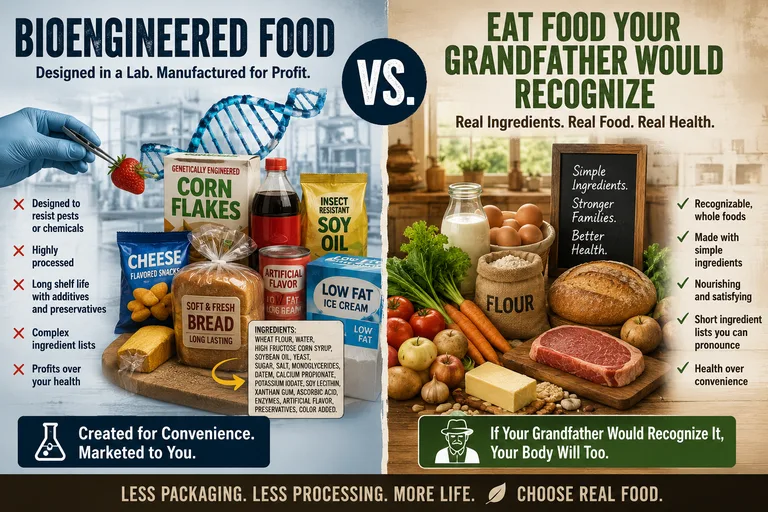
Bioengineered food vs Eat Food Your Grandfather Would Recognize
Bioengineered food is food produced from an organism whose genetic material has been deliberately changed through modern laboratory techniques to introduce, remove, or modify a particular biological trait.
I want to begin by making something clear: I am not an enthusiastic supporter of bioengineering. In fact, I am deeply skeptical of many attempts to redesign nature for profit, convenience, or industrial efficiency. I do not believe that every new technology should automatically be accepted simply because scientists have discovered how to use it.
But we also need to be honest about the history of our food.
Human beings have been altering plants and animals for thousands of years. The corn we eat today is not the same wild grass our ancestors first cultivated. Modern wheat has been selected over generations for yield, texture, disease resistance, and ease of harvesting. The chickens, cattle, pigs, and dairy cows raised today have been bred to grow faster, produce more meat, lay more eggs, or generate more milk.
The same is true of many fruits, vegetables, and even farm-raised fish. Farmers have always saved seeds from their strongest plants and bred animals that displayed the most desirable traits. Over time, those choices changed the food itself.
Traditional selective breeding is not identical to modern genetic engineering, and we should not pretend that it is. Modern bioengineering can make changes much more rapidly and sometimes in ways that conventional breeding could never accomplish. However, the broader point remains: very little of what we eat today exists exactly as nature originally produced it.
That is why I do not believe the word “bioengineered” should automatically end the conversation.
It should begin a better one.
The more useful questions are:
Where did this food come from?
How was it grown or raised?
How much was it altered after harvesting?
How heavily was it processed?
What ingredients were added?
And most importantly, should I be eating it at all?
The Real Problem May Be the Factory, Not the Farm
People often spend so much time arguing about whether a crop was genetically modified that they overlook the more immediate problem: what happened to the crop after it left the farm?
A kernel of corn is one thing. Corn syrup, corn starch, modified corn starch, corn oil, maltodextrin, dextrose, and chemically flavored corn snacks are something else entirely.
A grain of wheat is food. A heavily refined product made with bleached flour, industrial oils, artificial flavors, stabilizers, preservatives, emulsifiers, and added sugar may technically begin with wheat, but it has traveled a very long way from the field.
That is the distinction I believe matters most in everyday life.
Whole food usually comes from a plant or an animal.
Processed food often comes from a manufacturing system.
There is nothing automatically wrong with processing. Cooking is processing. Freezing vegetables is processing. Fermenting cabbage is processing. Grinding wheat into flour is processing. Pasteurizing milk is processing.
The problem is not that food has been touched.
The problem begins when food is broken apart, refined, chemically altered, reconstructed, flavored, preserved, colored, sweetened, stabilized, packaged, and marketed as something healthier than it really is.
At that point, you are no longer eating what came from the farm. You are eating what came from the laboratory, the marketing department, and the production line.
The Shelf-Life Question
Years ago, I learned a very simple lesson: pay attention to what happens when food is left alone.
Real food changes.
Fruit softens. Bread becomes stale or develops mold. Milk sours. Meat decomposes. Vegetables wilt. These changes occur because food is biological material. It contains moisture, nutrients, microorganisms, and enzymes. It is part of the natural cycle of life and decay.
When a food remains soft, brightly colored, and apparently fresh for an unusually long time, I begin asking questions.
What was added to preserve it?
How much moisture was removed?
Was it chemically treated?
Was it loaded with salt, sugar, industrial fats, or preservatives?
Was the packaging engineered to prevent oxygen, bacteria, or moisture from reaching it?
Shelf life by itself does not determine whether something is healthy. Honey, dried beans, rice, salt, vinegar, and many traditionally preserved foods can last a long time without being inherently unhealthy. Refrigeration, drying, canning, pickling, fermenting, and freezing have helped human beings preserve food safely for centuries.
So this is not a perfect scientific test.
It is a warning light.
When a product that should naturally deteriorate remains strangely unchanged for weeks or months, it is worth investigating why. Modern food manufacturers are very good at extending shelf life, preserving texture, and maintaining appearance. Those abilities reduce waste and make distribution easier, but they can also require extensive processing and a long list of additives.
The purpose of the product is no longer simply to nourish you. It must survive transportation, warehouses, delivery trucks, store shelves, fluctuating temperatures, consumer handling, and perhaps several weeks inside your kitchen.
That is a very different mission from feeding a family.
Read the Ingredients, Not the Advertising
The front of a package is designed to sell you something.
The back of the package is where the truth usually begins.
Words such as natural, wholesome, heart healthy, low fat, reduced sugar, high protein, and made with whole grains are marketing language. They may contain some truth, but they do not tell you the entire story.
The ingredient list tells you what the product is actually made from.
Suppose you are buying bread. You expect to see flour, water, yeast, and salt. Depending on the recipe, you might also see milk, butter, eggs, seeds, or a small amount of sugar.
That is recognizable food.
But many commercial breads contain a much longer list: dough conditioners, emulsifiers, sweeteners, preservatives, added oils, soy derivatives, enzymes, gums, colorings, and other ingredients that would never appear in a traditional kitchen.
Some of those ingredients may serve legitimate functions. They may improve consistency, prevent mold, soften the loaf, strengthen the dough, reduce production costs, or help the bread survive long-distance distribution.
But the consumer should still ask a basic question:
Why does my bread require all of this?
The same question applies to almost everything else.
Why does peanut butter need added sugar and hydrogenated oil?
Why does tomato sauce need so much sugar?
Why does flavored oatmeal require a paragraph of ingredients?
Why does coffee creamer contain little or no cream?
Why does a frozen breakfast sandwich need ingredients that no ordinary person keeps in the kitchen?
The longer the ingredient list becomes, the more attention you should pay.
You do not need a degree in chemistry to recognize complexity.
The Low-Fat and Low-Sugar Trap
For decades, consumers were taught to fear fat. Food companies responded by producing low-fat versions of almost everything.
But when fat is removed, something else often has to replace the flavor, texture, and satisfaction it provided.
That replacement might be sugar, starch, gums, emulsifiers, flavorings, or cheap industrial oils. The product can then be marketed as healthier because one undesirable ingredient was reduced, even though several others were added.
The same thing now happens with low-sugar products.
When sugar is removed, manufacturers still need the product to taste sweet and appealing. They may add artificial sweeteners, sugar alcohols, fibers, thickeners, or flavor-enhancing compounds. The label may look better at first glance, but the actual product may be more complicated than the original.
Consider ice cream.
Traditional ice cream is made from a relatively short list of ingredients: cream, milk, sugar, eggs, and flavoring.
It is rich. It contains fat. It contains sugar. It is not something you should necessarily eat in unlimited quantities.
But when manufacturers create low-fat, low-sugar, high-protein, shelf-stable, slow-melting ice cream, they must reproduce the texture and taste of the ingredients they removed. That usually means adding other substances to compensate.
The result may contain fewer calories or less sugar, but it is not automatically a healthier food.
Sometimes the honest choice is to eat a small amount of the real thing.
Better yet, make it yourself. Then you control the ingredients, the sweetness, the portion size, and the quality of the milk or cream.
The lesson is not that all reduced-fat or reduced-sugar products are bad. The lesson is that removing one ingredient does not automatically improve the entire product.
Always look at what replaced it.
Follow the Food Chain Backward
The farther you move away from the farm, the more complicated food tends to become.
A farmer grows a tomato.
A distributor sorts, washes, transports, and sells the tomato.
A manufacturer turns the tomato into sauce.
Another company adds sugar, oil, salt, preservatives, flavoring, and packaging.
A restaurant then combines that sauce with refined flour, processed cheese, cured meat, and additional oil.
At every stage, something may be added, removed, concentrated, refined, or altered.
This is what I mean by moving higher up the food chain.
The grocery store is not necessarily the source of the problem. Publix, Aldi, Winn-Dixie, Walmart, and other retailers are the final link in a much larger industrial system. They buy products from major manufacturers, contract with private-label producers, and sometimes operate their own processing and distribution facilities.
I have toured Publix production facilities. They are impressive. They are clean, organized, efficient, and governed by serious quality-control procedures.
But quality control and nutritional quality are not always the same thing.
A factory can produce an extremely consistent product. Every loaf can have the same weight. Every cookie can have the same diameter. Every container can be sealed correctly. Every batch can meet sanitation standards.
That does not necessarily mean the product is something you should eat every day.
Industrial food must satisfy requirements that home cooking does not. It needs to be affordable, consistent, transportable, attractive, and profitable. It may need to survive for weeks or months while still looking fresh.
There is only so much that even the best factory can do when shelf life is one of the primary design requirements.
Eat More Like Your Grandparents
The more I studied nutrition, the more complicated it initially appeared.
Every expert seemed to have a different theory.
One person said to avoid fat. Another said to avoid carbohydrates. One praised meat. Another condemned it. Some recommended frequent meals. Others recommended fasting. There were arguments about dairy, grains, eggs, salt, fruit, oils, protein, and almost everything else.
After years of reading and listening, the lesson became surprisingly simple:
Eat recognizable food.
Cook more often.
Use fewer ingredients.
Reduce the amount of food that comes ready to eat from a factory.
That is one reason I enjoy watching Amish families prepare meals. They often begin with ingredients rather than products. They use flour, eggs, butter, milk, vegetables, meat, broth, fruit, herbs, and salt. They cook meals rather than assemble packages.
Of course, no community is perfectly healthy, and no traditional diet should be romanticized. Eating from scratch does not guarantee perfect nutrition. A homemade pie is still pie. Too much sugar is still too much sugar. Large portions are still large portions.
But cooking from basic ingredients gives you something the modern food industry often takes away: control.
You decide how much sugar to add.
You choose the oil.
You control the salt.
You know whether the butter is real.
You determine the size of the serving.
You can recognize everything that went into the meal because you put it there yourself.
Your grandparents did not need a laboratory to produce dinner. They needed a kitchen.
My Wake-Up Call
I am not a physician, a dietitian, or a nutritional scientist. I do not pretend to know everything about human health.
My interest in nutrition came from necessity.
After I almost died, health stopped being an abstract subject. It became personal. For the last ten to fifteen years, I have studied nutrition, listened to doctors and researchers, examined different dietary philosophies, experimented with my own habits, and tried to understand why so many people in a wealthy country are chronically unhealthy.
I discovered that the more elaborate the advice became, the harder it was to follow.
But the fundamental principles kept returning:
Eat mostly real food.
Limit refined sugar.
Do not make ultra-processed products the foundation of your diet.
Learn to cook.
Pay attention to how food makes you feel.
Do not confuse clever packaging with good nutrition.
And do not assume that a product is healthy simply because the manufacturer found a legally acceptable way to place the word healthy on the package.
My own health crisis forced me to pay attention. I would prefer that other people begin paying attention before they experience their own crisis.
Use Common Sense at the Grocery Store
Healthy eating does not require perfection.
You do not need to grow every vegetable, raise your own chickens, bake every loaf of bread, or abandon grocery stores. Most people do not have the land, time, money, or physical ability to produce all their own food.
The goal is not purity. The goal is awareness.
When you shop, compare ingredient lists.
Choose the product with fewer unnecessary additives.
Buy plain oatmeal instead of flavored packets.
Buy whole fruit instead of fruit-flavored snacks.
Choose plain yogurt and add your own fruit.
Buy meat that still looks like meat.
Buy vegetables that still look like vegetables.
Choose real cheese over products designed to imitate cheese.
Buy nuts without layers of sugar, flavor powder, and industrial oil.
When possible, prepare sauces, soups, dressings, desserts, and breads yourself. You do not have to make everything from scratch every day. Even replacing a few heavily processed products can improve the overall quality of your diet.
The point is to shorten the distance between the original food and your plate.
A Question Worth Asking
The food industry is not necessarily trying to poison you. It is trying to sell you food at a profit while satisfying your demand for convenience, low prices, long shelf life, intense flavor, and immediate availability.
In many ways, it is giving consumers exactly what they have requested.
That means we also have responsibility.
We reward companies every time we buy a product.
We tell them what to manufacture through our purchasing decisions.
When we demand cheaper, sweeter, softer, faster, and more convenient food, companies will find ways to provide it. When we begin choosing simple ingredients and minimally processed foods, the market eventually responds to that demand as well.
So stand in the grocery aisle and ask questions.
Would my grandfather recognize this as food?
Could my grandmother have made something similar in her kitchen?
Do I understand what the ingredients are?
Does this product contain five ingredients or fifty?
Was it created primarily to nourish me, or was it engineered primarily to make me consume more of it?
Those questions will not produce a perfect diet, but they will lead you in a better direction.
The Organic Health Secret
The secret is not hidden in an exotic supplement, a miracle powder, or an expensive subscription plan.
It is not printed on the front of a brightly colored package.
It is not found in a product carrying the latest health slogan.
The secret is often much simpler:
Buy food your grandfather would recognize.
Cook with ingredients your grandmother would understand.
Keep the ingredient list short.
Treat desserts like desserts instead of pretending they are health foods.
Be suspicious when removing one natural ingredient requires adding six artificial replacements.
And when a loaf of bread remains soft and apparently fresh long after homemade bread would have changed, ask what made that possible.
You do not need to become afraid of food.
You need to become curious about it.
Read the label. Follow the food backward. Learn where it came from and what happened to it before it reached you.
The closer your food remains to its original form, the easier it usually is to understand what you are putting into your body.
That may not solve every health problem, but it is one of the best places to begin.
A bioengineered food is food produced from a plant, animal, or microorganism whose DNA has been deliberately altered using modern genetic-engineering technology to create a desired trait—such as resistance to insects, tolerance to herbicides, slower spoilage, or faster growth.
Under the USDA’s specific legal definition, a bioengineered food contains detectable genetic material modified through laboratory-based recombinant DNA techniques, and the modification could not otherwise be achieved through conventional breeding or occur naturally. (AMS)
This distinction matters:
Selective breeding: Farmers breed plants or animals with desirable natural traits over multiple generations.
Hybridization: Two compatible varieties are crossed.
Bioengineering/genetic engineering: DNA is directly altered using laboratory technology.
Genome editing: Tools such as CRISPR make targeted changes at specific locations in DNA.
Therefore, most modern foods have been selectively bred or otherwise modified through agriculture, but it would not be technically accurate to say that almost all modern foods are bioengineered. The FDA notes that “genetically modified” can sometimes be used broadly, while “bioengineered” and “genetically engineered” generally refer to modern DNA-altering techniques. (U.S. Food and Drug Administration)