Think of it as Yoga for the brain, we are going to stretch a bit.
What We Know Today About the Origin of COVID—and How Far Back the Story Really Goes
When the man who told the world to trust him pleads the Fifth 111 times, silence becomes the loudest testimony in the room. --YNOT!
For years, Americans were told that asking whether COVID-19 came from a laboratory was irresponsible, dangerous, or conspiratorial. PLEASE READ ME LAST COMMENT AT THE END.
People who questioned the official narrative were mocked. Scientists were dismissed. Social-media posts were censored. Reporters repeated the same approved explanations. Anyone who mentioned the Wuhan Institute of Virology was treated as though they had wandered into science fiction.
But the lab-origin question did not begin with politics.
It did not begin with Donald Trump. It did not even begin in 2020.
The deeper story stretches back more than a decade—to controversial experiments involving dangerous viruses, government funding, scientific arguments over gain-of-function research, and a philosophy that the knowledge gained from those experiments was worth the risk.
The Story Goes Back to At Least 2010
According to Senator Rand Paul, the controversy can be traced back to at least 2010, when researchers in the Netherlands conducted experiments involving avian influenza.
The purpose was to alter the virus and study whether it could become more transmissible between mammals. Critics warned that publishing the methods could provide a roadmap for creating biological weapons or producing a virus capable of causing a pandemic.
This was not a minor academic disagreement.
Scientists were already warning that deliberately enhancing a dangerous virus could create something that did not previously exist in nature—and that a laboratory accident could have catastrophic consequences.
Rand Paul’s central argument is that Anthony Fauci was not simply caught off guard by an unprecedented crisis in 2020. Fauci had supported this general category of research for years.
Paul described Fauci’s position as philosophical: that even if a researcher became infected or a virus escaped, the knowledge gained from the experiment could still be worth the risk.
That matters because it changes the question.
This is not merely about whether someone made an understandable mistake during the chaos of a pandemic.
It is about whether government officials spent years supporting research that other respected scientists considered unnecessarily dangerous.
The Wuhan Funding Began in 2014
The next major point in the timeline is 2014.
Funding connected to the National Institutes of Health and the National Institute of Allergy and Infectious Diseases was provided through the American nonprofit EcoHealth Alliance.
EcoHealth then directed part of that funding to the Wuhan Institute of Virology for research involving bat coronaviruses.
The transcript states that approximately $599,000 was sent to the Wuhan laboratory between 2014 and 2019, while broader American-funded subawards connected to the laboratory totaled approximately $1.4 million between 2014 and 2021.
Some defenders have argued that this was not technically “gain-of-function” research under the narrow regulatory definition used by Fauci and the NIH.
But Rand Paul argues that the semantics can become a distraction.
His question is simpler:“The real question is, was it dangerous?”
That is the question that matters.
Did researchers alter animal viruses in ways that changed their characteristics?
Did the work increase infectivity, transmissibility, or the ability to affect human cells?
Was this being done in a laboratory that had never been properly inspected by the people providing the money?
And should American taxpayers have been funding it at all?
According to Paul, even communications surrounding the funding referred to it as gain-of-function research. He argues that public denials relied on a narrow definition rather than confronting the actual danger of the experiments.
What Gain-of-Function Research Actually Means
Gain-of-function is a broad term covering experiments that give an organism new or enhanced characteristics.
In virus research, that can mean changing a virus so researchers can study whether it becomes more infectious, more transmissible, better able to enter human cells, or capable of spreading through the air.
Supporters claim this type of research can help scientists anticipate future threats, develop vaccines, and understand how viruses might evolve.
Critics argue that researchers are creating the very threats they claim to be preparing for.
The danger is obvious.A virus that cannot spread efficiently between humans may be dangerous but naturally limited. If researchers alter it until it can spread more easily, they may create a pathogen with pandemic potential.
A laboratory does not need to intentionally build a weapon for the consequences to become weapon-like.
It only takes one accident. One infected researcher.
One containment failure. One mistake.
The Humanized-Mouse Experiments
Rand Paul described experiments involving mice engineered to contain human-like lung tissue. Viruses could then be repeatedly passed through these animals—a process known as serial passage—until the virus became better adapted to infecting human cells.
Paul’s argument is that this process can create a virus already prepared to move efficiently among humans.
He claims that Fauci privately understood that researchers in Wuhan were conducting gain-of-function work and privately considered the possibility that the virus had been manipulated.
But publicly, the laboratory-origin theory was repeatedly discounted, while people raising the question were labeled conspiracy theorists.
That gap between private concern and public certainty is one of the most important parts of the entire story.
Scientists are allowed to be uncertain. Officials are allowed to say that the evidence is incomplete.
What they should not be allowed to do is privately discuss one possibility while publicly pretending that the possibility is absurd.
The Wet Market Was Not the Whole Story
The public was repeatedly told that COVID probably emerged naturally through animals sold at the Wuhan wet market.
But according to Paul, Fauci knew early in January 2020 that the earliest identified cases were not directly connected to the wet market.
The market may have been a superspreader location without being the original source of the virus.
That distinction is critical.
A crowded market could easily amplify an outbreak after the virus had already entered the population. Evidence of transmission at the market does not automatically prove that the virus originated there.
Paul argues that Fauci continued publicly emphasizing the wet-market explanation despite privately knowing that the earliest cases did not fit that account.
Again, the issue is not merely that one theory might have been wrong.
The issue is whether officials with potential responsibility for funding the nearby laboratory had a personal and institutional reason to steer the public away from a laboratory explanation.
The “Proximal Origin” Paper
Early in the outbreak, scientists discussed both natural and laboratory-related explanations.
Those discussions eventually preceded the publication of a scientific paper commonly called “Proximal Origin.” The paper argued that SARS-CoV-2 did not appear to have been deliberately engineered.
The controversy is not simply over what the paper concluded.
The controversy is over whether Fauci and other officials influenced the scientific discussion, encouraged researchers to move toward a natural-origin conclusion, or helped create the appearance of greater certainty than privately existed.
The transcript describes private uncertainty followed by a strong public presentation that the virus was not laboratory engineered.
That paper was then used repeatedly by politicians, media organizations, health officials, and technology companies as justification for dismissing the lab-origin theory.
Science was presented as settled long before it was settled.
Laboratory Escapes Are Not Science Fiction
The idea that a virus could escape from a laboratory is not imaginary.
Rand Paul pointed to the 1977 Russian flu as an historical example.
When researchers analyzed that influenza virus, they found that it was extraordinarily similar to a strain from the 1950s. Because naturally circulating viruses normally accumulate mutations over time, the lack of expected genetic change suggested that the virus had been preserved in a laboratory and later reintroduced into the population.
Paul used that case to make a simple point:
Laboratories are not perfect. Viruses have escaped before.
Researchers become infected. Containment systems fail.
Human beings make mistakes.
So why was the possibility of a Wuhan laboratory accident treated as impossible?
The outbreak occurred in the same city that contained one of the world’s largest collections of bat coronaviruses.
The laboratory was conducting coronavirus research.
American money had helped fund portions of that work.
Scientists had already warned for years that this category of research could cause a pandemic.
Yet the public was expected to believe that even asking about the laboratory was unreasonable.
Fauci’s Refusal to Answer
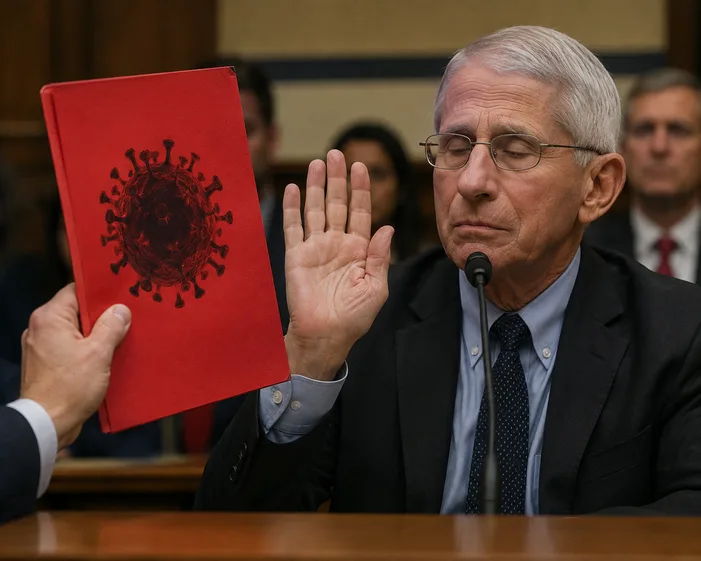
Years later, when Fauci was called before Congress, he reportedly invoked the Fifth Amendment 111 times.
He had previously said that he had nothing to hide and that he was willing to cooperate with congressional oversight.
But when questioned under subpoena, he declined to answer.
According to the transcript, Senator Rand Paul argued that the refusal obstructed the effort to understand the government’s funding decisions, the Wuhan research, and the origins of the pandemic.
Invoking the Fifth Amendment is a constitutional right.
But the American people also have the right to draw their own conclusions when a former government official—one who directed pandemic policy, influenced lockdowns, defended the research establishment, and helped shape the public narrative—refuses to answer basic questions.
The issue is larger than Fauci as an individual.
It is about whether unelected officials can fund dangerous experiments, control the investigation when something goes wrong, shape the scientific narrative, suppress opposing views, and then avoid accountability.
This Is Not About Revenge
Rand Paul said: “I’ve always been more interested in the truth than any kind of prosecution.”
That is the correct focus. The most important objective is not vengeance.
It is preventing the next disaster. Who approved the research?
Who decided the risks were acceptable?
Who inspected the laboratories?
Who knew that the wet-market explanation was uncertain?
Who participated in the private discussions about a possible laboratory origin?
Who encouraged the public to dismiss that possibility?
Who pressured scientists, reporters, physicians, and ordinary citizens to remain silent?
And is similar research still being funded today?
Those questions have still not received complete answers.
The Real Lesson
The origin of COVID is not merely an argument about China, Fauci, Trump, Republicans, Democrats, vaccines, or masks.
It is a warning about institutional power. Government agencies funded research.
Scientists depended on those agencies for money. Public-health officials controlled access to information.
Media organizations repeated the official position. Technology companies enforced it.
And the people responsible for examining the government’s actions often depended on the same institutions they were supposed to investigate.
That is not independent oversight. That is a closed system protecting itself.
The most dangerous words in modern government may be:
Trust the experts. Experts should be heard. They should be respected.
They should also be questioned, audited, challenged, and held accountable—especially when their decisions involve creating enhanced viruses capable of affecting the entire human population.
Because when an experiment goes wrong, the scientists do not pay the full price.
The entire world does.
Gain-of-function (GOF) research refers to experiments that change an organism—such as a virus—to give it new or enhanced biological properties. For viruses, this can mean altering characteristics like how easily the virus spreads, which species it can infect, or how it interacts with the immune system.
Scientists use the term in different ways, which has contributed to public confusion. In everyday discussion, “gain of function” often refers to making a virus more capable in some way. In regulatory and scientific contexts, however, there are narrower definitions that determine which experiments require special oversight.
Examples of changes that could be considered gain-of-function include:
Making a virus infect a new type of cell or host.
Increasing or decreasing how easily it spreads.
Altering how the immune system recognizes it.
Changing how severe the disease it causes may be.
Why do scientists do it?
Researchers have argued that these experiments can help:
Understand how viruses evolve.
Identify mutations that could become dangerous in nature.
Develop vaccines and antiviral drugs.
Improve surveillance for emerging diseases.
Why is it controversial?
Critics argue that creating or enhancing viruses carries significant risks, including:
An accidental laboratory release.
Potential misuse for biological weapons.
Creating a pathogen more dangerous than naturally occurring ones.
Supporters argue that, when performed under strict biosafety and oversight, the research can improve pandemic preparedness and scientific understanding.
The COVID-19 debate
The COVID-19 pandemic brought gain-of-function research into public debate. Much of the controversy has centered on:
Whether U.S. funding supported experiments at the Wuhan Institute of Virology.
Whether those experiments met the U.S. government’s regulatory definition of gain-of-function or a more restrictive category called enhanced potential pandemic pathogen (ePPP) research.
Whether SARS-CoV-2 originated from a laboratory accident or from natural spillover. This question remains debated, and U.S. agencies have reached differing assessments with varying levels of confidence.
Because of these differing definitions, two people may both say “this was” or “this wasn’t” gain-of-function research while referring to different regulatory standards rather than disagreeing about the underlying experiments.
In short, gain-of-function research is not inherently illegal or inherently dangerous, but certain forms of it—especially those involving pathogens that could pose a pandemic risk—are among the most heavily debated and closely regulated areas of biomedical research.
What Obama Connection is.
The action often described as “Obama’s order banning gain-of-function research” was not an executive order and not a law passed by Congress. On October 17, 2014, the Obama administration—through the White House Office of Science and Technology Policy and the Department of Health and Human Services—announced a federal funding pause for a limited category of gain-of-function experiments. NIH implemented it through funding notice NOT-OD-15-011. (whitehouse.gov)
It was officially called:
“U.S. Government Gain-of-Function Deliberative Process and Research Funding Pause.”
Why the administration imposed the pause
The immediate reason was a series of serious laboratory-safety failures in 2014, including mishandling of dangerous biological agents at federal facilities. The government concluded that it needed to reconsider whether the anticipated scientific benefits of certain experiments justified the danger of an accidental or deliberate release. (Grants.gov)
The policy launched a formal review involving:
The National Science Advisory Board for Biosecurity
The National Academies
A government risk-benefit assessment
Development of a replacement oversight framework
The original expectation was that this process would take roughly a year, although the pause ultimately remained in place for more than three years. (whitehouse.gov)
What research it stopped
The pause did not cover every experiment that could broadly be called gain-of-function.
It applied specifically to federally funded research involving:
Influenza viruses
SARS viruses
MERS viruses
The experiment had to be reasonably expected to give one of these viruses greater pathogenicity or respiratory transmissibility in mammals. In plain language, it covered experiments expected to make one of those viruses more dangerous, more capable of causing disease, or better able to spread through the air among mammals. (Grants.gov)
NIH said it would not provide new or continuation funding for projects falling within that definition while the pause was active. (Grants.gov)
What it did not stop
This is where the policy became much less absolute than the phrase “Obama banned gain-of-function” suggests.
The pause did not automatically prohibit:
Ordinary examination of naturally occurring viruses
Research that officials determined would not increase pathogenicity or transmissibility
Every form of genetic manipulation
Every experiment involving bat coronaviruses
Privately or foreign-funded research
All research already underway
For existing federal awards, NIH said projects would be handled case by case. Researchers outside the covered federal funding system were merely encouraged to pause voluntarily. (Grants.gov)
The public-health and national-security exception
The policy also contained an important exception.
The head of a federal funding agency could permit otherwise-covered research when that official determined that it was “urgently necessary to protect the public health or national security.” (Grants.gov)
Therefore, this was never an unconditional ban. It was a funding restriction administered by the same federal departments and agencies that supported the research.
The agencies themselves helped decide:
Whether an experiment met the definition.
Whether an existing grant should be stopped or modified.
Whether an exception was justified.
That agency discretion is central to the later controversy.
How the Wuhan research fits into the timeline
The NIAID grant to EcoHealth Alliance titled “Understanding the Risk of Bat Coronavirus Emergence” began on June 1, 2014—approximately four months before the October funding pause. EcoHealth subsequently supported coronavirus research involving the Wuhan Institute of Virology. (National Institutes of Health (NIH))
Because the award already existed, it fell into the category of an ongoing NIH award that could be evaluated case by case.
The central dispute is therefore not simply whether Obama announced a pause. He unquestionably did.
The dispute is:
Should the EcoHealth-Wuhan experiments have been classified as research covered by that pause?
NIH and NIAID operated on the position that the funded work did not meet the government’s narrow operative definition of prohibited gain-of-function research. Critics, including Senator Rand Paul, argue that experiments creating recombinant or chimeric bat coronaviruses with altered biological properties should have been covered regardless of the terminology used.
The grant materials describe laboratory work involving recombinant viruses, humanized mice, receptor binding, reverse genetics and evaluation of how novel bat coronaviruses could infect human cells. (RePORTER)
That does not by itself settle whether every experiment legally met the 2014 definition. It shows why the classification remains controversial.
The definition problem
The phrase gain-of-function can be used broadly or narrowly.
Broadly, it means modifying an organism so it gains or improves some biological function.
Under that broad meaning, many ordinary experiments could qualify.
The 2014 pause used a much narrower definition. The work had to involve influenza, SARS or MERS viruses and be reasonably anticipated to enhance pathogenicity or respiratory transmissibility in mammals.
That allowed officials to say simultaneously:
An experiment gave a virus new or altered capabilities.
But it was not the specific category of “gain-of-function research” covered by the federal funding pause.
That semantic distinction became the core of Fauci’s dispute with Rand Paul.
Paul’s argument has consistently been that the public should look beyond the administrative label and ask the more fundamental question:
Did the research make potentially dangerous viruses more capable of infecting mammals or human cells, and should taxpayers have financed it?
When the pause ended
During the final days of the Obama administration, the White House issued recommended policy guidance for reviewing research involving potential pandemic pathogens.
The pause itself was formally removed on December 19, 2017, during the Trump administration, when HHS implemented the P3CO Framework—Potential Pandemic Pathogen Care and Oversight. (Grants.gov)
Under that system, the government did not permanently ban covered research. Instead, proposals expected to create, transfer or use enhanced potential pandemic pathogens could be subjected to additional federal review before funding.
The bottom line
Obama’s 2014 action was real, but it is frequently described incorrectly.
It was:
A temporary funding pause, not a criminal prohibition
An administrative policy, not an executive order
Limited primarily to certain influenza, SARS and MERS experiments
Subject to definitional judgments by funding agencies
Subject to public-health and national-security exceptions
Applied to existing projects on a case-by-case basis
Replaced by a review framework in 2017
The most important historical question is not whether the government recognized the danger. The Obama administration clearly recognized it in 2014.
The harder question is why coronavirus experiments connected to Wuhan continued receiving support after the government had already warned that enhancing the dangerous properties of respiratory viruses could threaten public health.
There are many thing to talk about here. Millions Dead, tens of thousands of business closed, the lives of many children disrupted. The great question why the F was the US funding what is basically a bio-weapon with CHINA... Why in all that is good on earth? Why? The simple answer there are evil people that profited from it in ways we don't even understand.