Think of it as Yoga for the brain, we are going to stretch a bit.
Is AI Helping or Hurting Our Children?
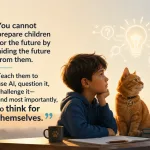
AI will not determine the future of our children. The habits they build while using AI will. Teach them to think first, question often, and let AI be a tool—not a substitute for their minds. — YNOT
Every generation inherits a new tool.
The question is never whether the tool is powerful.
The question is whether the tool is making us more capable—or making us dependent.
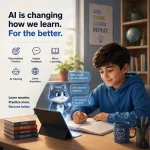
Artificial Intelligence may become one of the greatest educational inventions in history. Imagine every child having access to a patient tutor that can explain algebra ten different ways, teach a new language, help write computer code, answer endless questions, and adapt lessons to each student’s pace. Used correctly, AI could help millions of children learn more than any previous generation.
But there is another side to the equation.
If AI becomes a substitute for thinking instead of a tool for thinking, we could raise a generation that knows how to ask a chatbot for answers but never learns how to discover them on their own.
Recent reports showing declining reading comprehension, weaker math skills, and reduced critical thinking among many students should concern all of us. While these trends began before AI became widely available, AI now has the potential to either reverse the decline—or accelerate it.
The outcome depends on how we choose to use it.
A calculator didn’t eliminate the need to understand mathematics.
GPS didn’t eliminate the need to understand geography.
Likewise, AI should not eliminate the need to read, reason, write, debate, experiment, and solve problems independently.
Children need to struggle with difficult ideas. They need to make mistakes, revise their work, and wrestle with problems that don’t have obvious answers. That struggle is where understanding is built. If AI does all the intellectual heavy lifting, it may produce better homework—but weaker thinkers.
The goal of education has never been to produce correct answers.
The goal has always been to produce capable people.
Parents and teachers should think of AI the same way they think about nutrition. A healthy diet strengthens the body. Junk food satisfies an immediate craving while weakening long-term health.
AI can be intellectual nutrition—or intellectual junk food.
The difference isn’t the technology.
It’s how we use it.
The children who will thrive in the AI era won’t be the ones who rely on AI for every answer. They’ll be the ones who use AI to ask better questions, explore bigger ideas, and learn faster than ever before.
The future belongs not to those who let AI think for them, but to those who learn to think alongside it.