Think of it as Yoga for the brain, we are going to stretch a bit.
The Man Batista Spared and Miami sent Back to Cuba
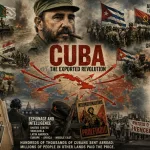
Batista spared Fidel Castro after Moncada. Cuban exiles financed his return. They believed they were funding Cuba’s liberation—only to discover they had financed the man who would imprison the nation. --YNOT!
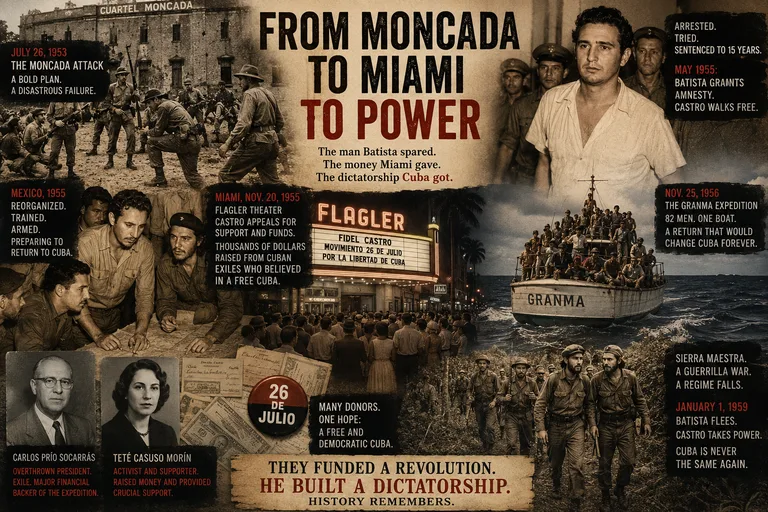
On July 26, 1953, Fidel Castro led roughly 160 armed followers in coordinated attacks against the Moncada Barracks in Santiago de Cuba and the Carlos Manuel de Céspedes Barracks in Bayamo. The plan was to capture weapons, seize strategic positions, and spark a national uprising against Fulgencio Batista, who had taken power through the military coup of March 10, 1952.
Militarily, it was a disaster.
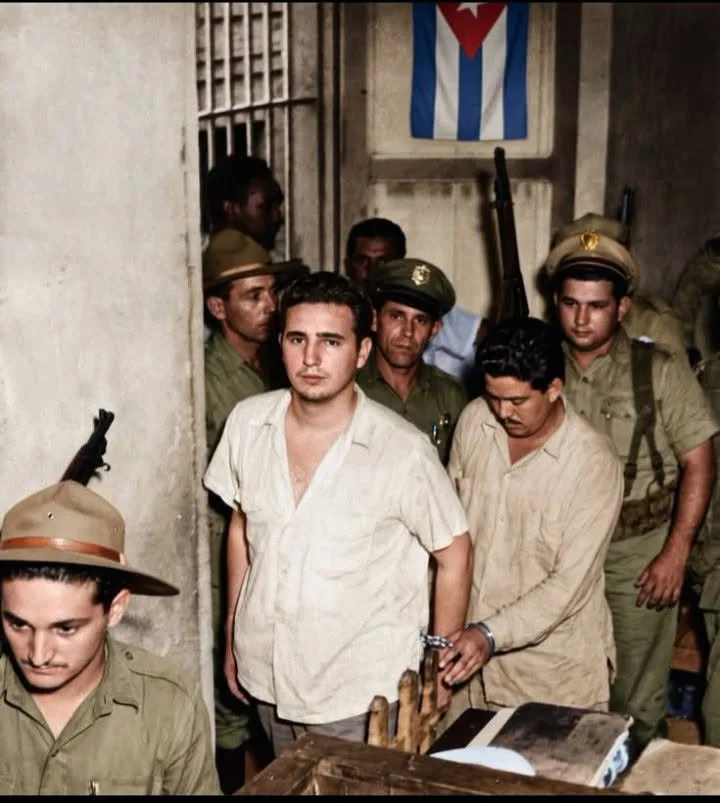
The convoy became separated, the element of surprise was lost, and Castro’s poorly trained force found itself fighting soldiers inside one of Cuba’s largest military installations. The attack collapsed almost immediately. Many rebels were killed during the fighting, while others were captured and later executed by Batista’s security forces. Castro escaped into the countryside but was arrested several days later. Intervention by Catholic Church figures helped ensure that he was taken alive rather than summarily killed. (PBS CGI)
Castro was placed on trial, where he transformed a failed military operation into a political performance. Acting partly as his own attorney, he delivered the speech later published as “History Will Absolve Me.” He was convicted and sentenced to fifteen years in the Presidio Modelo prison on the Isle of Pines.
Batista’s government was corrupt, authoritarian, and frequently brutal. But it nevertheless gave Castro something Castro would rarely give his own political enemies after taking power: a public trial, a prison sentence, and eventually freedom.
In May 1955, after Castro had served less than two years, Batista declared a general amnesty for political prisoners. The decision was intended partly to soften the government’s authoritarian image and reduce political tensions. Batista apparently believed Castro had been defeated, discredited, and neutralized.
It may have been the most consequential political miscalculation in Cuban history.
From Prison to Mexico
Once free, Castro quickly resumed organizing against Batista. Increasing pressure and surveillance made continued activity inside Cuba difficult, so he departed for Mexico in July 1955.
Mexico—not Miami—became the principal headquarters of the future invasion.
There, Castro reorganized his followers under the name Movimiento 26 de Julio, commemorating the failed Moncada attack. He reunited with his brother Raúl, met Ernesto “Che” Guevara, recruited Cuban exiles, purchased weapons, established safe houses, and arranged military instruction.
The group’s principal trainer was Alberto Bayo, a Spanish Civil War veteran who taught Castro’s men guerrilla tactics, marksmanship, navigation, forced marches, sabotage, and small-unit warfare. Bayo reportedly warned Castro that Moncada had been a reckless frontal assault and that a small revolutionary force could survive only by avoiding conventional battles with Batista’s larger army. (El País)
But soldiers, weapons, transportation, food, documents, communications, and safe houses all required money. Castro therefore traveled to the United States to collect it.
Fidel Castro Comes to Miami
In 1955, Miami was already home to a politically active Cuban community. Many of its members opposed Batista and believed Castro was a young nationalist fighting to restore constitutional government.
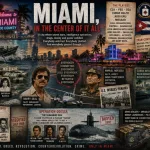
On November 20, 1955, Castro and fellow movement leader Juan Manuel Márquez appeared at the Flagler Theater, located at 313 West Flagler Street in downtown Miami.
Approximately one thousand Cubans reportedly attended. Castro appealed for money, organized supporters, and collected thousands of dollars for what the University of Miami’s Cuban Theater Digital Archive describes as the “Revolution-to-come.”
His public message emphasized Cuban dignity, justice for the poor, opposition to corruption, and punishment for officials who had stolen public money. Following the event, supporters created another local club affiliated with the July 26 Movement.
Castro was not standing in Miami openly announcing that he intended to abolish elections, confiscate private businesses, establish a one-party communist state, imprison political opponents, control the press, and govern Cuba for nearly half a century.
He was selling revolution as liberation.
Many of the people who contributed undoubtedly believed they were financing the restoration of the Cuban Republic—not the permanent destruction of it.
Who Funded Fidel’s Return?
Castro’s expedition was not financed by one mysterious sponsor. It was supported by a network of contributors:
Small donors gave money at rallies in Miami, New York, New Jersey, and other Cuban communities. July 26 Movement clubs collected regular contributions. Sympathizers inside Cuba raised money, provided documents and weapons, and maintained the urban underground. As the rebellion expanded, wealthy Cubans, businesses, and political figures also contributed substantial amounts.
One of the most important financial backers was Carlos Prío Socarrás, the constitutional president overthrown by Batista in 1952.
Prío was living in exile and wanted Batista removed. He met Castro and agreed to provide money, arms, and political support. Contemporary accounts describe the yacht Granma as having been purchased with Prío’s financial assistance. The vessel reportedly cost approximately $18,000 to $20,000, although historical accounts differ on the precise amount.
Another important supporter was Cuban writer and activist Teresa “Teté” Casuso Morín, who helped raise money, arrange assistance, and support preparations for the expedition. Castro later personally acknowledged the importance of her help. She eventually broke with his government after witnessing its increasingly dictatorial direction.
The great historical irony is that much of the money that helped Castro return came from Cubans who believed they were financing democracy.
Some were former officials. Some were wealthy opponents of Batista. Some were workers giving small contributions at exile meetings. Some were idealists who accepted Castro’s promises. Many would later lose their homes, businesses, freedom, or country to the government their donations helped place in power.
The Granma Expedition
On November 25, 1956, Castro and 81 other men crowded aboard the Granma, a yacht designed to carry far fewer passengers, and departed from Tuxpan, Mexico.
The voyage was slow and miserable. The overloaded yacht reached Cuba on December 2, later than planned. The expedition missed its coordination with the urban uprising organized inside Cuba, landed in difficult terrain, and was quickly attacked by Batista’s forces.
Once again, Castro’s military operation nearly ended in complete destruction.
Most of the expeditionaries were killed, captured, or scattered. Only a small group—including Fidel, Raúl, Che Guevara, Camilo Cienfuegos, and Juan Almeida—eventually regrouped in the Sierra Maestra. From there, they built the guerrilla campaign that culminated in Batista’s flight on January 1, 1959. (Reuters)
The Fatal Irony
Fidel Castro did not reach power because he was an undefeated military genius.
Moncada was a failure. The initial Granma landing was another failure.
What distinguished Castro was his ability to survive failure, convert defeat into mythology, attract money from people with different political objectives, and present himself as whatever his audience wanted him to be.
To nationalists, he was a follower of José Martí.
To democrats, he promised constitutional government.
To the poor, he promised justice.
To former politicians such as Carlos Prío, he was a weapon against Batista.
To Cuban exiles in Miami, he appeared to be a young patriot collecting money to liberate their homeland.
Batista gave Castro his life, a trial, and eventually his freedom. Cuban donors gave him money. Mexico gave him a place to organize and train. And Castro used every opportunity until he possessed enough power to deny those same opportunities to almost everyone who opposed him.
The man spared after Moncada returned aboard a boat financed by people who thought they were buying Cuba’s freedom. What they helped finance instead was a dictatorship that would outlive both Batista and nearly every person who contributed to it.