Think of it as Yoga for the brain, we are going to stretch a bit.
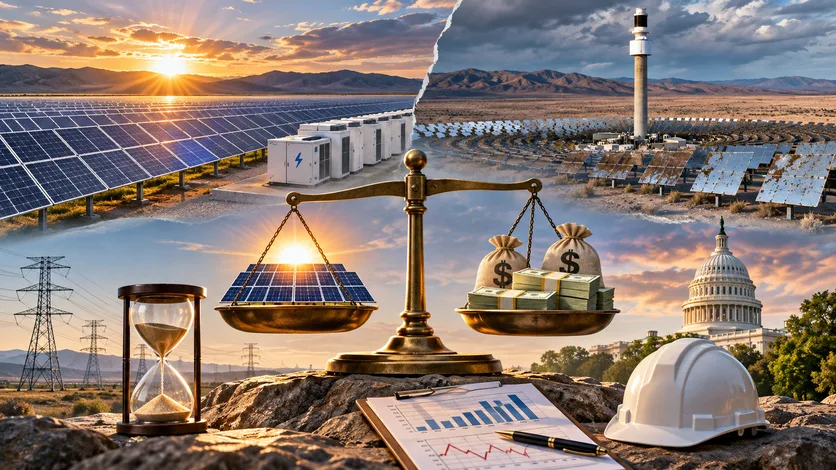
THE PROBLEM WITH LARGE-SCALE SOLAR FARMS The Sun Is Free. The Electricity Isn’t.
A solar farm that produces electricity is an engineering achievement. A solar farm that produces electricity at a profit is a business achievement. Confusing the two can become a very expensive mistake. -- YNOT!
Why Some Billion-Dollar Solar Projects Succeed, Others Fail, and Taxpayers Sometimes Pay the Price
There is nothing wrong with solar power. Let me make that clear from the beginning.
The sun is an enormous source of energy. Solar panels can convert sunlight into electricity without burning fuel, and the technology has improved enormously over the last twenty years.
Some of the largest solar farms in America are producing tremendous amounts of electricity. Others have become billion-dollar financial disasters.
And that raises a question we should be asking before spending another dollar of public money. Why do some large-scale solar projects succeed while others fail?
More importantly, how do we determine whether a project is actually a good investment?
Because here is the central problem. The problem with large-scale solar farms is not necessarily solar technology. The problem is assuming that because solar panels can generate electricity, every large-scale solar investment makes economic sense.
Those are two entirely different things. A solar farm can produce electricity and still lose money. It can operate exactly as designed and still be a terrible investment.
It can generate inexpensive electricity at noon while contributing very little when electricity is desperately needed at eight o’clock that evening.
And perhaps most troubling, it can be financially successful for its private investors while delivering a questionable return to taxpayers who helped finance it.
To understand the issue, we need to look beyond the political arguments about green energy and examine the technology, engineering, financial arrangements, and actual performance of these enormous projects.
Because the real story is considerably more complicated than simply declaring that solar power is good or bad.
THE BILLION-DOLLAR DISASTER IN NEVADA
Let’s start with one of the more spectacular failures.
The Crescent Dunes Solar Energy Project, located near Tonopah, Nevada, was supposed to demonstrate the future of renewable electricity.
Construction began in 2011. The project received a $737 million federal loan guarantee during the Obama administration, and the total cost of constructing the facility exceeded $1 billion.
It was an impressive engineering concept. More than 10,000 computer-controlled mirrors were arranged across the desert, reflecting sunlight onto a central tower.
The concentrated sunlight heated molten salt to extremely high temperatures. That hot salt could then be used to produce steam, drive turbines, and generate electricity.
Unlike ordinary solar panels, the system could store thermal energy and produce electricity after sunset. At least, that was the plan.
Unfortunately, the engineering was far more difficult than anticipated. The facility experienced serious molten-salt leaks, equipment failures, and extended shutdowns. Its electricity production repeatedly fell below expectations.
In 2019, NV Energy terminated its power-purchase agreement after the project failed to meet its obligations. Without its electricity customer, the financial situation deteriorated. The company entered bankruptcy in 2020.
After restructuring, the plant eventually resumed operations. But the financial problems continued. In January 2026, it entered bankruptcy again. During the summer of 2026, the billion-dollar facility was sold for approximately $7 million.
Think about that.
An energy project that cost more than $1 billion to construct was eventually sold for less than one percent of its original cost. The government had disbursed approximately $673 million in loan financing and, following the first bankruptcy, anticipated recovering approximately $441 million. That represented an estimated $232 million loan loss.
When a separate Treasury grant award of approximately $275.6 million is considered, estimates of the combined federal financial cost approach $508 million.
That figure is not a finalized government accounting of taxpayer losses. The grant and loan are different forms of financial assistance, and the ultimate amounts require confirmation.
But there is no question that the original investment was a financial disaster.
The important lesson is not that sunlight failed to produce energy. The engineering and business model failed to deliver electricity reliably and economically.
Crescent Dunes demonstrates what happens when an expensive, complicated technology encounters repeated failures and loses the revenue needed to support its financing.
And taxpayers were among those who paid the price.
BUT WAIT — SOME LARGE SOLAR FARMS ARE SUCCESSFUL
Before anyone concludes that solar power is inherently a failure, let’s examine several projects that have performed much better.
GEMINI SOLAR — NEVADA
The Gemini Solar Project, approximately 25 miles northeast of Las Vegas, began commercial operations in 2024. It has approximately 690 megawatts of solar generating capacity, combined with a 380-megawatt battery system capable of storing about 1,416 megawatt-hours of energy. Unlike Crescent Dunes, Gemini uses conventional photovoltaic solar panels.
Approximately 1.8 million panels convert sunlight directly into electricity. It also has a long-term, 25-year electricity-purchase agreement with NV Energy. That contract helps provide predictable revenue.
The batteries allow some of the electricity generated during the day to be delivered later, when demand may be higher.
Gemini represents a successful example of large-scale solar construction and commercial operation. But here’s an interesting detail.
It occupies approximately 6,500 acres of federal land.
And although it is operational, public information about its operating performance does not by itself establish its ultimate lifetime profitability.
That distinction is important.
TOPAZ SOLAR FARM — CALIFORNIA
Another example is California’s Topaz Solar Farm. This 586-megawatt installation began operating in 2014. It has produced electricity commercially for more than a decade.
It uses conventional photovoltaic technology and has demonstrated that large installations can operate over extended periods. Its continued operation is a legitimate achievement. Again, however, operational success and investment profitability are not automatically the same thing.
DESERT SUNLIGHT — CALIFORNIA
Desert Sunlight is particularly interesting because it also received substantial government assistance. The 550-megawatt project received approximately $1.5 billion in federal loan guarantees and began full commercial operation in 2015. Shortly afterward, a tornado damaged or destroyed approximately 170,000 solar panels.
Yet the project survived.
The Department of Energy reported in March 2024 that its federal loan was performing despite the damage. Why?
One important advantage is that conventional solar panels are modular.
A damaged section of a photovoltaic farm can often be repaired or replaced without requiring the entire generating system to be abandoned.
Compare that with a highly integrated solar-thermal facility, where a critical central component can disable an enormous portion of the operation.
The difference can be substantial.
WHAT THESE PROJECTS TEACH US
Crescent Dunes, Gemini, Topaz, and Desert Sunlight all use the sun to produce electricity.
Yet their experiences have been very different. The reasons have much more to do with engineering design, operational reliability, construction costs, financing, and electricity contracts than with whether the sun shines.
And that brings us to the real issues.
THE FIRST PROBLEM — TECHNOLOGY THAT WORKS VERSUS TECHNOLOGY THAT SOUNDS IMPRESSIVE
There are two major approaches to utility-scale solar generation.
The first is photovoltaic technology. These are the familiar solar panels that convert sunlight directly into electricity. The second is concentrated solar-thermal technology.
These plants use mirrors to concentrate sunlight and create heat, which is then used to produce electricity through more traditional turbine systems.
Both technologies work. But they involve very different engineering challenges.
A photovoltaic farm consists of enormous numbers of relatively independent modules.
Panels, inverters, and related equipment can be monitored, serviced, and replaced in sections. Solar-thermal plants often involve complicated mechanical systems, high temperatures, circulating fluids, specialized receivers, and large turbines.
There are more opportunities for a single major equipment failure to interrupt production.
This does not mean every solar-thermal facility is unsuccessful.
Arizona’s Solana Generating Station, for example, has demonstrated that concentrated solar technology with thermal storage can achieve substantial electricity production.
Nevertheless, conventional photovoltaic systems have become dramatically cheaper and more widely deployed. Even the operators of California’s Ivanpah solar-thermal facility acknowledged that photovoltaic technology had surpassed their approach economically.
Ivanpah cost approximately $2.2 billion to construct.
It has continued generating electricity, but its owners pursued early termination of certain electricity contracts because the economics had become unfavorable. California regulators rejected those proposed terminations in December 2025, and the facility remained operational in 2026.
Ivanpah is therefore not another bankruptcy. It is an example of a different problem.
A power plant can work technically while becoming economically obsolete. This happens in computers. It happens in telecommunications. It happens in manufacturing. And it happens in energy.
Building a facility that operates for thirty years is not necessarily a good investment if a competing technology can produce the same product much more cheaply ten years later.
THE SECOND PROBLEM — GENERATING CAPACITY IS NOT ACTUAL PRODUCTION
This is one of the most misunderstood concepts in the electricity industry. When someone announces a new 500-megawatt solar farm, what does that actually mean?
It means the facility has a rated generating capacity of approximately 500 megawatts under specified conditions.
It does not mean the facility produces 500 megawatts continuously. Solar panels don’t produce electricity at night. Cloud cover affects output. Seasonal changes affect output.
Temperature, equipment condition, and location also influence performance.
The important measurement is called the capacity factor. That measures how much electricity a facility produces over a period compared with what it would have generated if it operated at full rated output continuously.
According to Lawrence Berkeley National Laboratory’s October 2026 report, average utility-scale solar capacity factors range from approximately 16% in less-sunny regions to 33% in the sunniest.
For illustration, let’s use 25%. A 500-megawatt solar farm operating at a 25% annual capacity factor produces the equivalent of an average 125 megawatts throughout the year.
The calculation is straightforward. 500 MW × 8,760 hours × 25%
That equals approximately 1.095 million megawatt-hours annually.
Now compare that with a hypothetical 500-megawatt power station operating at a 90% capacity factor. That facility would produce approximately 3.94 million megawatt-hours annually. More than three times as much electricity.
That does not automatically make the second facility cheaper, because the technologies have different construction, fuel, maintenance, and financing costs.
But it demonstrates why nameplate capacity alone is a poor basis for comparing power plants. A 500-megawatt solar farm is not automatically equivalent to a 500-megawatt nuclear or natural gas plant.
We need to compare actual annual production, dependable capacity, and the value of electricity at the time it is delivered.
Otherwise, we are comparing numbers that don’t mean the same thing.
THE THIRD PROBLEM — THE SUN DOESN’T WORK ON OUR SCHEDULE
Imagine running a manufacturing plant. You need electricity at eight in the morning.
You need it at noon. You need it at five in the afternoon.
And depending on the operation, you may need just as much electricity at midnight.
Now imagine telling your customers that you can only operate your business when the sun is shining. That would be unacceptable.
Electricity consumers expect power whenever they need it.
Hospitals cannot shut down because of cloudy weather.
Data centers cannot turn off their servers every evening.
Factories cannot stop production because the sun has set.
And homeowners expect their air conditioners, refrigerators, and lights to operate around the clock. Solar power can contribute substantial electricity to that system.
But solar generation alone cannot satisfy round-the-clock demand. That is where storage, transmission, and other generation sources become important. And every one of those solutions costs money.
This is the distinction between generating electricity and providing a reliable electrical service. A solar farm may produce inexpensive electricity during sunny hours.
But supplying dependable electricity throughout the day and night is a much larger engineering and economic challenge.
THE FOURTH PROBLEM — BATTERIES ARE NOT FREE
One obvious solution is to store excess solar electricity during the day and use it after sunset. That is an excellent idea. And battery technology has improved substantially.
But batteries are not magic. They have construction costs. They require equipment, cooling, monitoring, and maintenance. They experience energy losses during charging and discharging. They gradually degrade and may eventually require replacement.
And most importantly, they store a limited amount of electricity.
Consider Gemini’s battery installation. Its approximately 380-megawatt battery system has about 1,416 megawatt-hours of storage.
At full rated discharge, that represents approximately 3.7 hours of electricity.
That is extremely useful for shifting electricity from afternoon production into evening demand.
But it is not enough to power the same load continuously through several cloudy days.
Longer storage duration requires additional investment or different technologies.
According to Berkeley Lab’s 2026 analysis, adding batteries to newly built solar projects increased the modeled levelized electricity cost by approximately $24 per megawatt-hour after tax credits, based on the hybrid configurations examined.
But batteries can also make electricity more valuable by allowing it to be sold during higher-priced hours.
So their financial value depends on the market.
A battery installation that makes excellent economic sense in one location might be a poor investment somewhere else.
The correct question is not whether batteries work. It is whether their financial benefits justify their complete costs.
And when assessing solar power, we should include storage where it is necessary to deliver the service being promised.
THE FIFTH PROBLEM — BUILDING MORE SOLAR FARMS CAN MAKE SOLAR ELECTRICITY LESS VALUABLE
This may sound contradictory. How can generating more electricity make electricity less valuable? Actually, it’s basic economics.
Supply and demand. Imagine a region with relatively few solar farms.
When the sun shines, their electricity has substantial market value. Now imagine that same region builds hundreds of additional solar installations. During sunny afternoons, all those facilities may produce large quantities of electricity at approximately the same time.
But electricity demand does not necessarily increase simply because more electricity is available. Eventually, the electrical grid may have more solar electricity than it can economically use or transmit.
Wholesale prices can fall dramatically. Sometimes they become negative. And sometimes grid operators instruct solar farms to reduce production.
This is called curtailment. California has already experienced this problem.
According to the U.S. Energy Information Administration, California’s grid operator curtailed approximately 3.4 million megawatt-hours of wind and solar generation in 2024, an increase of 29% over the previous year.
Much of that curtailed energy was solar. The principal reasons were oversupply and transmission constraints. Think about the investment implications.
A company might spend hundreds of millions of dollars building a facility capable of generating enormous amounts of electricity.
But if electricity prices are too low during its production hours, the project may struggle financially.
Even if every solar panel works perfectly. Even if the weather is ideal. Even if the engineering team did everything correctly. The problem is no longer technical.
It is economic.
Producing something that nobody needs at the moment you produce it does not automatically create a profitable business. Storage, better transmission, flexible demand, and improved market planning can help. But they must be evaluated as part of the investment.
THE SIXTH PROBLEM — THE LAND ISN’T FREE EITHER
Industrial-scale solar farms require substantial land. Depending on design and site conditions, a large installation may occupy thousands of acres.
Gemini, for example, covers approximately 6,500 acres. That is more than ten square miles. Now imagine developing numerous facilities of that size.
Land acquisition, leases, access roads, electrical substations, transmission corridors, environmental mitigation, and maintenance infrastructure all become part of the project. Some locations are well suited for solar development.
Others are not.
There is an important difference between installing solar panels on already-disturbed industrial property and clearing sensitive habitat.
There is also an important difference between developing unused land and converting productive agricultural property.
Neither situation is automatically right or wrong. But the consequences deserve examination. Large projects can disrupt wildlife habitats, alter drainage patterns, disturb soils, and change how land can be used for decades.
At some concentrated solar-thermal facilities, intense reflected sunlight has also caused bird mortality.
Conventional photovoltaic installations generally avoid that specific concentrated-radiation hazard, but they can still create habitat and land-use concerns.
Solar manufacturing also requires raw materials, energy, transportation, and eventual equipment disposal or recycling.
We should acknowledge that solar electricity generally has much lower life-cycle greenhouse-gas emissions than fossil-fuel generation.
That is a genuine environmental benefit. But low emissions do not mean zero environmental impact. And if we are evaluating major energy investments, those costs should be part of the assessment.
I would also ask another question.
Before covering thousands of additional acres with solar panels, have we adequately considered commercial rooftops, parking structures, industrial properties, and other already-developed locations?
Those alternatives are not always cheaper or capable of replacing large utility-scale projects.
But they deserve consideration. Because sunlight may be free.
Land, infrastructure, environmental protection, and maintenance certainly are not.
THE SEVENTH PROBLEM — WHO PAYS WHEN THE PROJECT FAILS?
This is where the argument becomes especially important to me.
In a private business, investors evaluate opportunities and accept financial risks. Sometimes they make money. Sometimes they lose money.
That’s part of capitalism.
Government-backed energy projects introduce another participant into the equation.
The taxpayer. The federal government has supported major energy investments through loan guarantees, grants, tax incentives, and other programs.
Some projects have been successful. Others have failed.
Crescent Dunes is a clear example of a costly failure involving substantial federal financial exposure.
Desert Sunlight is an example of a government-backed project that successfully reached commercial operation and maintained a performing federal loan, at least through the Department of Energy’s March 2024 assessment.
The mere existence of a government subsidy does not prove a project is bad.
Nor does a successful groundbreaking ceremony prove that public financial assistance was worthwhile.
The relevant questions are more demanding. Would this facility have been constructed without taxpayer support?
Was the technology sufficiently proven?
Were the financial projections realistic?
Did the government adequately evaluate the risks?
What public benefits justified the assistance?
And most importantly: Who receives the financial rewards when the project succeeds, and who is responsible for the losses when it fails?
Tax credits, grants, and loan guarantees are not all the same thing. A tax credit reduces tax liability. A grant generally represents a government expenditure. A loan guarantee exposes the government to potential losses if the borrower defaults.
Those distinctions matter when calculating actual taxpayer costs. But all forms of support deserve scrutiny.
If a company receives substantial government assistance, the public should be able to examine the project’s actual performance, its financial obligations, and the results achieved.
I have no objection to government supporting research into promising technologies.
But research funding and commercially financing an enormous, unproven power plant are two different decisions.
If taxpayers are helping fund the risk, taxpayers deserve transparency and accountability.
THE MOST IMPORTANT QUESTION — DOES THE SOLAR FARM ACTUALLY MAKE MONEY?
Let’s look at some basic numbers. According to Lawrence Berkeley National Laboratory’s October 2026 report, the average installed construction cost of new utility-scale solar projects completed in 2025 was approximately $1.69 million per megawatt of AC generating capacity.
So let’s imagine a company building a 500-megawatt solar farm. At that average, its construction cost would be approximately: $845 million.
Now assume it operates at a 25% annual capacity factor. That would produce approximately 1.095 million megawatt-hours of electricity annually.
Let’s examine the revenue. If the company receives an average of $40 per megawatt-hour, annual gross electricity revenue would be approximately: $43.8 million.
Now suppose the selling price falls to $25 per megawatt-hour. Annual revenue drops to approximately: $27.4 million.
Same solar panels. Same sunshine. Same construction costs. Same electricity production.
But nearly $16.4 million less annual revenue.
And remember, revenue is not profit.
The company still has to account for financing costs, operating expenses, maintenance, insurance, equipment replacement, taxes, and other financial obligations.
Depending on its contracts and financing, it may also receive other revenue or tax benefits.
These numbers are an illustration, not a profitability forecast for a specific project.
But they demonstrate something fundamental. A solar farm can be an engineering success and a financial failure at the same time.
Conversely, a project might be financially attractive because it secured favorable long-term electricity contracts, low construction costs, appropriate financing, and a location where its electricity has significant value.
That brings us back to the question of why some projects succeed.
WHY SOME SOLAR PROJECTS SUCCEED AND OTHERS FAIL
After examining these projects, I see seven major factors.
1. PROVEN TECHNOLOGY
Successful projects generally rely on equipment that has been extensively tested and commercially demonstrated.
Projects built around experimental technologies face greater engineering and financial uncertainty.
2. REALISTIC CONSTRUCTION COSTS
A project must be built at a cost that its expected revenue can support.
Even a reliable power plant can become a terrible investment if its construction costs are excessive.
3. RELIABLE ENGINEERING
The plant must produce electricity consistently.
Frequent breakdowns reduce revenue and increase maintenance expenses.
A plant that is constantly offline cannot generate the electricity needed to repay its financing.
4. THE RIGHT LOCATION
A good solar site needs more than sunshine.
It requires suitable land, reasonable construction conditions, access to transmission infrastructure, and an electricity market capable of using its output.
An isolated solar farm may face enormous grid-connection costs.
5. A DEPENDABLE CUSTOMER
Long-term electricity-purchase agreements can make financing easier by providing predictable revenue.
But the contract price must be sustainable for the buyer as well.
A project dependent on excessively expensive electricity contracts may become economically unattractive even while operating successfully.
6. STORAGE AND GRID INTEGRATION
A successful project must consider when electricity is produced and when customers need it.
Batteries, transmission capacity, and grid conditions can substantially influence the value of its electricity.
7. SOUND FINANCIAL MANAGEMENT
Realistic forecasts, adequate reserves, manageable debt, and sensible risk allocation are essential.
Optimistic projections cannot substitute for a workable financial model.
And this is where government agencies and private lenders should be asking the same questions.
Is the engineering reliable?
Is the financing sustainable?
Can the electricity be sold at an economically reasonable price?
And what happens when the assumptions turn out to be wrong?
GOVERNMENT SUBSIDIES CAN HIDE THE REAL ECONOMICS
Here is another reason comparisons between solar projects can be misleading.
Not every project is operating under the same financial conditions.
One developer may receive substantial tax incentives. Another may benefit from federal loan guarantees. A third may have a utility contract negotiated years earlier, when electricity prices and market conditions were very different.
A fourth may operate primarily in competitive wholesale electricity markets.
All four projects could produce electricity using essentially the same solar panels.
But their financial results could be dramatically different.
Berkeley Lab’s 2026 report estimated that the levelized generation cost of newly built utility-scale photovoltaic projects averaged approximately $61 per megawatt-hour without federal tax credits.
With tax credits, the modeled cost fell to approximately $41 per megawatt-hour.
That is a substantial difference.
It doesn’t mean the lower figure is fraudulent.
Tax incentives are legitimate components of project economics under the laws that authorize them.
And other energy technologies have received various forms of public assistance as well.
But it does mean that we need to be clear about what we’re comparing.
Are we calculating the cost of generating electricity?
Are we calculating what the private developer actually pays?
Are we calculating what the utility pays?
Or are we calculating the complete economic cost, including government support?
Those numbers are not necessarily identical.
A project can produce electricity at an attractive price for its customers while benefiting from substantial public financial support.
Whether that support represents a worthwhile investment depends on the public benefits, opportunity costs, risks, and overall results.
We cannot accurately judge an energy investment without examining where the money comes from and where it ultimately goes.
WE NEED TO DISTINGUISH THREE DIFFERENT TYPES OF SUCCESS
This is perhaps the most important lesson from all these projects.
A solar farm can succeed in one respect and fail in another.
ENGINEERING SUCCESS
Does the facility operate reliably?
Does it produce the amount of electricity promised?
Can it be maintained efficiently?
Crescent Dunes struggled badly in this category. Conventional photovoltaic projects such as Topaz and Desert Sunlight have demonstrated sustained commercial operation.
FINANCIAL SUCCESS
Does the project generate enough revenue and other legitimate economic benefits to justify its investment?
Can it repay its financing?
Does it provide an acceptable return relative to its risks?
Would its economics remain attractive without particular subsidies or unusually favorable contracts?
A plant can be technically successful and financially unsuccessful. Ivanpah illustrates how an operating technology can become economically unattractive compared with newer alternatives.
ELECTRICAL GRID SUCCESS
Does the electricity reach customers when they need it?
Does it reduce the overall cost of supplying dependable electricity?
Can the existing transmission system accommodate it?
Does it complement other generators or require additional storage and grid investment?
A solar farm producing enormous quantities of electricity during an oversupplied afternoon may deliver less economic value than another facility producing electricity during a period of high demand.
The best energy investments should be evaluated on all three dimensions: engineering, financial performance, and value to the electrical grid. Judging a project by its generating capacity alone tells us surprisingly little about its ultimate value.
AMERICA’S FUTURE ENERGY NEEDS MAKE THIS MORE IMPORTANT THAN EVER
America is entering a period of significant electricity-demand growth.
Artificial intelligence and data centers are expanding. Manufacturing facilities are becoming increasingly automated. Electric vehicles are adding new demand to some electrical systems. Homes and businesses continue to depend on reliable power for nearly everything they do.
We are going to need substantial amounts of electricity.
But we don’t simply need more generating capacity. We need reliable electricity, delivered at an affordable price, when customers need it.
Solar power can play an important role. So can nuclear power.
Natural gas, hydroelectric generation, geothermal energy, and other technologies also have important roles, depending on the location and the needs of the electrical system.
Battery storage can improve flexibility.
Transmission improvements can help deliver electricity where it is needed.
Demand management can reduce pressure during expensive periods.
But none of these solutions should be selected simply because they are politically fashionable.
Each technology has strengths, limitations, environmental consequences, and financial risks.
Nuclear plants can experience enormous construction cost overruns.
Natural gas plants depend on fuel availability and fuel prices.
Hydroelectric projects depend on water resources and can have major environmental impacts.
And solar farms depend on sunlight, land, transmission capacity, and the market value of their electricity.
There is no perfect energy source. There are only engineering and economic trade-offs.
America needs an energy strategy, not an energy religion.
BEFORE APPROVING ANOTHER BILLION-DOLLAR SOLAR PROJECT, ASK THESE QUESTIONS
I would like to see policymakers, utility regulators, investors, and taxpayers apply a much more demanding standard to major energy investments.
First, what will the facility actually produce over a typical year?
Not its maximum theoretical capacity.
Its realistic expected output.
Second, what will the complete project cost?
Include construction, financing, land, maintenance, storage where applicable, transmission upgrades, and eventual decommissioning.
Third, what will happen to electricity prices as more generating capacity enters the market?
A project that looks profitable today may become uncompetitive if its future electricity sales are worth substantially less than anticipated.
Fourth, is the technology commercially proven?
If it is experimental, are the financial risks properly reflected in the investment decision?
Fifth, who is responsible if things go wrong?
Will private investors absorb the losses, or will taxpayers be left holding the bill?
Sixth, what are the actual public benefits?
Will the project improve reliability, lower long-term electricity costs, reduce pollution, or provide other measurable benefits?
Finally, are there better alternatives?
Could the same investment produce greater value through another generating technology, battery storage, transmission improvements, energy efficiency, or a different combination of resources?
Those are the questions that should determine whether a project gets built.
Not political promises. Not promotional presentations. And certainly not the excitement of announcing another billion-dollar investment.
MY THOUGHTS — THE SUN IS FREE, BUT BAD INVESTMENTS ARE EXPENSIVE
I have nothing against solar power. In fact, I think solar technology is remarkable.
The ability to convert sunlight directly into electricity without burning fuel is an extraordinary engineering achievement.
And large-scale solar farms have demonstrated that they can generate substantial amounts of electricity. But that is not the same as proving that every large-scale solar farm is a sound investment.
Crescent Dunes is a warning about the consequences of complicated technology, disappointing performance, and unsustainable financing.
Ivanpah demonstrates that even a functioning power plant can become economically uncompetitive.
Gemini demonstrates the potential value of proven photovoltaic technology combined with batteries and long-term electricity contracts. Topaz and Desert Sunlight demonstrate that large-scale photovoltaic installations can operate commercially for many years.
California’s electricity curtailment problem demonstrates that producing more electricity does not automatically mean producing more economically valuable electricity. And government financing demonstrates that taxpayers can become exposed to financial risks they never personally agreed to accept.
These are not arguments for abandoning solar power.
They are arguments for evaluating solar projects with the same economic discipline we should apply to every other major infrastructure investment. I have spent enough time around business and technology to understand something fundamental.
A technology can be brilliant and still be a terrible business.
A product can work perfectly and still lose money.
A company can generate impressive revenue and still go bankrupt.
And an investment can look wonderful on paper until the original assumptions encounter reality.
Solar power is no different. When private investors want to build a solar farm using their own capital, they should be free to evaluate the opportunity and accept the financial consequences.
When taxpayer money is involved, however, the public deserves a more rigorous examination of the risks, costs, and expected benefits.
Because the purpose of an energy policy should not be to build the largest number of solar farms.
It should not be to produce the most impressive headlines.
And it certainly should not be to create opportunities for politically connected companies to pursue profits while transferring excessive financial risks to taxpayers.
The purpose should be to provide America with dependable, affordable electricity through investments that make sound engineering and economic sense.
The problem with large-scale solar farms is not necessarily solar technology.
The problem is assuming that because solar panels can generate electricity, every large-scale solar investment makes economic sense.
Those are two completely different propositions.
And until we learn to distinguish between them, we will continue building some excellent energy projects, some mediocre ones, and occasionally another billion-dollar financial disaster.
The sun may be free. The electricity certainly isn’t. And neither are the mistakes.