Think of it as Yoga for the brain, we are going to stretch a bit.
La Guerra de 1912 – The Forgotten War
They fought for a freedom they were promised, then came home to a country still deciding whether that freedom included them. I could say that for Afro-Cuban veterans of 1912 or Tuskegee Airmen, Cuba was ahead by 30 years. -- YNOT!
There are some wounds in a nation’s history that do not bleed in public anymore, but they never fully close.
Cuba remembers Spain. Cuba remembers independence. Cuba remembers Martí, Maceo, Máximo Gómez, the machete charges, the jungle camps, the hunger, the sacrifice, and the dream of a free republic. But not every Cuban sacrifice was honored equally after the flag was raised.
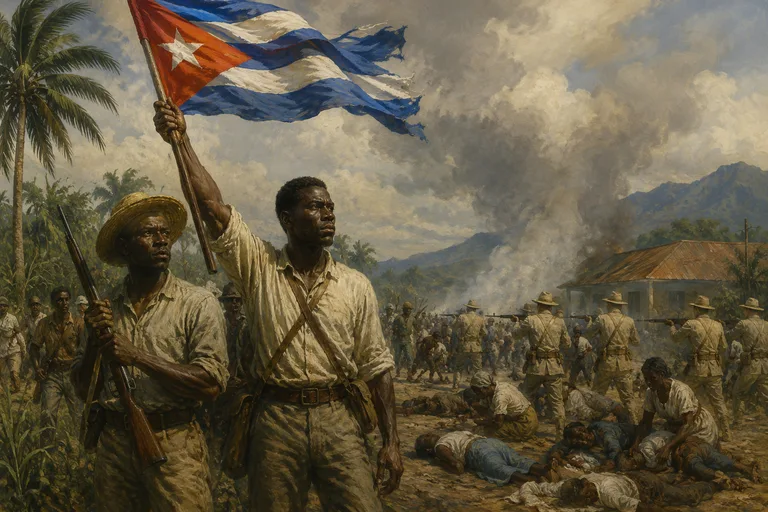
Some men fought for Cuba believing they were helping build a country where all Cubans would belong. Black Cubans and mixed-race Cubans fought in the wars of independence. They died in the fields. They marched through the mountains. They followed leaders like Antonio Maceo, whose courage became part of the soul of Cuba itself.
Then independence came.
And the same men who had been useful in war were told to wait in peace.
That is the root of La Guerra de 1912 — also known as El Doce, the Race War of 1912, or the armed uprising of the Independents of Color.
It was not simply a rebellion. It was a tragedy born from a broken promise.
The Promise After Independence
Cuba’s independence was supposed to mean a new beginning.
The Spanish empire was gone. The old colonial order was supposed to be buried. The republic was supposed to belong to all who had fought for it.
But after independence, power did not spread evenly.
White Cuban political elites controlled much of the new republic. Afro-Cubans, many of them veterans of the independence struggle, found themselves pushed aside. They had fought for freedom, but freedom did not automatically bring equality. Jobs, land, political appointments, military positions, and influence often remained in the hands of those already connected to power.
The republic spoke the language of equality, but too often lived by the habits of the old world.
That contradiction created anger.
For Afro-Cuban veterans, this was not an abstract political complaint. They could point to their scars. They could name the dead. They could say, “We were Cuban enough to die for the republic. Why are we not Cuban enough to help govern it?”
That question became dangerous.
The Partido Independiente de Color
In 1908, Afro-Cuban leaders helped form the Partido Independiente de Color, or Independent Party of Color.
Its purpose was not to destroy Cuba. Its purpose was to demand political representation for Afro-Cubans inside Cuba.
The party wanted recognition, rights, jobs, access, and respect. It represented those who believed that the existing political parties were using Black voters when convenient, but not truly representing them.
Two of its most important leaders were Evaristo Estenoz and Pedro Ivonnet.
These men understood the meaning of the independence war. They had lived through the promise. They also understood the betrayal that followed.
The Independent Party of Color became a direct challenge to Cuba’s political class. Not because it had more guns, more money, or more power, but because it exposed the hypocrisy of the young republic.
Cuba claimed to be raceless.
But when Afro-Cubans organized politically, the government suddenly discovered race everywhere.
The Morúa Law
In 1910, the Cuban government passed the Morúa Law, named after Senator Martín Morúa Delgado.
The law banned political parties based on race.
On paper, that may sound noble. A republic should not divide itself by race, the argument went. But in practice, the law was used to eliminate the Independent Party of Color.
It was a clever political weapon.
Instead of answering Afro-Cuban demands, the government criminalized the vehicle that carried them. Instead of asking why Afro-Cubans felt excluded, the state declared their independent organization illegal.
That is an old trick in politics.
When the complaint is uncomfortable, attack the form of the complaint. When people organize, accuse them of division. When the excluded ask for representation, call them dangerous.
The Morúa Law did not solve Cuba’s racial problem. It buried it under the floorboards of the republic.
And buried things do not stay quiet forever.
Why the Uprising Happened
By 1912, the Independent Party of Color wanted to be restored as a legal political party.
Its leaders believed they had exhausted the normal channels. The government had outlawed their party. Their grievances had not been answered. Their people remained excluded.
So they mobilized.
The uprising was not born from nowhere. It came from years of frustration, broken promises, racism, poverty, political exclusion, and the bitter reality that the republic did not treat all of its children equally.
The main reason was this:
Afro-Cubans had fought for Cuba’s freedom, but after independence many were denied a fair share of the republic they helped create.
The immediate trigger was this:
The government outlawed their party and refused to restore its legal status.
That is how political exclusion turned into armed protest.
And once armed protest began, the Cuban government and the Cuban press framed it not as a political crisis, but as a racial threat.
That made everything worse.
The Fire in Oriente
The conflict broke out in May 1912, especially in Oriente, the eastern part of Cuba.
Oriente had deep revolutionary history. It was a land of sugar, mountains, veterans, poverty, pride, and resentment. Many Afro-Cuban peasants and workers lived and labored there. It was also a place where the memories of the independence war still felt close.
The rebels were not a modern army. Many were peasants, veterans, and political supporters of the Independent Party of Color. They were lightly armed compared with the Cuban state.
The Cuban government responded with overwhelming force.
President José Miguel Gómez sent the army, the Rural Guard, and militia forces to crush the movement. The government did not treat it as a political protest that had turned militant. It treated it as an existential threat.
The language of the press became poisonous. Afro-Cuban protesters were portrayed as savages, criminals, rapists, and enemies of civilization. This racial panic helped justify violence.
Once that kind of language is unleashed, it gives ordinary cruelty a patriotic uniform.
The United States Arrives
The United States also intervened.
American Marines were sent to Cuba, especially to protect American citizens, plantations, mines, railroads, and business interests. The United States had deep economic interests in Cuba, especially in sugar and infrastructure.
The U.S. did not come as a neutral humanitarian force.
It came to protect property.
That is important to understand. The Cuban army carried out the main suppression of the uprising. The Marines were mainly positioned to guard American assets and stabilize areas where American interests were exposed.
In other words, Cuba’s racial crisis became entangled with foreign power, corporate property, and the reality that the young Cuban republic still lived under the shadow of Washington.
The Spanish empire was gone, but Cuba was not entirely free from outside pressure.
How It Was Resolved
La Guerra de 1912 was resolved by force.
Not by negotiation.
Not by reform.
Not by justice.
The Cuban government crushed the uprising.
Evaristo Estenoz was killed in late June 1912. His death broke the movement’s leadership. Pedro Ivonnet continued for a short time, but he too was captured or surrendered and was killed soon afterward. Officials claimed he was trying to escape, which is one of those explanations governments often provide when the dead can no longer object.
The Independent Party of Color was destroyed.
Thousands of Afro-Cubans were killed. The exact number remains disputed, but the scale of the violence was enormous. Many victims were not powerful military leaders. Many were poor Black Cubans caught in a campaign of repression.
By August 1912, the uprising was over.
The republic survived.
But something inside the republic had been exposed.
The Main Characters
Evaristo Estenoz
Estenoz was one of the central leaders of the Independent Party of Color. A veteran and political organizer, he represented Afro-Cuban demands for recognition, representation, and equality. His death in June 1912 helped break the rebellion.
Pedro Ivonnet
Ivonnet was another major leader of the movement. After Estenoz was killed, Ivonnet continued resistance for a short time. He was later captured or surrendered and was killed under suspicious circumstances, officially described as an attempted escape.
José Miguel Gómez
Gómez was the president of Cuba during the uprising. His government chose repression over reconciliation. Under his administration, the Cuban state responded to the movement with military force.
Martín Morúa Delgado
Morúa was the senator associated with the law that outlawed race-based political parties. The Morúa Law became the legal instrument used to eliminate the Independent Party of Color.
Juan Gualberto Gómez
A respected Afro-Cuban independence figure, Juan Gualberto Gómez opposed racial demonization and warned against the dangerous hatred being stirred up during the crisis. He represented an older independence ideal that saw Cuba as a nation for all Cubans.
The Afro-Cuban Veterans and Peasants
They were the heart of the tragedy. Many had fought for independence or descended from those who did. They believed Cuba owed them more than speeches. They wanted dignity, representation, work, land, and a place in the country they helped liberate.
The Cuban Army and Rural Guard
They carried out the suppression. Their campaign destroyed the movement and left thousands dead.
The United States Marines
They entered the crisis to protect American interests, especially property, railroads, mines, plantations, and citizens. Their presence showed how deeply Cuban politics, race, and foreign economic power were connected.
The Moral of 1912
La Guerra de 1912 is not just a story about race.
It is a story about what happens when a republic celebrates freedom but refuses equality.
It is a story about men who fought for a flag, only to be told later that the flag did not fully belong to them.
It is a story about how governments can turn political demands into criminal threats, and then turn criminal threats into justification for violence.
The Independent Party of Color may have been destroyed, but the question it raised did not die:
Who gets to belong to Cuba?
That question has followed Cuba across generations.
In 1912, Afro-Cubans asked for their rightful place in the republic.
The answer they received was bullets.
And that is why La Guerra de 1912 must be remembered — not as a footnote, not as an embarrassment, not as something to be hidden behind patriotic speeches, but as one of the great moral failures of the early Cuban republic.
Because a nation is not judged only by the wars it wins against foreign powers.
It is judged by how it treats the people who helped win its freedom.
I would use the title “La Guerra de 1912: The Forgotten War Inside the Cuban Republic” because it sounds historical, emotional, and serious without sounding like a textbook.